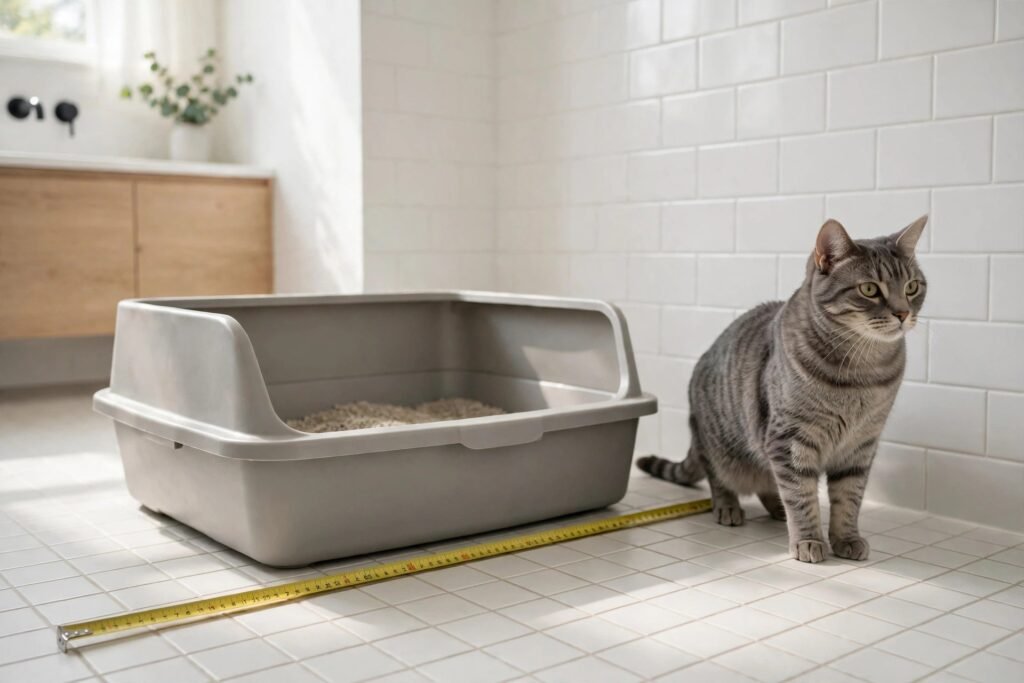
Most litter boxes are bought the wrong way round: the owner measures the corner of the bathroom, then hopes the cat fits. It should be the other way round. Measure the cat first, then find a box — and a spot — that fits the cat. This page gives you the one sizing rule worth using, the table to read it off, and what to do when your flat is too small for the “right” box.
Everything on this page comes from the guidance of International Cat Care, the ASPCA, Cornell’s Feline Health Center, and the US EPA and CDC. Where a number is calculated from a rule rather than quoted, it says so.
The 1.5x rule: measure nose to base of tail
International Cat Care’s rule is simple: the ideal length of a litter tray is one and a half times the length of your cat, measured from the nose to the base of the tail. Not the tip of the tail — the base, where the tail meets the body. The same page adds a warning worth hearing: many standard-sized trays are too small.
How to measure:
- Wait until your cat is standing normally, not stretched out asleep or curled up. A tape measure, a piece of string, or a phone charger cable all work.
- Measure from the tip of the nose to the base of the tail — where the tail joins the body. Write the number down.
- Multiply by 1.5. That is the minimum box length to shop for.
- Measure once a year, and after any big weight change. Kittens grow into their box; buy for the adult size, not the kitten in front of you.
Width gets no number from any authority we could find, so we will not invent one. The practical test is watching your cat turn around inside the box: if it has to back out to turn, the box is too narrow, whatever the label says.
Size table: cat length to box length
These numbers are calculated from International Cat Care’s 1.5x rule — multiply your cat’s length by 1.5 and you get the same figures.
| Cat length (nose to base of tail) | Minimum box length (1.5x) | What this means when shopping |
|---|---|---|
| 14 in | 21 in | A standard box is usually big enough |
| 16 in | 24 in | Look for large sizes; a small box will be tight |
| 18 in | 27 in | Large or XL only — most standard boxes are too small |
| 20 in | 30 in | XL or oversized; check the inside length, not the outside |
| 22 in | 33 in | Oversized only; measure the inside of the box before buying |
Two real examples, from listings we checked: a sifting steel box measuring 23 x 16 x 14 in suits a cat of about 15–16 in (23 ÷ 1.5 ≈ 15.3). A steel box with a 24 in pan suits a cat of about 16 in. The arithmetic works the other way too — if you already own a box, divide its inside length by 1.5 and that is the longest cat it properly fits.
One more thing to check while shopping: the length that matters is the inside length, where the cat stands. Thick rims, high guards and curved walls all eat into it, so a box labelled 24 in can offer far less usable space than the number suggests.
How deep should the litter be?
About 1–2 inches, per the ASPCA — “most cats like a shallow bed of litter. Provide one to two inches of litter rather than three to four inches.” International Cat Care says approximately 3 cm, which is about 1.2 inches, so the two sources agree. Deeper beds do not stay cleaner; they bake on harder and waste litter. If your cat digs to the bottom and the box floor shows through, add a little — but do not fill to the rim.
How many boxes?
One box per cat, plus one extra — the ASPCA’s rule, and International Cat Care says the same. Three cats need a minimum of four boxes. A bigger box does not replace a second box: two cats sharing one box, however large, still queue, still guard, and still sometimes go elsewhere. In a small flat the extra box can go in a second room, a hallway corner, or a ventilated cupboard — it does not need to sit next to the first one. Our guide to the best litter box for two cats covers the two-cat setup in more detail.
Shape: rectangular beats corner
International Cat Care recommends rectangular trays over corner, triangle or oval shapes — a rectangle gives the cat a straight line to walk in, turn, and dig. Corner trays look space-efficient on the shelf and feel cramped to the cat. If floor space is genuinely tight, a rectangular box turned lengthways along a wall usually fits better than a corner unit and gives the cat more room. Covered versus open is a separate question, and we compare the two in open vs covered litter box.
When the flat is too small for the “right” box
Apartments rarely have room for a 30-inch box in the bathroom. That does not mean the rule stops applying — it means you trade off honestly instead of pretending a small box is fine.
- Take the biggest box the spot allows, and measure the inside length. A 24-inch box in the hallway beats a 20-inch box squeezed into the bathroom, because the cat uses the box, not the room.
- Move the box before shrinking it. Under a desk, in a ventilated cupboard, or behind a room divider are all better than a box the cat cannot turn in. See where to put a litter box in a small apartment.
- Hide it without shrinking it. A piece of litter-box furniture or an enclosure keeps the box out of sight while the inside stays full-size. See hidden litter box furniture and automatic litter box enclosures.
- A top-entry box saves floor space in one direction — no litter kicked out the front — but it needs vertical clearance above it and a cat willing to jump in. See top-entry litter boxes for small spaces and top-entry vs front-entry.
- Consider a self-cleaning box only if you have a dry spot for it. PetSafe’s own setup guidance says not to place a ScoopFree in a high-humidity area such as a bathroom, and the Litter-Robot manual says the same — place the unit in a low-humidity area and avoid hot, humid areas even temporarily. A damp bathroom shortens tray life and is the worst place for electronics. See small automatic litter boxes and self-cleaning vs manual.
- If you have several cats, size for the biggest one. One box that fits the largest cat is better than two boxes that fit nobody properly. See automatic litter boxes for multiple cats.
If your cat is older or stiff, a low front edge is easier to step over — watch whether your cat hesitates at the edge or has to haul itself in. That hesitation is the cat telling you the box is wrong, and it is worth listening to before the cat starts going elsewhere.
When the cat won’t use the box
A cat that stops using a box it used happily is usually telling you something changed: the box got smaller, the litter got deeper, the box moved, or a second cat started guarding it. Check size, depth and placement first — those are the fixes you control.
But some signs are not a placement problem. Cornell’s Feline Health Center lists straining with little or no urine, blood in the urine, crying while peeing, and frequent trips with nothing produced as signs of lower urinary tract disease, and calls a blocked urethra “an absolute emergency” — a cat straining with little or no urine needs a vet immediately, not tomorrow, because a complete blockage can be fatal in under 24–48 hours. A cat that avoids the box after a move is usually a placement problem. A cat that strains or cries is a health problem.
After the box: disposal
Sizing is only half the job in a flat — the used litter has to leave the flat cleanly. Do not flush cat litter, even types labelled flushable: clumping clay is usually bentonite, which absorbs up to 15 times its weight in water and swells, blocking household and sewer pipes, and the US EPA’s septic guidance is blunt — flush only human waste and toilet paper, never cat litter. Bag used litter in a plastic bag, tie it shut, and put it in your household garbage cart; never put litter down a garbage chute — carry the tied bag to the dumpster or cart instead. Do not compost used cat litter at home: the EPA lists pet waste and cat litter under what to avoid in a backyard compost pile, because backyard piles generally do not get hot enough to break them down. If you are pregnant or immunocompromised, the CDC says have someone else change the litter if possible — and if no one else can, wear disposable gloves and wash your hands with soap and water afterwards. Our litter disposal guide for apartments covers the whole routine.
Guides for the next step
- How to choose a litter box for a small apartment — the full buying walkthrough
- Best litter boxes for small apartments — the overview list
- Best litter box for a small bathroom — when the bathroom is the only spot
- Best stainless steel litter boxes — including which picks are steel all the way through and which are steel only in the pan
- Best automatic sifting litter boxes — the no-motor middle ground
- How often to change cat litter in a small apartment — the cleaning routine that keeps a small flat smelling fine
- Best litter mats for small apartments — for the tracking that escapes the box
Sources
- International Cat Care, “Choosing a litter tray for your cat” — the 1.5x sizing rule, 3 cm depth, one tray per cat plus one extra, rectangular trays recommended. icatcare.org
- ASPCA, “Litter Box Problems” — 1–2 inches of litter, one box per cat plus one extra. aspca.org
- Cornell Feline Health Center, “Feline Lower Urinary Tract Disease” — signs of urinary problems, urethral obstruction as an absolute emergency. vet.cornell.edu
- US EPA, “How to Care for Your Septic System” and “Composting At Home” — never flush cat litter; pet waste and cat litter not for backyard compost. epa.gov
- CDC, “People at Increased Risk for Toxoplasmosis” — have someone else change the litter if possible; gloves and handwashing as the fallback. cdc.gov
- PetSafe ScoopFree setup guidance and Litter-Robot 4 manual (Whisker) — do not place self-cleaning boxes in high-humidity areas such as bathrooms.
Last updated: November 24, 2026