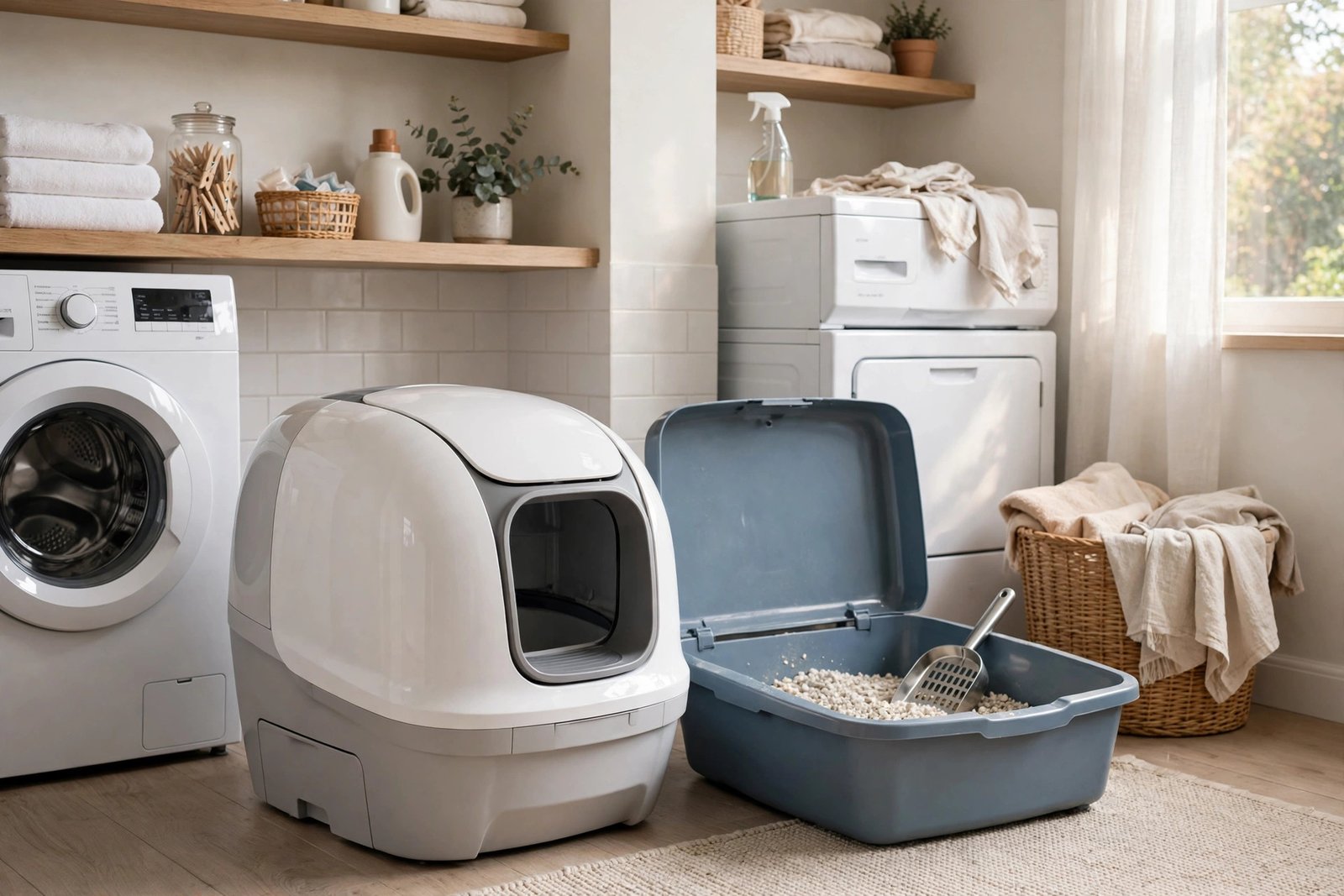
Choosing between a self cleaning litter box vs manual scooping is one of those decisions that sounds like it’s about convenience but is really about your apartment, your cat’s personality, and your budget spread over a year or more. The ads make it look simple: buy the fancy box, never scoop again, live odor-free forever. The reality is messier, and honestly, more interesting.
This guide compares both types the way an apartment dweller actually experiences them — odor in a 400-square-foot studio, noise through thin walls, floor space you don’t have, and costs that don’t show up on the product page. No brand endorsements here. Just what to expect, what the makers don’t say, and who should buy which.
How Each Type Actually Works
A manual litter box is exactly what you picture: a pan (open, covered, or top-entry) filled with litter. You scoop waste with a slotted scoop, usually twice a day, and do a full litter change every week or two. That’s the entire technology. It has worked for decades because it’s simple, silent, and gives you a direct daily window into your cat’s health — clump size, frequency, and color changes are often the first sign of a vet issue.
A self-cleaning box automates the scooping step. The most common design is a rake mechanism: after the cat leaves and a timer counts down, a comb-like rake sweeps through the litter and pushes clumps into a covered waste compartment. A second popular design is a rotating globe that tumbles litter through a sieve as it turns, dropping waste into a sealed drawer below. Both rely on clumping litter to work — without it, the mechanism can’t separate waste from clean litter.
The key phrase there is “after a timer counts down.” Automatic boxes don’t clean instantly. There’s a delay — typically several minutes, with the exact length varying by model and setting (cycle timing isn’t consistently published, so treat any specific minute count as not verified). This matters because if your cat uses the box again before the cycle finishes, most machines either pause or start over, which can mean the box sits un-scooped for a while in a busy multi-cat home.
Odor Control Compared: The Apartment Reality
Here’s where the comparison gets real for small-space living. A self-cleaning box has one genuine odor advantage: it removes waste on a schedule even when you forget. That 8 a.m. cycle happens whether you’re rushing out the door or not. In a studio apartment, where odor concentration builds fast because there’s nowhere for air to go, consistent removal beats perfect removal.
But there’s a catch that automatic-box marketing never mentions. The waste doesn’t leave your apartment — it goes into the machine’s waste compartment, which sits in the same small room as the box. If you don’t empty that compartment regularly, you’ve essentially built an automatic odor concentrator. Many owners find they empty the drawer every few days in a small space, compared to the week-plus the manufacturer suggests. And scooped waste in a sealed waste pail next to a manual box does the same job — with you in control of the seal.
The honest bottom line: an automatic box doesn’t magically smell less than a well-maintained manual box. What it does is enforce a minimum standard of waste removal. A manual box scooped twice daily with a sealed waste loop smells about the same — possibly less, since there’s no machinery holding onto residue. The people who report the biggest odor improvement from switching are usually people who weren’t scooping consistently before. The machine fixed their routine, not their box.
The True 1-Year Cost Math
This is where the comparison matters most, because the price difference goes far beyond the checkout page. Let’s break it down structurally — categories of cost, not invented numbers.
Upfront cost. A quality manual box costs a small fraction of a self-cleaning one. This isn’t close: automatic boxes typically cost many times more than a manual pan. The multiplier is real and it matters, because it sets the payback bar for everything below.
Consumables. A manual box’s ongoing costs are litter plus, at most, a waste bag and occasional replacement boxes. Self-cleaning boxes often add proprietary consumables: some models require special crystal litter that only they accept, others use disposable waste cartridges or liners designed for their specific drawer. If a machine is locked into a proprietary consumable, your per-month cost has a floor you can’t shop your way out of. Before buying, check whether the machine takes standard clumping litter or requires the brand’s own — this single detail can be the biggest line item of year one.
Electricity. An automatic box runs motors on a timer all day. The draw per cycle is small — this isn’t a space heater — but it does need to stay plugged in and powered, continuously, in whatever room the box lives. It’s a minor cost, but it also dictates placement: the box must live near an outlet, which in a small apartment removes some of your best placement options.
Replacement risk. A manual pan lasts years. A machine has motors, sensors, and moving parts that live in a dusty, gritty environment, and when something fails out of warranty, repairs are often not practical. No one is quoting you a precise failure rate here — that would require data nobody publishes honestly — but the structural fact stands: more parts, more failure points, and a much shorter expected lifespan than a plastic pan.
The rough verdict on cost: for a single cat in an apartment, a manual box wins year one by a wide margin, and the gap narrows only if the automatic box genuinely replaces scooping labor you were failing to do (missed work days, travel) rather than labor you could schedule around.
Noise, Space, and Outlet Needs
A manual box is silent and needs no electricity. An automatic box has a motor cycle. Manufacturers rarely publish standardized noise figures (treat any decibel number you see in ads as not verified — there’s no consistent testing standard for these), but the real-world reports are consistent: the cycle is a mechanical whir and rake-scrape that lasts somewhere in the neighborhood of a minute, depending on the model.
In an apartment, the question isn’t just how loud it is — it’s when it runs and what it’s next to. A cycle that triggers at 3 a.m. in a studio bedroom (because the cat decided to go) is a different experience than the same cycle in a house with the box in a laundry room. If your box will sit within earshot of where you sleep, look for models with programmable “do not disturb” windows — and check that the feature actually exists on the specific model rather than assuming it.
Space and power are the practical constraints. Automatic boxes are physically larger than the equivalent manual pan — they need room for the mechanism, the waste compartment, and the clearance for the rake or globe to move. Measure your intended spot against the machine’s stated dimensions, then add a few inches around it for the cat’s entry path. And it must live near an outlet. In a small apartment, that’s two constraints (floor space + outlet proximity) on top of the usual ones (ventilation, privacy, away from food). The outlet rule alone disqualifies some placements.
Which Cats Dislike Automatic Boxes (and Why)
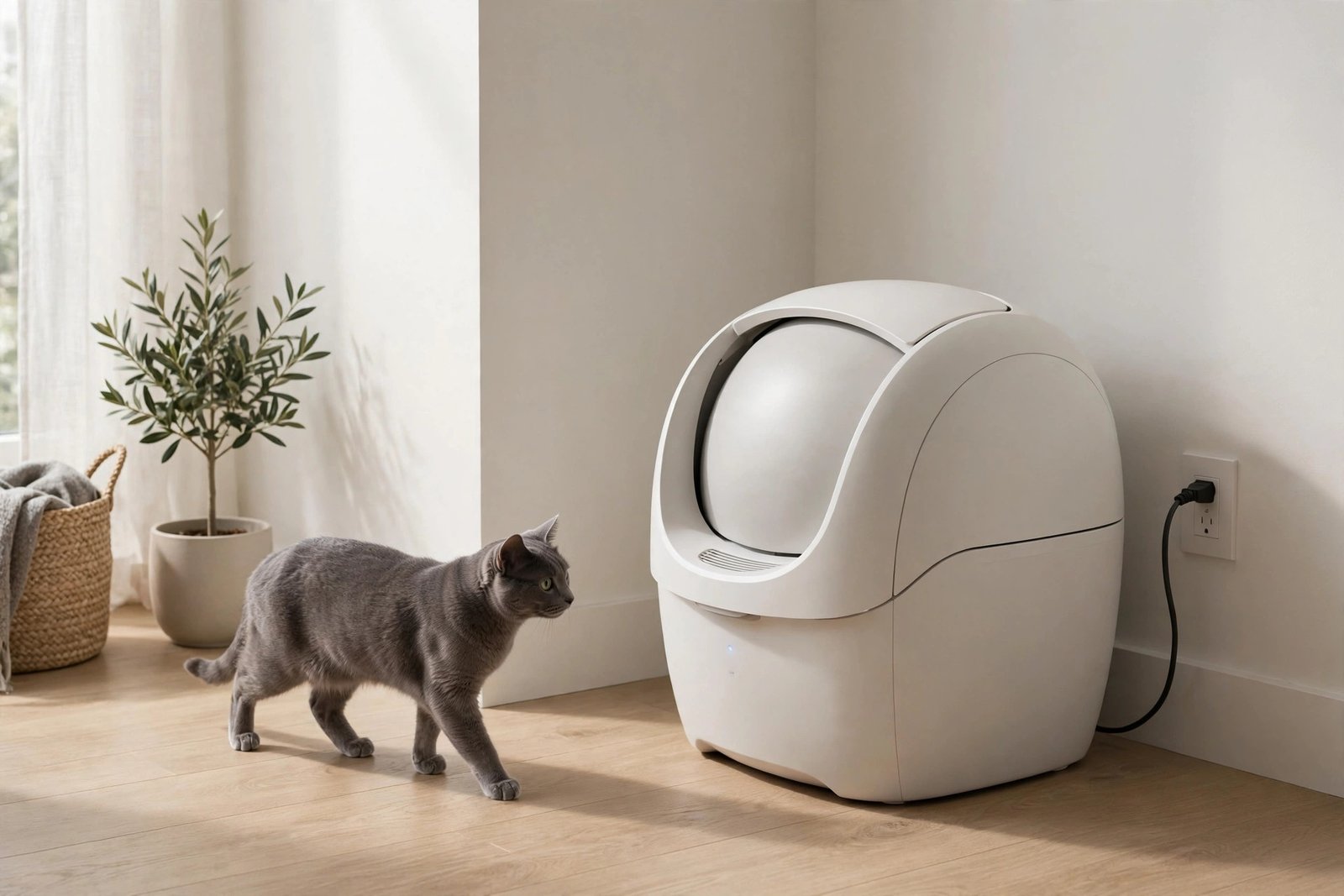
Some cats take to self-cleaning boxes immediately. Others never do, and the reasons are predictable once you think like a cat.
Skittish and noise-sensitive cats are the most common refusers. To a cat, a machine that starts moving on its own is a predator-shaped mystery, not an appliance. Kittens, newly adopted cats, and any cat that startles at the vacuum tend to view the box with suspicion.
Senior cats and cats with mobility issues often struggle with the entry design. Many automatic boxes sit higher than a manual pan — the cat has to step up and over a taller rim to get inside. For an arthritic cat or a very small kitten, that lip is a genuine barrier.
Very large cats can have the opposite problem: some globe-style machines have a smaller usable interior than a big open manual pan. A large cat that can’t turn around comfortably will simply refuse.
Multi-cat households present a behavioral wrinkle: some cats won’t use a box that smells like another cat, and the timer delay means the box may not be clean when the next cat needs it. Also worth noting — one machine per cat doesn’t work well when cats have different acceptance levels; you may end up maintaining a manual box alongside the machine anyway.
The honest advice: if your cat is skittish, elderly, or large, the odds of a smooth transition drop meaningfully. No machine is worth a cat that starts eliminating outside the box.
Maintenance the Brands Don’t Mention
“Self-cleaning” is a marketing term, not a literal one. Here’s what you still do.
First, the rake or globe gets dirty. Waste residue builds up on the mechanism itself, and litter dust coats sensors and moving parts. Most machines need a wipe-down of the rake and a sensor check every week or two, plus a full deep clean — litter emptied, interior washed, dried completely before refill — roughly monthly. Skip the deep clean and performance degrades: the mechanism drags, sensors misread, and odor from residue builds inside the machine.
Second, the waste compartment needs emptying. In a small apartment, that’s more often than the box suggests — remember, everything concentrates faster in small spaces, including smell inside a waste drawer.
Third, consumable management. Proprietary litter types run out on their own schedule, not yours, and if a brand discontinues a cartridge or litter format, your machine becomes an expensive manual box. This has happened. It’s worth checking that a model’s consumables are current and widely stocked before committing.
None of this is terrible. But “never scoop again” becoming “maintain a machine weekly and deep-clean monthly” is the expectation reset every buyer deserves before purchase.
Verdict: Who Should Buy Which
Get a self-cleaning box if: you travel for work and your cat is alone for long stretches; you consistently forget or can’t manage twice-daily scooping; your cat is confident, average-sized, and noise-tolerant; and you have floor space near an outlet that isn’t your bedroom. For you, the machine enforces a routine you’d otherwise miss.
Stick with a manual box if: your cat is skittish, senior, very large, or brand-new to your home; the box would sit near where you sleep; you’re a diligent scooper already (the machine buys you nothing); you have one cat and a consistent schedule; or the proprietary-consumable lock-in bothers you. A well-maintained manual box is quieter, cheaper, smaller, and gives you the health-monitoring window automation removes.
The middle path many apartment dwellers land on: a good manual box scooped on schedule, paired with a sealed waste pail and an odor-trapping litter. It costs a fraction of the machine, takes ninety seconds twice a day, and asks nothing of your cat’s nerves.
Where to Go Next
Whichever type you lean toward, the fundamentals of a good box don’t change — the right size, the right entry style, and odor-friendly features that suit a small space. See our picks for the best litter boxes for small apartments for models sized around real apartment constraints.
Frequently Asked Questions
Do self-cleaning litter boxes smell less in a studio apartment?
They enforce a consistent cleaning schedule, which helps if you weren’t scooping regularly. But the waste stays in the machine’s compartment in the same small room, so a manual box scooped twice daily with a sealed waste pail smells about the same. The machine fixes routine, not physics.
Will my cat actually use an automatic litter box?
Confident, average-sized, noise-tolerant cats usually adapt within days to a couple of weeks. Skittish cats, seniors with mobility issues, and very large cats refuse more often. Introduce it alongside the old box rather than swapping outright — let the cat choose, and don’t remove the manual box until the cat is using the machine reliably.
What happens during a power outage?
The machine stops cycling but remains usable as a plain manual box — cats can still go in it. The waste just sits until power returns. For outages longer than a day or so, you’ll need to scoop it manually or your cat may refuse it. If you live somewhere with frequent outages, this is a real consideration.
Are self-cleaning boxes worth it for one cat?
Usually the math is weakest here. One cat produces little enough waste that twice-daily scooping takes a couple of minutes total. The machine’s biggest selling point — handling waste when you can’t — matters most with multiple cats or travel schedules. For one cat and a consistent routine, a manual box is the practical choice.
How long should I wait before giving up on the transition?
Give it two to three weeks with the old box still available. If the cat is investigating but cautious, keep going. If the cat is avoiding the machine entirely or, worse, eliminating outside any box, stop — the machine isn’t worth a litter-box aversion, which is far harder to fix than a scooping routine.
Related reading
- Best Litter Boxes for Small Apartments — our picks sized around real apartment constraints.
Last updated: October 9, 2026