
If you went looking for an automatic sifting litter box expecting a small machine that quietly does the whole job, this category will surprise you: almost nothing in it has a motor. What “automatic” means here is a mechanism — a grate inside a rolling hood, a slotted pan you lift, a screen you pour litter through — that separates clumps from clean litter in one motion instead of a scoop-by-scoop dig. No sensors, no app, no cleaning cycle running at 3 a.m., and nothing electronic to fail in year two.
That trade is the point of this list, and we will be plain about both sides of it. The win is reliability and silence: every pick below is freestanding, unplugged and renter-safe, with no proprietary cartridge habit unless we flag one. The cost is that your hands still do part of the work — rolling, pouring, lifting, and in one case daily scooping — so each pick is labeled by its mechanism class, with the effort that remains stated in its own section. Six picks, all verified on live retailer listings, ranked for apartment life.
Quick picks
| Award | Product | Why it stands out | Check Price |
|---|---|---|---|
| Best overall | Arm & Hammer Sifting Cat Litter Pan, Large | The strongest ratings of any true sifter here, a dead-simple 3-pan lift-sift and an antimicrobial surface; 4.3★/1,388 | Check Price on Chewy |
| Best fully manual sifter | Frisco Sifting Cat Litter Box, Large, 22-in | The purest sifting mechanic in the set: three pans, zero consumables, and the longest pan here; 4.0★/768 | Check Price on Chewy |
| Best low-effort | Omega Paw Roll ‘n Clean Self-Cleaning Litter Box, Large | One roll sifts and drops clumps into a pull-out tray — no lifting litter, no shaking, no scooping; 3.4★/216 | Check Price on Chewy |
| Best framed sifter | Van Ness Sifting Cat Litter Pan with Frame (CP5) | Screen-transfer sifting with a frame that holds a liner in place and cuts floor scatter; 3.7★/462 | Check Price on Chewy |
| Best enclosed sifter | Van Ness Enclosed Sifting Cat Litter Pan | The same screen sift under a hood with a zeolite filter — the only manual pick that manages odor and scatter between cleanings; 3.7★/942 | Check Price on Chewy |
| Best urine-odor system — not a sifter | Tidy Cats Breeze Cat Litter Box System | A drain-through pellet system with a pad drawer: the strongest urine-odor story here, with daily hand-scooping as the trade; 4.3★/3,651 | Check Price on Chewy |
Best overall: Arm & Hammer Sifting Cat Litter Pan, Large

Mechanism class: manual lift-sift. The Arm & Hammer set is three pans — two regular pans and one sifting pan — and its own cleaning instructions describe the whole routine: pour the dirty pan’s contents into the empty pan with the sifter tray on top, lift the sifter out, and discard the clumps it caught. That is the entire machine. It is rated 4.3★ across 1,388 ratings on the Chewy listing we link — the strongest rating evidence of any true sifter in this set — with antimicrobial protection against stain- and odor-causing bacteria built into the plastic, clips that hold the stack together, and a made-in-the-USA build.
The brand’s pitch is “no shaking or scooping,” and the honest version is narrower: no scoop, yes — but you do pour a full pan of litter and lift the sifter out of it, every cleaning. The listing makes a point of the reinforced bottom, built to withstand lifting heavy clay litter, which tells you the makers know exactly where the effort sits. It is designed for clumping litter; listing reviewers also report sifting pine-pellet sawdust through it successfully, but that is reviewer practice rather than a brand promise, and we label it that way.
The drawback that rides with the award is in the name: despite the “Large” label, the litter bed is modest, and reviewers flag it as tight for genuinely large cats. The sifter tray also sits low — at least one listing reviewer modified theirs with foam blocks so it sat higher and sifted better — and setup confusion is a recurring review theme, because the stacking order is not obvious out of the box. The sides are not especially tall, so committed kickers will scatter litter, and with an open design there is no sealed waste anywhere: odor control rests on the antimicrobial pan and on how often you sift.
Apartment scorecard: Installation — none; stack the pans in the right order, sifter in the middle of the working stack. Rental-friendly — yes; freestanding plastic, no power, no plumbing, nothing attached to the unit. Cleaning — pour, lift the sifter, dump the clumps; the antimicrobial surface wipes down and there are no parts to replace. Best room — a small bathroom, where a compact pan earns its keep.
Best fully manual sifter: Frisco Sifting Cat Litter Box, Large, 22-in

Mechanism class: manual lift-sift. Chewy’s house-brand sifter is the purest version of the idea in this set: two solid pans and one sifter pan with fine slits — about 1/6 inch, per the listing — stacked together. You lift the sifter, shake it, and the clean litter falls through into the pan below; the clumps stay behind in the sifter to be tipped into the trash. Nothing else is involved: no tray, no bag, no filter, no consumable of any kind. It is rated 4.0★ across 768 ratings, and at 22 inches long per its name it is the largest sifting pan here — the one pick where a bigger cat gets a genuinely longer bed to work with.
The effort is equally pure, and it is the honest headline of every lift-sift design: a full pan of wet clay litter is heavy. Listing reviewers put a full load at roughly 15 to 20 pounds, lifted by fingertip grips on the pan edges and shaken over a trash can. That is a fair trade for some households and a disqualifying one for others — bad backs, wrist problems and senior owners should read this section twice, because no technique removes the lift. The lift is the mechanism.
The remaining drawbacks are mechanical. Clumps stick through the slats and sometimes need prying loose, and the slits need clearing when litter gums them. Clumping clay is the listing’s recommendation; reviewers who run pine pellets report mixed results — whole pellets can fall through the slots and disintegrated sawdust can gum the holes — so this is not a pellet-first design. And there is no lid and no sealed waste storage: clumps sit in the open sifter until you walk them to the trash, so odor between siftings is entirely unmanaged.
Apartment scorecard: Installation — none; stack the three pans. Rental-friendly — yes; freestanding plastic, no power or plumbing. Cleaning — lift the sifter, shake, dump the clumps; wash all three pans periodically and clear gummed slits. Best room — a bathroom or laundry area with a wide enough spot for a 22-inch pan and room to lift and shake over a trash can.
Best low-effort: Omega Paw Roll ‘n Clean Self-Cleaning Litter Box, Large

Mechanism class: semi-automatic roll-to-clean. The Omega Paw is the one pick here where a single motion does the sifting for you. You roll the hooded box onto its back and back upright; an internal sifting grate separates the clumps from the clean litter as it turns, and the clumps drop into a pull-out tray — the only waste tray in this set. No motor, no batteries, no outlet: the power is yours, but the sifting is the grate’s. It runs on clumping litter (the design depends on clumps holding together through the roll; the listing’s Q&A suggests some crystal litter may work, but clumping is the verified primary).
That is why it takes the low-effort award: you never lift a pan of litter, never shake a sifter, never scoop. Roll, pull the tray, dump it. For owners who cannot or do not want to hoist 15-plus pounds of wet litter several times a week, no other pick in this set comes close — and in a small apartment the routine takes seconds and makes no noise worth the name.
Now the costs, carried as plainly as its listing carries them: at 3.4★ across 216 ratings, this is the lowest-rated pick here, and the reviews explain why. The internal grate — the one moving part — cracks within months for some owners. The side clips are flimsy and the hood can shift mid-roll. Clumps stick to the bottom, and owners report having to smack the box to free them. The roll has to be slow and nearly upside-down or the sift comes out incomplete, and the screen’s holes miss small clumps, which stay in the clean litter. Reviewers also consistently note that the usable interior is small relative to the outside, because the grate takes up room — larger cats are cramped in a box that looks full-size. Buy it for the effort, with your eyes open about the grate.
Apartment scorecard: Installation — none; assemble the hood, grate and tray, fill with clumping litter. Rental-friendly — yes; freestanding, no power, no plumbing, nothing attached to the unit. Cleaning — roll, pull the tray, dump it; periodic full wash, and the grate needs scrubbing when clumps stick. Best room — a bathroom or laundry corner with enough open floor to roll the box onto its back — not a tight closet.
Best framed sifter: Van Ness Sifting Cat Litter Pan with Frame (CP5)
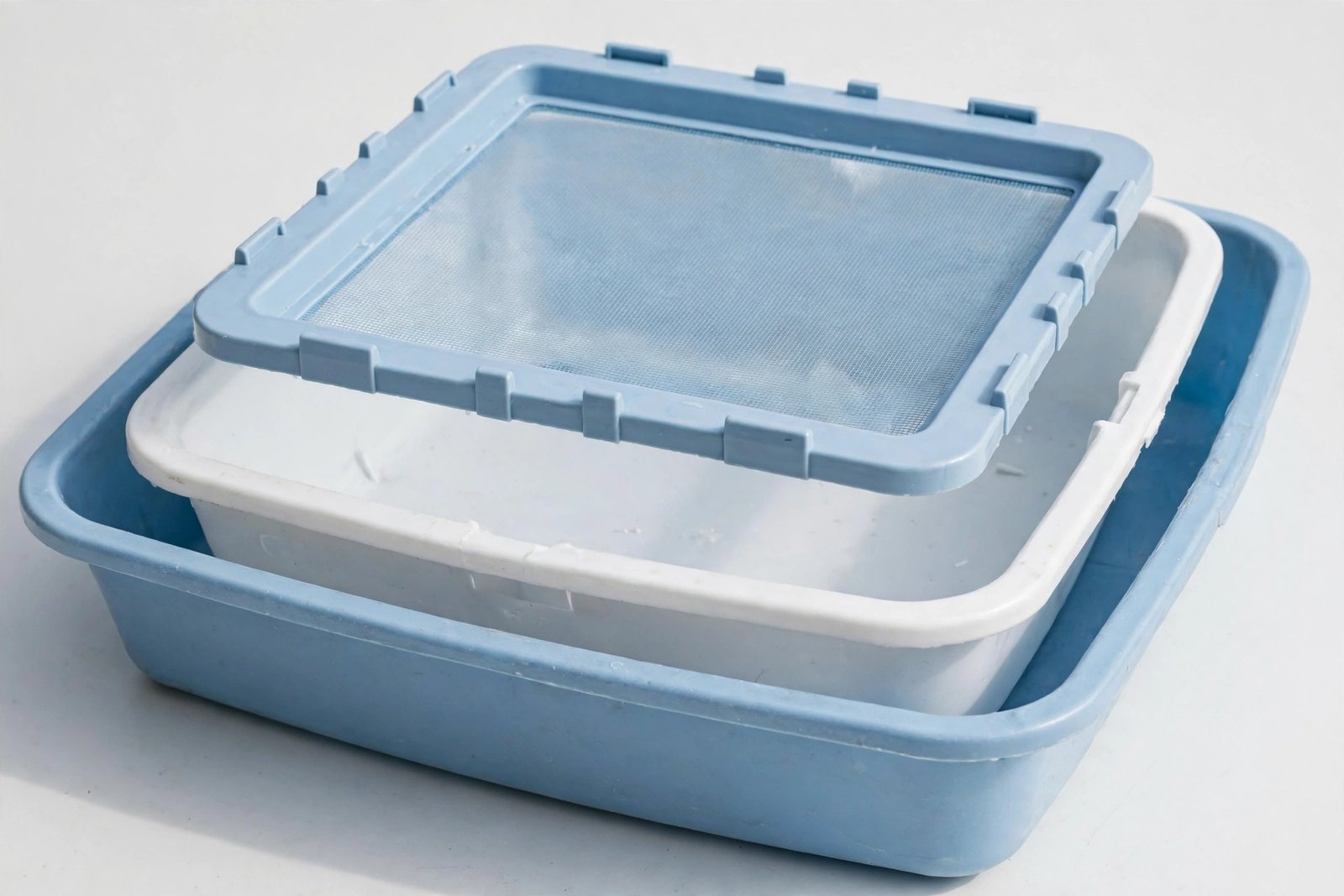
Mechanism class: manual screen-transfer. The CP5 works slightly differently from the lift-sift pans above: two nesting pans plus a sifting screen. Per the listing, you set the screen in the empty pan, transfer the litter through it, restack, and you are done — the litter pours through the screen rather than being shaken through a slotted pan. The frame is the distinguishing hardware: it adds height and locks a liner in place, which is exactly the combination that keeps litter off a rental’s floors. It is rated 3.7★ across 462 ratings, and it is the one pick here with a listing-verified size: the listing’s Q&A gives the assembled pan at 19 × 15⅛ × 8 inches, so it is also the scorecard below that can honestly print a footprint.
Litter compatibility is where this pick needs both sides stated. The listing’s Q&A includes a yes for wood pellet litter, and some reviewers transitioned from clumping to pellets successfully; other reviewers warn that the sifting grates clog easily with pine pellets and that pellets stick in the holes. Both experiences are on the same listing, so our position is the listing’s safe one: clumping litter is the verified use, pellets are a try-it-and-see experiment. The listing also describes a high-polish finish that resists stains and odor, which helps the wipe-down side of ownership.
The drawbacks are about the screen itself. Multiple reviewers find the sieve holes run small — litter gets stuck in the sieve instead of falling through — and urine clumps can form around the sifter grid and stick hard if litter sits in contact with the screen, so leaving a full pan standing works against you. The plastic is described as a little weak by reviewers, and several call the pan a little small for larger cats despite the frame’s added height.
Apartment scorecard: Footprint — 19 × 15⅛ × 8 in assembled, per the listing’s Q&A. Installation — none; the pans nest and the frame snaps on and can lock into the sifting pan. Rental-friendly — yes; freestanding, no power or plumbing, and the frame reduces floor scatter, which landlords’ floors appreciate. Cleaning — transfer the litter through the screen, dump the clumps, wipe the high-polish finish; unclog the screen holes as needed. Best room — a bathroom, or anywhere litter scatter on hard floors is the complaint.
Best enclosed sifter: Van Ness Enclosed Sifting Cat Litter Pan

Mechanism class: manual screen-transfer, enclosed. This is the CP5’s idea under a roof: two base trays, one sifter, and a hood with a flap door and a replaceable zeolite air filter. The cleaning works the same way — screen into the empty pan, move the litter across, restack — but between cleanings the hood and filter do the odor and scatter management that no open pan in this set attempts. It carries the deeper review base of the two Van Ness sifters, at 3.7★ across 942 ratings, and for an apartment where the box has to live somewhere visible, that enclosure is the entire argument.
Litter choice is narrower here, and the listing’s reviews are unusually direct about it: this is a clumping-litter pan in practice. The sifter holes are large, pine pellets fall straight through, and one listing review is literally titled “Avoid if using pine pellet litter.” Pellet households should be looking at the CP5’s mixed evidence or at the Breeze below instead — not at this pan.
Two honest drawbacks. First, the manufacturer’s own stacking instructions draw fire: a detailed listing review warns that stacking the sifter on top as directed makes urine clumps form around the sifter grid and stick, and owners develop their own order — workable, but you should not have to out-think the manual. Second, the flap door is a love-it-or-remove-it feature; reviewers detach it, and the high ledge still contains litter with the flap off, so consider it optional equipment rather than a fixed trait. The zeolite filter is also the only ongoing consumable among the manual picks — small, but it is a swap on a schedule, not a one-time purchase.
Apartment scorecard: Installation — none; assemble the trays, sifter, hood and filter. Rental-friendly — yes; freestanding, no power or plumbing, and the hood contains scatter and odor better than any open pan here. Cleaning — screen-transfer like the CP5, plus a zeolite filter to swap on schedule. Best room — living-area-adjacent corners and hallways, anywhere an open pan’s looks and smell are the problem; less ideal for a cat that refuses flaps unless the flap comes off.
The different system: Tidy Cats Breeze Cat Litter Box System

Mechanism class: drain-through pellet system — not a true sifter. We are including the Breeze in this roundup because searchers lump it in with sifting boxes, and we would rather label it correctly than leave the confusion standing. There is no sifting anywhere in it — the listing’s own reviewers say so in those words. Proprietary zeolite pellets sit on a grated floor; urine drains through to an absorbent pad in a drawer below; solids stay on top of the pellets, where they are scooped by hand, daily. Rated 4.3★ across 3,651 ratings, it has by far the largest review base in this set, and its urine-odor story is genuinely the strongest here: the liquid waste is sealed away in a pad drawer instead of sitting in an open pan, which is why listing reviewers praise it specifically in apartment bedrooms.
The running-cost shape is the mirror image of the five picks above. The pans ask nothing of you after purchase; the Breeze asks for its own pellets and its own pads, forever, by design. Per the listing description and reviewer routines, pads swap roughly weekly and the full pellet load refreshes roughly monthly — no prices here, as always, but the structure is the point: two proprietary streams, on a schedule, for the life of the box. Reviewers also report off-label success running it with pine pellets and generic pads; that is reviewer practice, not brand guidance, and we flag it as such.
The drawbacks follow from the design. Solids sit uncovered on top of the pellets — cats cannot bury waste in this system — so solid-waste odor is immediate until you scoop, and reviewers are blunt about it. The standard size is genuinely small: reviewers consistently call turning and squatting room the top complaint, and one describes a 12.5 lb cat as too big for it, with the curved high back eating into the usable space; a larger XL version exists for exactly that reason. Pellets can rattle under digging paws and a few still get tracked, and reviewers note the system is not suited to diarrhea-prone cats, since the pellets do not absorb it. As an odor-first alternative for one small cat, honestly framed, it earns its place. As a “sifter,” it is not one, and no headline here will pretend otherwise.
Apartment scorecard: Installation — none; set the grate, add the pellets, slide a pad into the drawer. Rental-friendly — yes; freestanding, no power or plumbing, and the low tracking helps floors — the trade-off is the consumable supply, not the unit. Cleaning — scoop solids daily, swap the pad about weekly, full pellet refresh and a soap-and-water wash about monthly. Best room — a bedroom or living room, on the strength of its urine-odor control; keep it out of kitchen-adjacent spots, because solids are uncovered.
How we picked
Every pick is verified against the live retailer listing we link, and the table above is drawn from those listings, not from roundup recycling. Reviews are the best evidence a reader can check at home: we counted only Chewy ratings and their counts as recorded when we checked the listing, and we do not infer anything about a product that its listing, manual or reviewer reports do not say. Prices are deliberately omitted: they change weekly, and anyone can check the price on the listing from the links above. No paid placements, no hands-on testing, no veterinary claims — and no prices anywhere on this page.
What “automatic” means here is mechanism, not electronics. Every pick is freestanding, unplugged and renter-safe, with no proprietary cartridge habit unless we flag one. Our picks are ranked by mechanism class, with the effort that remains stated in each pick section. And we flag the one exception: one pick on this list is not a sifter at all, and it is labeled as such wherever it appears.
Buying guide: what matters in an apartment
“Self-cleaning” here is three different mechanisms
The lift-sift pan and the screen-transfer pan both make you move litter, but differently: the lift-sift asks you to hoist a pan and shake; the screen-transfer asks you to pour one pan’s litter through a screen into another. The roll box is a third thing entirely: it drops clumps into a pull-out tray, and a fourth, the drain-through pellet system, runs urine through to a pad. None of these is “no work” — choose by what you will actually do on a tired evening, and by whether you can lift 15 to 20 pounds of wet clay one-handed, because one pan in this set cannot be used by an owner who cannot.
Audit the effort, not the headline
Every “no scooping” claim here is true in a narrow sense and incomplete in a broad one. The lift-sift pans replace scooping with a 15-to-20-pound lift-and-shake; the screen-transfer pans replace it with a pour-and-restack; the roll box replaces it with a roll-and-tray-dump — and one pick, the Breeze, replaces it with thirty seconds of hand-scooping every day. Add it up over a week rather than admiring the mechanism in isolation, and ask the honest question: is the effort smaller, or is it just differently shaped?
Two cats change the audit, not the mechanism. The 15-to-20-pound lift-sift pan gets hoisted twice as often, the screen-transfer pour happens twice as often, and the roll box’s tray gets dumped twice as often — and the daily-vs-twice-weekly schedule decision matters more, because the sifted waste waits in an open sifter until it is carried out, and two cats double the unsealed waste waiting. The Breeze’s thirty seconds of daily scooping scales the same way: it is thirty seconds per day for one cat, and it does not stay thirty seconds for two. Nothing here seals waste, so the second cat’s cost is paid in sifting frequency, not in a new pick.
The odor reality of no-motor boxes
No pick in this roundup seals waste. Every clump stays in the pan, in an open sifter or a pull-out tray until you carry it out, and that timing is the entire odor story: sift on a daily rhythm, and odor stays a non-event; leave the box three days, and it becomes one. The Breeze earns its urine-odor award because the urine drains into a sealed pad drawer rather than sitting in the pan; the enclosed Van Ness earns a mention because its zeolite filter and hood contain odor between cleanings; every open pan in this set is honest about what it cannot do.
Litter compatibility decides more than the pan does
Clumping clay is the safe default for everything in this roundup: it is the verified primary for the Arm & Hammer, the Frisco, the Omega Paw, the CP5 and the Enclosed Van Ness — five of six picks, with the Breeze’s own pellet system as the sixth. Non-clumping options are narrow: the Breeze’s own pellets and pads are proprietary, and the Omega Paw’s Q&A suggests some crystal litter may work but clumping is verified. Wood pellets are the live disagreement on this page: the Frisco’s reviewers report whole pellets falling through its slots while sawdust gums them, and the CP5’s Q&A says yes to wood pellets while its reviewers warn about clogging. Check the pellet rules before the pan size, because the wrong litter breaks the mechanism first.
One gap in this list is worth naming: no pick here is built for pellets. The open pans argue both sides — the Frisco’s reviewers report whole pellets falling through its slots while sawdust gums them, and the CP5’s Q&A says yes to wood pellets while its reviewers warn about clogging. The one purpose-built pellet sifter on this site is the JOEJOY in our stainless steel litter box guide — a 201-grade stainless steel sifting box with a filter panel built for pine pellets, not a slotted pan being asked to do a pellet job. It lives there, not here, because this roundup is about no-motor sifting pans — but if pine pellets are your litter, that is the pick to read first.
Depth matters too. Depth matters too: about 1–2 inches of litter (ASPCA guidance) — deeper beds bake on harder and waste litter.
Read “Large” with suspicion
Nominal size is least honest claim in this category. Every pick calls itself “Large,” and yet the beds range from genuinely long to cramped in use; the Omega Paw’s interior is small relative to its footprint, the Breeze’s standard size is too small for a 12.5 lb cat, and the Arm & Hammer’s bed is modest despite the “Large” label. The only checkable size on this page is a footprint: the CP5’s assembled 19 × 15⅛ × 8 inches, per its listing Q&A. The Frisco’s 22 inches, in its name, is the only other checkable number. Where a listing states no dimensions, we say so; “Large” on a box is marketing until proven by a ruler.
Measure the cat first. Measure the cat first: about 1.5× its length, nose to base of tail (International Cat Care) — that is the box length to shop for. The Frisco’s 22 inches is the only checkable number on this page, and it is the number to test against your cat’s length before you test it against your floor space.
Frequently asked questions
Are any of these big enough for a large cat?
Start with the Frisco: at 22 inches long, it is the largest sifting pan in this set and the only one named by its length. The CP5’s footprint is 19 × 15⅛ × 8 inches, per the listing’s Q&A. Everything else is genuinely smaller in use than its “Large” label suggests: the Omega Paw’s interior is cramped because the grate takes up room, the Breeze’s standard size is too small for a 12.5 lb cat, and the Arm & Hammer’s bed is modest. Size labels are unreliable in this category — the only numbers we can print are the Frisco’s 22 inches and the CP5’s footprint.
Do any of these handle litter odor?
The Breeze, for urine: liquid waste drains into a sealed pad drawer, which is why it earns the urine-odor award. The enclosed Van Ness, for general odor between cleanings: its hood and zeolite filter contain it better than any open pan here. The open pans, for neither: clumps sit in the pan or the sifter until you carry them out, so odor depends on sifting frequency, not on the pan.
Can you use pine pellets with these?
Not reliably, and not with every pick. The Frisco’s reviewers report whole pellets falling through its slots while sawdust gums them. The CP5’s Q&A says yes to wood pellets, while its reviewers warn about clogging. The enclosed Van Ness is the clearest no: its sifter holes are large, pine pellets fall straight through, and one listing review is titled “Avoid if using pine pellet litter.” The Breeze runs on its own pellets, not pine. Clumping clay is the safe default for the five true sifters.
Are any of these actually automatic?
Only in the mechanism sense, not the electronic sense. The Omega Paw’s roll-to-clean grate is the closest thing to automatic in this set — one roll separates clumps from clean litter and drops them into a tray — but it is still powered by your hands, and there is no motor, sensor or app in any pick here. If you want a machine that cleans itself on a schedule, these are not it; a motorized box is a different category.
Do these work in a small bathroom?
Yes, with room to work. The Arm & Hammer and the CP5 are compact and freestanding, and a bathroom is where their footprint earns its keep — but you need room to lift and shake a sifter over a trash can, or to pour litter through a screen, and the Omega Paw needs floor space to roll onto its back. Measure the working space, not just the pan’s footprint.
Is the Breeze worth it for an apartment?
If your priority is urine odor in a bedroom and you have one small cat, yes — the sealed pad drawer is the strongest urine-odor story in this set, and the daily scoop takes about thirty seconds. If you want true sifting, a larger bed, or no proprietary consumables, no: the Breeze is a pellet-and-pad system with a weekly pad and monthly pellet schedule, and solids sit uncovered until you scoop them.
Related reading
If you want a motorized box instead, start with our best automatic litter box guide. If you need a box that fits a small bathroom, see our best litter box for small bathroom guide. For a steel option, see our best stainless steel litter box guide. For a second box in a multi-cat home, see our best automatic litter boxes for multiple cats guide.
Last updated: November 20, 2026