
The best litter box for small bathroom spaces has a harder job than any other box in the house. The bathroom is often the only room with a hard floor, a door that closes, and plumbing nearby — which is why it becomes the default box room in small apartments. But bathrooms are measured in inches, not feet: the corner beside the toilet might be 24 inches wide, the space under the vanity is shallow, and the air in a windowless bathroom does not move the way living-room air does. So we researched seven boxes on Chewy and Petco through the filter that matters here — exact footprint, odor containment in a small enclosed room, and honest drawbacks for bathroom placement. No testing claims, no paid placements: verified listing details first, paraphrased buyer-review evidence second, brand marketing last.
One distinction before the picks, because it keeps this article honest: this is a placement guide, not a mechanism guide. Our deep-dive on best litter boxes for small apartments covers the whole category, and our top-entry roundup ranks top-entry boxes as a format. This article answers one narrower question: if the box has to live in the bathroom, which boxes actually fit, ventilate, and survive next to the toilet.
Quick picks
| Award | Product | Why it stands out | Check Price |
|---|---|---|---|
| Best overall | IRIS USA Portable Hooded Corner Cat Litter Box with Scoop & Handle, Gray, Large | Corner geometry built for bathroom corners, hooded for odor, scoop + handle included | Check Price on Chewy |
| Best premium | Modkat Cat Litter Box, X-Large, Black | Seamless base, configurable top or front entry, the box that does not look like a litter box | Check Price on Chewy |
| Best front-entry compact | Modkat Flip Cat Litter Box, Gray | 3-position hinged lid, tall seamless base, the high-pee-ers answer for bathroom walls | Check Price on Chewy |
| Best compact top-entry | Catit PIXI Top Entry Cat Litter Box, White | Perforated grid lid, smallest base on this list, fits where nothing else fits | View at Petco |
| Best corner for large cats | Nature’s Miracle Advanced Hooded Corner Cat Litter Box | Corner shape at a genuinely roomy scale, charcoal filter, non-stick antimicrobial surface | View at Petco |
| Best compact covered | So Phresh Geometric Covered Cat Litter Box, 17.5″ L x 17.5″ W | Square 17.5-inch footprint, carbon filter, house-brand value for tight bathrooms | View at Petco |
| Best low-profile open | FRISCO Open Top Cat Litter Box with Rim, Large, Gray, 19-in | Rimmed open design with a lowered front, the smallest visual footprint here | Check Price on Chewy |
Best overall: IRIS USA Portable Hooded Corner Cat Litter Box

The IRIS wins the bathroom brief because it was designed for the bathroom’s geometry. A corner box turns the room’s most awkward dead space — the corner beside the toilet — into the box’s home, and the triangular footprint wastes nothing. Per the Chewy listing: hooded for odor containment, a scoop and carry handle included, and In Stock at research time. Buyer reviews back the small-space thesis — one 4-star review calls it a “modern, compact corner litter box” that is “perfect for small spaces.” The hood matters more in a bathroom than anywhere else: it slows odor escaping into a small enclosed room, and it keeps shower steam off the litter.
The honest drawbacks are scale and company. This is a one-cat box — buyer reviews note it is not ideal for multi-cat households, and the “Large” in the name refers to the corner form, not a large-cat interior. Interior dimensions were not verified on the listing, so we make no claim about large cats; measure your cat against the opening, not the name. The hood also means the entry is front-facing only, so the box needs its door side clear — plan the corner orientation before you buy, not after.
Apartment scorecard: Footprint — corner form; exact dims not verified on the listing — the corner shape is the thesis, not the numbers. Noise — n/a; no moving parts. Installation — none; unbox, add litter. Rental-friendly — yes; freestanding, moves room to room. Cleaning — hooded boxes need the hood wiped on a schedule; scoop included. Best room — the bathroom corner beside the toilet; that is what the geometry is for.
Best premium: Modkat Cat Litter Box, X-Large
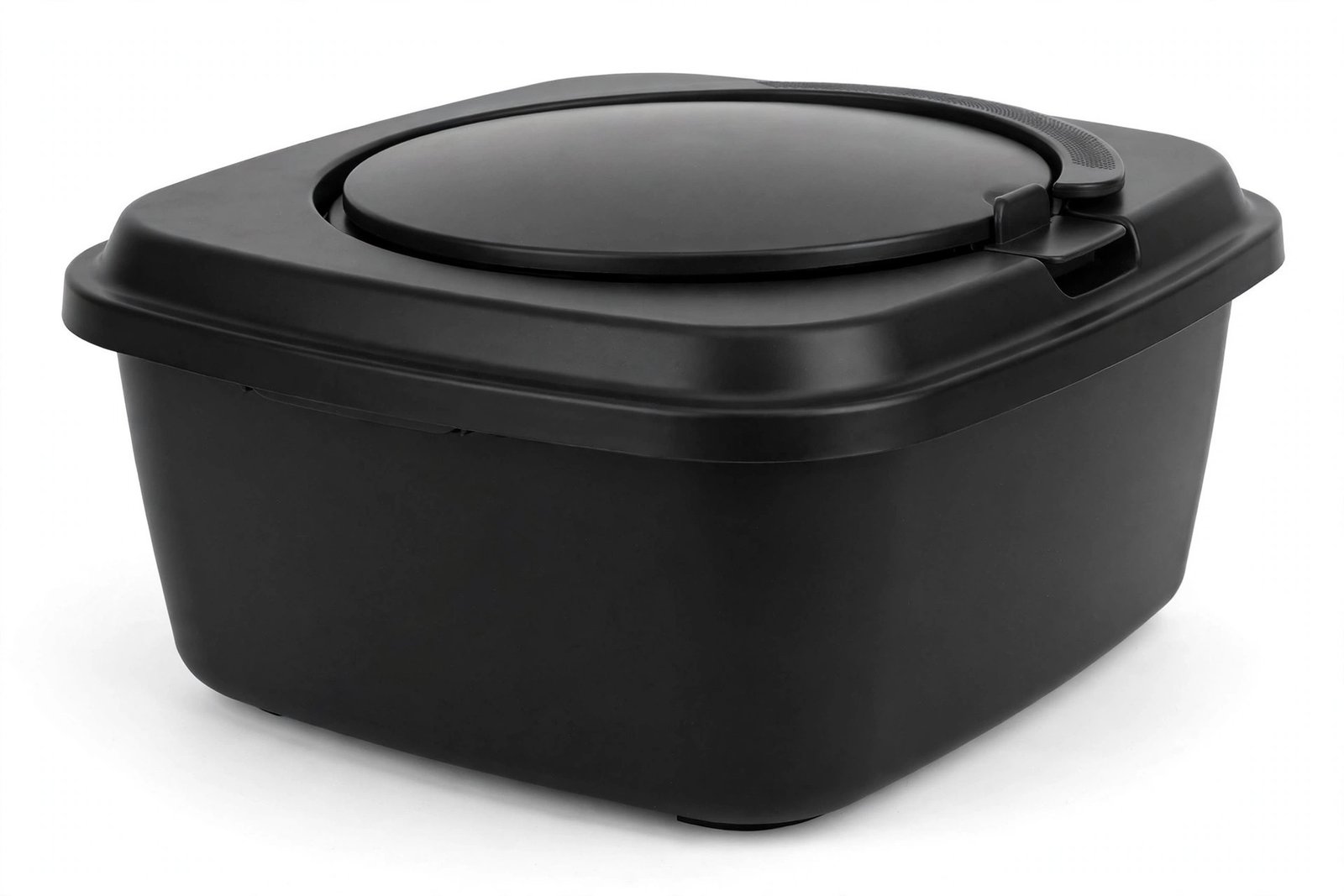
Modkat is the pick for the bathroom you do not want to look like a litter room. The design claim — that it does not look like a litter box — is retailer-stated, not tested, but the specs behind it are real: 21.0 x 16.5 x 17.0 inches, a seamless base with no corner seams for grime to hide in, and entry that configures as top OR front. That configurability is the bathroom argument: run it top-entry when odor and tracking matter most, front-entry when a guest uses the bathroom and the cat needs the easy door. The lid carries a 30-pound capacity per the Chewy listing, which matters for big cats that stress lids. Rating count was not verified on the listing; the 4.3★/11 figure floating around is a small sample — treat it as a hint, not a verdict.
The honest drawbacks are price and size honesty. This is the premium pick because it costs like one, and at 21 inches long it is bigger than its minimalism suggests — tape-measure the bathroom wall before assuming it disappears. The reusable liners are washable, not free; factor them in. And the top-entry configuration inherits the format’s exclusion zone: wrong for seniors, arthritic cats, and kittens. If your cat is in that group, run it front-entry only.
Apartment scorecard: Footprint — 21.0 x 16.5 in (verified) — measure the wall; minimalism is not smallness. Noise — n/a; swivel lid only. Installation — minimal; liners fit the seamless base. Rental-friendly — yes; freestanding, furniture-grade looks suit visible bathrooms. Cleaning — seamless base wipes clean; liners wash and reuse. Best room — the guest bathroom; this is the box you do not have to hide.
Best front-entry compact: Modkat Flip Cat Litter Box
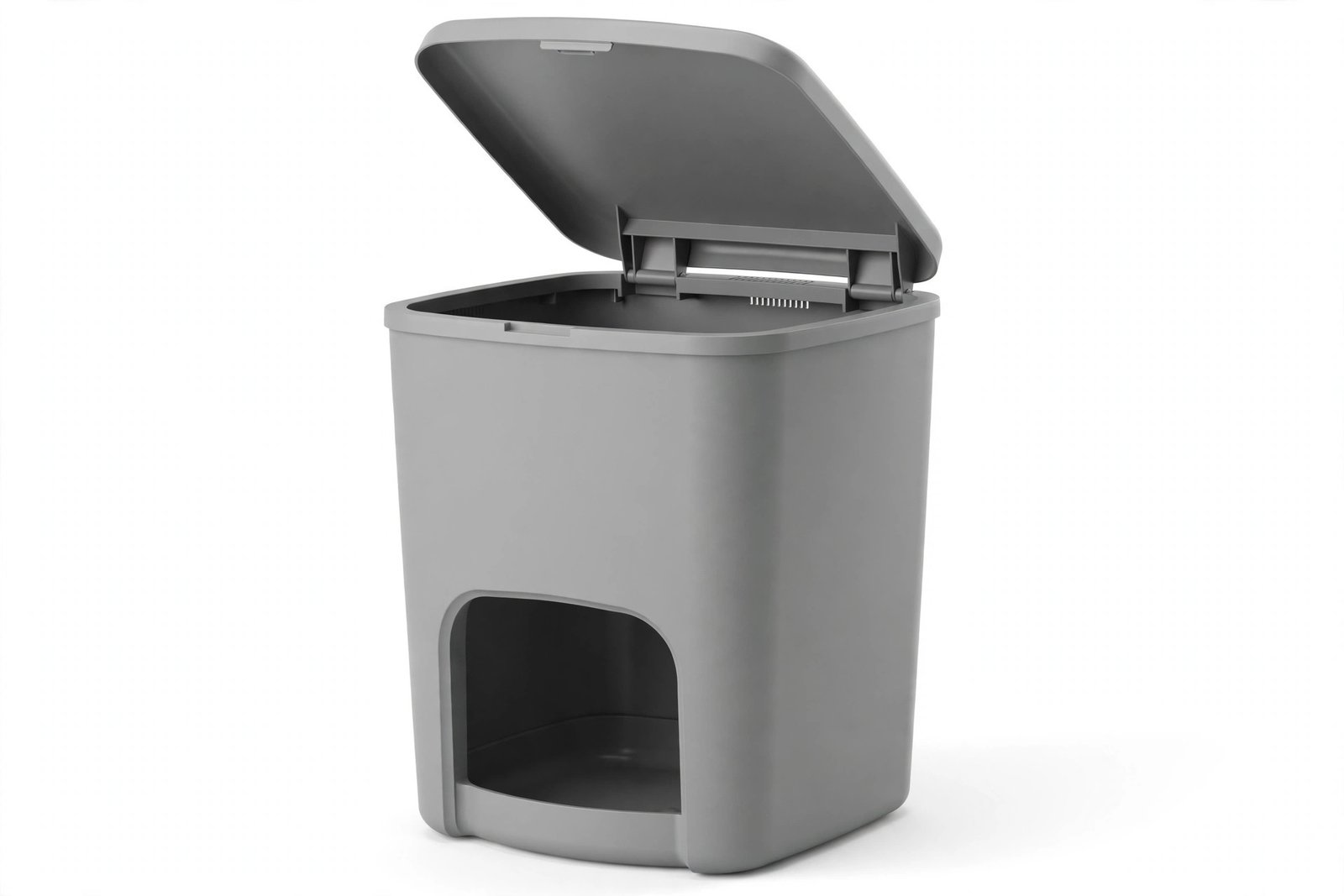
The Flip is the bathroom wall’s best friend. High-pee-ers — cats that urinate standing up or with a high arc — are the reason bathroom walls behind litter boxes get ruined, and the Flip’s tall seamless base with a 3-position hinged lid is built for exactly that problem. Per the Chewy listing: In Stock, 4.6★/98 ratings, and the tall base houses reusable type-F liners. The hinged lid flips to three positions for scooping access, which matters in a bathroom where you are scooping in a tight space and do not want to wrestle a full hood off. The seamless base is the cleaning story: no corner seams for caked litter in a humid room.
The honest drawback is the liner system. Type-F liners are proprietary — “reusable” means washable, not forever, and you are buying into Modkat’s liner ecosystem. The tall base that saves your walls also makes the box visually dominant; it reads as furniture, not a pan. And 98 ratings is a solid start, not a settled score — the 4.6 average is encouraging but young. If your cat is not a high pee-er, you are paying for tall walls you do not need.
Apartment scorecard: Footprint — compact front-entry; exact dims not verified on the listing — the tall base is the feature, measure height clearance under shelves. Noise — n/a; hinged lid only. Installation — minimal; liners fit the base. Rental-friendly — yes; freestanding, and it protects the walls your deposit depends on. Cleaning — tall seamless base wipes clean; hinged lid gives scoop access without hood removal. Best room — bathroom with a high-pee-er; the walls stay clean.
Best compact top-entry: Catit PIXI Top Entry Cat Litter Box
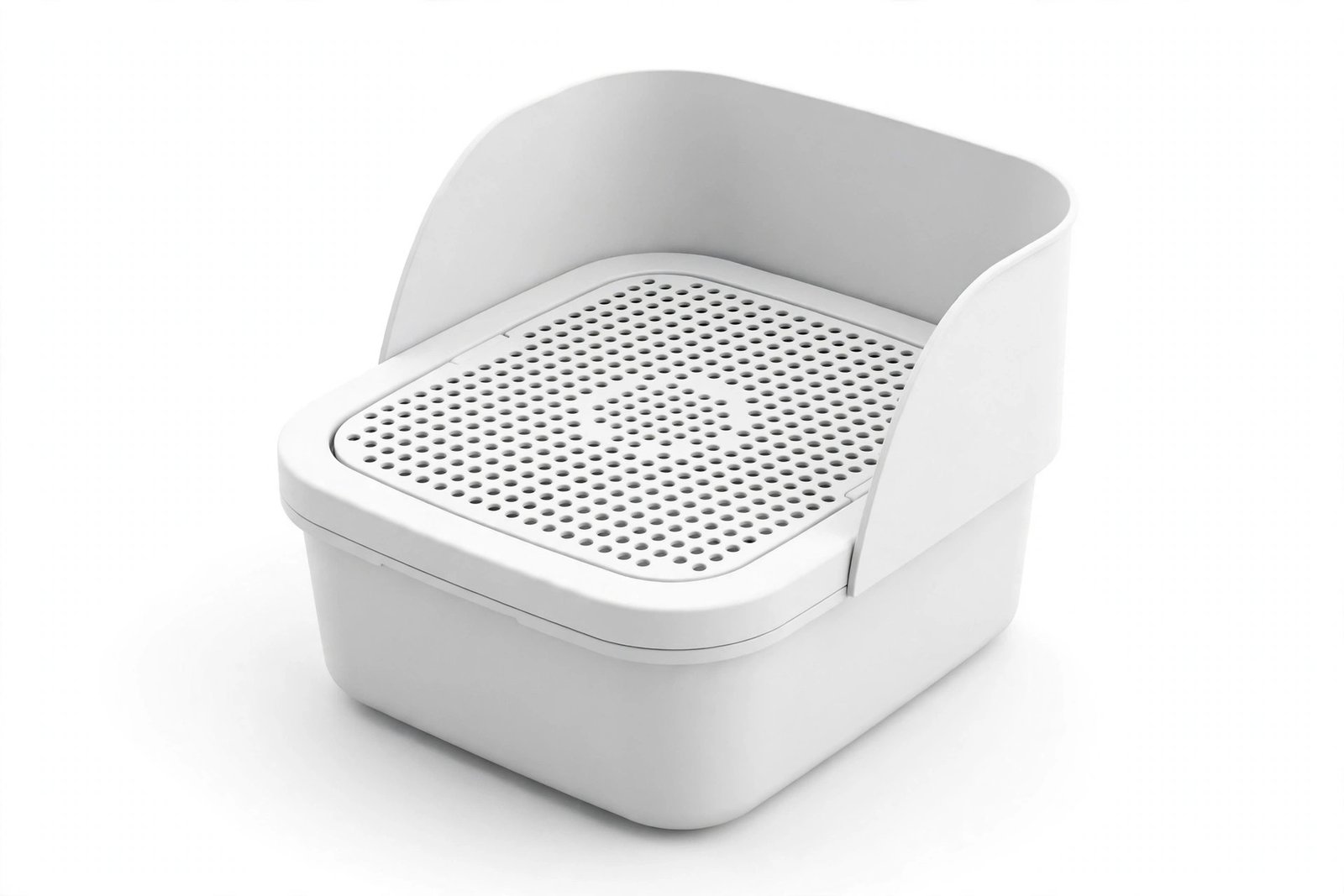
When the bathroom corner is genuinely tiny, the PIXI is the footprint play: 20.4 x 16.1 inches per the Petco listing — the smallest base area on this list. The lid is a perforated grid, so litter falls back through the holes instead of being tracked across bathroom tile, and the seamless leak-proof base matters in a wet room. The back-shield exit guide directs the cat across the grid. This is the same product as the compact pick in our top-entry roundup — it earns a second appearance here because few boxes fit bathroom footprints this small. Rating count was not verified on the Petco listing; we make no rating claim.
The honest drawbacks are height and exclusion. At 18.7 inches tall on a 20.4-inch base, it is a tall box for its footprint — visually dominant in a tiny bathroom. And top-entry is the wrong format for seniors, arthritic cats, and young kittens; the grid lid that catches tracking is also the lid they cannot climb. The perforated grid is brilliant when the cat exits across it and useless when an athletic cat jumps clean over the lid. Buy it for the smallest bathroom on this list; do not buy it for a large or aging cat.
Apartment scorecard: Footprint — 20.4 x 16.1 in, 18.7 in tall (verified) — smallest base here; plan for visual height. Noise — n/a; swivel lid only. Installation — none. Rental-friendly — yes; freestanding, smallest footprint. Cleaning — perforated grid shakes out; seamless base wipes clean. Best room — the tiniest bathroom or a closet nook; the grid lid is the tracking story.
Best corner for large cats: Nature’s Miracle Advanced Hooded Corner Cat Litter Box
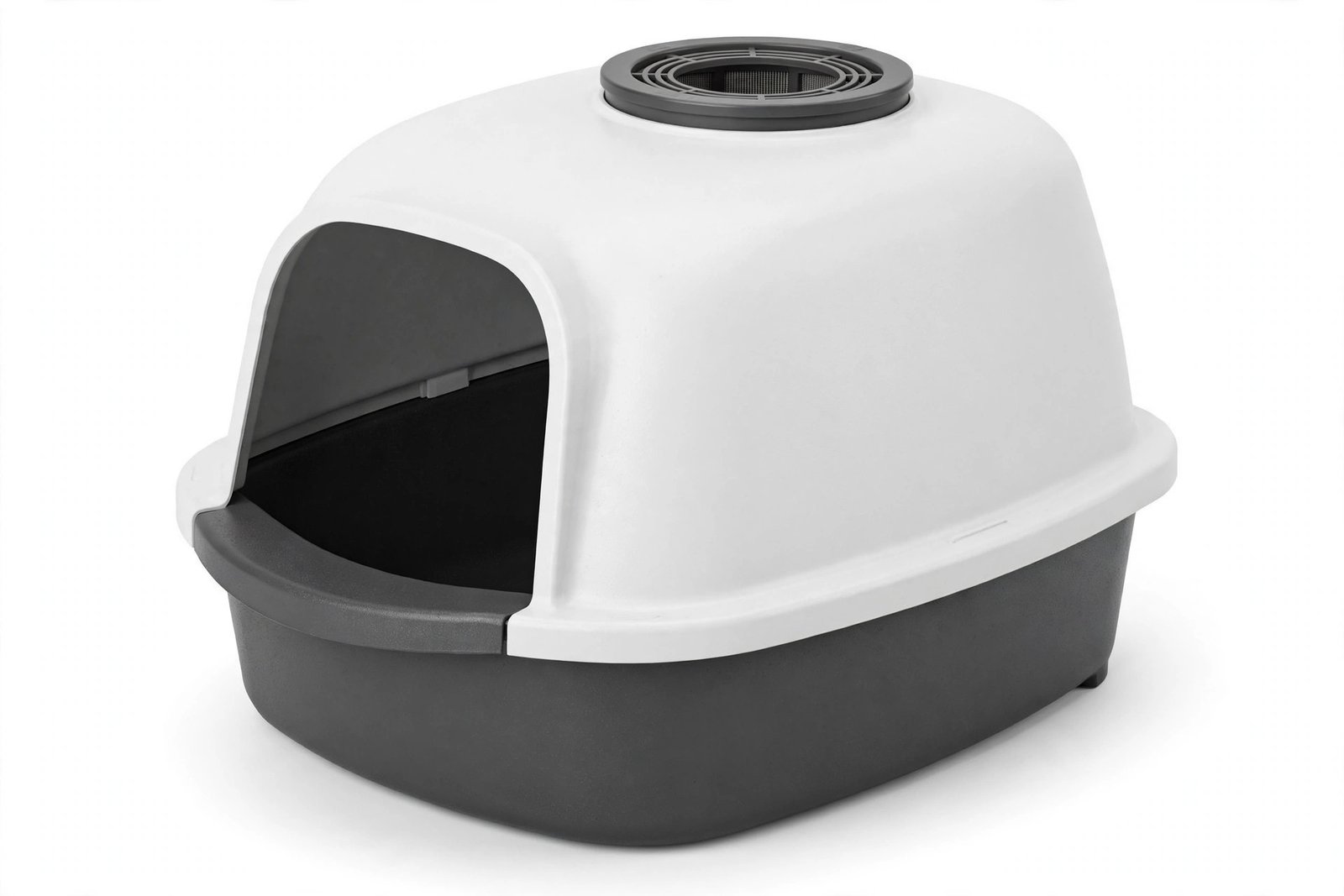
This is the corner box for households where the IRIS’s compact corner feels cramped. Per the Petco listing: 26 x 23 x 20 inches, a hooded corner design with a built-in charcoal filter, antimicrobial product protection that inhibits odor-causing bacteria, and a non-stick surface that resists litter caking. That last detail matters in a bathroom: humidity plus caked litter is how boxes start smelling permanent, and a non-stick surface breaks the cycle. The graphite-and-white styling is neutral enough for a bathroom that guests use. Third-party reviews note it is one of the few corner boxes that genuinely fits larger breeds — the corner form without the small-box penalty.
The honest drawback is that 26 x 23 inches is not a small footprint — it is the largest box on this list, and “corner” does not mean “compact.” If your bathroom corner is 24 inches wide, this box does not fit; measure before you fall for the corner thesis. The charcoal filter is replaceable and needs replacing — factor the ongoing cost. Rating count was not verified on the Petco listing; we make no rating claim.
Apartment scorecard: Footprint — 26 x 23 x 20 in (verified) — the largest here; measure the corner, not the concept. Noise — n/a; no moving parts. Installation — none; charcoal filter slots in. Rental-friendly — yes; freestanding, and the charcoal filter helps the enclosed-room odor math. Cleaning — non-stick antimicrobial surface resists caking; replace the charcoal filter on schedule. Best room — a bathroom with a real corner and a large cat.
Best compact covered: So Phresh Geometric Covered Cat Litter Box

The So Phresh is the value play for tight bathrooms: 17.5″ L x 17.5″ W x 16″ H per the Petco listing — a true square that slots against a bathroom wall with nothing wasted. The covered design includes a carbon filter for odor, and Petco reviews (4.0★/83, 80% recommend) praise the compact footprint and the way it fits small apartments without looking industrial. As Petco’s house brand, it is the cheapest covered route onto this list. For a bathroom where every inch is negotiated, the square geometry is the honest advantage: no diagonal dead space, no corner commitment.
The honest drawbacks are capacity and construction. Petco reviewers with larger cats report the box feels too small or shallow — this is a small-to-medium-cat box (reviewers cite the 7-to-13-pound range), and a large cat will find it cramped. A few reviews mention urine leaks and difficulty with the lid seal, which is the house-brand trade: the price is right, the tolerances are not premium. The carbon filter needs replacing like any filtered box. If your cat is over 13 pounds, skip this one and look at the Nature’s Miracle corner instead.
Apartment scorecard: Footprint — 17.5 x 17.5 in, 16 in tall (verified) — the squarest, most wall-efficient shape here. Noise — n/a; covered box only. Installation — none; carbon filter slots in. Rental-friendly — yes; freestanding, house-brand value. Cleaning — wipe the smooth interior; replace the carbon filter on schedule. Best room — a tight bathroom with a small-to-medium cat; not for large cats.
Best low-profile open: FRISCO Open Top Cat Litter Box with Rim
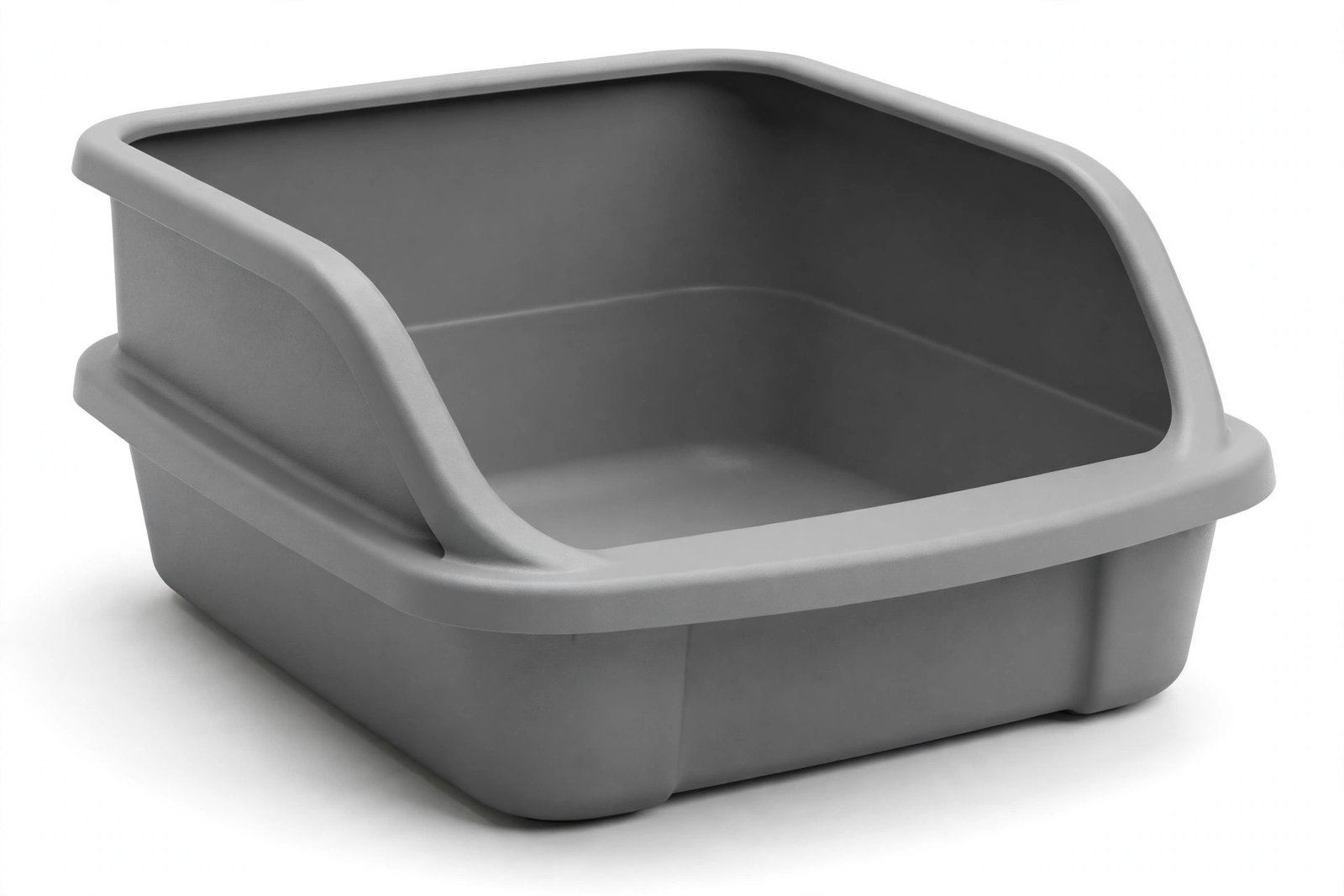
Not every bathroom wants a hood. The Frisco open-top is the low-visual-bulk option: a 19-inch box with a raised rim on the sides and back wall that keeps litter and spray inside, and a lowered front wall so the cat steps in easily. Per the Chewy listing: In Stock, BPA-free recyclable plastic, inner dimensions 14 x 18.75 inches, entrance 5 inches high (6.5 with the rim). The rim is the whole design thesis — it gives you most of a hood’s scatter control with none of a hood’s visual mass or lid-removal ritual. For a bathroom where the box sits beside the vanity in plain sight, low-profile is a legitimate aesthetic choice.
The honest drawback is odor. An open box in a small enclosed bathroom has no odor containment — the rim stops scatter, not smell. This pick assumes a disciplined scooping routine and probably a disposal pail beside it (our odor guide covers the rest of the system). It is also not the pick for high-pee-ers: the lowered front is easy entry and easy overspray. Buy it for the sightlines and the simplicity; do not buy it expecting a hood’s odor control.
Apartment scorecard: Footprint — 19-in box, 14 x 18.75 in interior (verified) — the smallest visual mass here. Noise — n/a; no moving parts. Installation — none. Rental-friendly — yes; freestanding, lowest profile. Cleaning — open design scoops and wipes easily; no hood crevices. Best room — a bathroom where the box is visible; pair with disciplined scooping.
How we picked
We researched current Chewy and Petco listings for litter boxes through one filter: bathroom placement. The first cut was footprint — exact dimensions verified from the listing, with corner and square geometries ranked for the way bathroom corners actually work. The second cut was the enclosed-room reality: odor containment (hoods, filters, antimicrobial surfaces) and humidity tolerance (non-stick surfaces, seamless bases) carry real weight when the box shares a small room with a shower. The third cut was honesty about scale: a “compact” box that does not fit a large cat is not compact for that household, and we say so in every section where it applies. Two briefed picks did not survive verification — a Frisco hooded box and a So Phresh compact box with no verifiable retailer listing were dropped rather than linked unverified — and the Catit PIXI moved from Chewy to Petco, its actual retailer. No brand paid for placement, none of these picks is sponsored, and we did not lab-test any of these boxes.
Buying guide: measuring the corner, ventilation, humidity, and the toilet question
Measure the cat first. A box is sized for the cat, not the room. International Cat Care’s rule: the ideal box length is about 1.5× the cat’s length, nose to base of tail — that is the box length to shop for. Get the cat’s number before you measure the corner, because the failure mode is easy to miss: a box that is too short leaves the cat’s back end hanging over the edge, and urine lands on the bathroom floor even though the cat “used” the box. Measure the cat, then measure the spot for a box that size.
Measure the corner, not the room. Bathroom floor space is negotiated in inches. Measure the actual spot — beside the toilet, under the vanity, the dead corner — and buy to the spot, not to the room’s square footage. Measure height too — under the vanity, a shelf, or a counter overhang. A tall hooded box that does not fit under the vanity is a return. A 26-inch corner box in a 24-inch corner is a return, not a purchase. Tape the outline on the floor before you order; it takes two minutes and prevents the most common bathroom-box mistake.
One bathroom, two cats? The rule still applies: one box per cat, plus one extra (ASPCA) — even in a small flat. Two cats sharing one bathroom box means one cat can guard it while the other goes elsewhere, usually the bedroom rug. And the second box does not belong beside the first — two boxes side by side count as one toilet to the cat. Put it in a different room: a bedroom corner or a laundry nook. Our best litter box for two cats guide covers the full setup.
The ventilation question. A windowless bathroom has still air, and still air plus a litter box is the odor equation that matters. If the bathroom has an exhaust fan, run it — that single habit does more for odor than any box design. Hooded and covered boxes slow odor escaping into the room, which helps in a small enclosed space, but they concentrate odor inside the box, which means scooping discipline matters more, not less. Our guide to reducing litter box smell in a small apartment covers the full system: scooping, litter choice, and placement.
Humidity and litter dust. Bathrooms are humid rooms, and humidity plus litter dust is how boxes develop that permanent smell: dust settles on damp surfaces, litter cakes onto the box, and the plastic starts holding odor. The defenses are the ones this list rewards — non-stick surfaces (Nature’s Miracle), seamless bases (the Modkats), and a box you can wipe down easily (the Frisco open-top). A low-dust litter helps more than any box feature. And keep the bag of fresh litter out of the bathroom if you can; humidity degrades litter before it is ever used.
Should the bathroom box clean itself? An automatic box is the worst fit for a bathroom, for two reasons the makers state themselves. PetSafe’s setup guidance for the ScoopFree says: “Do not place in a high-humidity area such as a bathroom or laundry room” — bathroom moisture shortens the crystal tray’s life. Litter-Robot’s manual says the same in its own words: place the unit “in a low-humidity area” and “avoid placing it in hot, humid areas, even temporarily”. Add the size and noise trade-offs: an auto box is bigger and noisier than every manual pick on this list. And the cat side: International Cat Care notes self-cleaning trays “often make random movements or noises that can startle cats”. If you still want one, introduce it switched off for the first days with the old box still out — and put it in a dry room, not the bathroom.
The next-to-the-toilet reality. If the only spot is beside the toilet, say so and buy for it: you need a box that survives splashes, fits a narrow gap, and does not block the toilet’s access panel. Corner boxes (IRIS, Nature’s Miracle) are built for exactly this. The honest exclusion: if the cat has to squeeze past the toilet to reach the box, some cats will simply stop using it — a box the cat avoids is not a box, it is a decoration. Watch the first week; avoidance is the cat voting.
Moving the box into the bathroom. Do not move the box and change the litter on the same day. Step one: put the new box next to the old one, in its current room, with the same litter the cat already knows. Step two: drop a scoop of used litter into the new box so it smells familiar. Step three: once the cat uses the new box for three to five days, move it to the bathroom — and keep the old box out for a week after the move, not a day. Step four: when the cat uses the bathroom box every time, remove the old box. If the cat stops using it after the move, that is usually placement — try a different bathroom spot before you blame the box.
The guest-bathroom test. If guests use this bathroom, the box needs to pass the ten-second test: a guest glancing in should not recoil. That is a design criterion, not vanity — it is what the Modkat’s furniture-grade looks and the So Phresh’s square compactness are for. A disposal pail with a real seal beside the box does more for the guest test than any box shape.
Frequently asked questions
Will my bathroom smell like a litter box?
Only if the system is incomplete. A hooded or covered box plus a charcoal filter plus daily scooping plus an exhaust fan is a complete system, and it works — the bathroom smells like a bathroom. Any one of those missing is where the smell starts. The box is one part; scooping discipline and ventilation are the other two. Our odor-reduction guide walks through the whole thing.
Does bathroom humidity ruin litter?
It degrades it, yes — humidity makes litter clump weakly and cake onto the box, and damp litter holds odor. The fixes: a low-dust litter, a box with a non-stick or seamless surface you can wipe down, and storing the fresh litter bag outside the bathroom. A covered box helps by shielding the litter from shower steam. If the box develops a permanent smell that washing does not fix, the plastic has absorbed it — replace the box.
What if my cat will not go near the toilet?
Some cats are genuinely uneasy about the toilet — the flushing sound, the water, the confined space. If the cat avoids a box placed beside the toilet, that is a placement failure, not a cat failure. Try the box in a different bathroom spot first (under the vanity, the far corner); if the whole bathroom is the problem, the box needs a different room. A box the cat will not use is not a box.
When is bathroom avoidance a vet visit?
Straining with little or no urine, blood in the urine, or crying while peeing — vet the same day. Cornell calls a blocked urethra “an absolute emergency”: a cat straining with little or no urine needs a vet immediately, not tomorrow, because a complete blockage can be fatal in under 24–48 hours. A cat that stops using the box after a move is usually a placement problem; a cat that strains or cries is a health problem, not a placement problem.
Is a hooded box better in a bathroom?
For odor, yes — a hood or cover slows odor escaping into a small enclosed room, and a charcoal filter helps further. For the cat, it depends: some cats dislike covered boxes, and a hood in a tiny bathroom can make the box feel like a trap. Watch the cat for the first week. If it hesitates at a hooded box, try the hood off before you try a different box — many cats accept the same box unhooded.
How do I hide the box in a small bathroom?
Honestly: you mostly do not. Bathroom litter boxes are a placement problem, not a hiding problem — the room is too small for furniture enclosures, and enclosing a box in a humid room creates an odor trap. The better strategy is a box that looks intentional (the Modkat, the So Phresh square) plus a disposal pail with a real seal, so the room reads as clean rather than hidden. Our small-apartment litter box guide covers the category-wide options.
Can I put the litter box in the shower or tub?
We do not recommend it. A tub is a dead end — the cat has one exit, the litter gets wet, and you are moving the box every time someone showers, which breaks the cat’s routine. Cats need a box that stays put. The corner beside the toilet or under the vanity is a better permanent home than any spot that moves.
Related reading
For the whole category, our best litter boxes for small apartments is the litter pillar this guide sits under. For the top-entry format ranked as products, see our best top entry litter boxes for small spaces. For the odor side of small-space litter life, see how to reduce litter box smell in a small apartment. For the waste side of a small-bathroom setup, see our guide to the best cat litter disposal systems for apartments.
Last updated: November 20, 2026
Pingback: Best Litter Box for Small Apartment: 8 Odor-Smart Picks 2027
Pingback: Best Top Entry Litter Box for Small Spaces 2027
Pingback: Best Place to Put Litter Box in Small Apartment
Pingback: How to Fix Litter Box Smell in Small Apartment