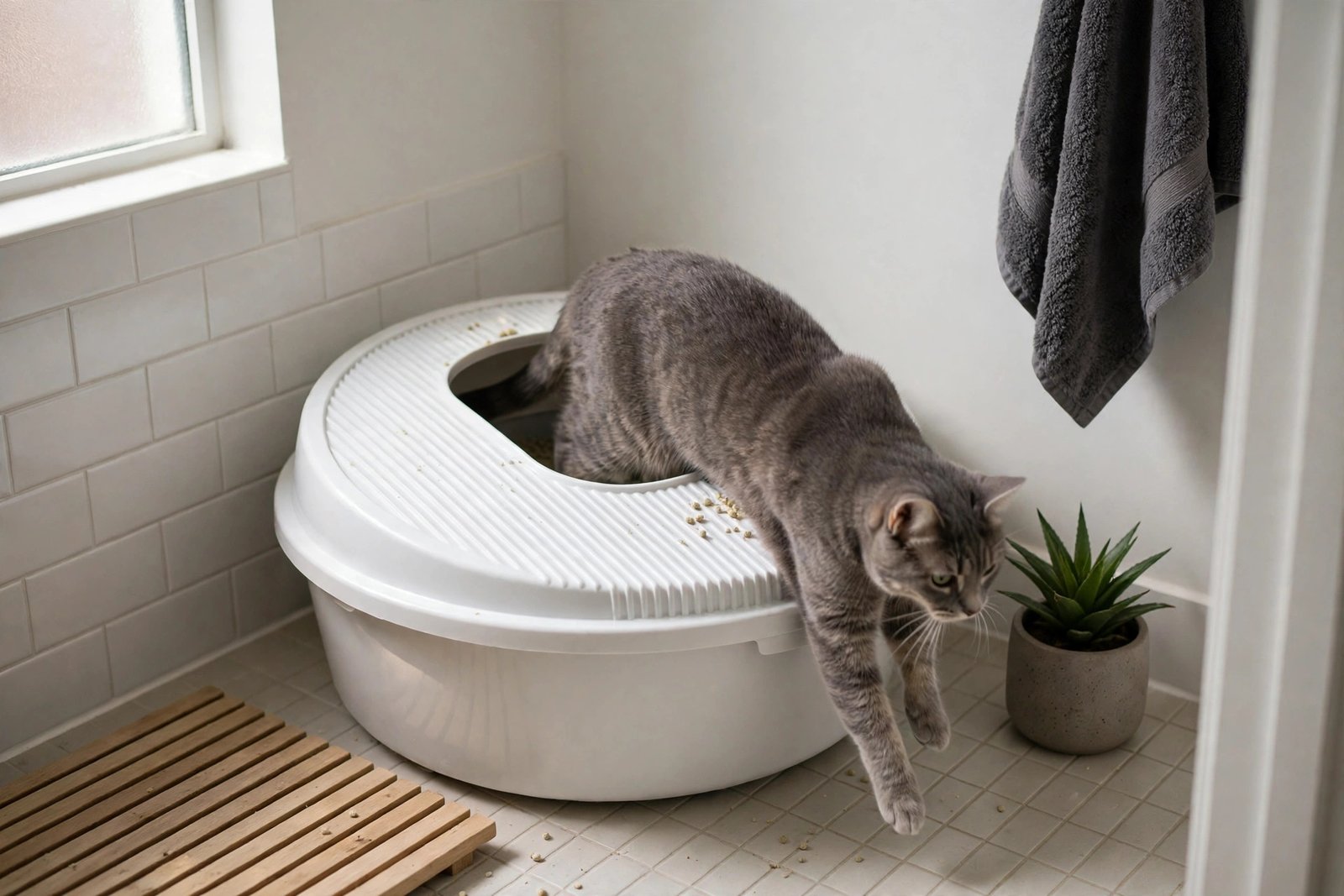
The best top entry litter box for small spaces solves the one litter problem apartments amplify: tracking. In a 500-square-foot apartment, every stray grain of litter ends up underfoot, on the sofa, or in your bed. Top-entry boxes attack the problem with geometry — the cat jumps in and out through the top, and the lid’s grooved or perforated surface catches litter off the paws before it reaches the floor. It is a simple, mechanical idea, and it works: the lid is the doormat. So we researched seven top-entry models on Chewy and Petco with the filter we always use: verified listing details first, paraphrased buyer-review evidence second, brand marketing last. And because this format has a genuine exclusion zone — top-entry is flat-out wrong for some cats — that exclusion is stated up front and carried through every pick. No testing claims, no paid placements, just the honest comparison.
Why top-entry wins in small spaces
The tracking math is simple. A front-entry box lets the cat walk straight out, and litter clinging to the paws goes wherever the cat goes. A top-entry box forces a pause: the cat stands on the lid for a moment before and after, and the lid’s ridges or perforations knock litter loose right there. In a small apartment, where the box often sits in the bathroom or a hallway, that pause is worth more than any litter mat. There is a second apartment benefit nobody markets: dogs. A top-entry box is functionally dog-proof — most dogs will not jump into a hooded box to raid it. The trade-offs are real and stated plainly in the buying guide: the format excludes seniors, arthritic cats, and young kittens, and heavy cats can stress some lids. If your cat qualifies, it is the lowest-tracking format you can buy.
For help choosing a box that fits a tight washroom, see our guide to bathroom placement.
Quick picks
| Award | Product | Why it stands out | Check Price |
|---|---|---|---|
| Best overall | IRIS USA Large Round Top Entry Cat Litter Box & Scoop, Gray/White | Grooved lid traps tracking, round shape fits corners, scoop hangs on the lid | Check Price on Chewy |
| Best premium | Modkat Cat Litter Box, X-Large, Black | Seamless base, reusable liners, 30-lb lid capacity — the engineered option | Check Price on Chewy |
| Best value | FRISCO Top Entry Cat Litter Box, Extra Large, Gray, 23-in | House-brand value with a 33-lb lid capacity and a dog-proofing angle | Check Price on Chewy |
| Best compact | Catit PIXI Top Entry Cat Litter Box, White | Perforated grid lid, seamless leak-proof base, smallest footprint here | View at Petco |
| Best budget | Petmate Top Entry Litter Pan for Cats | Made in USA, 95% recycled plastic, hinged lid — the no-frills pick | View at Petco |
| Best self-cleaning | PetSafe ScoopFree 2nd Gen Top Entry Self-Cleaning Cat Litter Box | Automatic rake plus top-entry tracking control and a health-monitoring counter | View at Petco |
| Best front-opening lid | So Phresh Top-Entry Cat Litter Box, Tan | Tilting lid opens from the front for scooping — no lid-removal ritual | View at Petco |
Best overall: IRIS USA Large Round Top Entry Cat Litter Box & Scoop
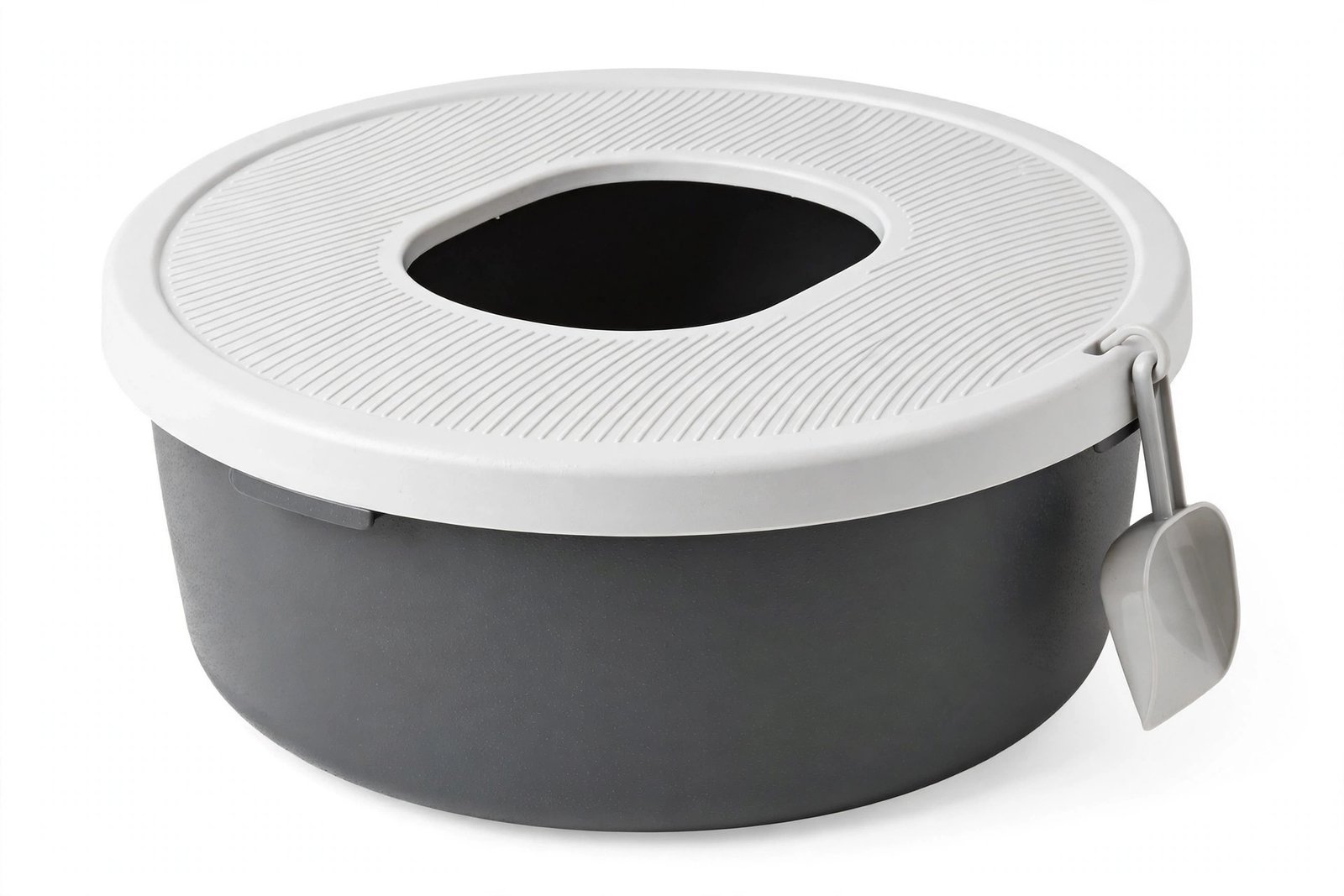
The IRIS earns the top slot because it nails the format’s two jobs at once: the grooved lid is a genuine litter trap, and the round shape is the most corner-friendly footprint on this list. The numbers, all from the Chewy listing: 20.5″ long by 14.75″ wide by 14.38″ tall, with a 9″ x 10.5″ top opening. The listing states Made in USA and BPA-free construction. Buyers report cats adopting it fast, and the scoop hanging on the lid is a small detail that matters in a small bathroom — no scoop lying on the counter. The listing’s rating count was not verified on the Gray/White variant page we link; note that the Black/White variant page shows 4.4★/951 ratings, which is a different colorway, not this one.
The honest drawback is the lid under load. Buyer reports include lid-collapse complaints from households with large or heavy cats — the lid is a plastic bridge, and it has a weight limit. If your cat is over about 15 pounds, this pick’s main mechanism is also its main risk. The 9″ x 10.5″ opening is fine for average cats but tight for large breeds. It is the best overall for typical apartment cats; it is not the pick for big ones.
Apartment scorecard: Footprint — 20.5 x 14.75 in (verified) — the round shape tucks into corners other boxes waste. Noise — n/a; no moving parts. Installation — none; unbox, add litter. Rental-friendly — yes; freestanding, moves room to room. Cleaning — the grooved lid traps litter by design but the grooves need a brush or shake to empty; wipe the smooth base. Best room — bathroom corner; the round footprint is made for tight corners.
Best premium: Modkat Cat Litter Box, X-Large
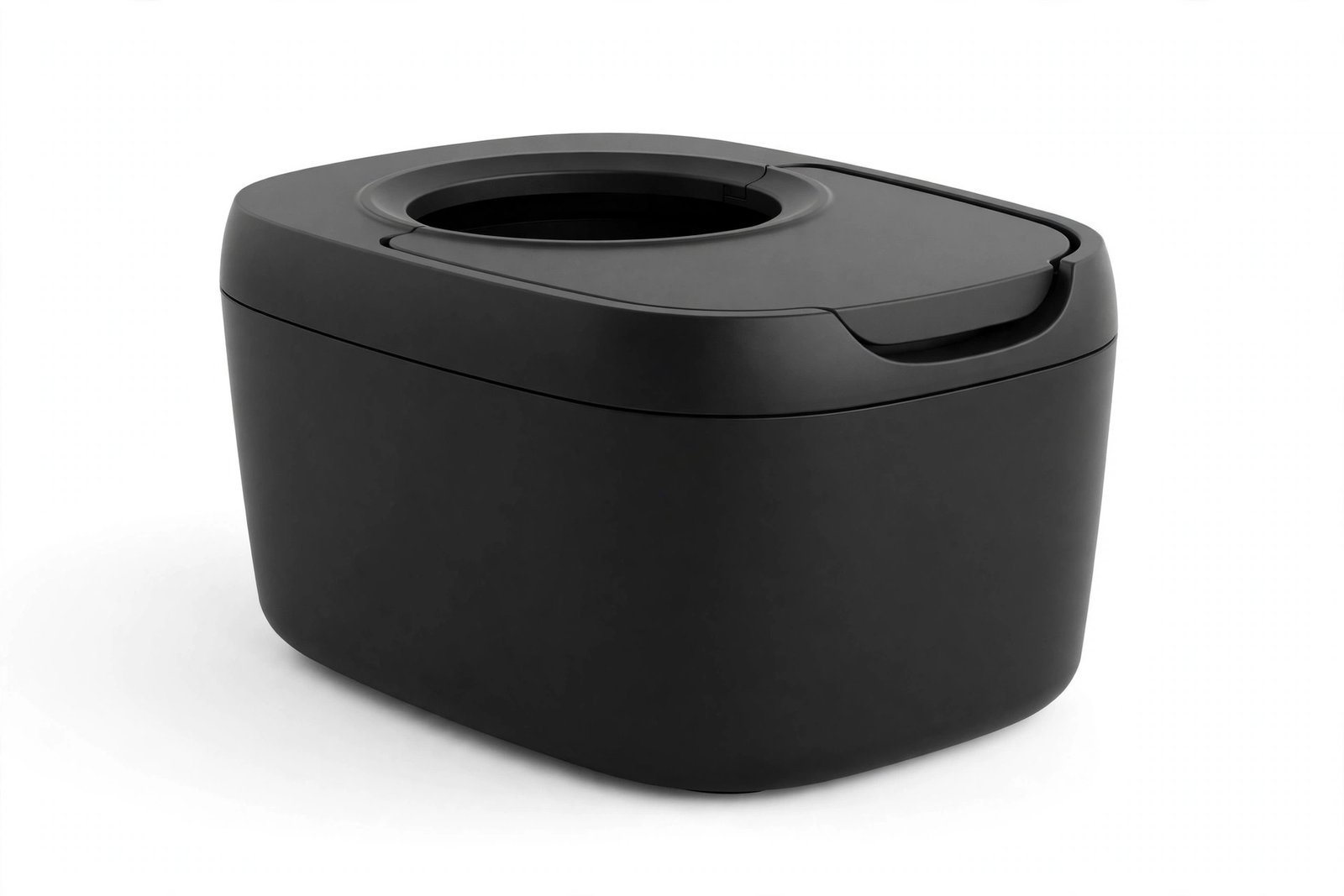
Modkat is the engineered option on this list, and the specs show it: 21.0 x 16.5 x 17.0 inches, a seamless base (no corner seams for grime to hide in), a swivel lid, reusable liners, and — the number that matters for big cats — a 30-pound lid capacity. The top-entry opening is 10.25 inches wide, per the Chewy listing. Where the IRIS asks you to trust the lid, the Modkat puts a number on it. The seamless base is the cleaning story: smooth interiors wipe down with none of the crevice scrubbing cheap boxes demand. Rating count was not verified on the Chewy listing; we make no rating claim for this pick.
The honest drawback is price — this is the premium pick because it costs like one. The reusable liners are also an ongoing expense to factor in; “reusable” means washable, not forever. And at 21 inches long, it is bigger than its premium minimalism suggests — measure before assuming it disappears into the bathroom. You are paying for the seamless base and the lid capacity; if your cat is average-sized and your budget is not premium, the IRIS does the same job for less.
Apartment scorecard: Footprint — 21.0 x 16.5 in (verified) — larger than it looks in photos; tape-measure first. Noise — n/a; swivel lid is the only moving part. Installation — minimal; liners fit the seamless base. Rental-friendly — yes; freestanding and furniture-grade looks. Cleaning — seamless base wipes clean; liners wash and reuse. Best room — visible spots; this is the one you do not hide.
Best value: FRISCO Top Entry Cat Litter Box, Extra Large
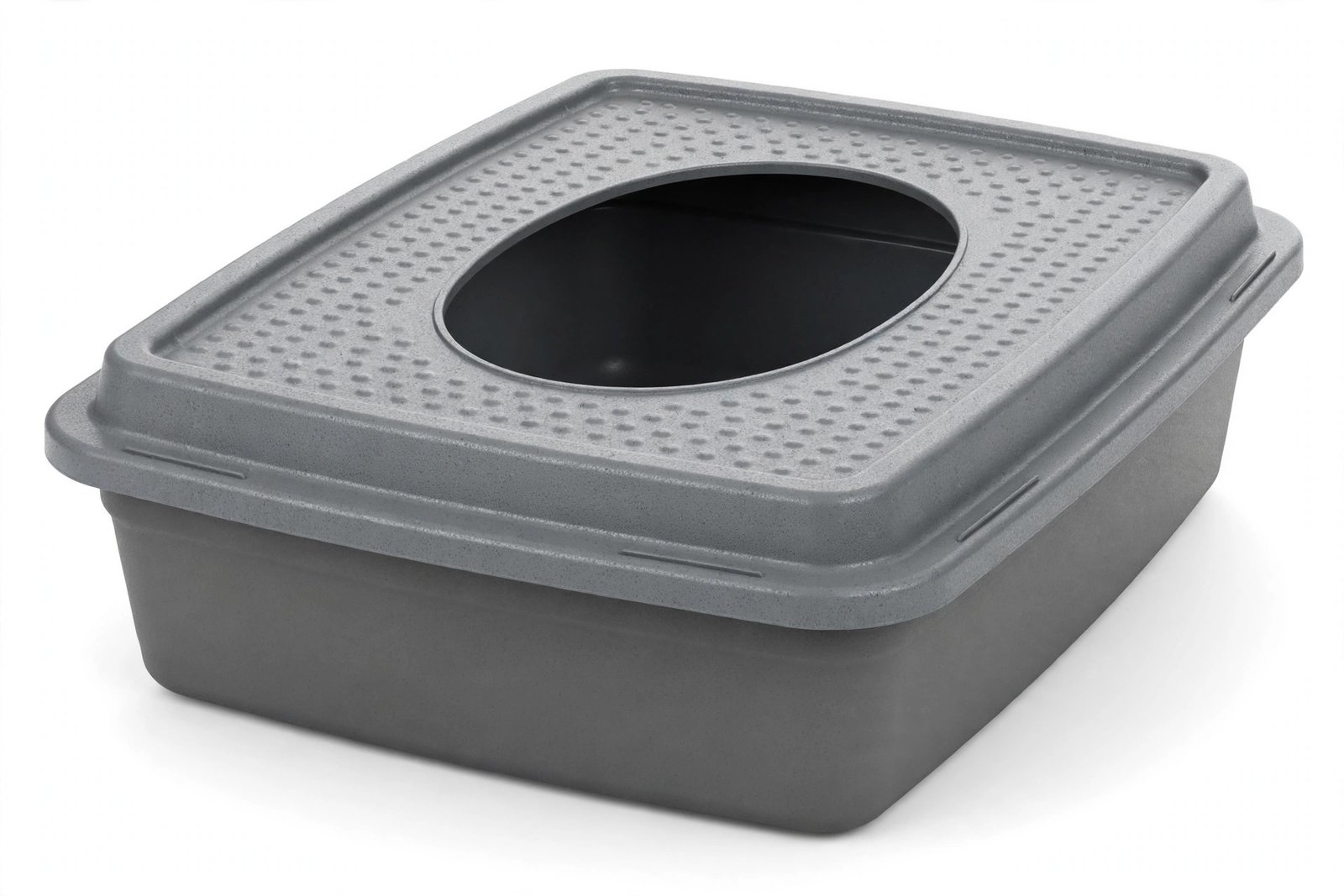
Chewy’s house brand is how you get the format for less, and the Frisco’s numbers are competitive: 23 inches of Extra Large box with a 33-pound lid capacity and BPA-free plastic per the Chewy listing. The textured lid is the tracking trap, and the 33-lb capacity — higher than the premium Modkat’s 30 — is the spec to check if your cat is on the heavier side. The dog-proofing angle belongs here too: top-entry is the format that keeps most dogs out of the litter, and the Frisco is the cheapest way onto that list. Rating count was not verified on the listing; we make no rating claim.
The honest drawback is the house-brand trade: fewer detailed buyer reviews to draw evidence from than the long-lived IRIS, and the styling is strictly utilitarian — this box will live in the bathroom, not the living room. The textured lid is functional but less refined than grooved or perforated designs; it catches litter, it does not look designed doing it. For the money, it is the value pick precisely because nothing about it is premium except the lid capacity.
Apartment scorecard: Footprint — 23-in Extra Large (verified) — the longest here; measure the wall it sits against. Noise — n/a; no moving parts. Installation — none. Rental-friendly — yes; freestanding, and the top-entry format is the dog-proofing story. Cleaning — textured lid shakes clean; smooth base wipes. Best room — bathroom or laundry; utilitarian looks suit utility rooms.
Best compact: Catit PIXI Top Entry Cat Litter Box
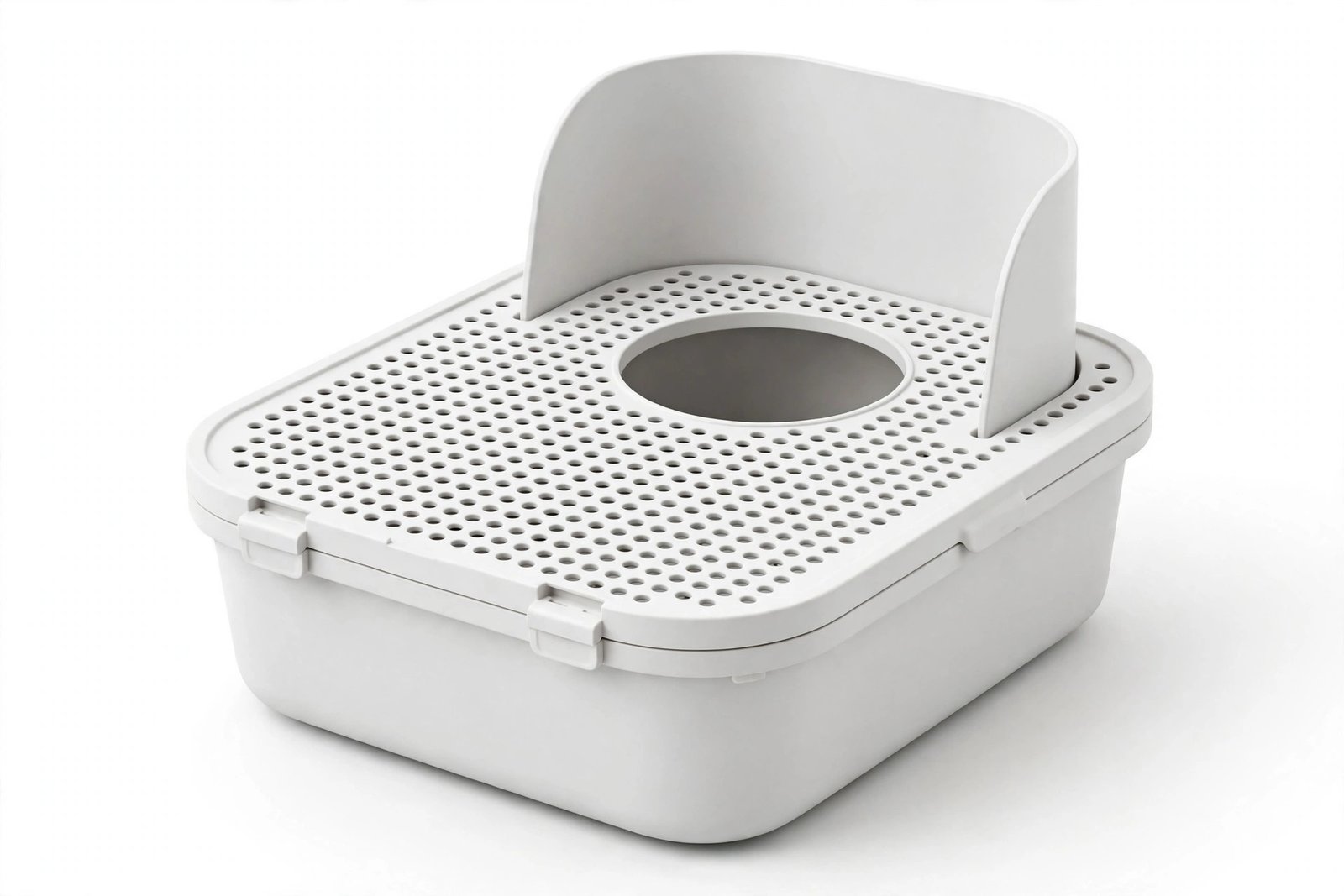
When the apartment is genuinely small, the PIXI is the footprint play: 20.4 x 16.1 inches per the Petco listing, the smallest base area on this list. The lid is a perforated grid — litter falls through the holes back into the box rather than sitting in grooves, which is the cleverest tracking design here. The listing notes a seamless leak-proof base, a swivel lid, and a back-shield exit guide that directs the cat’s exit across the grid. Rating count was not verified on the listing; we make no rating claim.
The honest drawback is the height-to-footprint ratio: 18.7 inches tall on a 20.4-inch base is a tall box for its footprint, which makes it visually dominant in a tiny bathroom. The perforated grid is brilliant when the cat exits across it and useless when the cat jumps clean over the lid — athletic cats can defeat the whole mechanism. And the compact base means compact interior; this is a one-average-cat box, not a big-cat or multi-cat box. Buy it for the smallest bathroom on this list; do not buy it for a large cat.
Apartment scorecard: Footprint — 20.4 x 16.1 in (verified) — smallest base here; height is 18.7 in, plan for visual bulk. Noise — n/a; swivel lid is the only moving part. Installation — none. Rental-friendly — yes; freestanding, smallest footprint. Cleaning — perforated grid shakes out; seamless base wipes clean. Best room — the tiniest bathroom or a closet nook; the perforated lid is the tracking story.
Best budget: Petmate Top Entry Litter Pan

The Petmate is the budget pick that stays honest: 20.3″ x 15.1″ x 15.2″ per the Petco listing, with a hinged lid, Made in USA construction, and 95% pre-consumer recycled plastic. It does the format’s core job — top-entry tracking reduction — with no premium features and no premium price. The hinged lid is the usability detail: it opens like a door instead of requiring a full lid lift-off, which makes scooping less of a production. Rating count was not verified on the listing; we make no rating claim.
The honest drawback is that budget shows. The design is utilitarian, the plastic is basic, and the hinged lid is convenient but less rigid than a full-rim lid — this is not the box for a heavy cat that stresses lids. The recycled-plastic story is nice, but it does not change the tracking or cleaning physics. It is the cheapest way to find out whether your cat accepts top-entry, which is a legitimate buying strategy: if the cat rejects the format, you have lost the least money on the experiment.
Apartment scorecard: Footprint — 20.3 x 15.1 in (verified) — compact and honest. Noise — n/a; hinged lid only. Installation — none. Rental-friendly — yes; freestanding, cheapest experiment on the list. Cleaning — basic plastic; wash on a schedule since plastic holds odor over time. Best room — bathroom; the utilitarian looks stay behind a door.
Best self-cleaning: PetSafe ScoopFree 2nd Gen Top Entry Self-Cleaning Cat Litter Box

This is the only pick on the list that scoops itself: the ScoopFree’s automatic rake runs on a timer after the cat exits, pushing waste into a covered trap, and the 2nd Gen adds a health counter that tracks usage — a genuinely useful signal for catching urinary changes early. It keeps the top-entry format, so you get the tracking control plus the automation. The numbers from the Petco listing: 20.375″ x 11.68″ x 28″, 19.2 pounds. It uses crystal litter only, with disposable trays. Rating count was not verified on the listing; we make no rating claim.
The honest drawbacks are the subscription-shaped ones. Disposable trays are an ongoing cost that dwarfs the box’s price over a year — price the trays before you buy the box, not after. Crystal litter is the only option, so cats that reject crystals reject this box. And 28 inches tall makes it the tallest box here by a wide margin — it is a piece of furniture, and it needs a real corner. The health counter is useful, but it is not a vet; it flags changes, it does not diagnose them. Buy it for the automation, budget for the trays, measure for the height.
Apartment scorecard: Footprint — 20.375 x 11.68 in base, 28 in tall (verified) — smallest base, tallest box; plan vertical space. Noise — the rake cycle is the only powered pick here; runs briefly on a timer. Installation — set the timer, load a tray; no tools. Rental-friendly — yes; freestanding, though 28 in tall needs a real corner. Cleaning — swap disposable trays on schedule; wipe the rake. Best room — laundry nook or a dedicated corner; the automation earns its floor space.
Best front-opening lid: So Phresh Top-Entry Cat Litter Box

The So Phresh’s trick is the tilting lid that opens from the front: you get scoop access without the full lid-removal ritual that makes some top-entry boxes annoying to clean. Per the Petco listing: 23.2″ L x 15.4″ W x 15″ H, a ridged lid for tracking control, and a polished interior that wipes clean. It is the usability pick — the box for the owner who will actually scoop daily because scooping is easy, and daily scooping beats any design feature. Rating count was not verified on the listing; we make no rating claim.
The honest drawback is the hybrid compromise. A lid designed to tilt open easily is a lid with more flex than a fixed rim — and the top-entry format’s lid rigidity is what holds heavy cats. The ridged lid catches tracking, but the tilting seam is one more place litter collects. And at 23.2 inches long, it is the longest box here alongside the Frisco — the scooping convenience comes with a real footprint. It is the best top-entry box for the reluctant scooper; it is not the sturdiest lid here.
Apartment scorecard: Footprint — 23.2 x 15.4 in (verified) — the longest here; needs a real wall. Noise — n/a; tilting lid only. Installation — none. Rental-friendly — yes; freestanding, and easy scooping means consistent cleaning. Cleaning — tilting lid gives full scoop access; polished interior wipes clean. Best room — bathroom; wherever the daily scoop happens.
How we picked
We researched current Chewy and Petco listings for top-entry litter boxes and compared verified listing details against paraphrased buyer-review language. The first filter was the format’s real job: tracking control in small spaces. Picks had to show a credible lid mechanism — grooves, perforation, ridges, or texture — that catches litter off the paws, with dimensions verified from the listing. The second filter was the honest exclusion: top-entry is wrong for seniors, arthritic cats, and kittens under about six months, so the picks are ranked for the cats the format actually suits, and the exclusion is stated in every relevant section rather than buried. The third filter was the lid-load question: heavy cats stress lids, so lid capacity is stated where the listing gives it and flagged where it does not. Where a listing did not state a spec — ratings, mostly — we say so rather than inventing it. No brand paid for placement, none of these picks is sponsored, and we did not lab-test any of these boxes.
Buying guide: the senior-cat rule, lid design, and the transition
The senior-cat rule, stated first. Top-entry boxes require the cat to jump in and out through the top. That excludes senior cats, arthritic cats, cats recovering from injury, and kittens under about six months — for them, jumping in and out of a box is pain or risk, not exercise. This is not a product defect; it is the format. If your cat is aging into stiffness, a top-entry box you love today becomes the wrong box in two years — plan for that transition now, or buy the front-entry format instead. Our comparison of top entry vs front entry litter boxes for apartments covers the decision in full.
Lid design is the whole purchase. The lid is not a cover; it is the litter trap. Grooved lids (IRIS) catch litter in ridges you shake out; perforated grids (Catit PIXI) drop litter back through holes; textured lids (Frisco) are the basic version of the same idea. Whatever the design, it only works if the cat pauses on the lid — cats that jump clean over it defeat the mechanism, and no lid design survives that. Watch your cat’s exit style for a week; if it vaults the lid, the format’s main benefit is gone.
Footprint versus interior space. Small apartments need the box’s outside numbers, but the cat needs the inside ones. A 20-inch box with thick walls and a small opening gives the cat less room than a 20-inch box with thin walls. The top opening size is the number that matters most for the cat: 9″ x 10.5″ (IRIS) is fine for average cats, 10.25″ wide (Modkat) suits larger ones. If your cat is over 15 pounds, the lid-collapse reports on the IRIS are your warning — buy on lid capacity (Modkat 30 lb, Frisco 33 lb), not on footprint.
The transition protocol for lid-skeptical cats. Some cats look at a top-entry box and refuse. The protocol that works: leave the lid OFF for the first few days so it is just an open box, then place the lid beside the box for a day, then put it on. Use the same litter the cat already knows — do not change the box and the litter in the same week. Most cats accept it within a week; a cat that still refuses after a fair trial is telling you the format is wrong for it, and no transition trick overrides that.
Frequently asked questions
Will my cat actually use a top-entry litter box?
Most healthy adult cats do, usually within a few days to a week. The transition protocol above — lid off first, then lid beside, then lid on, same litter throughout — is what the buyer reports that succeed have in common. Kittens under about six months, seniors, and arthritic cats are the real refusals, and for them it is not stubbornness, it is the jumping. If your cat is in one of those groups, do not buy a top-entry box hoping it adapts.
Is top-entry better for odor?
Slightly, as a side effect — not as the point. The lid slows airflow out of the box, which contains odor the way any covered box does, but the format’s real win is tracking, not smell. If odor is your main problem, the lid helps less than scooping discipline and litter choice; our guide to reducing litter box smell in a small apartment covers what actually moves the needle.
For the most odor-proof option overall, a stainless steel litter box beats any plastic box, top-entry or not.
What if my cat is a senior?
Do not buy a top-entry box for a senior or arthritic cat. The jump in and out is the whole problem — it is painful for stiff joints and risky for cats with mobility issues. Choose a low-entry front-opening box instead; the tracking trade-off is real, but it is smaller than the pain trade-off. When a younger cat ages into stiffness, retire the top-entry box rather than watching the cat struggle.
Do top-entry boxes work for large cats?
They can, but buy on lid capacity, not footprint. The IRIS has buyer reports of lid collapse under heavy cats — that is your warning. The Modkat (30-lb lid capacity) and Frisco (33-lb lid capacity) put numbers on the lid’s strength, and the top opening width matters too: a 9″ x 10.5″ opening is tight for a large breed. Measure the cat against the opening, not just the room against the box.
How do you scoop a top-entry box?
Lift or remove the lid, scoop as normal. That is the format’s small daily tax — which is exactly why the So Phresh’s tilting front-opening lid earns its award: it removes the lift-off ritual. Whatever the box, scoop daily; a covered-format box concentrates odor faster than an open one when scooping slips, and in a small apartment you will notice by evening.
Do top-entry boxes really stop dogs from getting into the litter?
For most dogs, yes — that is the format’s unmarketed superpower. A dog that will happily raid a front-entry box usually will not jump into a hooded top-entry one. It is not a guarantee against a determined large dog, but for the small-to-medium dogs most apartments hold, top-entry is the simplest dog-proofing there is. If the dog is the problem you are actually solving, this format beats every front-entry deterrent.
Related reading
For the whole category, our best litter boxes for small apartments is the litter pillar this guide sits under. For the odor side of small-space litter life, see how to reduce litter box smell in a small apartment.
Last updated: October 19, 2026
Pingback: Top Entry vs Front Entry Litter Box for Apartments 2027
Pingback: Best Litter Box for Small Apartment: 8 Odor-Smart Picks 2027
Pingback: How to Choose Litter Box Small Apartment 2027: 7 Rules
Pingback: Best Litter Box for Small Bathroom 2027
Pingback: Best Covered Litter Box for Small Apartment Living 2027
Pingback: Best Cat Litter Disposal System for Apartments 2027
Pingback: Best Place to Put Litter Box in Small Apartment