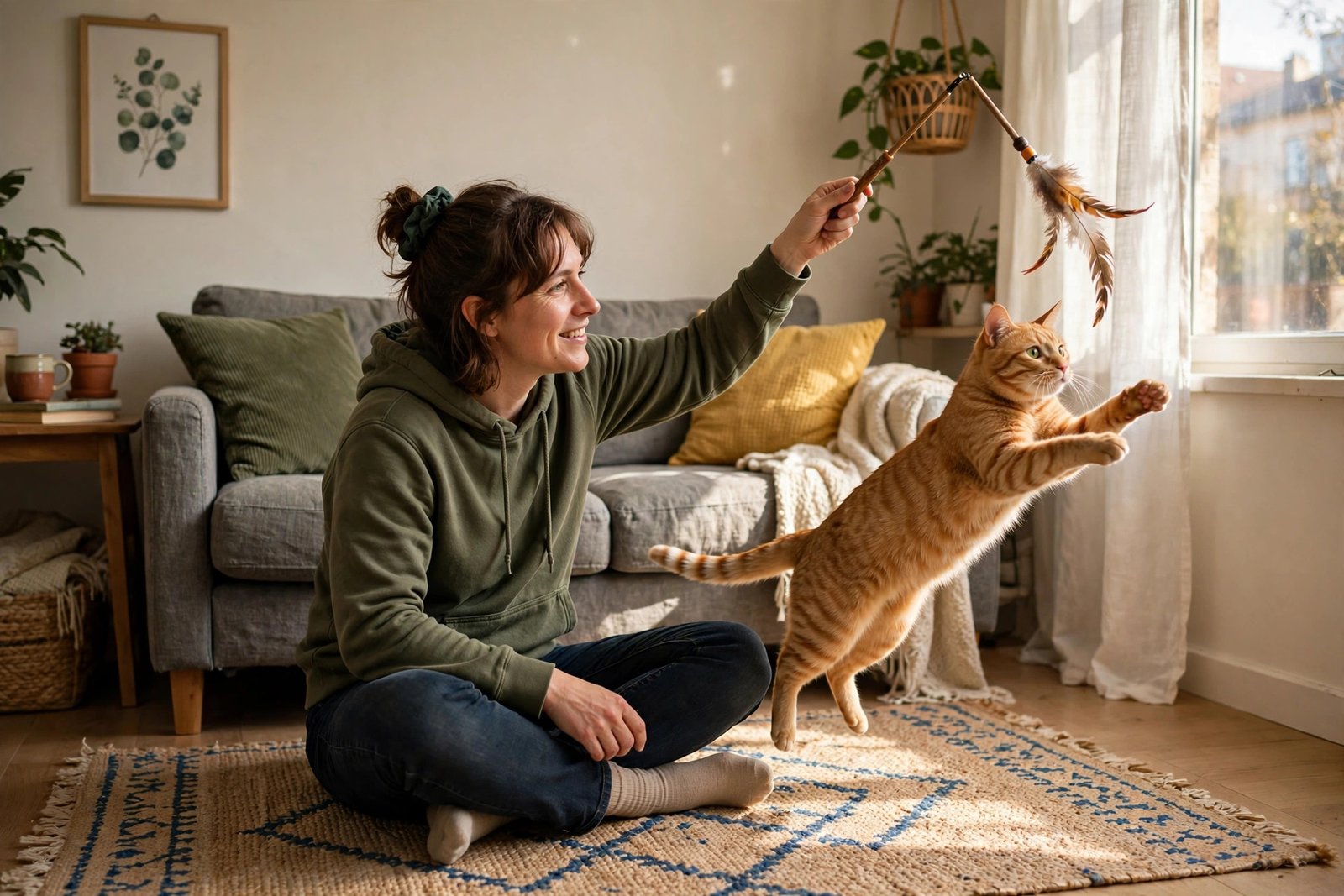
Learning how to play with your cat matters more in an apartment than it does in a house. An indoor cat in a 500-square-foot flat does not chase real prey, does not patrol a yard, and does not get the hundred tiny movement-puzzles a day that outdoor life provides. That makes you, with a feather wand in your hand for ten minutes, the single most important part of your cat’s physical and mental health. The good news: a small space is not the obstacle it looks like. Play in an apartment can be better play, because the routine is predictable, the space is manageable, and the cat’s attention never has far to wander. This guide is the routine: the prey-sequence structure that trainers and behaviorists teach, a ten-minute session broken down step by step, the best times of day for apartment life, seven small-space games that actually work, and the mistakes that quietly ruin the game. No product roundup here — just the method. When the routine calls for a tool, it calls for it by type (a feather wand, a crinkle toy), and our toy guides cover the specific picks.
Why play matters more in apartments
A bored indoor cat in a small apartment does not just nap extra. The boredom leaks out somewhere: dawn wake-up calls, ankle ambushes, furniture scratching, overeating, obsessive grooming. These are not behavior problems in the way we usually mean that phrase — they are energy and instinct with nowhere to go. Play is the outlet that converts that pressure into satisfaction, and it does two jobs at once. Physically, a real play session — running, jumping, pouncing — is exercise for an animal that was built to sprint in bursts. Mentally, chasing something that behaves like prey is the job cats are wired for; finishing a hunt (even a fake one) settles something in the feline brain that a stuffed mouse on the floor does not.
The apartment case is simple arithmetic. In a house, a cat’s day contains incidental activity: stairs, multiple rooms to patrol, windows in three directions, maybe other animals. In a studio or one-bedroom, the territory is small and the novelty is thin, so your deliberate play sessions carry a bigger share of the day’s stimulation. Ten focused minutes twice a day in a 400-square-foot apartment does more for a cat’s wellbeing than a pile of toys gathering dust in a house. The toys matter less than the schedule.
The prey sequence: stalk, chase, pounce, catch
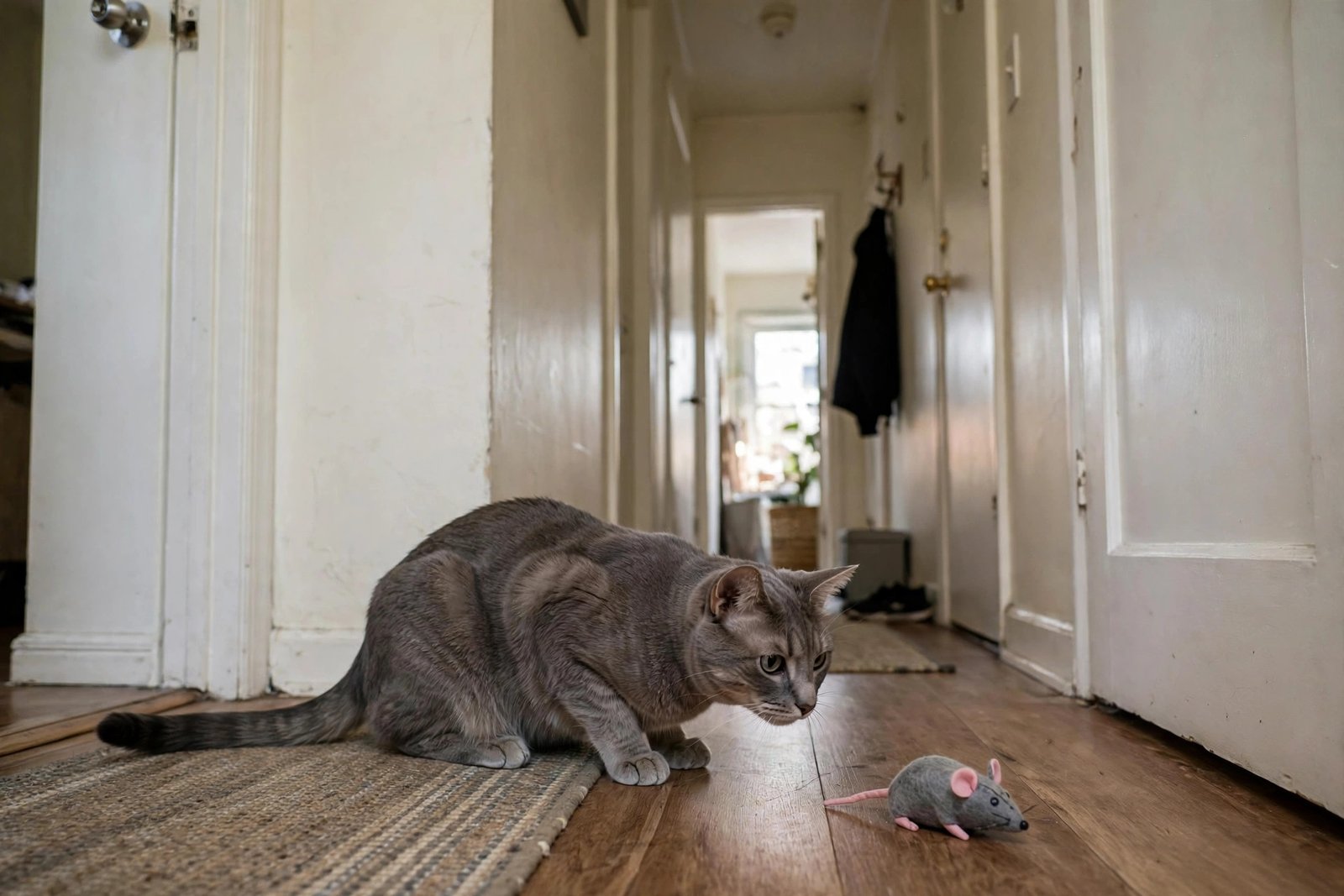
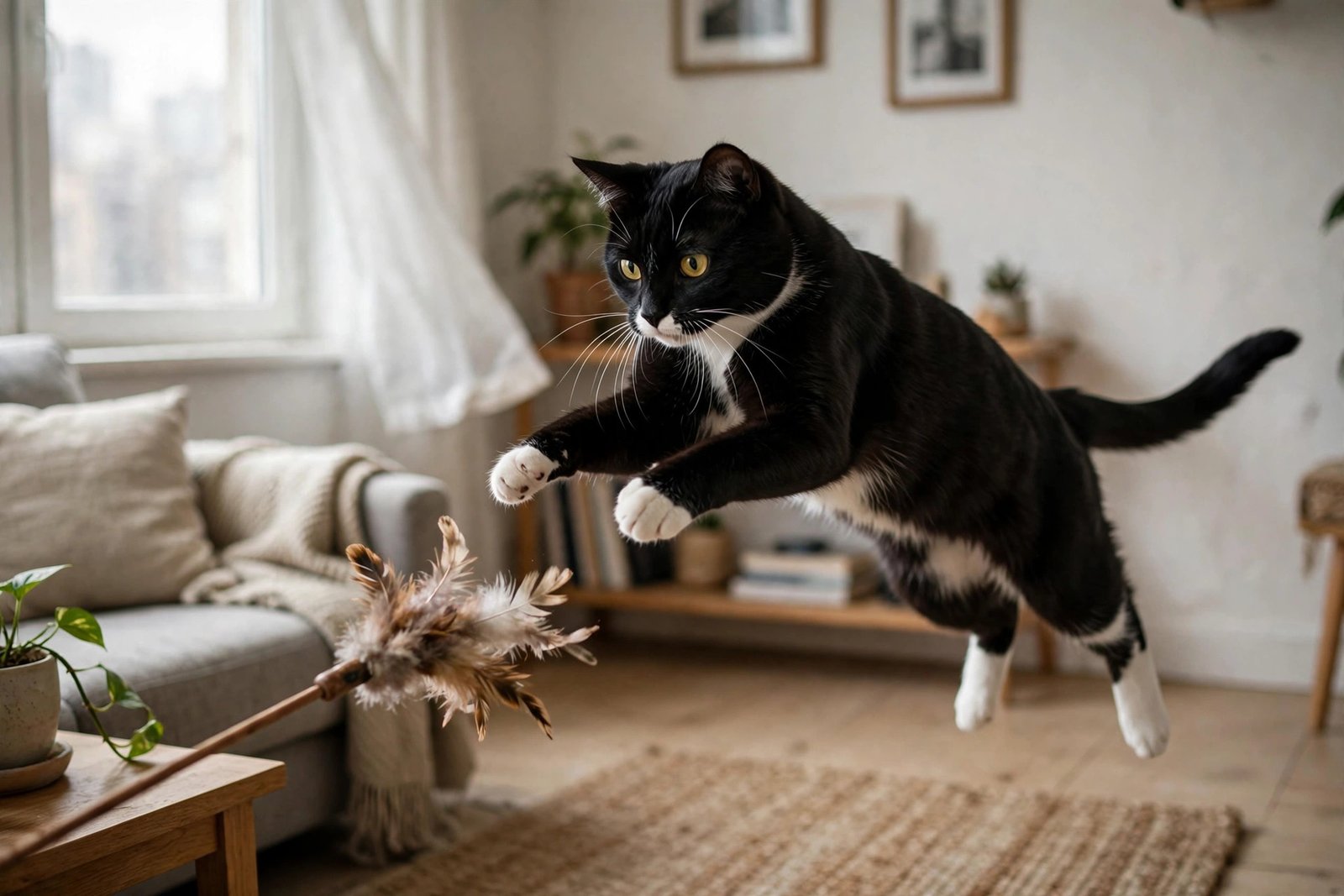
Good play mimics a hunt, and hunts have a structure. Behaviorists and trainers widely teach the prey sequence as the blueprint for play: the cat stalks, then chases, then pounces, then catches. You do not need to invent this or learn a creator’s special method — it is simply what happens when you move a toy the way prey moves. A feather wand dragged slowly across the floor in view of the cat is the stalk. Sudden faster movement away from the cat, darting behind a couch or around a corner, is the chase. The toy pausing, twitching, and the cat launching is the pounce. The cat grabbing the toy with paws and teeth is the catch — the part people skip, and the part that matters most.
The catch is the payoff the whole sequence builds toward. A cat that chases a laser dot or a wand tip endlessly, with no grab at the end, is running a hunt that never resolves. That is why laser pointers need a tangible catch at the end of the game — finish the session by landing the red dot on a treat, or switch to a physical toy the cat can grab. The frustration of the never-caught target is real and well documented; the fix is thirty seconds at the end of the session. Stalk, chase, pounce, catch — close the loop every time.
The 10-minute routine, step by step
Ten minutes is not an arbitrary number. It is roughly how long a cat’s real hunt would take, and it matches a cat’s attention span for sustained intensity. Here is the session, in four phases, using a feather wand as the example tool (our feather wand guide covers the picks and the full technique):
Minutes 0–2: the warm-up stalk. Drag the wand toy slowly across the floor in the cat’s line of sight. Let the cat watch. Do not make the toy attack the cat or bounce in its face — you are presenting prey, not starting a fight. Wait for the signs: the butt wiggle, the lowered crouch, the pupils widening. This patience phase is the difference between play the cat chose and play you imposed.
Minutes 2–6: the chase. Move the toy faster, away from the cat, in short darts with pauses. A prey animal does not run at constant speed; it freezes, then bolts. Let the toy hide behind chair legs and peek out. The pauses are as important as the sprints — they are when the cat re-locks on and the excitement builds.
Minutes 6–8: the pounce and catch. Let the cat catch the toy, several times. This is where many owners go wrong: they keep the toy just out of reach to keep the game going, and the cat’s frustration climbs. Let it grab, bite, and bunny-kick. The catch is the reward that makes the chase worth repeating tomorrow.
Minutes 8–10: the cool-down and the meal. Slow the toy down, let the energy fade, and end with one last easy catch. Then feed the cat — a small meal or a few treats right after play completes the hunt-eat-groom-sleep cycle that ends in a long nap. This is the whole secret of the pre-bed session: hunt, eat, sleep. It is also why this routine beats the 3 a.m. zoomies more reliably than any single toy does.
Best times to play: pre-work and pre-bed
Two sessions a day, ten minutes each, is the target — and the timing matters as much as the toy. The first session should be pre-work, before you leave for the day. A cat that has hunted, eaten, and settled is a cat that will nap for hours instead of redecorating the living room out of morning restlessness. This is also when automatic toys for while you’re at work earn their keep: a timed or motion-activated toy cannot replace the session, but it can provide the midday movement-puzzles that fill the gap until you are home.
The second session should be pre-bed, and this one solves the most complained-about problem in apartment cat life: the 3 a.m. sprint across the bed. Cats are crepuscular — wired for dawn and dusk activity — so a dusk session followed by a meal lines their instinct up with your sleep schedule instead of against it. Play, feed, then lights out. It does not work every night with every cat, but it is the single most effective anti-zoomies intervention that costs nothing and requires no product.
Small-space games that actually work
A small apartment is not a limitation for play — it is a design constraint, and some of the best games fit it perfectly. Seven that earn their place in a studio or one-bedroom:
1. Hallway fetch. The classic small-space game. A soft ball or a crumpled paper ball down a hallway is a straight-line chase with walls doing the containing. Hallways are the apartment’s one built-in play field.
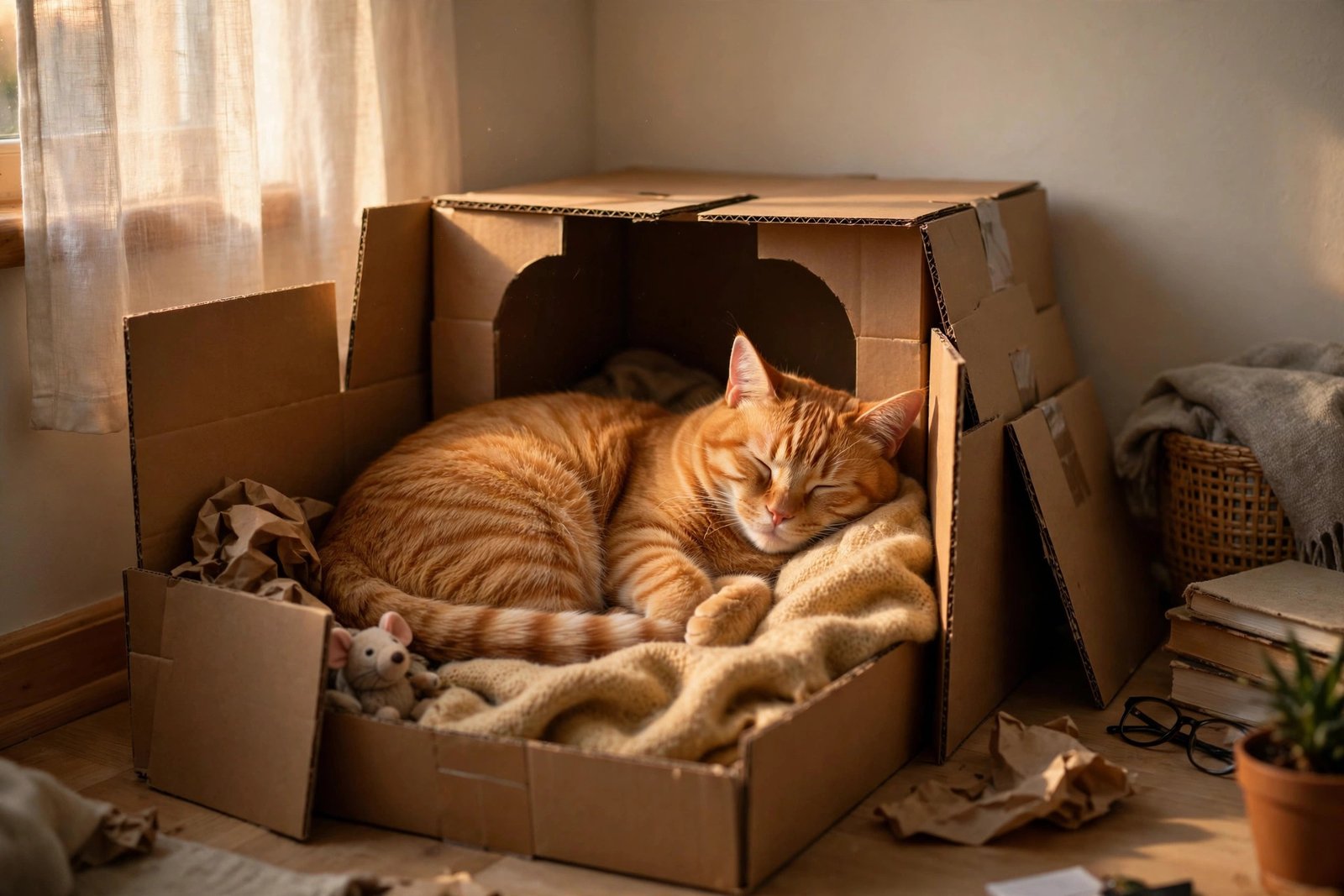
2. Box forts. Leave a few cardboard boxes out with holes cut in the sides. Drag a wand toy around the outside, let it disappear into the holes. The fort turns a ten-square-foot zone into a hunting ground with cover — exactly what the chase phase wants.
3. Stair chase, where available. If your building has a stairwell the cat is allowed in (or your flat has internal stairs), a feather wand going up the steps is serious cardio. Supervise, and skip this for arthritic or very young cats.
4. The doorframe dart. Crouch in a doorway and flick the wand toy around the frame so it appears and disappears. Doorframes are natural ambush points, and the cat will learn them — the anticipation is half the game.
5. Bathtub hockey. A ping-pong ball in a dry bathtub: the ball ricochets, the cat ricochets, the acoustics stay inside the bathroom. This is one for the quiet toys end of the day, not midnight.
6. Under-the-rug chase. Drag a wand under the edge of a rug or blanket so the shape of the prey bulges and moves underneath. The cat pounces the shape. This works absurdly well for the stalk and pounce phases, and it costs nothing.
7. The shopping-bag tunnel. A paper grocery bag on its side is a tunnel with crinkle acoustics built in. Roll a ball through it, or let the cat ambush a wand toy emerging from the other end. (Cut any handles first — a cat’s head and a bag handle are a bad combination.)
For a sturdier version of this game, see our picks for the best cat tunnel for indoor cats.
Two more for variety: hide-and-seek, where you toss a treat or toy into another room and let the cat hunt it down, and shadow boxing, where you wiggle your fingers under a blanket (never bare fingers as the target — more on that below) so the cat attacks the moving lump. The pattern across all nine: use the apartment’s furniture and geometry as the play structure. You do not need floor space; you need corners, covers, and corridors.
Mistakes that kill the game
Most cats do not refuse to play — their owners accidentally train them out of it. The common kills, stated plainly:
Laser-only sessions with no catch. The red dot is exciting for about three minutes, then it becomes a hunt with no prey. Used well, a laser is a chase-phase tool: finish with the dot landing on a treat the cat can eat, or transition to a grabbable toy. Used alone, it builds frustration, and some cats develop anxious light-chasing habits from it. The catch rule is not optional.
Hands as toys. Wrestling with your hand is adorable at eight weeks and a bite wound at eight months. Hands are never toys — not fingers under blankets as the target, not roughhousing. Once a cat learns that hands are prey, every hand that reaches to pet becomes a gamble. Always put a toy between your body and the cat’s claws.
Stopping mid-hunt. Ending the session when the cat is mid-chase because the phone rang leaves the sequence unresolved — the cat was promised a hunt and got an interruption. If you must stop early, do a fast catch: land the toy in front of the cat, let it grab, and end there. Never end on a miss.
Overlong sessions. Twenty minutes of escalating intensity is not better than ten — it is how cats get overstimulated and turn rough. A cat that suddenly bites the wand hand or goes flat-eared mid-session is not being bad; it is over threshold. Read the signals, wind down, and end with a catch.
Same toy, same move, every day. Prey that never changes its behavior stops being interesting. Rotate toys weekly, change your movement patterns, and retire the wand for a few days when the cat starts yawning at it. Rotation is covered in detail in our interactive toys guide and matters more than buying new toys constantly.
When your cat won’t play
A cat that ignores toys is usually giving you information, not being difficult. Start with the easy explanations: age (a ten-year-old cat plays less and differently than a ten-month-old — try slower, ground-level toys and shorter sessions), new-home adjustment (a cat in a new apartment may need a week or two before play feels safe; let it watch the toy without pressure), and the wrong toy for the cat (a chase-cat will not care about a puzzle feeder, and a pounce-cat will not care about a laser — try the other end of the prey sequence).
One vet note, and it matters: a cat that suddenly stops playing — a cat that used to chase the wand and now sits it out — may need a vet. A sharp drop in play is one of the earliest signs of pain, dental trouble, arthritis, or illness, because cats hide discomfort until it is hard to hide. Gradual slowing with age is normal. A cliff is not. If the change is sudden, book the appointment before you buy a new toy. For the slower signals of understimulation versus contentment, our guide to the signs your indoor cat is bored helps you read which one you are looking at.
Frequently asked questions
How long should play sessions be?
Ten minutes, twice a day, is the standard that matches a cat’s natural hunt cycle and attention span. Kittens may want shorter bursts more often (five minutes, three to four times a day). Seniors may want five slow minutes. The right length is the length where the cat stays engaged through the catch phase — if it quits at minute seven, your session is seven minutes. Consistency beats duration: two daily tens do more than one occasional thirty.
My cat ignores toys — why?
Usually one of four reasons: the toy is wrong for the cat’s play style (try a wand for chasers, a kicker for wrestlers, a puzzle for thinkers — our interactive toys guide breaks down the types), the movement is wrong (slow drag, not frantic waving), the cat is overstimulated or overtired, or — if the disinterest is sudden — something hurts. Try changing the toy and the movement first; if a formerly playful cat goes flat, read the vet note above.
Is it okay to play with my cat before bed?
It is the best time, done right. A pre-bed session followed by a small meal completes the hunt-eat-groom-sleep cycle and is the most reliable fix for 3 a.m. zoomies. The mistake is playing in bed or right as you lie down — that teaches the cat that the bed is the arena. Play in the living room, feed, then head to bed yourself. The cat should be winding down, not winding up.
Are laser pointers bad for cats?
Not inherently — badly used, yes. The problem is never the laser itself; it is the unresolved hunt. A laser session must end with a tangible catch: land the dot on a treat the cat can eat, or finish with a physical toy it can grab. Never shine it in the cat’s eyes, and watch for obsessive light-chasing behavior (staring at reflections, chasing shadows long after the session) — if you see it, retire the laser and switch to grabbable toys.
Can I play with my cat too much?
Overstimulation is the real risk, not overexercise. Signs you have gone too long: the cat’s play turns rough, ears flatten, the tail starts lashing, or it suddenly bites the toy hand. End every session on a calm note — slow the toy, one last easy catch, then food. Two tens a day is plenty for most adult cats; kittens set their own pace with shorter bursts.
Do I need expensive toys for a good play routine?
No. The routine is the product, and the best tools in it are a feather wand, a crumpled paper ball, a cardboard box, and a hallway. Expensive toys can add variety — motion-activated ones have a real role while you are at work — but no toy replaces ten minutes of you moving something like prey. Buy toys to rotate variety into the schedule, not to replace the schedule.
Related reading
Go deeper on the tools and the technique: our feather wand guide is the technique deep-dive for the routine above; interactive toys for indoor cats is the enrichment pillar for the whole category; automatic toys for while you’re at work covers the midday gap; quiet toys for thin-walled apartments keeps the neighbors happy; and the boredom-signs guide helps you read whether the routine is working. Our catnip, kitten, and crinkle guides pair with this routine.
Last updated: October 16, 2026
Pingback: Best Feather Wand Toys for Cats 2027
Pingback: Best Cat Tunnel for Indoor Cats 2027 - Velvnox
Pingback: Best Cat Carrier for Apartment Living 2027
Pingback: Best Interactive Cat Toys for Indoor Cats 2027