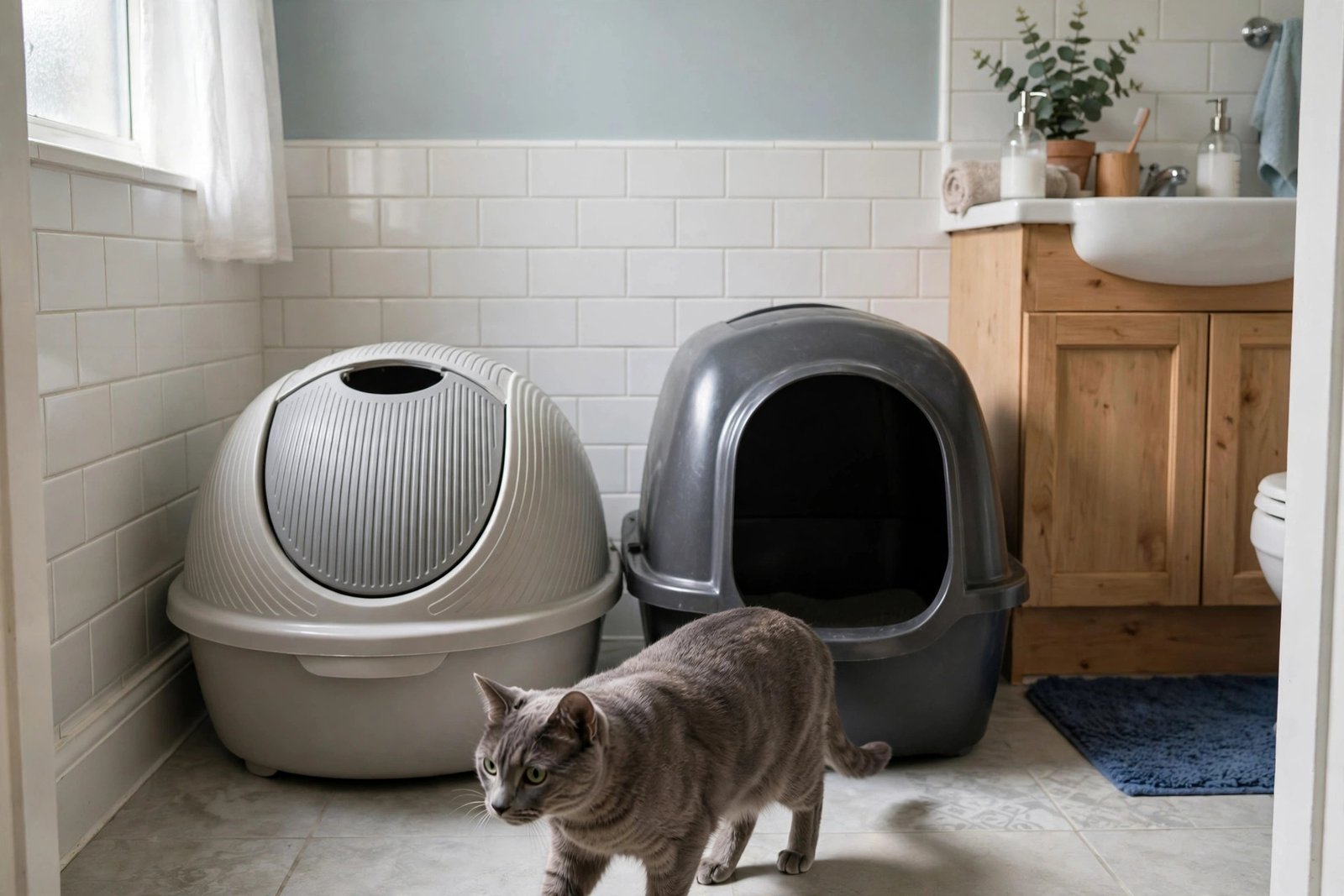
The top entry vs front entry litter box question is really two questions wearing one trench coat: which keeps the apartment cleaner, and which will your cat actually use. The answers point in different directions, and that tension is the whole article. Top-entry wins on tracking — the lid catches litter off the paws — but it excludes seniors, arthritic cats, and kittens, and some cats simply refuse the lid. Front-entry wins on accessibility — every cat can walk in — but it surrenders the tracking fight at the door. Here is the one-paragraph verdict, then the full framework: choose top-entry if your cat is a healthy adult and tracking drives you mad; choose front-entry if your cat is senior, arthritic, very young, very large, or lid-skeptical. Everything below is the evidence for that sentence. No testing claims, no paid placements — this is the decision guide our top-entry rankings for small spaces points to.
The head-to-head comparison
| Factor | Top entry | Front entry |
|---|---|---|
| Tracking control | Best in class — the lid is a litter trap; the cat pauses on it exiting | Weakest — the cat walks straight out and litter goes with it; needs a mat |
| Odor containment | Good — the lid slows airflow like a cover | Covered front-entry is comparable; open front-entry ventilates (and smells) more |
| Accessibility | Poor for some cats — requires jumping in and out | Best — walk in, walk out; suits every age and mobility level |
| Footprint | Needs headroom above for the jump; round models fit corners well | Needs door-swing clearance in front; low profile fits under things |
| Cleaning ease | Lid removal for scooping (unless tilting-lid design); lid grooves need shaking out | Direct scoop access; simplest daily routine |
| Cat acceptance | Most healthy adults accept within a week; some refuse outright | Near-universal — the format cats evolved with, roughly speaking |
| Dog-proofing | Excellent — most dogs will not jump into a hooded box | Poor — an open invitation unless the box is gated or elevated |
Top entry: strengths and honest limits
The strength is the tracking math, and it is real: the lid forces a pause on exit, and grooved, perforated, or ridged lids strip litter off the paws at that pause. In a small apartment, where the box is never far from the bed or sofa, that is the single highest-impact design choice available. The secondary strengths: the lid contains odor the way any cover does, and the format is functionally dog-proof for most household dogs — the unmarketed superpower. The honest limits: the jump excludes seniors, arthritic cats, post-surgery cats, and kittens under about six months — for them it is pain or risk, not exercise. Heavy cats stress lids (buyer reports of lid collapse exist — buy on lid capacity, not footprint). Some cats refuse the lid on principle, and no transition protocol overrides a genuine refusal. And scooping means lid handling unless you buy a tilting-lid design.
Front entry: strengths and honest limits
The strength is universality: every cat — kitten, adult, senior, arthritic, post-surgery, large breed — can walk into a front-entry box. There is no jump, no lid to negotiate, no acceptance gamble. Scooping is direct: open the door or reach in, no lid ritual. The honest limits: tracking is the format’s open wound — the cat walks straight out and the litter goes with it, which is why front-entry boxes in apartments live or die by their litter mat. Odor containment depends entirely on whether the box is covered; an open front-entry pan ventilates freely, which in a studio is a smell commitment. And dog-proofing is poor — a front-entry box is an open invitation to a curious dog, so multi-pet homes need a gate, a door, or elevation as well. Front-entry is the accessible default; it just asks more of you on tracking and dogs.
Which suits your cat: the matcher
Kittens under ~6 months → front entry. They are still learning the box; do not add a jump to the lesson. Graduate to top-entry later if tracking bothers you.
Healthy adults, vigorous diggers → top entry. This is the format’s home turf: the cat can jump, the digging stays contained, the lid earns its keep on tracking. If the cat is over ~15 lbs, buy on lid capacity (30+ lb rated lids exist).
Seniors, arthritic cats, limited mobility → front entry, low sides. Non-negotiable. The jump is pain. When a younger cat ages into stiffness, retire the top-entry box — do not watch the cat struggle because the box was expensive.
Large breeds → front entry, or top-entry only with verified lid capacity. The opening must fit the cat and the lid must hold the cat. A 9″ x 10.5″ opening is tight for a big cat; measure the cat, not just the room.
Multi-pet homes with a dog → top entry has the edge. The dog-proofing is the tiebreaker when the cat qualifies for the format. If the cat does not qualify, front-entry plus a baby gate or door barrier is the honest fallback.
Lid-skeptical cats → front entry. Some cats look at a top-entry box and refuse, and a week of fair transition effort is the limit of what you should ask. Listen to the cat.
Can you switch styles? The transition protocol
Yes, in both directions, with one method. Front to top: place the new top-entry box next to the old box with the lid OFF for a few days — it is just an open box. Then rest the lid beside the box for a day so the cat investigates it. Then put the lid on. Use the same litter throughout; do not change the box and the litter in the same week. Most cats accept within a week. Top to front (the aging-cat transition): this direction is easy — put the front-entry box next to the top-entry one and let the cat discover the easier option; cats in stiffness figure this out fast. In both directions, keep both boxes available during the transition and remove the old one only when the new one is reliably used. A cat that avoids the new box after a fair trial is voting; count the vote.
Related reading
For the top-entry models ranked as products, see our best top entry litter boxes for small spaces. For choosing within the whole category, see how to choose a litter box for a small apartment, and for placement once you have decided, where to put the litter box in a small apartment.
Last updated: October 19, 2026
Pingback: How to Choose Litter Box Small Apartment 2027: 7 Rules
Pingback: Best Top Entry Litter Box for Small Spaces 2027