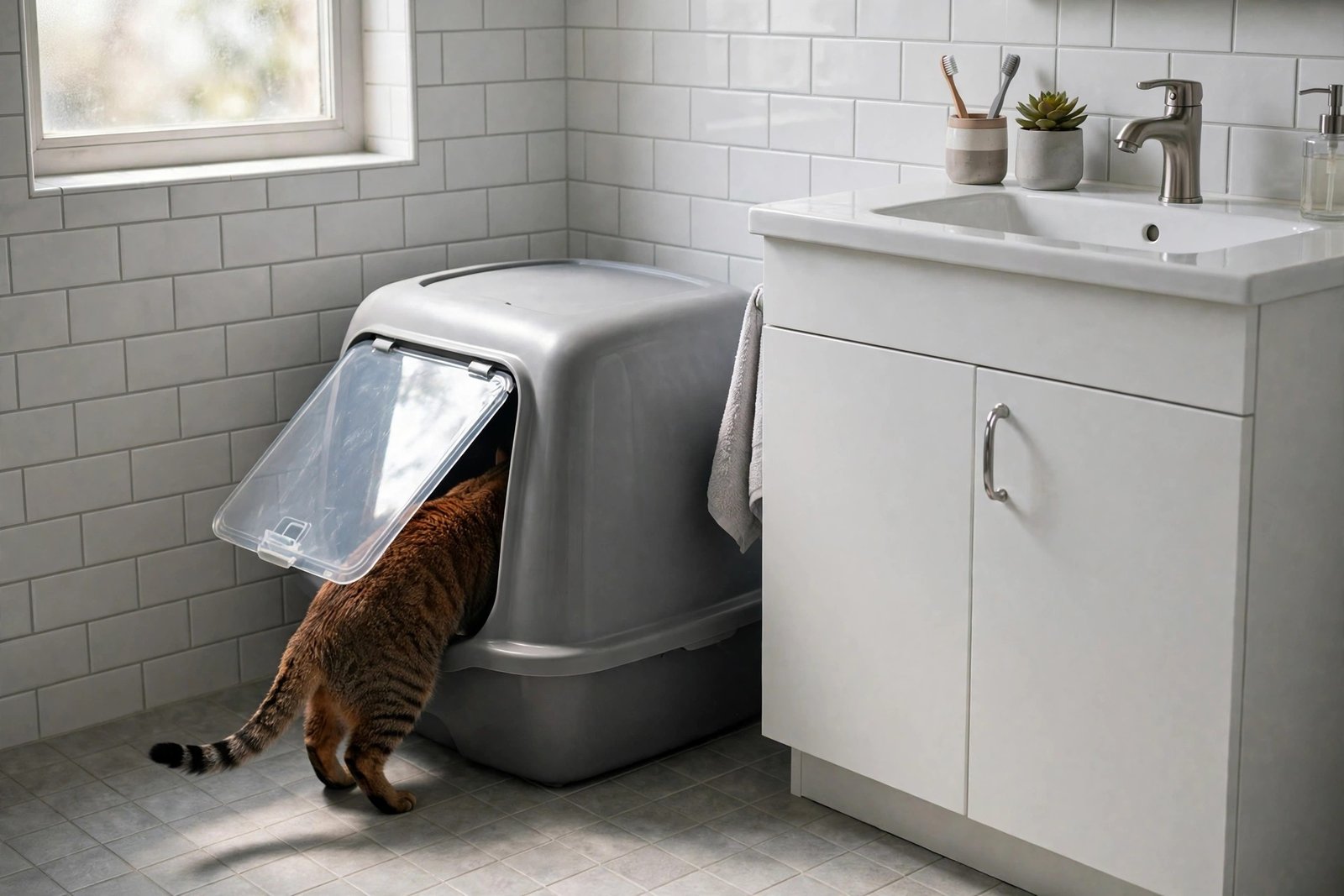
A covered litter box is the compromise most apartment cats end up with: the mess stays hidden, the litter stays (mostly) off the floor, and the box can sit in a bathroom or laundry corner without announcing itself. The catch is that hoods are not all honest about their size, and a hood changes where the smell goes rather than removing it. Finding the best covered litter box for small apartment life means checking the numbers the listing actually publishes — exterior footprint, the interior room left after the hood and walls take their share, entry height, and whether the door flap comes off — instead of trusting the word “jumbo” on the box.
So that is what this guide does. Every pick below is a hooded, manual pan verified on its Chewy or Petco listing on November 9, 2026: dimensions, entry details, filter type, ratings and the drawbacks owners report on those same listings. Top-entry models are covered in their own guide, automatic covered machines in theirs, and furniture enclosures in another — this list is hooded pans only, because that is the comparison you are actually making when floor space is tight.
Quick picks: the 7 covered boxes compared
| Award | Product | Why it stands out | Check Price |
|---|---|---|---|
| Best overall | Catit AiRSiFT Hooded Litter Pan, Jumbo — 4.5★/4,235 | Lift-up hood, bag anchor for one-handed scooping, carbon filter and a removable door on the deepest review base here. | Check Price on Chewy |
| Best XL corner | Nature’s Miracle Hooded Corner Multi-Cat Litter Box, X-Large — 4.6★/3,493 | A corner triangle that owners on the listing report fitting 20 lb-plus cats, with antimicrobial odor control built into the plastic. | Check Price on Chewy |
| Best for very large cats | Frisco Multi-Function Covered Cat Litter Box, 29-in, With Tray — 4.5★/2,121 | The biggest footprint here at just under 30 inches long, with high walls for sprayers — but read the tray measurements before you buy. | Check Price on Chewy |
| Best flip-top access | Van Ness EZ Clean Enclosed Cat Litter Box, Jumbo — 4.7★/191 | The front of the hood flips open for scooping and the maker publishes true interior dimensions — on the thinnest review base in this list. | Check Price on Chewy |
| Best for cats that refuse flaps | Nature’s Miracle Silver Oval Hooded Litter Box — 4.5★/1,977 | No door at all — a wide open doorway under the hood, a smooth oval interior with no corners for waste to cake into, and a flip-top front. | Check Price on Chewy |
| Best compact corner | Frisco Flip Top Hooded Corner Cat Litter Box, Large, 21-in — 4.1★/625 | A 21-inch corner wedge with the lowest step-in here at 5 inches and a removable door — sized for one average cat, not a big one. | Check Price on Chewy |
| Best low entry at Petco | So Phresh Jumbo Enclosed Cat Litter Box — 4.3★/641 | A low front and high back that suits both stiff seniors and overshooters, with a flap owners can take off — and a seam high pee-ers should know about. | View at Petco |
Best overall — Catit AiRSiFT Hooded Litter Pan, Jumbo

The Catit AiRSiFT is the default recommendation because it gets the daily mechanics right. The hood’s front section lifts up so you can scoop without unclipping the whole top, a built-in bag anchor holds a liner bag open and frees both hands, and the carbon-impregnated filter in the hood is there to trap odor at the vent rather than perfume it. The clear door is removable, which matters more than it sounds: plenty of cats accept a hood long before they accept pushing through a flap, and Chewy’s own Q&A on the listing puts the door opening at 10.4 inches tall, generous for a cat to duck through. It holds a 4.5-star average across 4,235 ratings on Chewy — the deepest review base in this guide — with the listing’s own feature scores running 84% positive for size and design and 80% for odor control.
The honest size note: the manufacturer’s published exterior is 22.4 x 19.7 inches and 18.3 inches tall, but owners reviewing on the listing who measured the pan itself put the usable base at about 22.4 x 18.3 inches, with pan walls tapering from roughly 9 inches at the back to 6 at the front. In a studio, plan for the full footprint on the floor and a cat-sized interior, not a jumbo one. The drawbacks are also on the listing: the swing door can scrape the rim and hang up — one owner reports a kitten that could not get back out until the door was propped — the sliding locks are fiddly with a liner in place, and the little carry-handle tabs are not built for hauling a full box. Treat it as a scoop-in-place box, not a carry-to-the-sink one.
Apartment Scorecard
- Footprint: 22.4 x 19.7 in exterior, 18.3 in tall (manufacturer’s dimensions); owners on the listing measure the usable pan a touch narrower, about 18.3 in wide
- Installation: None — the hood clips onto the pan with sliding locks; the door pops off if your cat refuses it
- Rental-friendly: Yes — freestanding, nothing fixed, no floor contact beyond the pan itself
- Cleaning: Flip the hood’s front section open for daily scooping, lift the whole hood off for a full change; the carbon filter swaps out on a schedule
- Best room: Laundry room or bathroom with a clear 2 ft run of floor
Best XL corner — Nature’s Miracle Hooded Corner Multi-Cat Litter Box, X-Large
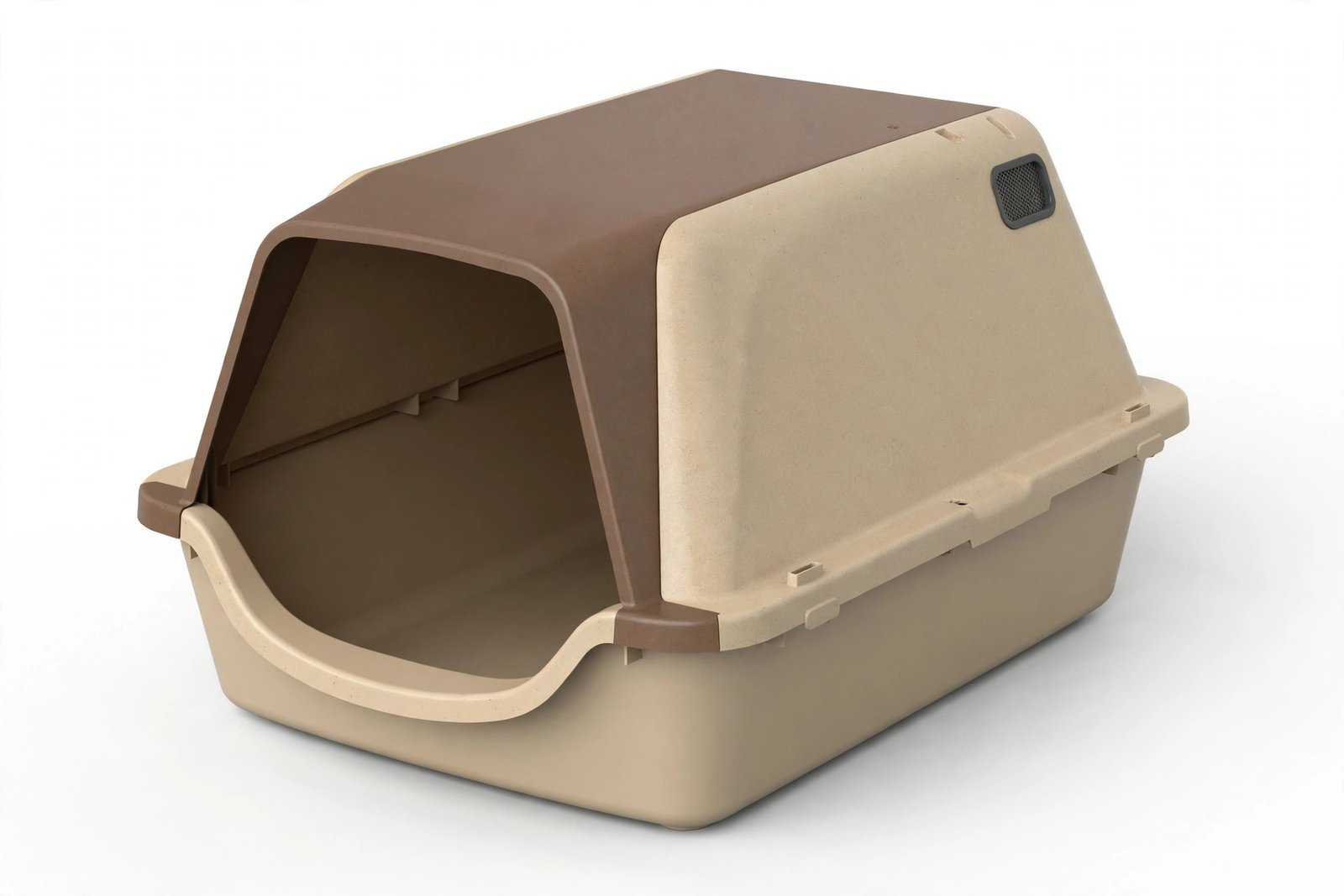
A corner is the one patch of apartment floor that is usually wasted, and this is the corner box built for genuinely big cats. The brand’s dimensions, given on its Petco listing, are 26 x 23 inches and 20 inches tall, and the fit evidence is on the Chewy listing’s Q&A: an owner who bought it specifically for its size reports a 22 lb cat and several cats around 20 lb using it in comfort. The odor system is built into the materials rather than hung on top — an antimicrobial treatment the brand calls Ionpure, aimed at bacteria odors and at stopping odor soaking into the plastic — plus a replaceable charcoal filter that the brand says lasts up to about three months and that the listing’s Q&A confirms is optional and unscented. It carries the highest rating in this guide, 4.6 stars across 3,493 ratings.
Two honest catches. First, there is no door: the entryway is open, so this hood contains spray and scatter from above and the sides, not tracking through the front. Second, the pan rim is low, and reviews of the listing document urine getting trapped around the rim where the hood meets the base — a real annoyance for a cat that pees high against the seam, and the triangular shape rules out standard liners and pads, so budget for the brand’s charcoal filters as the one recurring cost. If your cat is big, your corner is empty and your cat is not a seam-sprayer, this is the strongest corner option here.
Apartment Scorecard
- Footprint: 26 x 23 in, 20 in tall (brand’s dimensions on its Petco listing); a corner triangle, so it sits where rectangular boxes cannot
- Installation: None — the hood sets onto the pan; no door to fit or remove
- Rental-friendly: Yes — freestanding; the non-stick surface is a plus for keeping the corner itself clean
- Cleaning: Non-stick interior wipes down without litter caking; check the rim joint when you scoop, and swap the charcoal filter roughly every three months per the brand’s guidance
- Best room: Bathroom or laundry-room corner
Best for very large cats — Frisco Multi-Function Covered Cat Litter Box, 29-in, With Tray
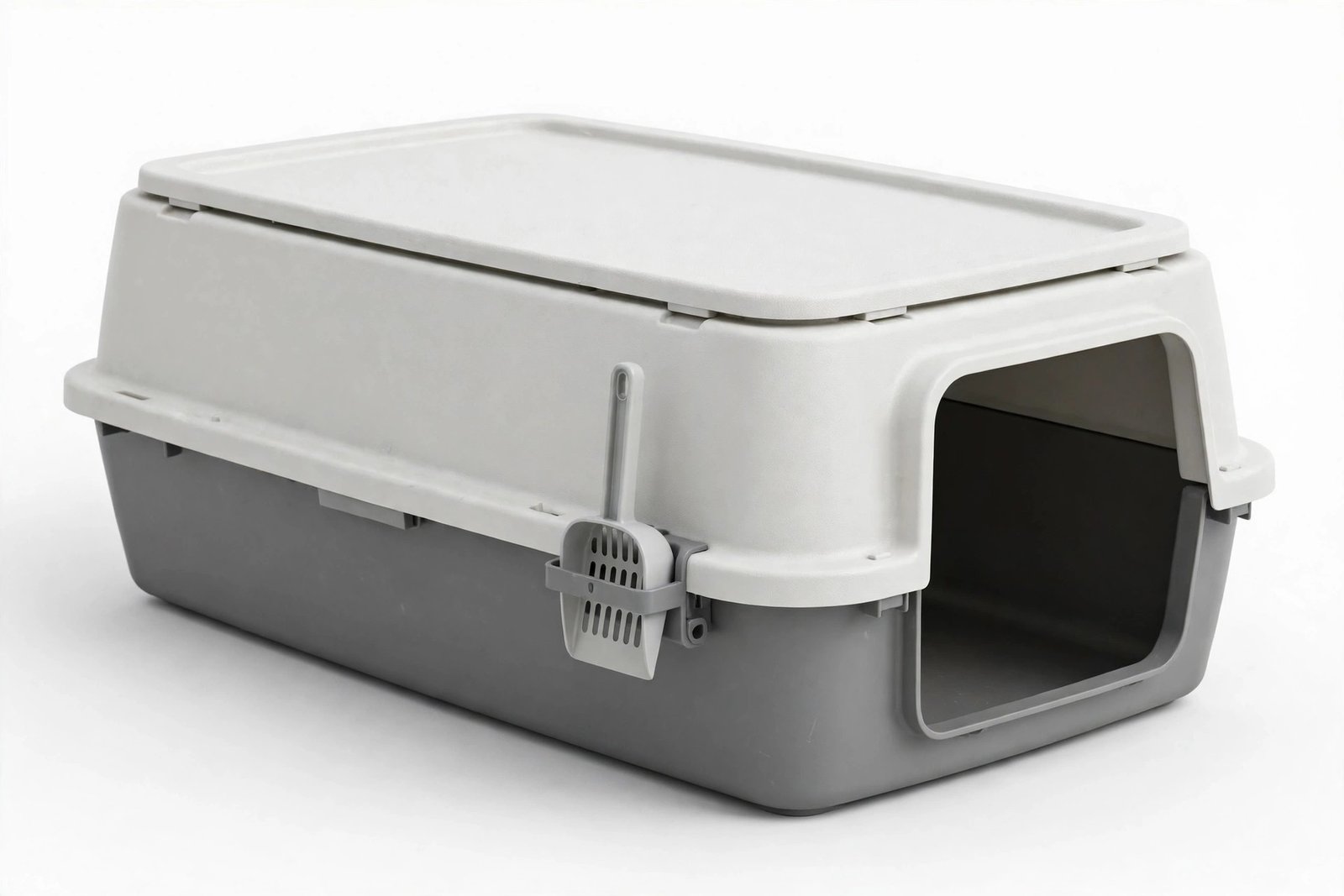
This is the biggest covered pan in the guide, and Chewy’s own FAQ on the listing gives the numbers plainly: 29.73 x 17.5 inches overall and 17.64 inches tall, with a wide, low-profile entrance at about a 6-inch threshold and no door to push through. The high walls are the point — they contain spraying and kicked litter that escape a standard pan — and the listing’s Q&A backs the size claim, with owners reporting very large cats fitting without a problem. It is BPA-free, made in the USA, needs no tools, and its listing feature scores are the strongest set here: 87% positive for both odor control and size and design across 2,121 ratings, for a 4.5-star average.
Now the part the product name glosses over: the removable inner tray measures only 14.5 x 18.2 inches. The tray is a convenience for carrying waste out, not the cat’s actual bathroom — the listing’s Q&A confirms the housing can be filled with litter and used as the box itself, and that is how many owners run it. Two more drawbacks from the listing’s reviews: the lid sits in grooves rather than on a hinge, so it can fall while you scoop unless you hold it or take it off, and the handle cutouts in the cover can let urine escape if your cat pees vertically against them — one owner taped over the cutouts. And measure your wall run first: 30 inches of covered box is a lot of laundry room.
Apartment Scorecard
- Footprint: 29.73 x 17.5 in, 17.64 in tall (listing FAQ); the optional inner tray is only 14.5 x 18.2 in — most cats will use the full base
- Installation: None — no tools; the lid lifts straight off, and the scoop and holder are included with the tray version
- Rental-friendly: Yes — freestanding; high walls protect the wall and floor behind it from spray
- Cleaning: Scoop the tray or the base; the cover’s molded interior dividers take a little more wiping than a smooth hood
- Best room: Laundry room or a pantry wall with a full 30 in run
Best flip-top access — Van Ness EZ Clean Enclosed Cat Litter Box, Jumbo
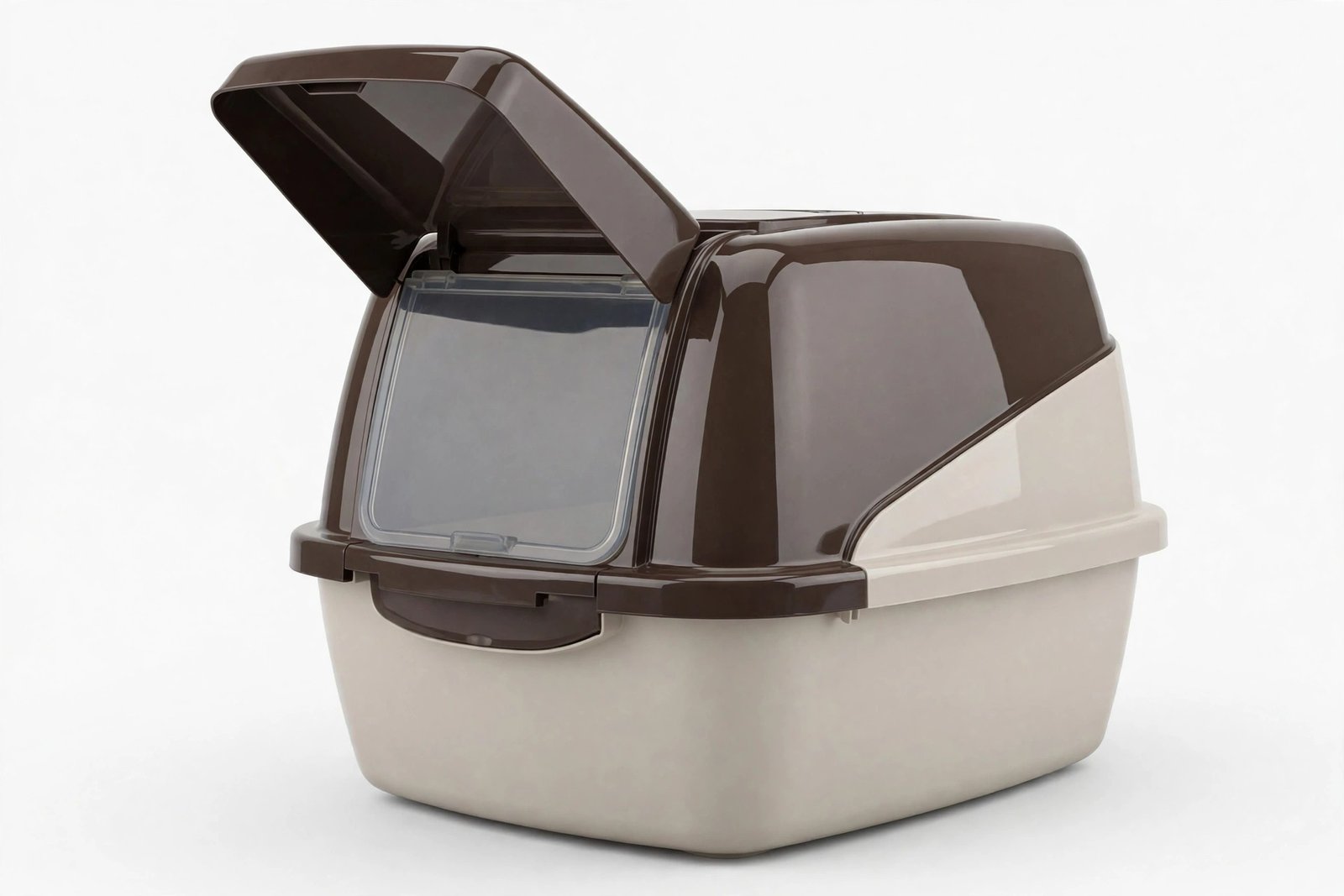
The EZ Clean’s pitch is in the name: the front of the lid flips up, so daily scooping happens through the top of the hood instead of by unclipping and lifting the whole cover — the chore design most likely to survive a tired weekday. Van Ness is also unusually straight about dimensions. The listing’s Q&A gives the assembled size as 24 x 19.5 inches and 18.5 inches tall, and the manufacturer publishes the interior at 21.5 x 17.5 inches, the roomiest verified interior in this guide relative to its footprint. High sides, a polished finish the brand says resists stains and odors, and an included zeolite filter round out the listing, and it holds the highest average here: 4.7 stars.
Hold that rating loosely, though — it rests on 191 reviews, the thinnest base in this list by a wide margin. And two design facts from the listing’s Q&A deserve weight. The door flap can be lifted for cleaning but cannot be removed, so a cat that flatly refuses flaps has no workaround here. And the step-up is approximately 8.5 inches, the highest in this guide, with a door opening of about 8.5 x 9 inches — fine for a healthy adult, a poor match for a kitten or a stiff senior. Buy it for the flip-top and the honest interior numbers; buy something else for a flap-hater or an arthritic cat.
Apartment Scorecard
- Footprint: 24 x 19.5 in, 18.5 in tall (listing Q&A); interior 21.5 x 17.5 in per the manufacturer
- Installation: None — arrives as pan, hood and filter; the flap is fixed and cannot be removed
- Rental-friendly: Yes — freestanding, high sides contain scatter
- Cleaning: The easiest daily routine here — flip the front of the lid, scoop, close; the zeolite filter swaps out on a schedule
- Best room: Bathroom, where the step-up can sit against a low mat
Best for cats that refuse flaps — Nature’s Miracle Silver Oval Hooded Litter Box

Some cats will use a hood happily and a swinging door never. This is the pick for them: the Silver Oval has no flap at all, just a wide open doorway under the hood, and reviewers on the Chewy listing single that out — cats that balk at doors walk straight in. The oval shape is the second half of the design: with no corners inside, there is nowhere for wet litter to cake into a right angle, and the listing describes a smooth, flat, non-stick interior that wipes clean and disinfects easily. Built-in odor neutralizers and a charcoal filter handle the vent, the front section flips up for scooping, and it holds 4.5 stars across 1,977 ratings. The listing’s Q&A puts it at 25.25 x 18.75 inches and 16.5 inches tall, with an entry step of about 7 inches.
The trade-offs: no door means less help containing odor and scatter at the front than a flapped box, so placement and a mat matter more. And the snap latches are this design’s known weak point — owners on the listing who also had the brand’s older oval call the silver version’s lid tabs noticeably less friendly, so expect the lid to need a firm hand rather than a click you can trust blindly. In exchange you get the lowest-friction entry in the guide for a door-refusing cat, in a shape that suits a hallway alcove better than a rectangle does.
Apartment Scorecard
- Footprint: 25.25 x 18.75 in, 16.5 in tall (listing Q&A)
- Installation: None — the hood snaps onto the pan with latches; no door to fit, ever
- Rental-friendly: Yes — freestanding; pair it with a mat, since the open doorway tracks more than a flapped one
- Cleaning: Flip-top front for scooping; the corner-free oval interior is the easiest here to wipe down; charcoal filter swaps on a schedule
- Best room: Hallway alcove or bathroom
Best compact corner — Frisco Flip Top Hooded Corner Cat Litter Box, Large, 21-in

If the Nature’s Miracle corner box is too much box, this is the smaller wedge: a 21-inch corner footprint, a flip top for cleanup, a detachable hood, and a disposable charcoal filter, in BPA-free plastic made in the USA. The apartment-relevant number is in the listing’s Q&A: the step-in height is 5 inches, the lowest in this guide, which makes it the corner option a kitten or an older cat can actually use. The entrance sits about 11 inches out from the corner, the door comes off if your cat objects (the listing’s Q&A confirms it), and the same Q&A names the replacement filters — Nature’s Miracle’s universal charcoal filters fit. It holds 4.1 stars across 625 ratings.
Be clear-eyed about the size, though: a corner wedge spends some of its footprint on the shape, and both reviewers on the listing and the listing’s own “roomy by kitty standards” framing point the same way — this suits one average-sized cat, and larger cats are cramped. The base pan is shallow, one owner on the listing reports a cracked swing-door hinge, and another found the hood and base fiddly to separate and the fit against the corner less flush than expected. None of that disqualifies it; it just means this is a small-cat, small-bathroom pick, bought for the corner and the low step, not for capacity.
Apartment Scorecard
- Footprint: 21-in corner footprint (per the listing’s product name); the step-in is 5 in per the listing Q&A
- Installation: None — hood detaches; the door is removable
- Rental-friendly: Yes — freestanding and the lightest claim on floor space here
- Cleaning: Flip top for daily scooping, hood off for a full change; disposable charcoal filter, with the brand’s universal replacements named on the listing
- Best room: Small bathroom corner
Best low entry at Petco — So Phresh Jumbo Enclosed Cat Litter Box
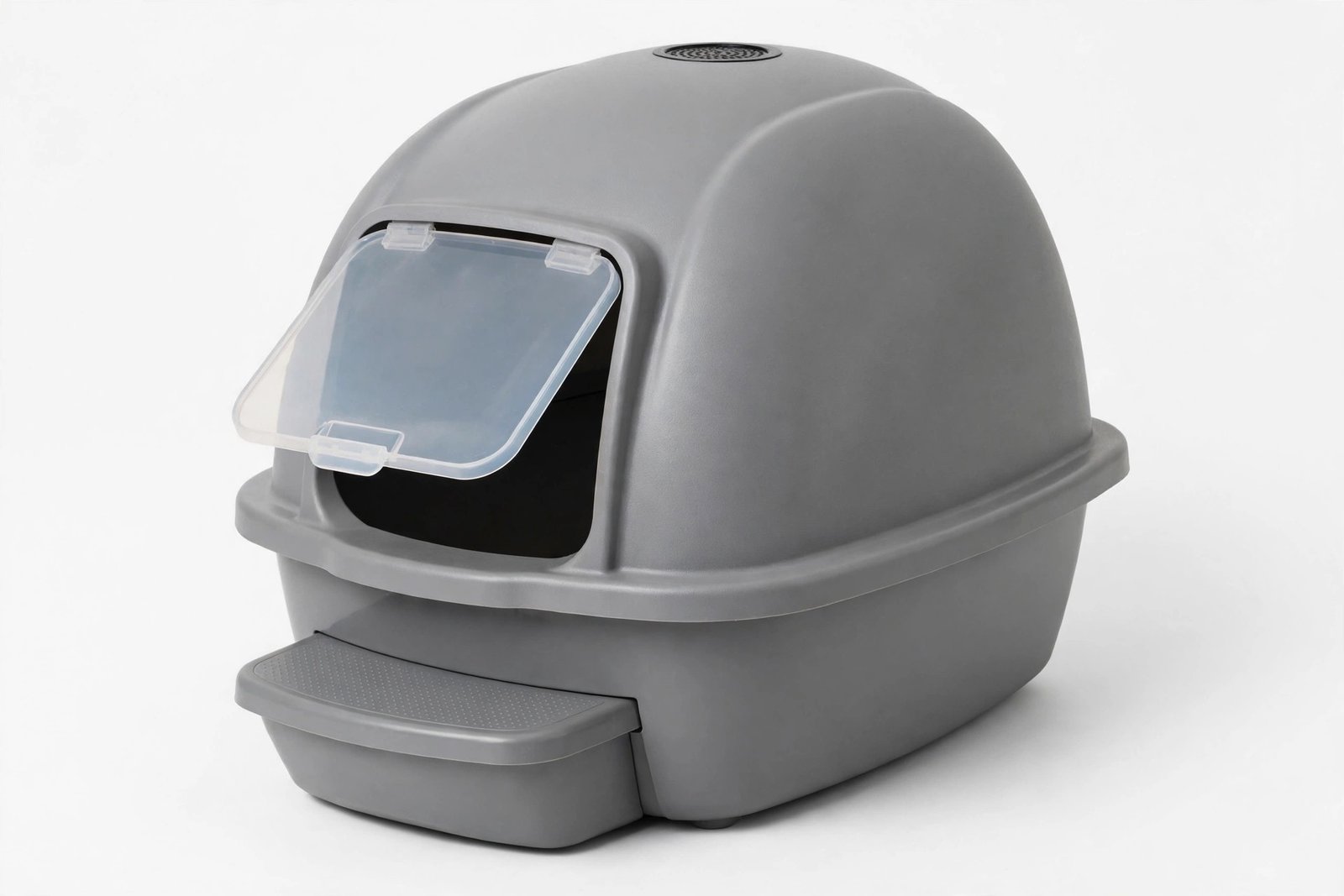
Petco’s house-brand jumbo earns its place on one design detail: the pan is low at the front and high at the back. Petco’s own answer on the listing puts the entry at approximately 6 inches off the ground at its lowest point, and reviewers on the listing praise exactly the combination that profile gives — easy step-in for a heavy or stiff cat, coverage at the back for a male cat who overshoots. The dimensions are printed in the product name: 23.4 x 19.3 inches, 18.5 inches tall. There is a carbon filter, the hood comes off, and the swinging flap is removable — several owners on the listing run it flap-free. Fit evidence is strong: reviewers report a 16 lb Maine Coon mix, a tall 18 lb cat and a 14 lb cat all using it comfortably, and it holds 4.3 stars across 641 reviews with 82% of reviewers recommending it.
The warnings are equally specific, and they are on the listing. The seam where the hood meets the pan can trap urine and let it drip out for a high pee-er — the listing’s most-helpful critical review is titled “Leaks,” and a detailed review describes urine sitting in the contoured lip where it smells and is hard to clean. Several reviewers report the door hinges and plastic latches failing within months, and Petco’s own Q&A answer confirms there is no replacement door available if yours breaks. The rounded interior corners also take more scoop work than a square pan. If your cat pees low and steps stiffly, this is a kind, roomy box; if your cat sprays the seam line, pick one of the high-walled options above instead.
Apartment Scorecard
- Footprint: 23.4 x 19.3 in, 18.5 in tall (dimensions in the listing’s product name)
- Installation: None — hood lifts off; the flap can be removed
- Rental-friendly: Yes — freestanding; put a waterproof mat under it if your cat pees high, because of the seam
- Cleaning: Hood off for full changes; the carbon filter swaps on a schedule; rounded corners need an extra pass with the scoop
- Best room: Bathroom or laundry room, on a mat
What a hood actually does to odor (the honest version)
Every box above is sold partly on odor, so here is the trade-off stated plainly. A hood slows odor reaching the room: less air moves across the litter surface, kicked litter stays in, and a charcoal or zeolite filter at the vent absorbs some of what escapes. That part is real, and in a studio it is worth having. But the odor does not vanish — it concentrates inside the box, at exactly the height of your cat’s nose, in the space your cat has to stand in. The person who benefits most from a hood is you; the one who pays for a neglected hooded box is the cat.
The research agrees with the unglamorous conclusion. A preference study published in the Journal of Feline Medicine and Surgery found no overall group preference between covered and uncovered litter boxes when both were kept clean — hygiene, not the hood, decided acceptance. Read that both ways: a clean hooded box is not a compromise your cat resents, and a dirty open box is not saved by its openness. What decides smell in a small apartment is scooping frequency, litter depth, ventilation at the spot you choose, and only then the lid. If a hood tempts you to scoop less because you can no longer smell the reminder, it has made things worse, not better — an open box you scoop daily beats a hooded box you scoop when guests are coming, every time.
How we picked
We researched the current Chewy and Petco listings for hooded manual litter pans on November 9, 2026, and compared what each listing itself states: exterior dimensions, interior size where the brand publishes it, entry height and door design, filter type, the rating and rating count as displayed, and the drawbacks in each listing’s own reviews and Q&A. No products were sent to us, no placements are paid, and we do not claim hands-on testing — this is listing research, cross-checked pick by pick, and where a listing and the manufacturer’s copy disagreed on a dimension we used the listing’s figure and said so.
The boundaries were deliberate. This guide covers hooded manual pans only: top-entry boxes live in our top-entry guide, covered self-cleaning machines in our covered automatic guide, and furniture enclosures in our hidden litter box furniture guide. One well-known dome box was left out because we could not verify a current listing for it at the retailers we link to, and a standard enclosed pan from a brand already represented here was cut to keep the list at seven genuinely different designs.
Buying guide: choosing a covered box for a small apartment
Measure the exterior, then discount the interior
The footprint on the listing is the floor space the box takes; it is not the room your cat gets. Hoods, liners, thick walls and corner wedges all take their cut — the Catit’s usable pan measures narrower than its shell, and the Frisco Multi-Function’s inner tray is barely half the length of its housing. Use the rule of thumb that the interior should be about one and a half times your cat’s body length so they can turn around, and when a brand publishes interior dimensions, as Van Ness does, trust those over the headline size.
Entry height and the flap question
The step-ins in this guide run from 5 inches (Frisco’s corner box) to about 8.5 inches (the Van Ness EZ Clean), and that spread decides more purchases than capacity does: kittens and arthritic seniors need the low end. Then decide about the door. A flap contains more odor and scatter but is the part cats most often refuse. Removable flaps — on the Catit, the Frisco corner box and the So Phresh — let you start with the door off and add it later; the Nature’s Miracle Silver Oval skips the door entirely; the Van Ness EZ Clean’s flap cannot be removed at all, which should settle the question if your cat is a known flap-refuser.
The filter is the one recurring cost
Every pick here uses a disposable filter — charcoal on most, zeolite on the Van Ness — and filters only work while they are fresh. Nature’s Miracle’s own guidance on its listing is a swap roughly every three months; treat other brands’ charcoal filters on a similar cadence and the cost stays trivial, in single filter packs rather than anything structural. Prefer unscented filters: a perfume you enjoy is another smell concentrated at your cat’s nose, and the hood is already doing that job.
Placement in a rental
Put the box where air moves a little — a bathroom with a fan, a laundry corner — not in a sealed closet, where the hood-plus-door combination concentrates odor fastest and can put a cat off the box entirely. Keep it away from food and water bowls, give a high pee-er a washable waterproof mat under the seam line, and remember that corner boxes earn their keep precisely because they use the one patch of floor nothing else wants. For the bigger picture, our guide to litter boxes for small apartments covers open and high-sided pans alongside these hooded picks.
If odor is your main worry, consider a stainless steel litter box instead — steel won’t hold smells the way plastic does.
Frequently asked questions
Does a covered litter box actually reduce smell?
It reduces the smell that reaches you, not the smell itself. The hood slows air movement over the litter and a charcoal or zeolite filter absorbs some odor at the vent, but what is contained stays concentrated inside the box where your cat breathes it. Scooping daily does more for apartment odor than any lid — the hood is a supplement to that habit, not a substitute for it.
Do cats prefer covered or uncovered litter boxes?
As a group, neither — a study published in the Journal of Feline Medicine and Surgery found no overall preference between covered and uncovered boxes when both were kept clean. Individuals vary: some cats like the privacy, some dislike the door or the enclosed smell. The practical approach is to choose a box with a removable door and watch your own cat’s behaviour for the first week rather than assuming either way.
Why do some vets object to covered litter boxes?
Two concerns come up. The first is behavioural: because owners smell a hooded box less, some scoop it less, and cats then face a dirtier, smellier box — the hygiene problem above. The second is the individual cat: a fearful cat may dislike a single-exit enclosed space, and owners of cats with asthma are often advised to be cautious about dusty, enclosed litter environments. Neither is a blanket rule against hoods; both are reasons to keep the box scrupulously clean and to switch designs if your cat starts avoiding it.
Covered or top-entry: which is better for a small apartment?
Top-entry boxes are better at stopping tracked litter and suit agile cats, but they ask the cat to jump up and drop in, which rules them out for many seniors and kittens. A front-entry covered box like these is easier to get into and out of, and the hood does the privacy and scatter work instead. Our top-entry vs front-entry comparison works through the trade-offs, and the top-entry picks are there if your cat is a jumper.
How often do covered-box filters need replacing?
On the cadence the brands themselves state: Nature’s Miracle’s guidance on its listing is roughly every three months for its charcoal filters, and that is a sensible default for the other charcoal filters here too. The Van Ness uses a zeolite filter on a similar swap schedule. A spent filter does nothing, so the swap matters more than the brand — and one pick, the Nature’s Miracle corner box, states on its listing that the filter is optional if you would rather run without.
My cat is large. Will a covered box actually fit them?
Some will — check the interior, not the headline size. Owners on the Nature’s Miracle corner box’s listing report cats of 20 lb and more using it comfortably, the Frisco Multi-Function’s listing Q&A reports very large cats fitting its 29-inch housing, and Van Ness publishes a 21.5 x 17.5 inch interior for the EZ Clean. Compact corner boxes are the opposite case: fine floor-space savers, but genuinely tight for a big cat.
Related reading
- Best litter boxes for small apartments — the pillar guide, open and high-sided pans included
- Best top-entry litter box for small spaces
- Top-entry vs front-entry litter boxes
- Best hidden litter box furniture
- Best covered automatic litter boxes — the self-cleaning counterpart to this guide
Last updated: November 9, 2026