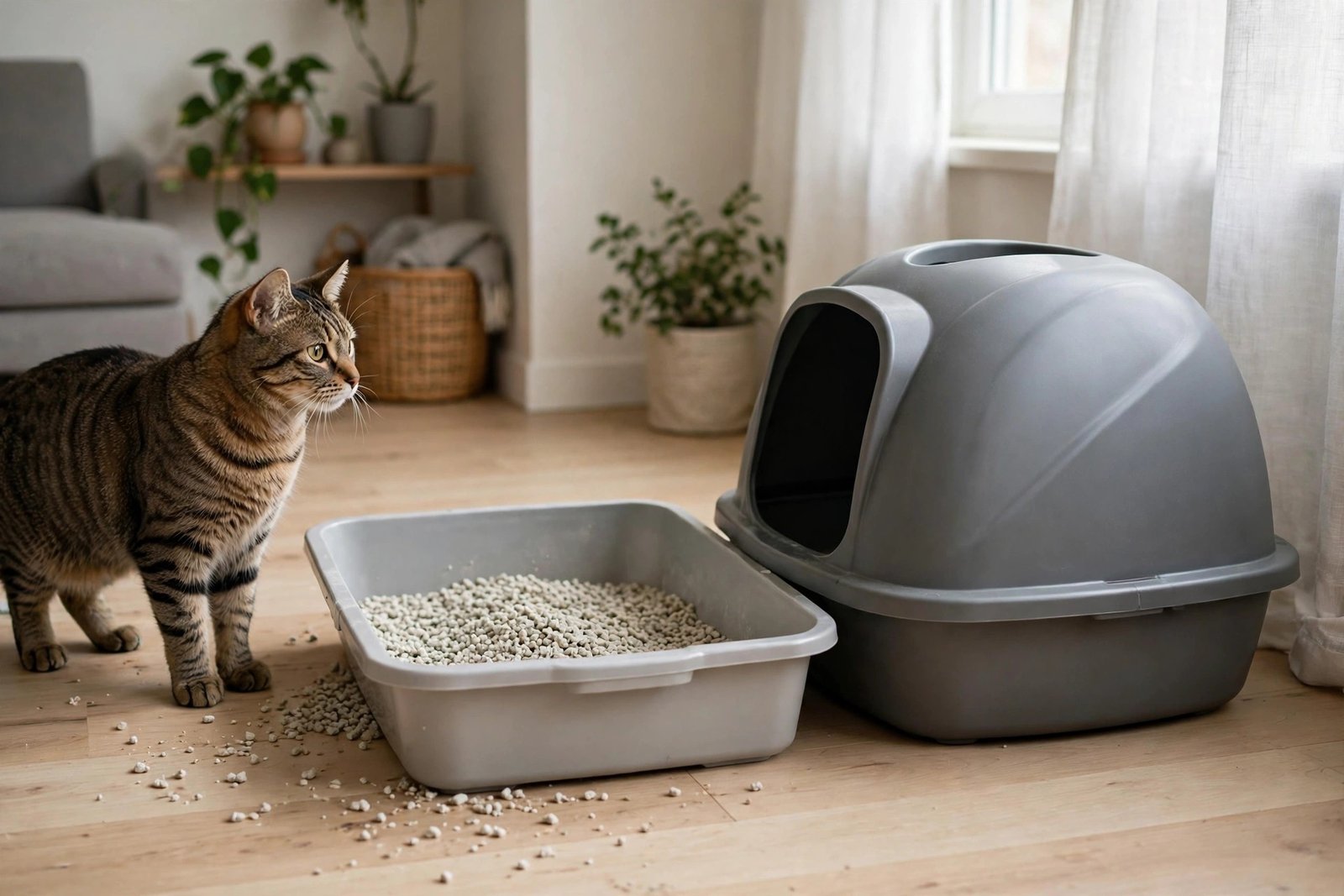
Walk into any pet store and the litter box aisle gives you two answers to the same question: a plain open tray, and the same tray with a hood snapped on top. The hood costs more, looks tidier, and promises to keep the smell in — so most people buy it and never ask whether their cat wanted it. The open vs covered litter box question is really four smaller questions stacked on top of each other: who smells what, how much litter ends up on the floor, what the cat prefers, and which room the box lives in. In a small apartment, all four matter more than they would in a house, because the box is never far from where you eat, sleep, and sit.
This guide pulls together what the comparison pages actually say — the Neakasa guide, Petso’s side-by-side, Petco’s buying guide, and The Meow Picks’ two-week test — plus the one study that gave cats a real choice, and then applies each point to a small flat, where the box shares a room with your life. Where the sources disagree, the disagreement is stated rather than smoothed over.
| Factor | Open tray | Covered box |
|---|---|---|
| Odor in the room | Smell disperses into the room right after use; you notice it sooner | Smell is contained at first, then concentrates inside the hood |
| Odor for the cat | Milder, because air moves freely | Stronger if scooping slips — Neakasa calls it a “port-a-potty” effect |
| Litter tracking | More scatter and tracking; a mat is essential on hard floors | Walls and hood catch most kicked litter; still needs a mat |
| Cat preference | Broadly accepted; best default for shy, senior, or large cats | Suits cats that seek privacy — if the cat enters willingly |
| Entry and exit | Step in from any side; easy for kittens and arthritic cats | One doorway; a second cat can block the only exit |
| Cleaning | Fast to scoop and scrub; waste is always visible | Hood must come off for a full clean; hidden mess gets skipped |
| Privacy and looks | Everything is visible; no barrier for dogs or toddlers | Hides waste; keeps dogs and small children out |
| Best room | Bathroom or laundry corner, where ventilation is already there | Living room or bedroom corner, where the box is on display |
What the research actually says
The most useful evidence on this question did something simple: it gave cats a choice. In a study published in the Journal of Feline Medicine and Surgery, Grigg and colleagues offered 28 pet cats a covered box and an uncovered box, both large, filled with the same fine clumping litter, and scooped daily. Use was measured by weighing the waste in each box, so the researchers were tracking what the cats actually did rather than what their owners assumed.
The pooled result was no significant overall preference: most cats used both boxes without favoring either style. Of the 27 cats included in the analysis, 19 showed no preference at all, and the 8 that did split exactly evenly — 4 preferred the covered box, 4 preferred the uncovered one. The authors’ conclusion was that if boxes are kept sufficiently clean, with scooping at least once a day, most cats will not show a preference for either type, and they recommended offering a “cafeteria” of styles so an individual cat’s preference can be found. That is the study’s finding, not a Velvnox claim, and it is worth reading with its caveats in mind: the study boxes were oversized storage bins, larger than most commercial “large” covered boxes, and the results may not generalize cleanly to large cats or busy multi-cat homes, where space and competition change the picture.
The practical upshot for an apartment is that the lid is not the deciding factor most people think it is. If the box is roomy and scooped daily, most cats will use either style — which means the decision should be made on the other factors in the table above, not on a guess about what cats in general prefer. The exception is the minority of cats that do have a strong preference, and the only reliable way to find out whether yours is one of them is the two-box test at the end of this guide.
Odor: who smells what
A covered box does not remove odor; it relocates it. The hood keeps the smell from spreading into the room right after the cat uses the box, which is exactly what you want when the box sits three feet from the sofa. But the same hood traps that smell inside, and if scooping slips by even a day, the interior of a covered box smells far worse to the cat than an open tray ever would. Petco makes the same point from the other side: look for a covered box with built-in ventilation, and scoop at least once daily to keep the interior fresh.
An open tray is honest about odor in both directions. The room smells it sooner after use, which is the price of the design — but the cat smells less of it, because air moves freely, and you notice a dirty box immediately, which means it gets scooped. The Neakasa guide flags the hidden cost of covered boxes directly: owners scoop less often when they cannot see the mess, and the cat is the one who pays for it. In a studio or one-bedroom flat, where the box is in your airspace whether you like it or not, that trade-off matters: a covered box that is scooped daily beats an open tray that is scooped every other day, and an open tray that is scooped daily beats a covered box that is forgotten behind its own hood.
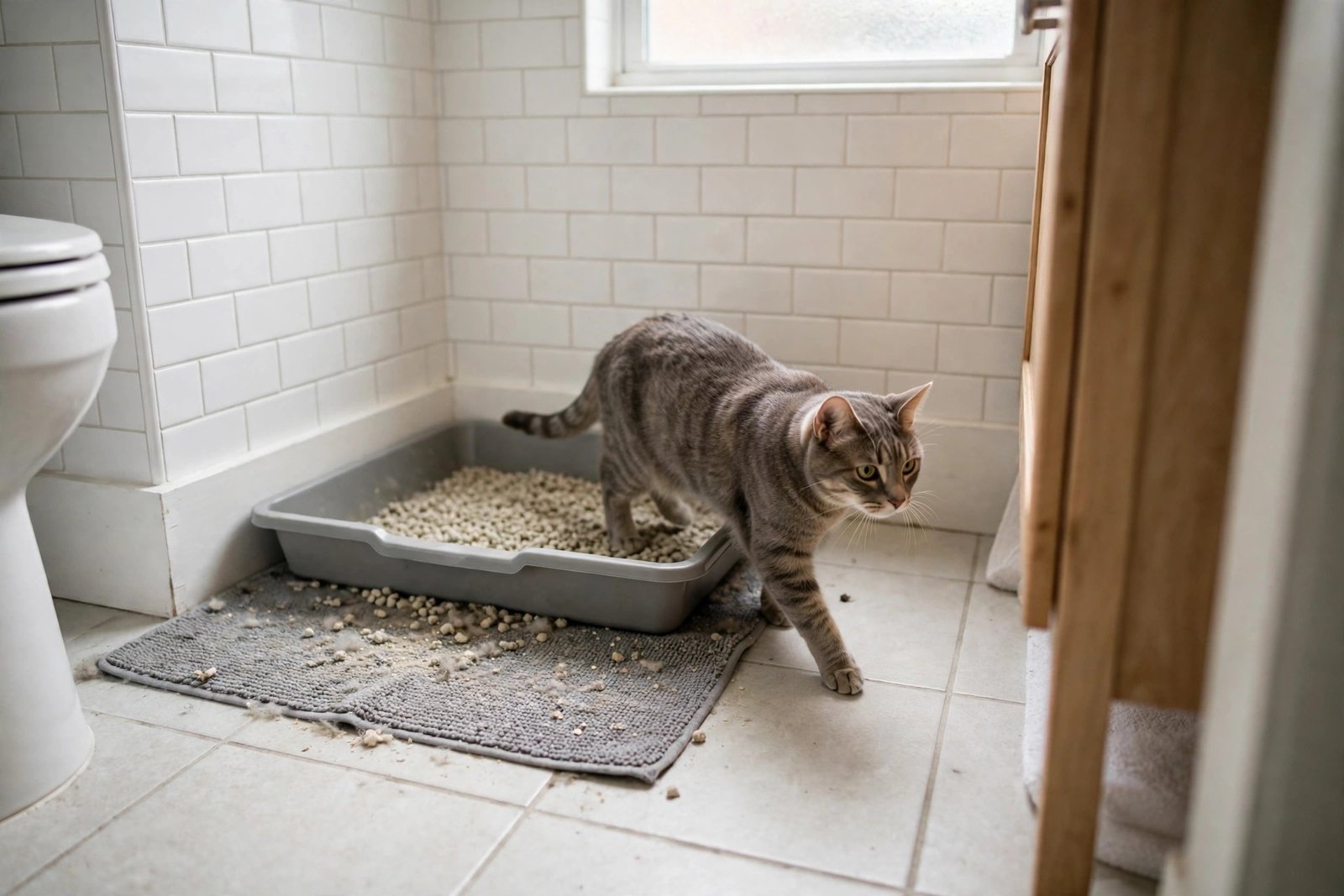
None of this is solved by the lid alone. Our guide to how to reduce litter box smell in a small apartment works through the levers that actually move odor — scooping frequency, litter choice, and ventilation — and every one of them applies to both styles. If odor is the reason you are considering a covered box, read that first: a cover is a container, not a cure.
Tracking and the mess around the box
This is the one factor where a covered box wins clearly, and it is the factor that matters most on hard apartment floors. A cat that digs hard will kick litter over the low sides of an open tray, and on wood or laminate that litter travels — into the hallway, under the sofa, into the kitchen. The walls and hood of a covered box catch most of it before it leaves the box. Petso’s comparison puts it plainly: covered usually means reduced scatter, open usually means more tracking.
But “reduced” is not “none.” A covered box still needs a mat, because litter sticks to paws on the way out of either design, and the mat is what catches it. The difference is how much mat you need: an open tray in a small flat wants a large mat, and ideally a high-sided tray, to keep the scatter zone contained. Our guide to how to reduce litter tracking in an apartment covers mats, litter choice, and placement together, and it applies whichever style you choose. If your cat is a vigorous digger and your floors are hard, the covered box’s containment is a real, daily benefit — just do not expect it to end tracking on its own.
What your cat actually cares about
Size comes before the lid. Every source in this guide agrees on that, and the veterinary guidelines behind them agree too: a box should be at least 1.5 times your cat’s length from nose to base of tail, which for most adult cats means at least 24 inches long, with walls at least 4 inches high. A box that is too small is aversive regardless of cover style — but the effect shows up more often in covered models, because manufacturers shrink the usable interior to keep the hood compact. A covered box can look large from the outside while offering less turning room inside than a plain open tray. Measure the interior floor area and the doorway, not the outside dimensions.
Entry matters as much as size. An open tray lets a cat step in from any side, with no door to push through and no roof brushing its whiskers. That is why the open style is the safer default for kittens, senior cats, and cats with arthritis: Petco recommends 2 to 3 inch walls for kittens so they can step in and out without struggling, and a low threshold matters more than the lid for an older cat. A covered box asks the cat to commit to a single doorway, and in a multi-cat home that doorway is a vulnerability — a second cat waiting outside can turn the hooded box into a dead end. The Meow Picks guide makes the same point: if you use covered boxes with more than one cat, choose models with two openings or a wide front panel so the cat inside always has an escape route.
Then there is the question of who the privacy is for. Some cats genuinely prefer a darker, enclosed space, and a shy or easily startled cat may relax inside a hood. But some of the privacy a covered box offers is the owner’s, not the cat’s: it hides the waste from the living room, and it hides the cat from view. A confident cat that wants to see the room while it toilets will not be reassured by a hood; it will be annoyed by one. Watch the behavior rather than assuming: a cat that perches on the edge, goes in half-way and backs out, or pauses long at the entrance is telling you the setup is wrong, whatever the style.
Placement: bathroom vs living room
In an apartment, the room often decides the style. A bathroom is the natural home for an open tray: it is tiled, it ventilates, litter on the floor is a sweep rather than a crisis, and nobody eats in there. The trade-off is that a bathroom box must stay dry and the door must stay open — a cat that will not push through a closed door has no box at all. Our guide to where to put a litter box in a small apartment works through the room-by-room options in detail.
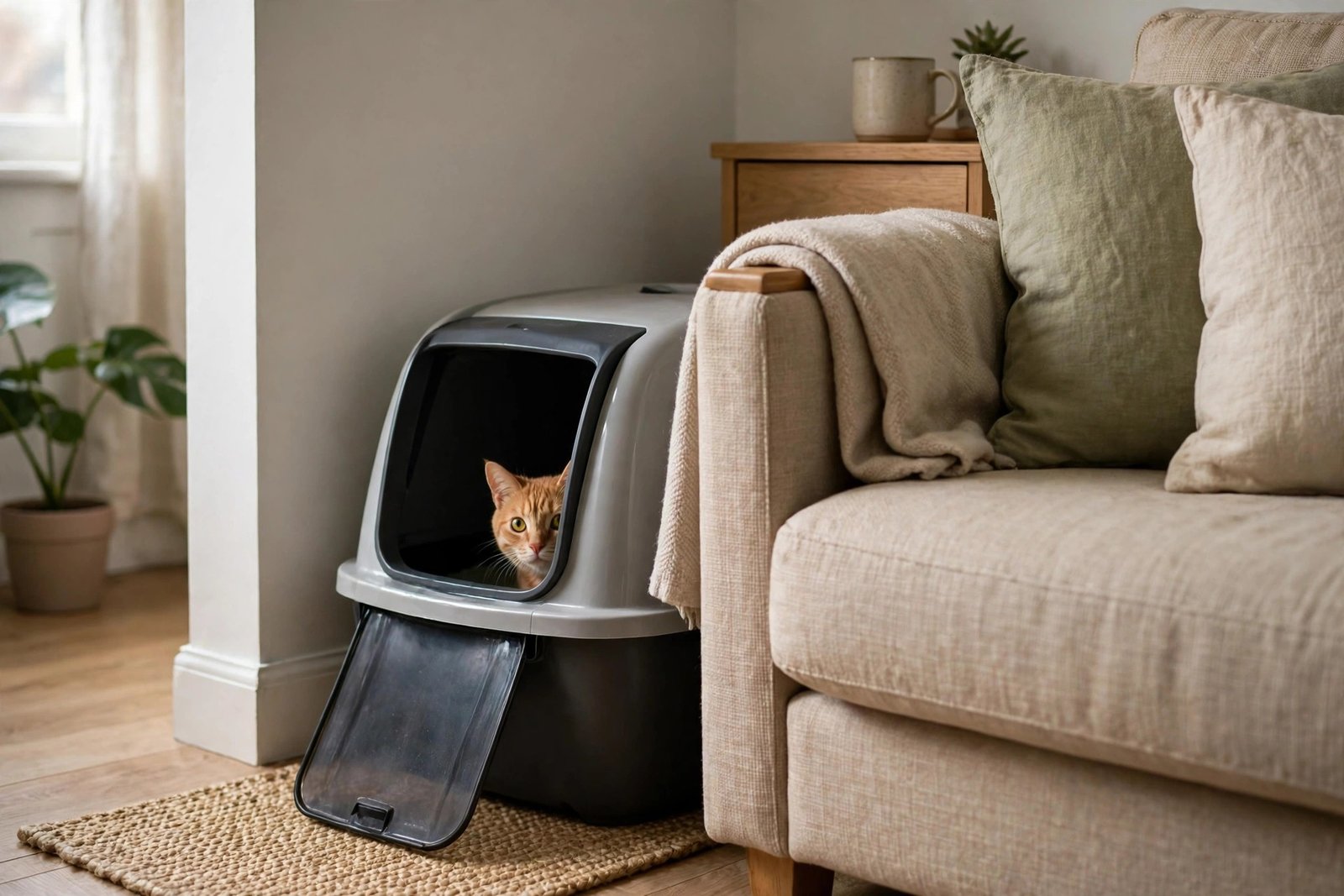
A living room or bedroom corner is where a covered box earns its keep. The box is on display in the room you live in, so hiding the waste and containing the smell between scoops is worth real money and real effort. The conditions are the same as anywhere else: the spot must be quiet, away from the food and water, and never in a dead-end corner where the cat has only one way out. A covered box pushed into a corner behind the sofa, with its single doorway facing a wall, is the worst of both designs — enclosed and trapped. Give it a corner with two open sides of approach, and keep it out of the hallway traffic.
Multi-cat flats add one more placement rule: spread the boxes out. The standard guideline is one box per cat, plus one extra, and the boxes should be in different areas of the home rather than lined up together, so one confident cat cannot guard them all. That rule is independent of lid style, but it interacts with it — two covered boxes side by side in the same corner are one guarded resource, not two. Our guide to the best litter box for two cats covers the sizing and spacing for a two-cat flat.
The two-box test: settle it in two weeks
Guessing is free, but it is also wrong about a third of the time — remember that 8 of the 27 cats in the Grigg study had a real preference, and they split evenly. The reliable way to find out which your cat is, is to run the test the study ran, scaled down to a flat. Set up one large open tray and one large covered box, side by side or in comparable quiet spots, with the same litter at the same depth in both. Scoop both on the same schedule, at least once a day. Then keep a short log for one to two weeks: which box gets used first each day, how often the cat hesitates at either entrance, and whether litter kicking or avoidance shows up at one of them.

If your cat clearly favors one style, keep that box and retire the other. If use stays roughly even, you have flexibility — pick based on your own needs for odor and scatter control, which is to say, pick the covered box for the living room and the open tray for the bathroom. Two practical notes: do not judge after a single day, and do not change the litter type mid-test, or you will not know whether the cat was reacting to the lid or the litter. And if the cat avoids both boxes, the problem is almost certainly not the lid — check size, cleanliness, and placement first, and if avoidance persists, talk to a veterinarian before buying anything else.
The quick verdict
Choose a covered box when the box lives in a room you sit in, when a dog or a toddler needs keeping out, when your cat is a vigorous digger on hard floors, or when your cat has shown you — by using one willingly — that it likes the enclosure. If you go covered, the model matters more than the category: it must be roomy inside, with a wide doorway, a removable top so scooping never becomes a chore, and ideally some ventilation. Our listicle of the best covered litter boxes for small apartments compares the models that actually fit a flat.
Choose an open tray when your cat is a kitten, a senior, very large, or has any history of urinary or stress issues; when the household has more than one cat; when the box lives in the bathroom; or when you want the lowest-friction scooping routine you will actually keep up. If the question is not covered versus open but how the cat gets in, our comparison of top-entry vs front-entry litter boxes covers the other entry decision, which matters more than the lid for some cats.
How this guide was put together
This guide is a comparison of published sources, not a product test: the Neakasa open-vs-covered guide, Petso’s covered-vs-open comparison, Petco’s litter box buying guide, and The Meow Picks’ two-week test write-up, plus the Grigg et al. paired-choice study as published in the Journal of Feline Medicine and Surgery and summarized by the American Veterinary Society of Animal Behavior. Where the sources agreed, the agreement is stated; where they disagreed, the disagreement is stated too. No product was tested, no cat was observed by Velvnox for this guide, and there are no paid placements anywhere in it. Sizing guidance follows the widely cited 1.5-times-body-length rule from the AAFP/ISFM feline environmental guidelines, as cited by Petco and Cornell; the exact figures are the sources’ figures, not Velvnox measurements. If your cat’s elimination habits change suddenly, or avoidance persists after you have fixed size, cleanliness, and placement, the right next step is a veterinarian, not a different box.
FAQs
Do most cats prefer an open or covered litter box?
Most cats show no clear preference. In the Grigg et al. paired-choice study of 28 cats, with both boxes large and scooped daily, there was no significant overall preference: 19 of the 27 cats analyzed used both styles freely, and the 8 with a preference split evenly, 4 for covered and 4 for uncovered. Size and cleanliness mattered more than the lid.
Do covered litter boxes control odor better?
They contain odor better in the short term, which helps when the box is in the living room. But they trap and concentrate smells inside the hood, so a covered box that is not scooped daily smells worse to the cat than an open tray. Frequent scooping and ventilation are far more dependable odor control than a lid on its own.
Are open litter boxes better for senior cats?
Usually, yes — but entry height matters more than the lid. An open tray with a low threshold is easy to step into, with no door to push through and no roof to duck under. A covered box can still work for a senior cat if it has a low entry, a wide doorway, and enough interior room to turn.
Will a covered litter box stop litter tracking?
It reduces tracking, it does not stop it. The walls and hood catch litter kicked during digging, but litter still sticks to paws on the way out. A large mat in front of either style is what actually keeps litter off the floor, and high-sided trays help open boxes catch up.
Should I use a covered litter box with two cats?
Be cautious. A covered box has one doorway, and in a multi-cat home a second cat can block the only exit, which turns the box into a trap. If you use covered boxes with more than one cat, choose models with two openings or a wide front panel, keep the standard one-box-per-cat-plus-one count, and spread the boxes across different areas of the home.
How do I find out which style my cat prefers?
Run a two-box test: one large open tray and one large covered box, same litter and depth, comparable quiet spots, both scooped daily, for one to two weeks. Log which box gets used and whether the cat hesitates at either entrance. A clear lean means you have your answer; even use means you can choose on odor and scatter alone.
Related reading
- Best Covered Litter Boxes for Small Apartments — the covered models that actually fit a flat, if the test points you toward a hood.
- Top-Entry vs Front-Entry Litter Box — the other entry decision, which matters more than the lid for some cats.
- How to Reduce Litter Box Smell in a Small Apartment — the scooping, litter, and ventilation levers that control odor in either style.
- How to Reduce Litter Tracking in an Apartment — mats, litter choice, and placement, for whichever box you choose.
- Where to Put a Litter Box in a Small Apartment — the room-by-room placement decision, bathroom vs living room.
- Best Litter Box for Two Cats — sizing and spacing when more than one cat shares a flat.
Last updated: November 12, 2026