
The question is not really which feeder is better. It is which one fits the way you actually live — and in a small apartment, that answer turns on things the comparison articles skip over: whether your cat eats wet food, whether a jammed feeder would be noticed before the next meal, and whether anyone is home to notice a cat that stopped eating. The automatic vs manual cat feeder for cats decision is a routine decision, not a gadget decision, and the routine is yours, not the manufacturer’s.
This guide works through the five questions that actually decide it — wet vs dry food, jams and power, skipped-meal risk, appetite monitoring, and travel — drawing on the comparison guides from J’s PetHub and Serlig, and then applying each point to a small flat, where there is no spare room to hide a mistake. Where the sources disagree or where a claim could not be checked, that is stated rather than smoothed over.
| Question | Automatic feeder | Manual bowl |
|---|---|---|
| Schedule | Feeds on time even when you are late or out | Feeds when you are there, and only then |
| Portion control | Same measured portion every time, once set | As accurate as your scoop and your honesty that day |
| Wet food | Standard hoppers take dry kibble only; wet food needs a carousel feeder with ice packs | Any food, any time, served fresh |
| Jams and power | Can jam, and a wall-powered unit fails in a power cut unless it has battery backup | Nothing to jam, nothing to plug in |
| Skipped-meal risk | A failed dispense is silent — nobody sees the empty bowl | You see the empty bowl because you filled it |
| Appetite monitoring | Easy to miss a cat eating less unless you check the bowl or the app | You notice at once when the bowl comes back full |
| Travel | Covers a weekend of dry meals, but a human should still check in | Needs a sitter or a neighbour for every meal |
| Cleaning | Bowl every couple of days, hopper about monthly; kibble oils build up inside | One bowl, washed in the sink in a minute |
| Bonding | Feeding becomes a machine’s job unless you replace it with play | Feeding time is face time, twice a day |
The food question decides first: wet vs dry
Before anything else, look at what is in the bowl today. A standard automatic feeder is a hopper that drops dry kibble on a timer. That is the whole machine, and it is the first thing the comparison guides agree on: if your cat eats wet food, the standard feeder does not serve it. Serlig’s review is direct on this point — wet food needs a carousel-style feeder with built-in ice packs to keep the food fresh through the day, which is a different device, with different cleaning, from the hopper most people picture when they say “automatic feeder”.
In an apartment this matters more, not less, because wet food left out goes off faster in a warm flat, and a small kitchen has no cool corner to park a carousel in. A cat on a wet-food diet, or on a mixed diet where the morning meal is wet, is a manual-feeding cat for at least that meal, whatever the feeder marketing says. The honest test is simple: if more than half your cat’s food is wet, an automatic feeder is a supplement to your routine, not a replacement for it. If the diet is all kibble, the feeder can genuinely take over the schedule — and that is where the rest of this guide applies.

One more food question the guides raise and apartment owners should take seriously: a gravity feeder is not an automatic feeder. A gravity feeder refills the bowl as the cat eats, which is free feeding under another name, and Serlig’s comparison is blunt that constant access to kibble is a leading cause of overeating. If the goal is portion control, the choice is between a timed automatic feeder and a measured manual scoop — the gravity silo is neither.
Jams, power cuts, and the meal that never arrives
Every automatic feeder has moving parts, and moving parts fail. Both comparison guides put mechanical failure at the top of the automatic feeder’s drawback list: kibble jams in the mechanism, batteries die, Wi-Fi drops. Serlig notes that some newer models reverse their gears to clear a blockage and try again, but that is a feature of some models, not a guarantee of the category — and Velvnox has not verified which models do it reliably, so this guide does not name any.
The power question is the sharper one in an apartment. A feeder that runs only on a wall outlet stops in a power cut, and the cat’s next meal simply does not happen. Serlig’s advice is to look for a dual power supply — wall power plus battery backup — so the programmed schedule keeps running when the electricity does not. That is sound advice, but it has a catch the guides do not stress: the backup only helps if the batteries in it are fresh. A battery backup with dead batteries is a wall-powered feeder with extra steps, so the backup needs the same checking habit as the food hopper itself.
The apartment angle here is space and notice. In a house, a feeder sits in a utility room and a jam is found at the next visit. In a one-bedroom flat, the feeder is six feet from the sofa, and a jam is found within the hour — if you are home. The failure mode that actually hurts a cat is the quiet one: the feeder jams on a Friday evening, you are out for the weekend, and nobody sees the empty bowl until Sunday. That is the scenario the next section is about.
The skipped-meal risk nobody sees
A manual bowl fails loudly. You pick it up, it is still full, and you know at once that the cat did not eat. An automatic feeder fails silently. The hopper still holds kibble, the display still shows the schedule, and the bowl underneath is empty — and nothing in the room tells you so. That asymmetry is the single most important difference between the two systems, and it is the one the comparison guides mention only in passing.
For a healthy adult cat, one missed meal is an inconvenience. For a kitten, a senior cat, or a cat on medication timed to food, it is a real problem. And the risk is not theoretical: jams happen, and they happen most often with oddly shaped kibble or a hopper filled past its comfortable level. The mitigation is unglamorous and it works — check the bowl every day, even when the feeder is doing the feeding. Look at the bowl after the morning dispense, not just at the hopper level. If the bowl is empty when it should hold a portion, something failed, and you have caught it within hours instead of days.

There is a second, quieter version of the same risk: the feeder works perfectly and the cat does not eat. A cat that stops eating is the earliest sign of illness most owners ever get, and a manual feeder hands you that signal for free, twice a day, because you are the one holding the scoop. An automatic feeder hands you nothing unless you look. So the rule for automatic feeding is the same as the rule for a jam: the machine dispenses, but you still inspect the bowl. If that daily check sounds like it defeats the purpose, it does not — it takes ten seconds, and it is the difference between automation and abandonment.
Appetite monitoring: what the bowl tells you
J’s PetHub makes the manual case plainly: when a cat is unwell or on medication, you want to watch appetite, and manual feeding puts you in front of the bowl at every meal. That is not sentiment; it is the cheapest health check a cat owner has. A cat that leaves half its breakfast two days running is telling you something, and the person holding the scoop hears it first.
Automatic feeding does not make that signal disappear, but it does make it easier to miss. The fix is a habit, not a device: note how much is left in the bowl after each meal, and treat a half-eaten portion as information, not leftovers. Some newer feeders advertise app-based eating analytics, and Serlig’s review describes that feature as part of the 2026 smart-feeder landscape — but Velvnox has not verified those claims against real models, so this guide does not lean on them. A glance at the bowl, twice a day, is verified by nothing except common sense, and it works with any feeder ever made.
The same logic applies in reverse for multi-cat flats. In a home with two cats, one cat can quietly eat both portions from a single automatic feeder, and the other cat’s hunger is invisible until it shows up as weight loss. J’s PetHub suggests microchip-activated feeders for exactly this case, so each cat gets only its own food. That is a real solution, but it is also a second purchase and a second setup — worth weighing honestly against the simpler answer, which is feeding the cats separately, by hand, where you can see who ate what.
Travel: what an automatic feeder can and cannot do
The strongest case for an automatic feeder is the weekend away. Both comparison guides agree: a timed feeder covers a day or two of dry meals, and it beats leaving a mountain of kibble in a bowl, which is free feeding with all of its problems. For a busy owner with irregular hours, the same logic applies on a smaller scale — the feeder holds the 6 p.m. meal on the evening you work late, and the cat eats on time.
What the feeder cannot do is replace the check-in. Both guides say it, and it is worth repeating plainly: a cat left alone for a weekend still needs a human to look in on it. The feeder covers food; it does not cover water, litter, a jammed mechanism, a power cut, or a cat that stopped eating. In a small apartment, the practical version is a neighbour or a sitter who drops in once a day, checks the bowl, tops up the water, and scoops the litter. The feeder makes that visit short and easy; it does not make it unnecessary. Anyone who tells you a feeder means you can leave a cat alone for a week is selling a feeder, not giving advice.
One apartment-specific travel note: the feeder needs an outlet that stays live while you are away, and in some flats the kitchen circuit is shared with something that trips. Test the feeder on its outlet for a full week before trusting it to a trip, and leave the manual bowl full as a backup for the first trip, not the second. The backup bowl costs nothing and covers exactly the failure this guide keeps coming back to.
The hybrid setup most apartment cats end up with
After all of that, the answer most owners land on is the one J’s PetHub calls the hybrid approach, and it is the answer this guide recommends for most apartment cats: feed the wet food by hand in the morning or evening, and let the automatic feeder handle the dry kibble meals in between. The wet meal keeps you in front of the bowl, watching appetite, and the dry meals keep the schedule when you are late or out. You get the bonding and the monitoring from the manual meal, and the consistency and the portion control from the machine.
The hybrid only works if it is a real routine and not a drift. Set the feeder’s portions to cover the dry meals only, and do not let the manual meal grow into a second full meal on top of the feeder’s portions — that is how a cat gains weight while the owner believes the portions are controlled. Weigh the day’s total food once, when you set the system up, and then trust the routine. If the cat is a grazer that picks at kibble all day, the timed feeder still beats the gravity silo, because the portions are set; if the cat is a fast eater that inhales a portion and then begs, a slow feeder bowl for the manual meal is the honest companion piece, and our guide to the best slow feeder for cats covers that side of it.
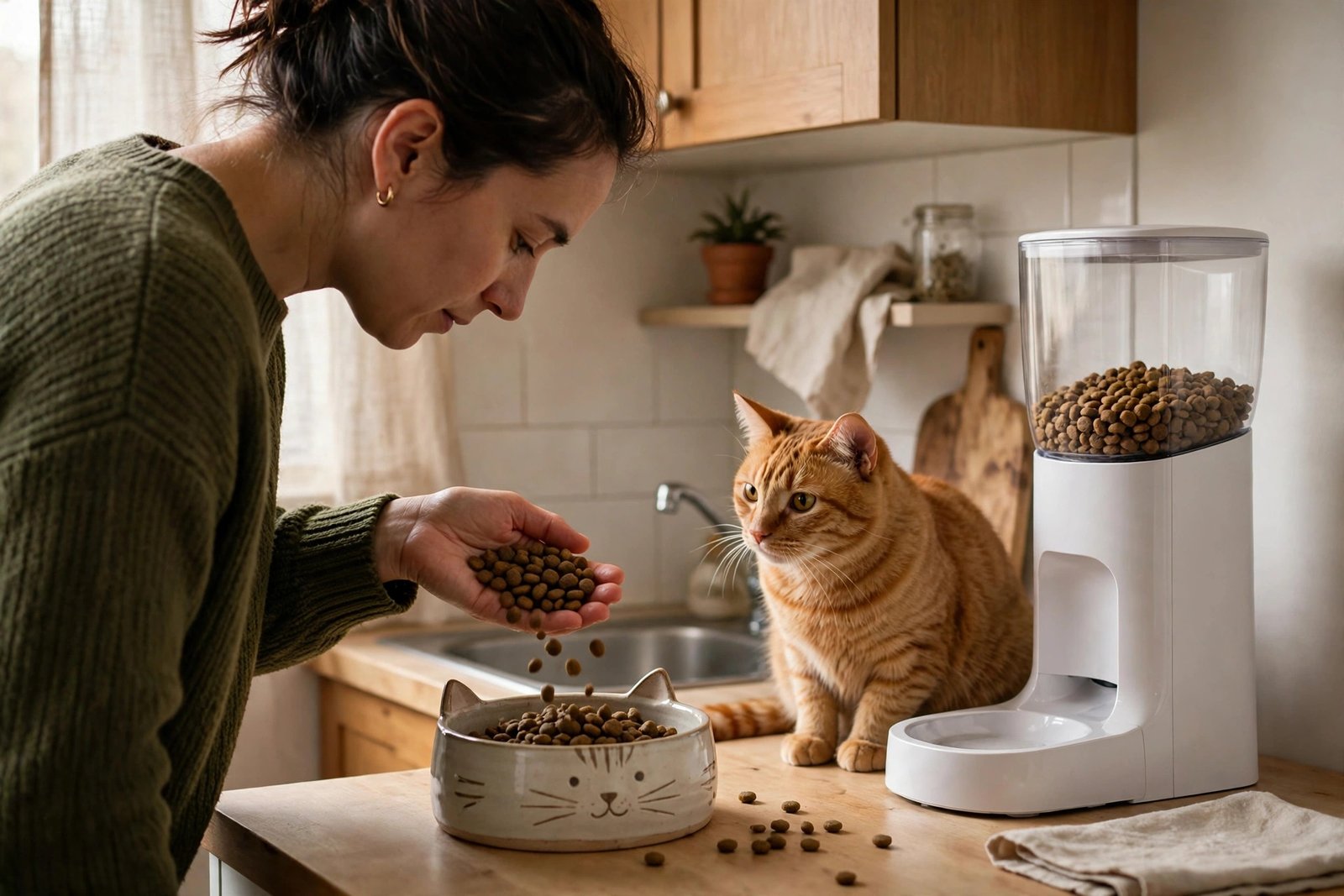
Cleaning is the last part of the hybrid, and it is the part people skip. Serlig’s guidance is a bowl wash every couple of days and a full hopper wash about monthly, because the oils from dry food build up on the inside surfaces and can go rancid. In a small kitchen that is a five-minute sink job, not a project — but the hopper is the piece that gets forgotten, because it looks clean from the outside while the inside is coated. Put it on the same monthly rhythm as the rest of the kitchen deep clean, and the feeder stays a tool instead of becoming a smell.
Which one should you choose?
If your schedule is predictable, your cat eats wet food, or your cat is young, old, or on medication, manual feeding wins — the bowl tells you what the cat is doing, and you are there to hear it. If your hours are irregular, you travel for weekends, or the 5 a.m. wake-up meow is wearing you down, an automatic feeder for the dry meals wins — provided it has battery backup, provided you check the bowl daily, and provided a human still looks in on the cat when you are away. If neither description quite fits, the hybrid is the answer, and it is the answer most apartment owners end up with for good reason: it keeps the human in the loop and the schedule on time at once.
Whichever you choose, the feeder is the least important part of the decision. The routine is the decision — who checks the bowl, who notices when the cat eats less, and who is there when the machine fails. Get that routine right and either feeder works. Get it wrong and no feeder fixes it.
How this guide was put together
This guide was put together by reading and comparing the published comparison guides on automatic versus manual feeding — J’s PetHub’s pros-and-cons comparison and Serlig’s worth-it review — and then testing each of their claims against the constraints of a small apartment: wet vs dry food, outlet access, jams nobody notices, and weekend travel. Two further pages listed in the original research brief, both on Alibaba’s product-insights section, returned 404 errors when checked on November 12, 2026, so nothing from them is cited or relied on here. No products were tested and no products are recommended in this guide; the companion listicle for owners who do want to buy is our roundup of the best automatic cat feeder for busy owners. No paid placements, no sponsored content, and no veterinary advice — if your cat stops eating, or eats noticeably less for more than a day, contact your vet.
FAQs
Are automatic cat feeders worth it?
For dry-food cats with irregular schedules, yes — a timed feeder holds portions and mealtimes steady when you are late or away for a weekend. For wet-food cats, or cats that need close appetite monitoring, a manual bowl is worth more, because you see at once when the cat eats less. The hybrid — manual wet food plus automatic dry kibble — is the setup most apartment owners end up with.
Can automatic cat feeders serve wet food?
Standard hopper feeders cannot; they take dry kibble only. Wet food needs a carousel-style feeder with ice packs to keep it fresh, which is a different device with different cleaning. If your cat’s diet is mostly wet food, manual feeding is the practical answer for those meals.
What happens if an automatic cat feeder jams or the power goes out?
The cat misses a meal, and nothing in the room tells you so. Choose a feeder with battery backup so the schedule survives a power cut, keep the backup batteries fresh, and check the bowl after the morning dispense every day — a jam caught in hours is an inconvenience, and a jam caught in days is a problem.
Will my cat still bond with me if a machine feeds it?
Feeding is one bonding moment, not the only one. Play, grooming, and lap time carry the bond, and a hybrid setup — hand-feeding the wet meal, automating the dry ones — keeps a daily face-to-face feeding in the routine. J’s PetHub makes the same point: the feeder is a tool, not a replacement for attention.
Is an automatic feeder safe to leave with a cat for a weekend?
It covers the food, but it does not cover water, litter, a jam, or a cat that stops eating. A neighbour or sitter should still check in once a day. Never leave a cat alone for a week on a feeder alone, and leave a full manual bowl as backup on the first trip.
How often should I clean an automatic cat feeder?
Serlig’s guidance is the bowl every couple of days and the full hopper about monthly, because kibble oils build up inside and can go rancid. In a small kitchen that is a five-minute sink job — the hopper is the piece people forget, because it looks clean from the outside.
Related reading
- Best Automatic Cat Feeder for Busy Owners — the companion listicle: the actual models to buy once this guide has settled the decision.
- Best Slow Feeder for Cats — for the fast eater in a hybrid setup: slow the manual meal down so the timed portions are not undone in thirty seconds.
- Best Puzzle Feeder for Cats — turn the dry meal into enrichment instead of a machine drop, for cats that eat too fast or get bored.
- Best Elevated Cat Bowls — the manual side done well: raised bowls for the hand-fed meal, especially for senior cats.
- Best Small Cat Water Fountains — water is the other half of the weekend-away setup: a fountain the cat actually drinks from while the feeder handles the food.
Last updated: November 12, 2026
Pingback: Best Airline Approved Cat Carriers 2027