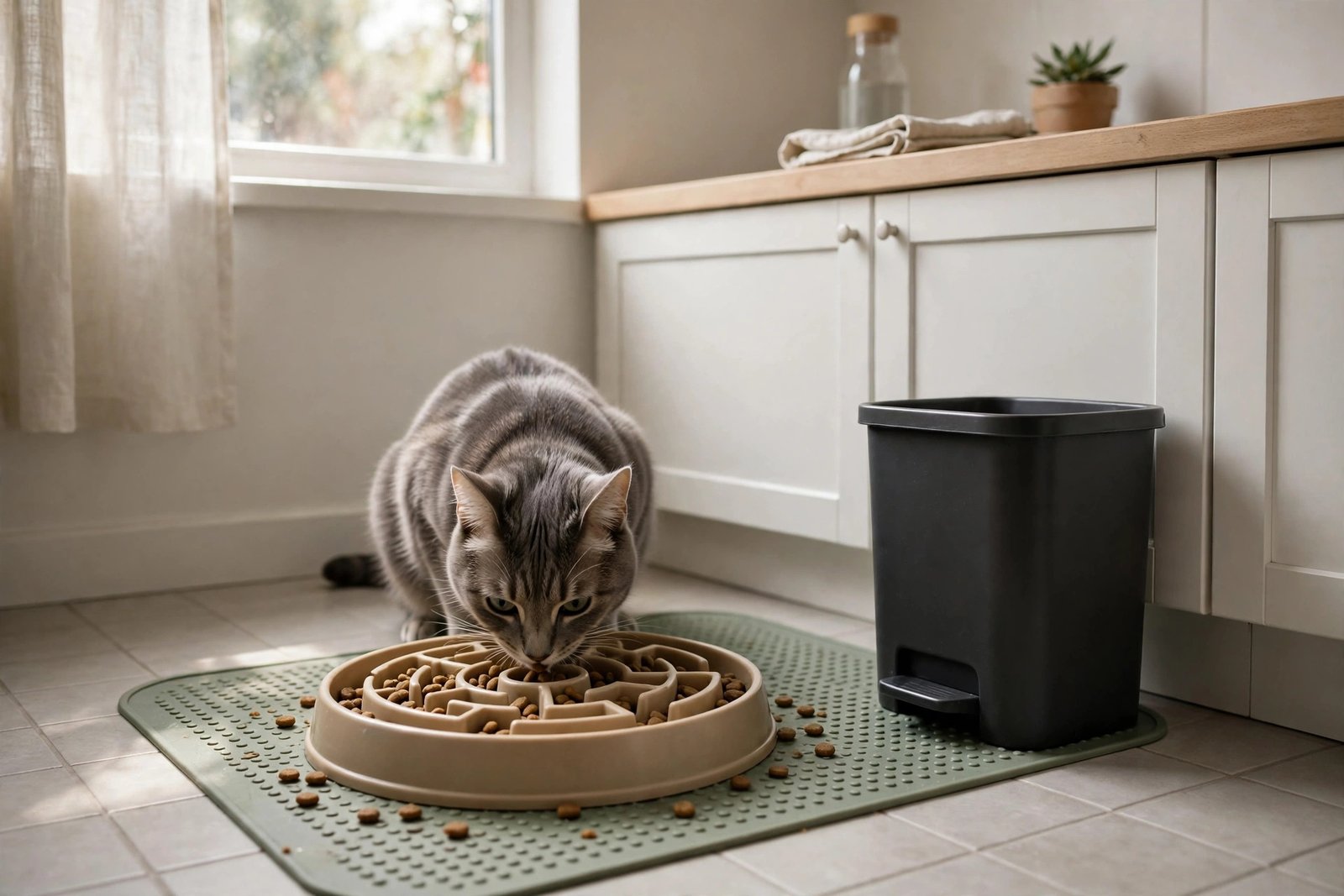
The search for the best slow feeder for cats usually starts on the rug: the familiar scarf-and-barf cycle, where a fast eater inhales dinner in ninety seconds and returns it to the living-room carpet twenty minutes later. In a small apartment, that rug is often the only rug, and the problem is not cosmetic — it is daily. Slow feeders fix the mechanics: raised ridges, maze grooves, and textured surfaces inside the meal bowl force the cat to work around obstacles, stretching a ninety-second inhale into a five- or ten-minute meal. We researched and compared seven slow-feeder bowls and lick mats for fast eaters, weighing slowing power against the honest cleaning trade-off, and checked every product page on the day of writing. No testing claims, no paid placements — just listing facts, verified buyer feedback, and the drawbacks stated plainly.
One important distinction before the picks, because these categories get mixed up constantly: this guide covers slow-feeder bowls and mats — the raised ridges and textures served at mealtimes to slow gulping, targeting vomiting and weight. It does not cover puzzle feeders, which are foraging games — treat-dispensing toys that make cats work for food as play between meals. If you want the between-meal enrichment lane, our guide to the best puzzle feeders for cats covers it. Many households end up with both: a slow feeder for dinner, a puzzle feeder for the afternoon. One intent, one article — this one is the mealtime fix.
How to use this guide: the comparison table gives you the seven picks at a glance. Below it, each product section explains why it earned its award, what buyers actually report, and the clearest drawback we found. The buying guide at the end gives you the decision framework — kibble goes to maze bowls, wet food goes to lick mats — plus the cleaning reality every slow feeder shares and the chewer warning worth reading before you buy.
Scarf-and-barf: the apartment problem
The fast-eating cycle is simple and miserable. A cat — often a former stray, a multi-cat-competition eater, or just an enthusiastic one — gulps food without chewing, swallows air with it, and the overloaded stomach rejects the meal. The result lands on the floor, usually the softest surface available, which in a small apartment is the rug you also walk on barefoot. Beyond the cleanup, habitual vomiting is not great for the cat either: repeated regurgitation irritates the esophagus and can mask the line between “eats too fast” and “something is actually wrong,” which is why this guide ends with a vet note we mean seriously.
A slow feeder breaks the cycle mechanically, not medically. The ridges do not change the food or the cat’s appetite — they change the pace. A meal that took ninety seconds takes eight minutes, the stomach fills gradually, and the air-swallowing drops. Buyer evidence across all seven picks centers on exactly this: slowed eaters, fewer post-meal vomiting episodes, calmer multi-cat feeding stations. It is not a cure for every vomiting cause, but for the pure speed problem, it is the most direct fix available — and it costs less than one rug cleaning.
Slow feeder vs puzzle feeder: not the same thing
Because the two get conflated in nearly every search result, here is the clean split. A slow feeder is a bowl or mat with raised obstacles inside it. You serve the regular meal in it, at mealtimes, and the obstacles slow the eating pace. Its job is gulping, regurgitation, and portion pacing. A puzzle feeder is a foraging game: the cat bats, rolls, or paws at a toy to release kibble or treats between meals. Its job is boredom, enrichment, and the hunting instinct. Different tool, different moment, different article.
The practical upshot: if your cat inhales dinner and vomits, you want this guide. If your cat is bored at 2 p.m. and needs a job, you want our puzzle feeder guide. Plenty of apartment households run both — slow feeder at breakfast and dinner, puzzle feeder for the midday shift while you are at work — and they do not compete. Just do not buy a puzzle feeder expecting it to fix scarf-and-barf, or a slow feeder expecting it to entertain a bored cat. Each does one job.
Quick picks
| Award | Product | Why it stands out | Check Price |
|---|---|---|---|
| Best overall maze bowl | Petstages Kitty Slow Feeder, Green, 0.75 cup | The classic kibble maze; buyers report slowed eaters and less post-meal vomiting — grooves can run deep for small cats | Check Price on Chewy |
| Best for wet food | LickiMat Variety Pack Slow Feeder Cat Lick Mat, Green & Turquoise, 2 count | Two textured mats that stretch wet food into minutes of licking; 4.0–4.1 stars across 132–146 ratings | Check Price on Chewy |
| Best bowl-style lick mat | LickiMat Felix Non-Skid Thermoplastic Rubber Cat Bowl | Bowl shape contains wet food better than flat mats; non-skid base for hard floors, 4.5 stars across 53 ratings | Check Price on Chewy |
| Best for kittens | LickiMat Catster Non-Skid Thermoplastic Rubber Cat Bowl | Slowed ravenous kittens from ~1-minute inhaling to ~10 minutes of licking, per buyers; 4.5 stars across 95 ratings | Check Price on Chewy |
| Best for seniors / flat-face | LickiMat Casper Non-Skid Thermoplastic Rubber Cat Bowl | Flat, shallow, whisker-friendly design for older cats; in stock — rating count not verified | Check Price on Chewy |
| Best simple silicone maze | Catstages Non-Skid Slow Feeder Cat Bowl, Orange, 0.5-cup | Quieter-than-plastic silicone maze with non-slip base; 4.3 stars across 299 ratings, dishwasher-safe top rack | Check Price on Chewy |
| Best elevated option | Neater Pets Adjustable Non-Skid Plastic Slow Feeder Dog & Cat Bowl, 2.5-cup | Adjustable-height elevated feeder with removable slow-feeder insert; 4.1 stars across 46 ratings | Check Price on Chewy |
Best overall maze bowl: Petstages Kitty Slow Feeder, Green, 0.75 cup
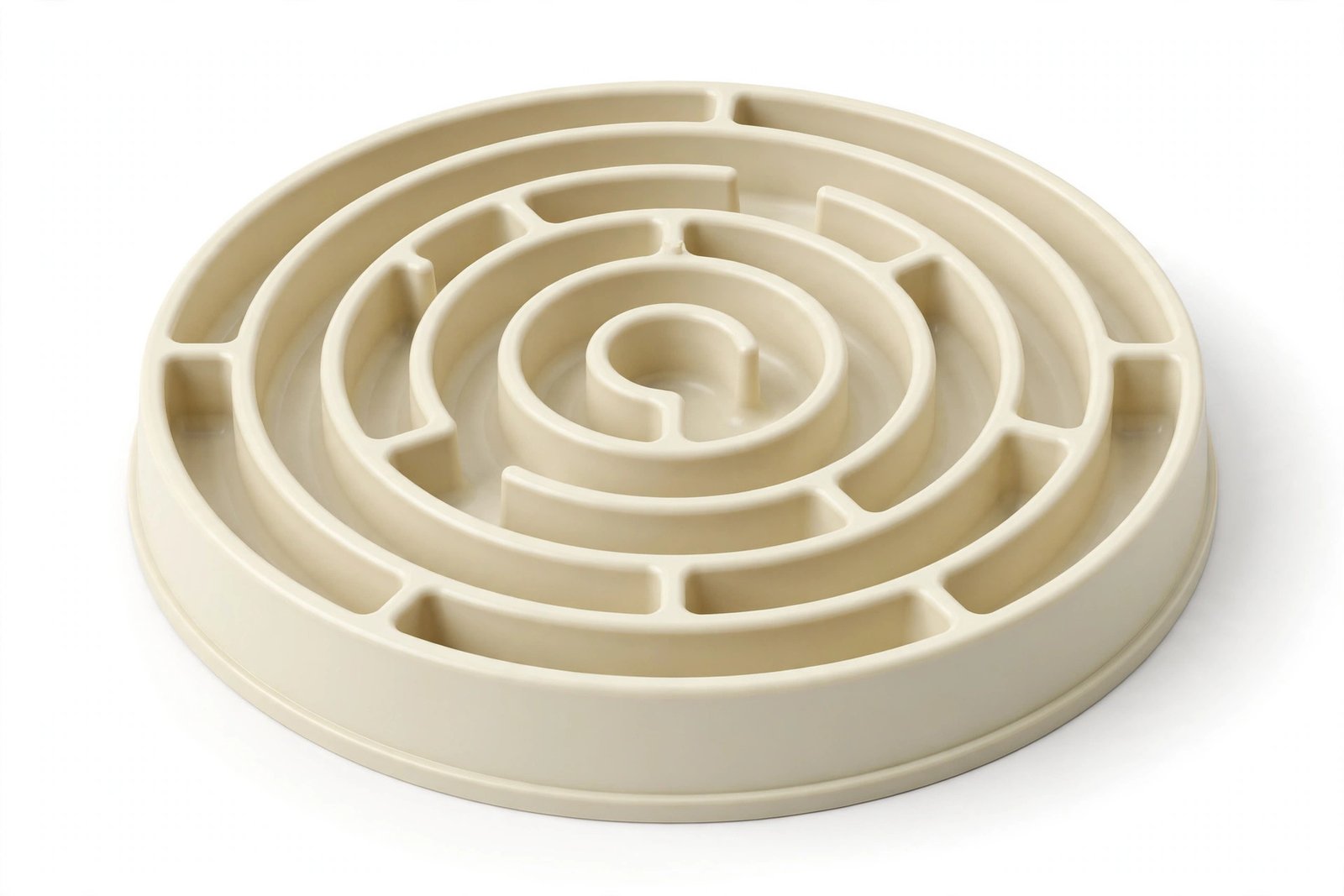
This is the classic answer to the fast kibble eater: a 0.75-cup bowl in hard plastic (polypropylene, BPA/PVC/phthalate-free per Chewy’s customer Q&A) with raised maze grooves that force the cat to eat around obstacles instead of inhaling. The buyer evidence is the core slow-feeder promise delivered — reviewers report it slowed fast eaters and reduced post-meal vomiting, and one multi-cat buyer notes it stopped a gulper from raiding other cats’ dishes and restored calm at feeding time. Designed in Colorado and manufactured in China, with a solid bottom that does not stack, per the listing Q&A.
The honest drawbacks, and we state them plainly because the rating is mixed: 4.0 stars across 383 ratings on the deals page, with the product page showing 3.5 across 694 — this is not a universally loved pick. The recurring complaint is that the grooves can be too deep for smaller or less persistent cats; multiple buyers report cats unable to reach food in the deepest channels, with one resorting to cutting out ridges to make it usable. Hard plastic is also not the pick for cats that chew their bowls. It earns best overall as the category-defining maze bowl with real scarf-and-barf evidence — not as a flawless one.
Apartment scorecard: Footprint — 0.75-cup capacity; compact single-bowl size for a feeding corner. Noise — hard plastic clatters on hard floors; a mat underneath quiets it. Installation — none; solid-bottom bowl, place and fill. Rental-friendly — yes; no mounting, no damage. Cleaning — smooth hard plastic wipes and washes easily, but food packs into the deep grooves — soak before washing. Best room — kitchen or feeding corner on a washable mat.
Best for wet food: LickiMat Variety Pack Slow Feeder Cat Lick Mat, Green & Turquoise, 2 count
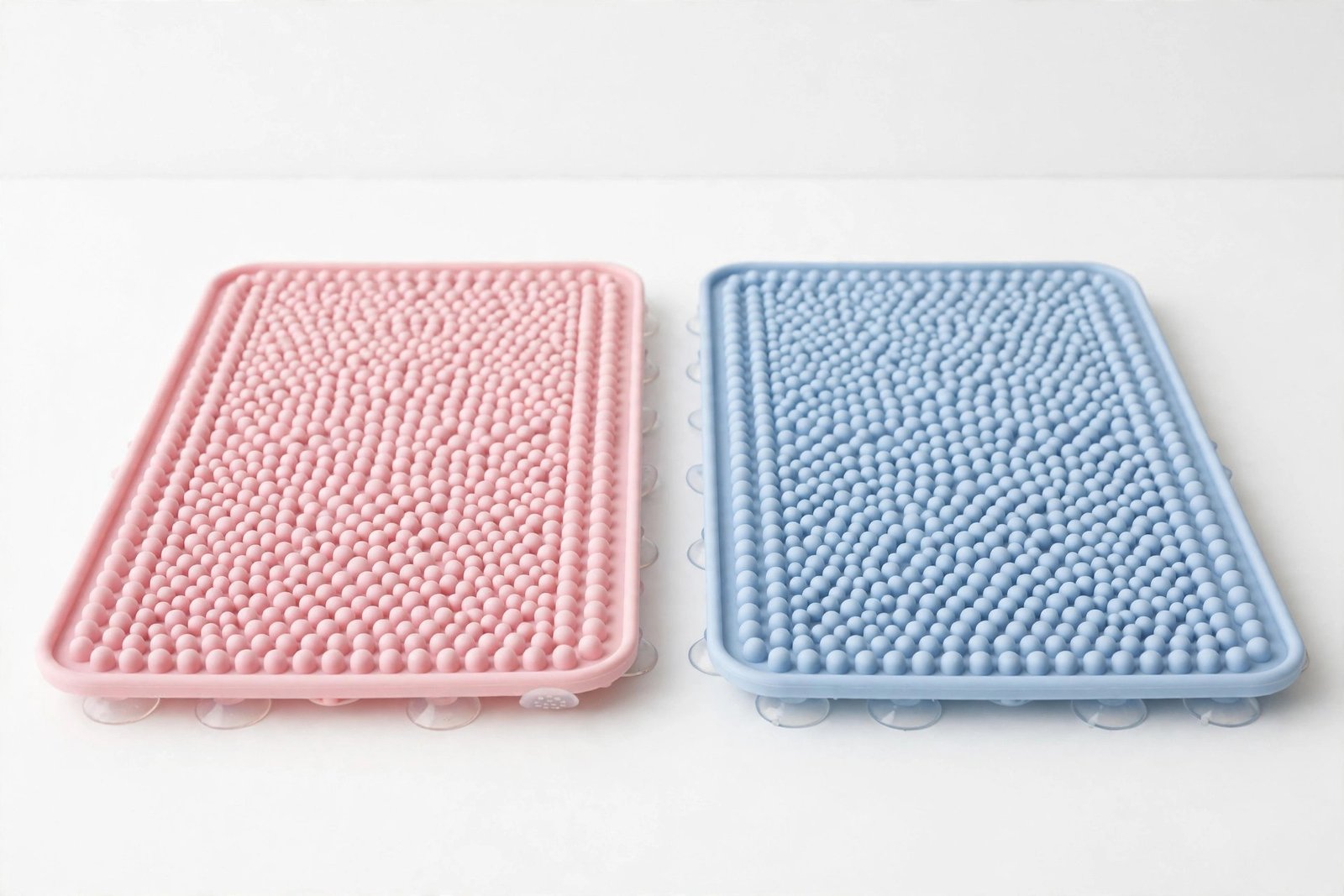
Maze bowls are built for kibble; wet food needs a different surface, and that is the LickiMat’s lane. This two-pack of flat textured mats works with raw, wet, dry, freeze-dried, and liquid food, per Chewy’s customer Q&A — you smear the food across the raised nubs and the cat licks instead of gulps. The buyer evidence is striking on the time scale: reviewers report a treat that vanished in seconds stretching to roughly five minutes of licking, and one five-cat household reports it solved a gulping-then-vomiting problem at the shared feeding station. It holds 4.0 to 4.1 stars across 132 to 146 ratings. Bonus use buyers keep mentioning: smeared with a lickable treat, it doubles as a grooming or vet-visit distraction tool.
The honest drawbacks: the cleaning trade-off, stated up front because it is buyers’ number-one complaint across this whole category. Textured ridges that slow a cat also trap food — these need scrubbing or soaking, and the Q&A recommends hand-washing, with the dishwasher only if the mat is laid perfectly flat. And they are not for aggressive chewers: thermoplastic rubber can be gnawed, and a mat is not a chew toy (see the buying guide). For wet-food households, though, nothing else on this list slows a meal like a lick mat.
Apartment scorecard: Footprint — two flat mats; nearly zero storage footprint, slide anywhere. Noise — silent; licking makes no sound. Installation — none; lay flat and smear. Rental-friendly — yes; nothing to mount, nothing to damage. Cleaning — the trade-off pick: ridges trap wet food, so soak-then-scrub is the routine; hand-wash recommended. Best room — kitchen floor on a washable mat; doubles as a calm-down tool anywhere.
Best bowl-style lick mat: LickiMat Felix Non-Skid Thermoplastic Rubber Cat Bowl
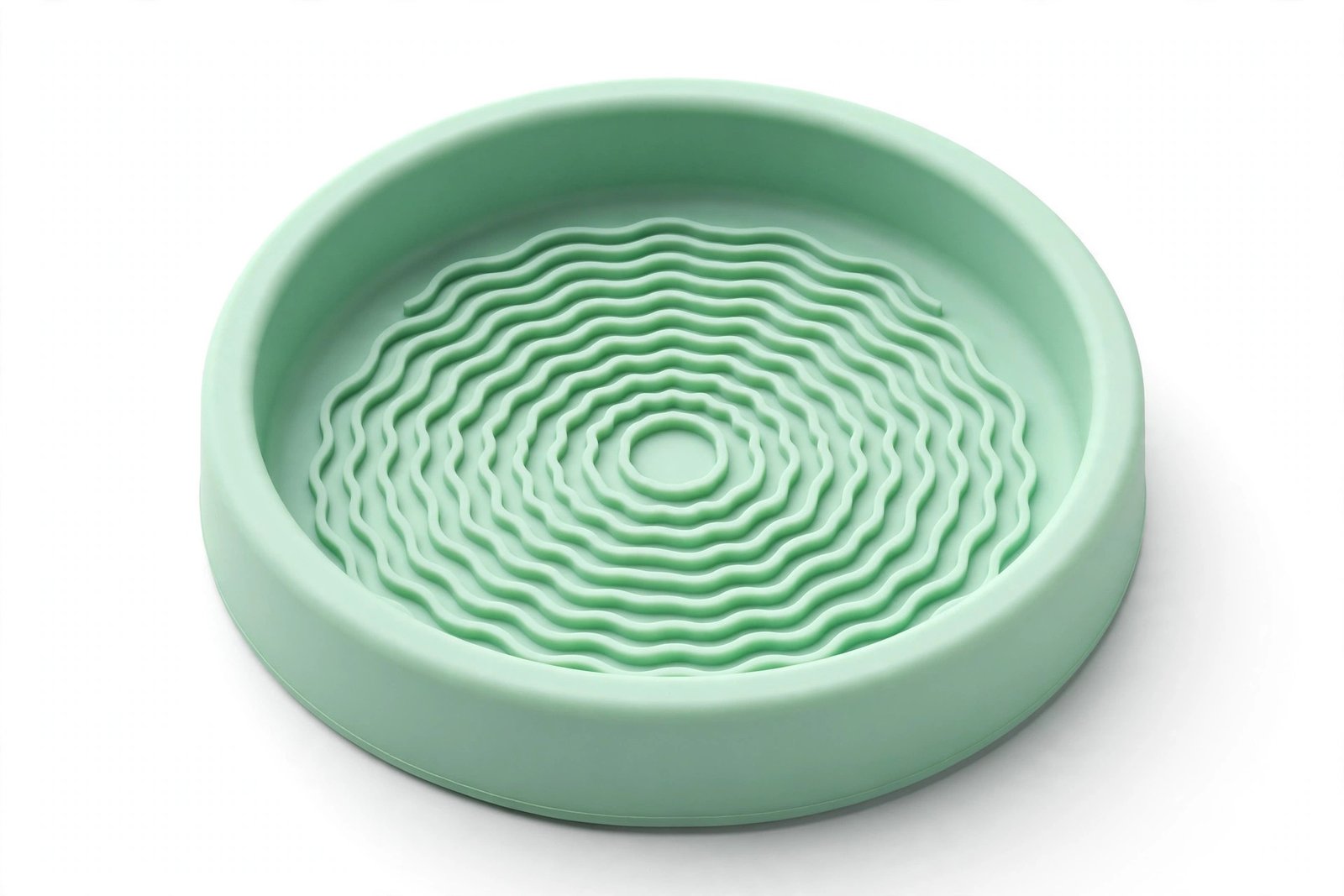
The Felix answers the flat mat’s one structural weakness: on hard floors, smeared wet food migrates off the edges. This is the same LickiMat texture concept in a bowl shape, with a non-skid base — the walls contain the food, the base keeps the unit from skating across tile or wood. The buyer story that defines it: one reviewer switched from ceramic slow feeders that kept chipping and reports the Felix slowed a wet-food scarfer enough for a housemate cat to eat in peace. That is two problems solved at once — the gulping and the multi-cat dinner tension. It holds 4.5 stars across 53 ratings: a smaller review base, stated honestly.
The honest drawbacks mirror the flat mats: cleaning is the recurring complaint, with wet food sticking in the ridges and needing a soak, and determined chewers can damage the thermoplastic rubber. The review base is also thin at 53 ratings, so the evidence is promising rather than deep. Pick the Felix over the flat Variety Pack if your floors are hard and your cat pushes food around; pick the flat pack if you want the multi-surface variety and the distraction-tool use case.
Apartment scorecard: Footprint — single bowl footprint; contains food better than flat mats on hard floors. Noise — silent; rubber does not clatter. Installation — non-skid base; place on tile or wood without sliding. Rental-friendly — yes; no mounting, floor-safe. Cleaning — wet food sticks in ridges; soak before washing, per buyer reports. Best room — kitchen or feeding station on hard flooring, where the non-skid base earns its keep.
Best for kittens: LickiMat Catster Non-Skid Thermoplastic Rubber Cat Bowl
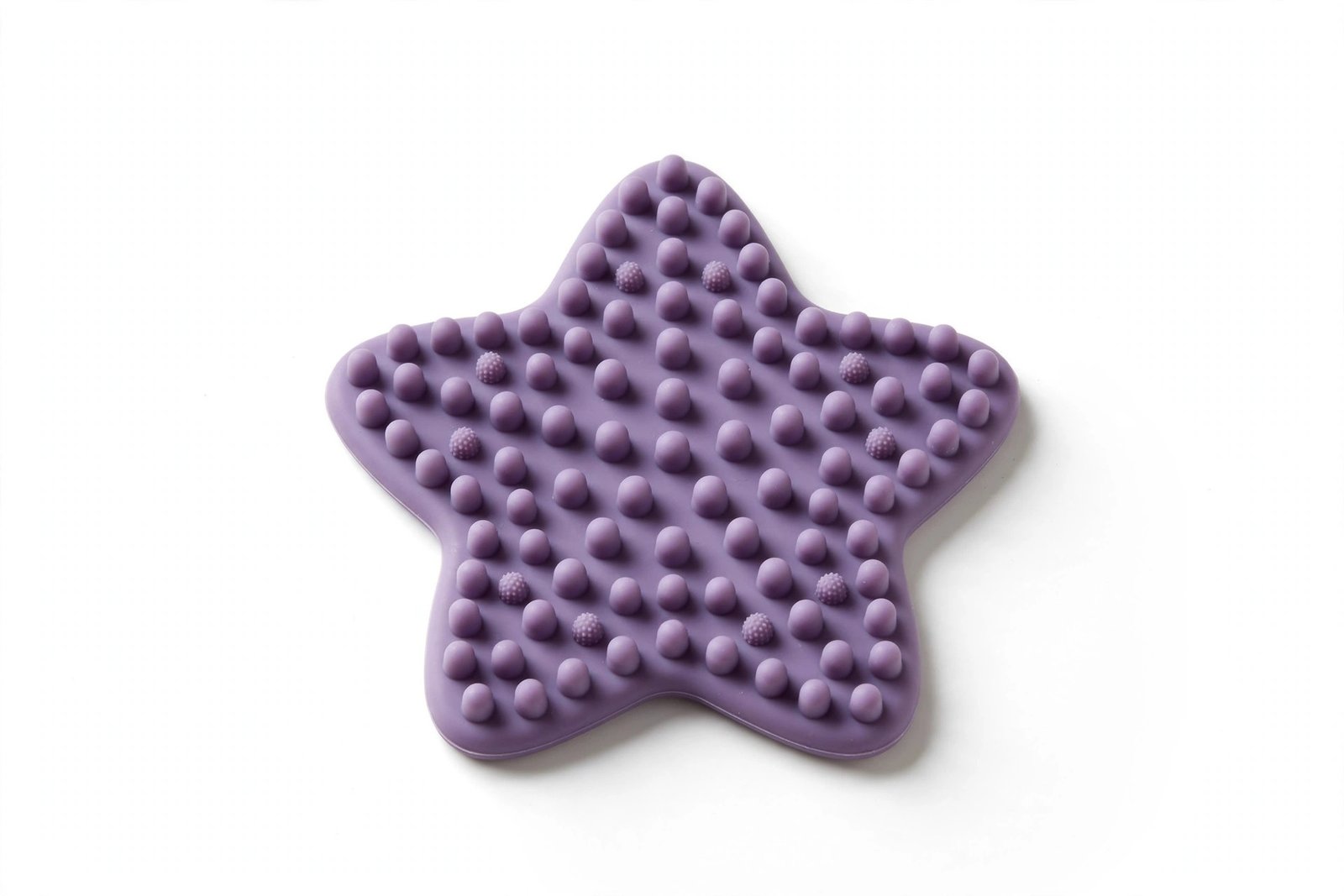
Kittens are the worst gulpers — young, competitive, and convinced every meal is the last one — and the Catster is the LickiMat line’s answer sized for them. Same bowl-style concept as the Felix: textured licking surface, non-skid thermoplastic rubber base, portion pacing instead of inhaling. The buyer evidence is the strongest age-specific result on this list: reviewers report it slowed ravenous kittens from roughly one-minute inhaling to about ten minutes of licking, and one buyer notes a formerly huge-bellied kitten now naps contentedly after meals. Chewy’s customer-mention data shows design at 90% positive and effectiveness at 86% positive, with 4.5 stars across 95 ratings.
The honest drawbacks are the familiar LickiMat pair: leftover bits in the corners need a soak — kitten portions are small, but the texture still traps them — and the same chew-risk caveat applies, doubly so for teething kittens that mouth everything. Supervise rather than leaving it down all day with a determined chewer. For the apartment with a new kitten inhaling meals and a rug you would like to keep, this is the most targeted fix on the list.
Apartment scorecard: Footprint — small bowl; kitten-portion size for tight feeding corners. Noise — silent. Installation — non-skid base; stays put on hard floors. Rental-friendly — yes. Cleaning — hand-washable; soak the corners where bits collect. Best room — kitchen feeding corner; wherever the kitten’s meals happen.
Best for seniors / flat-face: LickiMat Casper Non-Skid Thermoplastic Rubber Cat Bowl
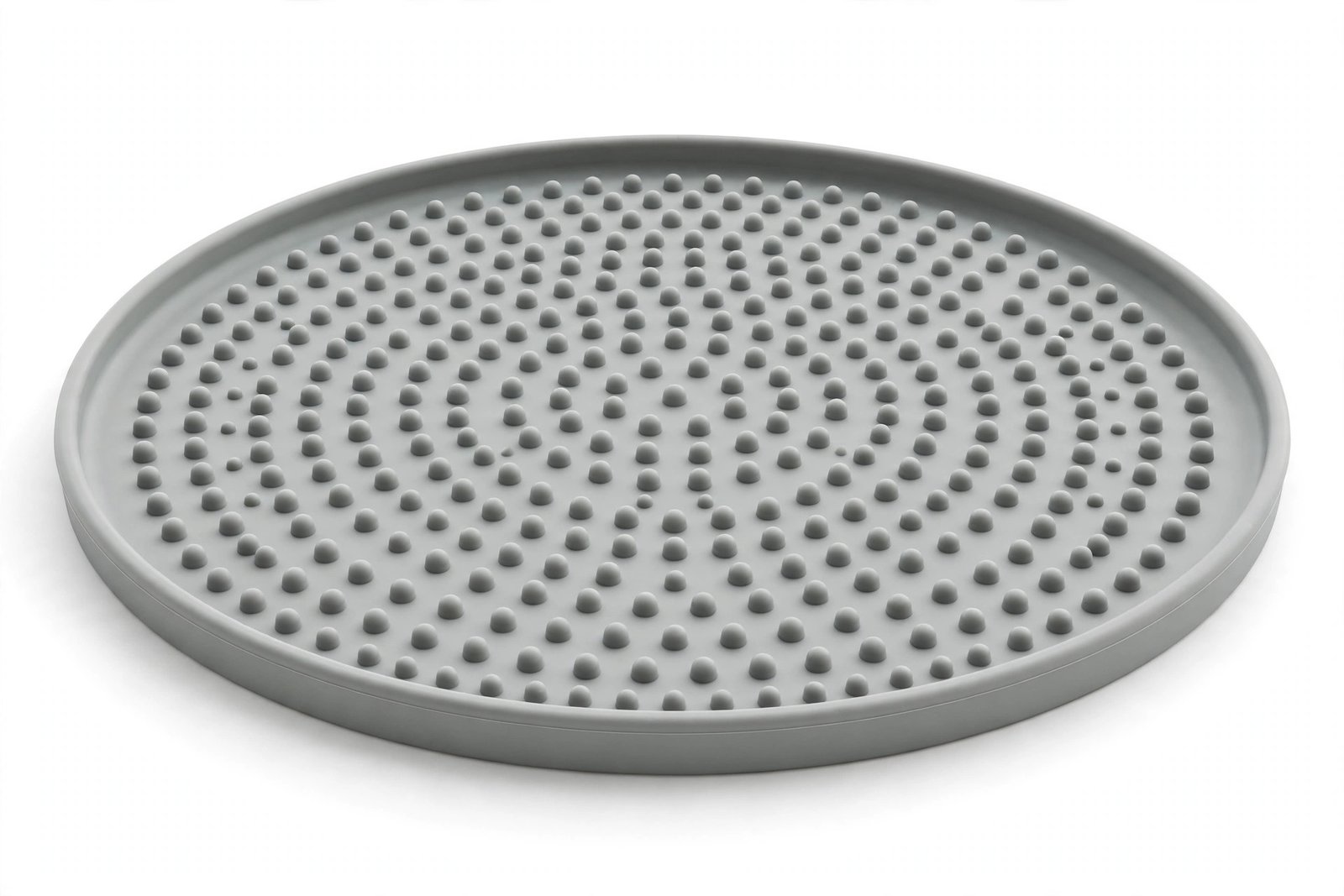
Deep maze grooves are a young cat’s game; older cats, flat-faced breeds, and cats with neck or whisker sensitivity need the opposite geometry. The Casper is LickiMat’s flat, shallow answer: a low-profile textured surface the listing describes as made for mature cats, comfortable crouching, and no whisker stress, with hydration surfaces for broth and cream alongside kibble, wet, raw, pates, and gels. The shallow licking surface is the entire senior/flat-face argument — the cat eats without pressing whiskers against walls or craning into channels. The page was in stock on the day of research; the rating count was not verified on today’s fetch, so we make no rating claim for this pick.
The honest drawbacks, and the trade-off is structural: shallow means less slowing power for truly frantic gulpers. If your senior cat is also a speed eater, the Casper paces the meal but will not brake it the way a deep maze bowl does — that is the price of the whisker-friendly geometry, stated plainly. The rating base is also unverified, so this award rests on the design rationale and the listing’s positioning rather than deep buyer evidence. For the older cat that eats politely but uncomfortably, though, the shape is exactly right.
Apartment scorecard: Footprint — flat shallow mat-bowl; slides into any feeding spot. Noise — silent. Installation — non-skid base; place and serve. Rental-friendly — yes. Cleaning — shallow texture rinses easier than deep grooves; hand-wash per the line’s guidance. Best room — wherever the senior cat already eats; low profile suits floor-level feeding.
Best simple silicone maze: Catstages Non-Skid Slow Feeder Cat Bowl, Orange, 0.5-cup
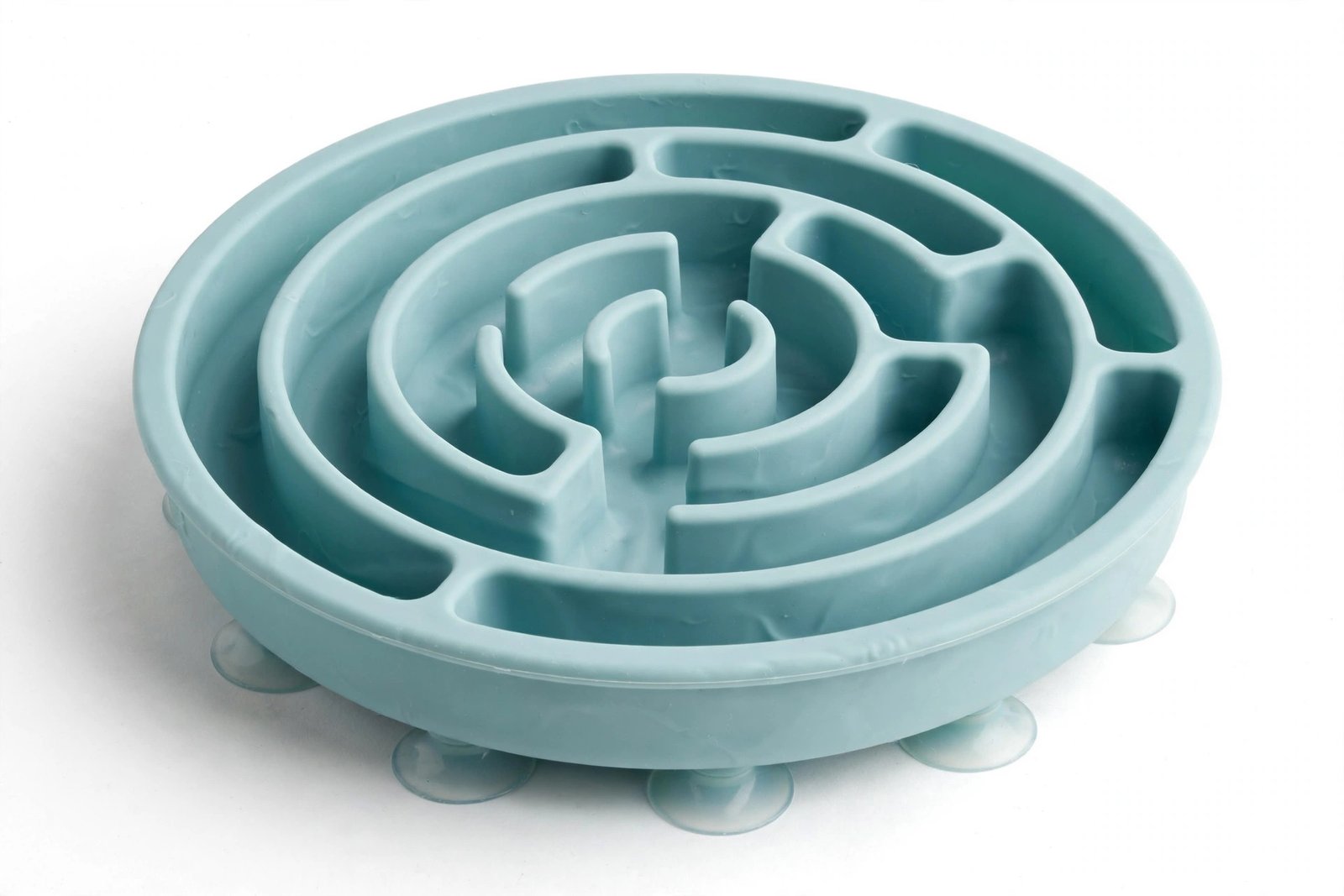
For the buyer who wants the maze-bowl concept without the hard-plastic clatter, the Catstages Non-Skid is the silicone answer: a 0.5-cup maze bowl with a non-slip base, verified by Chewy’s customer Q&A as silicone on the harder side rather than soft, dishwasher-safe on the top rack only, and workable with both wet and dry food. Buyer evidence is straightforward — reviewers report it slows fast eaters, and the non-slip base keeps it put. It holds 4.3 stars across 299 ratings, the second-deepest review base on this list. The apartment argument is acoustic as much as anything: silicone is quieter than hard plastic on hard floors, which matters when breakfast happens at 6 a.m. against a shared wall.
The honest drawbacks: the harder-side silicone may not suit cats that prefer soft textures — a few buyers note the firmness — and 0.5 cup is small for large cats or big meals, so check your portions against the capacity before buying. Against the Petstages best-overall, the trade is noise and washability versus groove depth: this one is quieter and top-rack dishwasher-safe, with a simpler maze. For a single-cat apartment with a moderate gulper, simpler is often enough.
Apartment scorecard: Footprint — 0.5-cup capacity; the smallest bowl here, ideal for single-cat apartments. Noise — quiet; silicone beats hard plastic on hard floors. Installation — non-slip base; no assembly. Rental-friendly — yes. Cleaning — dishwasher-safe top rack only, per Chewy Q&A; simpler maze traps less than deep grooves. Best room — kitchen feeding corner; the quiet pick for early-morning meals near shared walls.
Best elevated option: Neater Pets Adjustable Non-Skid Plastic Slow Feeder Dog & Cat Bowl, 2.5-cup
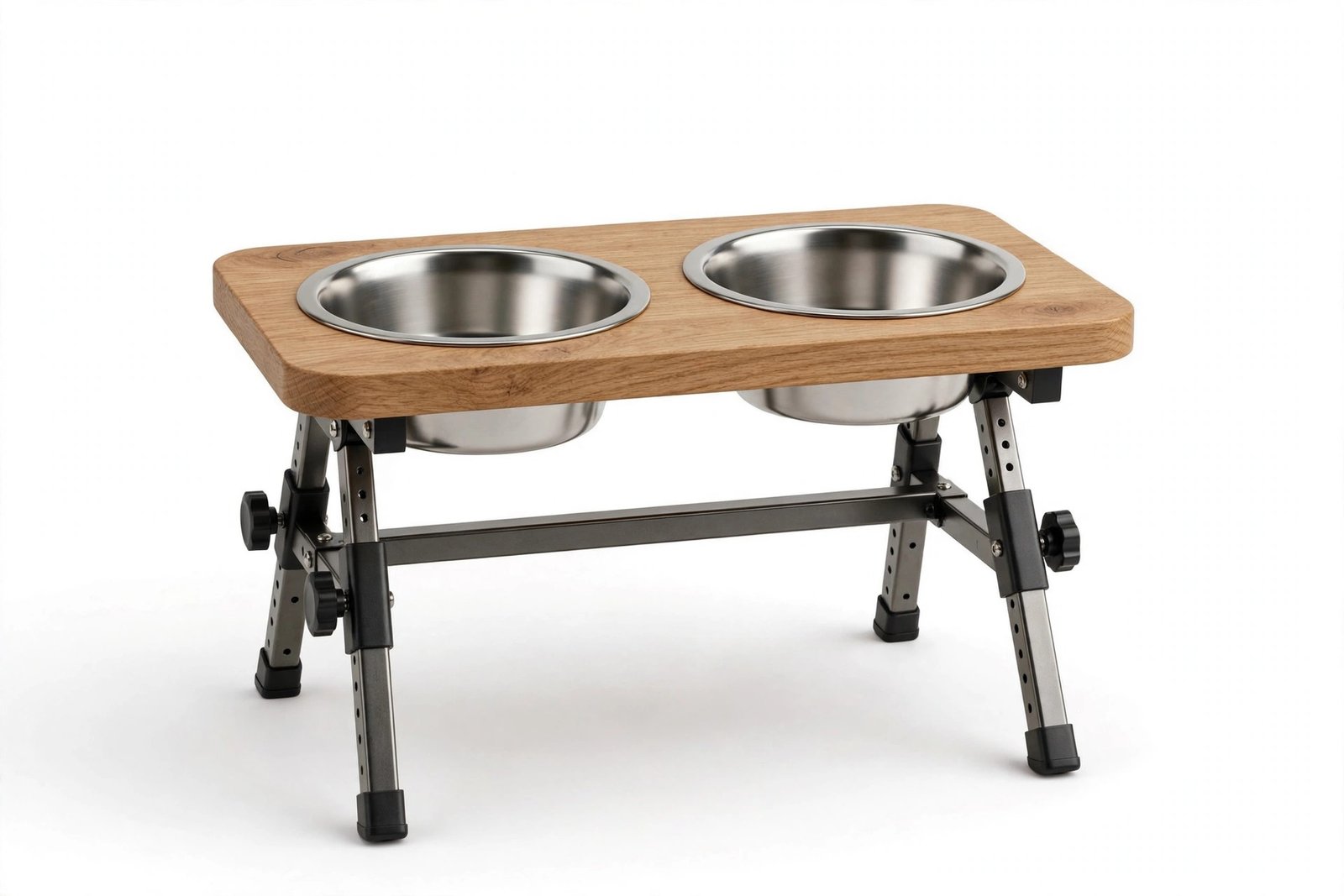
The Neater Pets is the multi-cat and comfort pick: a 2.5-cup elevated feeder with adjustable height — 2, 3, or 4.5 inches via leg extensions, per Chewy’s customer Q&A — a non-skid bottom, and a slow-feeder insert that buyers report is removable, converting it to a normal bowl when the training wheels come off. The buyer evidence centers on the household use case: reviewers report three cats eating simultaneously, with the elevated position praised. For the apartment feeding station serving more than one cat, one 2.5-cup unit replaces a cluster of bowls. It holds 4.1 stars across 46 ratings — a smaller review base, stated honestly.
The honest drawbacks: the review base is thin at 46 ratings, so treat the evidence as promising rather than proven. The construction is plastic, and at 2.5 cups it is sized more like a small-dog bowl — large for petite cats and oversized for a single-cat studio. This is the pick for the specific household it serves — multi-cat, or a cat that genuinely prefers eating elevated — not the default first slow feeder. Everyone else should start with picks 1 through 6.
Apartment scorecard: Footprint — 2.5-cup elevated unit; the largest here — measure your feeding corner. Noise — plastic; moderate, quieter on a mat. Installation — leg extensions set the height (2 / 3 / 4.5 in); insert lifts out for normal-bowl mode. Rental-friendly — yes; freestanding, non-skid. Cleaning — removable insert washes separately; plastic wipes clean. Best room — kitchen or dedicated feeding station with room for the footprint.
How we picked
We researched current Chewy listings for slow-feeder bowls and lick mats with credible buyer evidence behind them, compared verified ratings and review language, and checked every product page on the day of writing. The first filter was the article’s angle: mealtime pace. Picks had to show evidence of actually slowing fast eaters — reviewer language about longer meals, reduced vomiting, calmer multi-cat feeding — not just a textured surface with a claim. The second filter was the apartment fit: footprint and capacity honesty, noise on hard floors, the cleaning trade-off stated for every pick, and the chewer warning where the material demands it. The LickiMat family shares a brand across four picks on purpose — each is differentiated by format (flat mat, bowl, kitten bowl, shallow senior), not re-covered. No brand paid for placement, none of these picks is sponsored, and we did not lab-test any of these feeders.
Buying guide: the wet-vs-dry decision framework, cleaning, and chewers
The decision framework — start here. Dry kibble gulper: buy a maze bowl (picks 1, 6, or 7). The raised grooves work by forcing the cat to eat around obstacles, and kibble’s shape makes it catch in the channels exactly as designed. Wet-food gulper: buy a lick mat (picks 2 through 5). Smearing pate or gravy across texture turns gulping into licking, which is a fundamentally slower motion — maze bowls do not grip wet food the same way. Senior or flat-faced cat: buy shallow (pick 5, the Casper) — deep grooves punish cats with whisker stress or neck stiffness. Multi-cat household: buy capacity and calm (pick 7, the Neater Pets) — one 2.5-cup elevated unit instead of a scrum of bowls. Match the tool to the food and the cat, in that order.
Slow feeder vs puzzle feeder, one more time. If you arrived here from a search and you are still unsure which category you need: the slow feeder slows the meal; the puzzle feeder entertains between meals. Vomiting after eating points here. Boredom at 2 p.m. points to our puzzle feeder guide. They are complementary, not competing — the healthiest apartment setup is often both.
Cleaning is the real trade-off. Say it once and plan for it: every ridge that slows a cat also traps food. It is buyers’ number-one complaint across all seven picks, and no design on this list escapes it — deep maze grooves pack kibble dust, lick-mat texture holds wet food, corners collect bits. The routine that works: soak first, then wash. The Catstages silicone (pick 6) is the easiest of the set at top-rack dishwasher-safe; the LickiMats want hand-washing with a soak. Buy a feeder you will actually clean, because a grimy slow feeder gets abandoned — and an abandoned slow feeder is just a bowl. If cleaning effort is your hard constraint, rank the picks by groove depth: shallower is faster to wash and slower to frustrate.
Supervise chewers. Silicone and thermoplastic rubber mats are feeding surfaces, not chew toys. The cautionary pattern from buyer reports elsewhere in the category: cats that gnaw textured mats can ingest pieces, and one well-known snuffle-mat design’s worst reviews are cats eating the silicone petals. If your cat chews bowls, pick hard plastic (pick 1) or silicone under supervision (pick 6) — and take any mat up between meals rather than leaving it down all day. Texture invites licking; determined chewing is a different behavior and needs a different answer.
The vet note, stated once and plainly. Slow feeders help with scarf-and-barf — the speed problem. They do not diagnose anything. If vomiting persists after switching to a slow feeder, or if it comes with weight loss, lethargy, diarrhea, or blood, see a veterinarian. Habitual vomiting has causes a bowl cannot fix, from food intolerance to conditions that need treatment. The feeder buys you information: if slowing the pace stops the vomiting, it was speed. If it does not, that is data for the vet visit — not a reason to buy a deeper maze.
Frequently asked questions
Do slow feeders really work for cats that eat too fast?
For the speed problem, yes — that is the best-evidenced claim in this guide. Buyers across all seven picks report longer mealtimes and fewer post-meal vomiting episodes, with the most dramatic numbers on lick mats (a seconds-long meal stretching to five or ten minutes of licking). The mechanism is simple: obstacles force pacing, pacing reduces air-swallowing and stomach overload. What a slow feeder does not do is fix vomiting with other causes — see the vet note in the buying guide if the problem persists after the pace changes.
Should I get a maze bowl or a lick mat — wet food or dry?
Match the tool to the food. Dry kibble goes in a maze bowl: the kibble pieces catch in the grooves and the cat works them out one by one. Wet food goes on a lick mat: smearing pate, gravy, or treats across texture converts gulping into licking, which maze bowls cannot do well because wet food slides rather than catches. If you feed both, the honest answer is one of each — or start with whichever meal causes the vomiting and expand from there.
Are lick mats safe for cats that chew?
With supervision, for most cats — but not as unsupervised all-day items for determined chewers. Thermoplastic rubber and silicone mats are feeding surfaces, not chew toys, and an aggressive chewer can gnaw pieces off textured mats. The practical rule: serve the meal on the mat, pick the mat up when the meal is done. If your cat chews bowls habitually, lean toward the hard-plastic maze bowl (pick 1) and supervise any mat use.
What’s the difference between a slow feeder and a puzzle feeder?
A slow feeder is a bowl or mat with raised obstacles, served at mealtimes to slow gulping — its job is eating pace, vomiting, and portion control. A puzzle feeder is a foraging game played between meals — the cat works a toy to release treats, and its job is boredom and enrichment. Vomiting after dinner points to this guide; a bored cat at 2 p.m. points to our puzzle feeder guide. Many households use both without conflict.
My cat still vomits after switching to a slow feeder — when should I see a vet?
Now — or at least soon, and without buying a deeper maze first. A slow feeder fixes the speed problem; persistent vomiting after the pace changes means the cause is something else, and the list of something-elses includes food intolerance, hairballs, parasites, and conditions that need diagnosis. Go sooner if vomiting comes with weight loss, lethargy, diarrhea, blood, or a sudden change in appetite. Bring the observation that slowing the pace did not help — that is genuinely useful information for the vet.
Related reading
Feeding is one system; these are the connected ones: our best automatic cat feeders for busy owners covers scheduled meals when you are out; the puzzle feeder guide is the between-meal enrichment companion to this article; and signs your indoor cat is bored helps you tell a feeding problem from an enrichment problem, since the two get confused constantly.
Last updated: October 16, 2026
Pingback: Best Puzzle Feeder for Cats: 8 Picks for Fast Eaters 2027
Pingback: Best Automatic Cat Feeder for Busy Owners 2027
Pingback: Best Elevated Cat Bowls 2027
Pingback: Best Lick Mat for Cats 2027 - Velvnox
Pingback: Best Slow Feeder for Small Dogs 2027 - Velvnox
Pingback: Automatic vs Manual Cat Feeder for Cats 2027