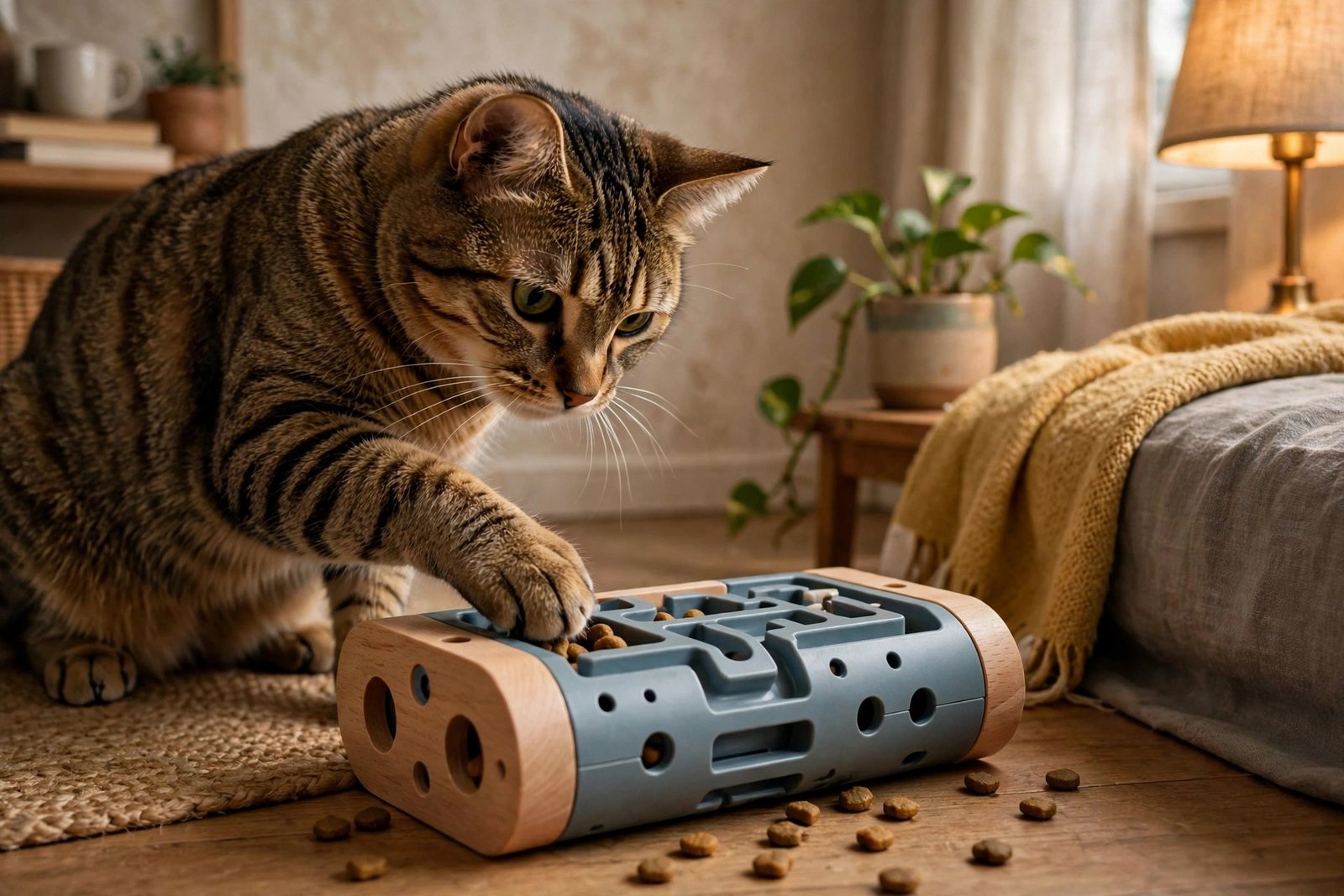
A cat that inhales dinner in thirty seconds flat and then pesters you for more isn’t necessarily still hungry — eating is one of the few activities in a boring indoor day. The best puzzle feeder for cats turns that 30-second inhale into a 15-minute project: the cat has to bat, paw, and problem-solve to extract every kibble, which engages the “work for food” part of the hunting sequence that a bowl completely skips. We compared eight picks across beginner boards, treat balls, and wet-food options, with honest notes on difficulty, cleaning, and noise.
Every pick below was researched from Chewy and Petco listings, ratings, and review text — no paid placements, no hands-on testing. Where a spec couldn’t be verified, we say so instead of guessing.
| Award | Product | Why it stands out | Check Price |
|---|---|---|---|
| Best overall | Catit Senses 2.0 Food Tree | 3 difficulty settings, BPA-free; 4.1 stars from 459 ratings | Check Price on Chewy |
| Best for beginners | Nina Ottosson Melon Madness Puzzle & Play | Adjustable difficulty, no removable parts, easy to clean | Check Price on Chewy |
| Best for fast eaters | Catit Senses 2.0 Digger | 5 tubes slow gobblers down; reviewers report it can’t be flipped | Check Price on Chewy |
| Best treat ball | PetSafe SlimCat Interactive Feeder Ball | Adjustable openings, dishwasher safe; 4.1 stars from 926 ratings | Check Price on Chewy |
| Best puzzle board | TRIXIE Activity Fun Board 5-in-1 | 5 modules including a wet-food tongue module; dishwasher safe | Check Price on Chewy |
| Best wet-food option | LickiMat Casper | Whisker-friendly flat design; works with wet, raw, and gels | Check Price on Chewy |
| Best for advanced cats | Nina Ottosson Buggin’ Out Puzzle & Play | 16 hidden compartments; 4.4 stars from 1,773 ratings | Check Price on Chewy |
| Best budget | Catstages Kitty Cube Puzzle | 10 treat cups for the price of a coffee; 4.7 stars on Petco (thin base) | View at Petco |
Best Overall: Catit Senses 2.0 Food Tree
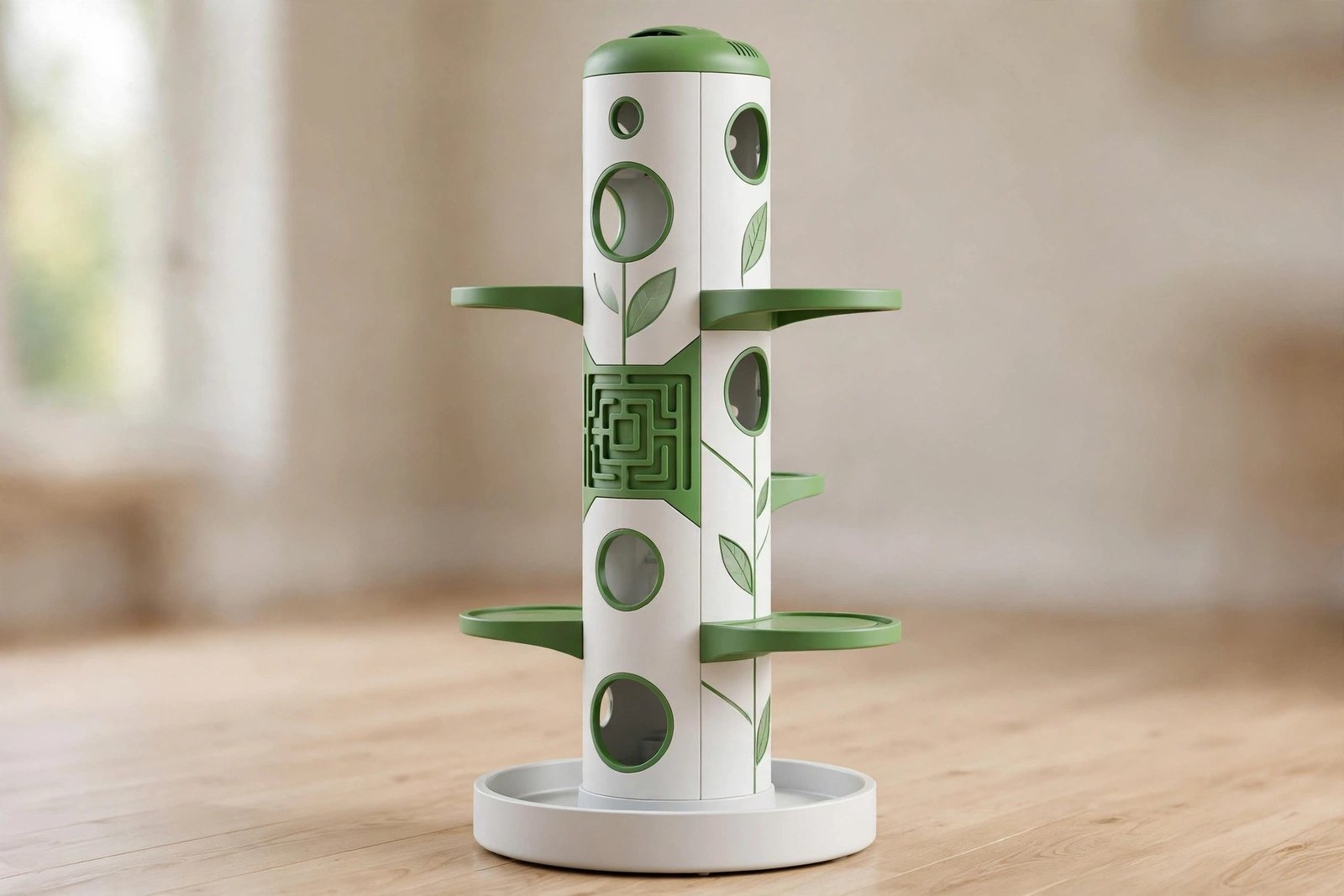
The Food Tree is the puzzle feeder we’d hand to a first-timer: a tower the cat paws kibble through, with three opening settings that adjust the difficulty as the cat learns. Start wide open so food falls easily, then narrow the openings as the cat gets skilled. That progression is the difference between a puzzle the cat uses for years and one abandoned after a day.
It holds 4.1 stars from 459 ratings — not the highest score on this list, but a solid one for a product with genuine mechanical complexity. The BPA-free construction is reassuring for a food-contact product, and it’s designed for dry food and treats.
The honest cleaning note: it’s handwash only, not dishwasher safe. In practice that means a quick rinse of the tower rather than tossing it in with the dishes — a minor chore, but worth knowing before you buy. For a first puzzle feeder, the adjustability outweighs the handwashing.
Apartment scorecard: Footprint: tower format — small floor footprint · Noise: kibble rattling in plastic — mild · Installation: none · Rental-friendly: yes · Cleaning: handwash only · Best room: kitchen or feeding corner — where the kibble already lives
Best for Beginners: Nina Ottosson Melon Madness Puzzle & Play
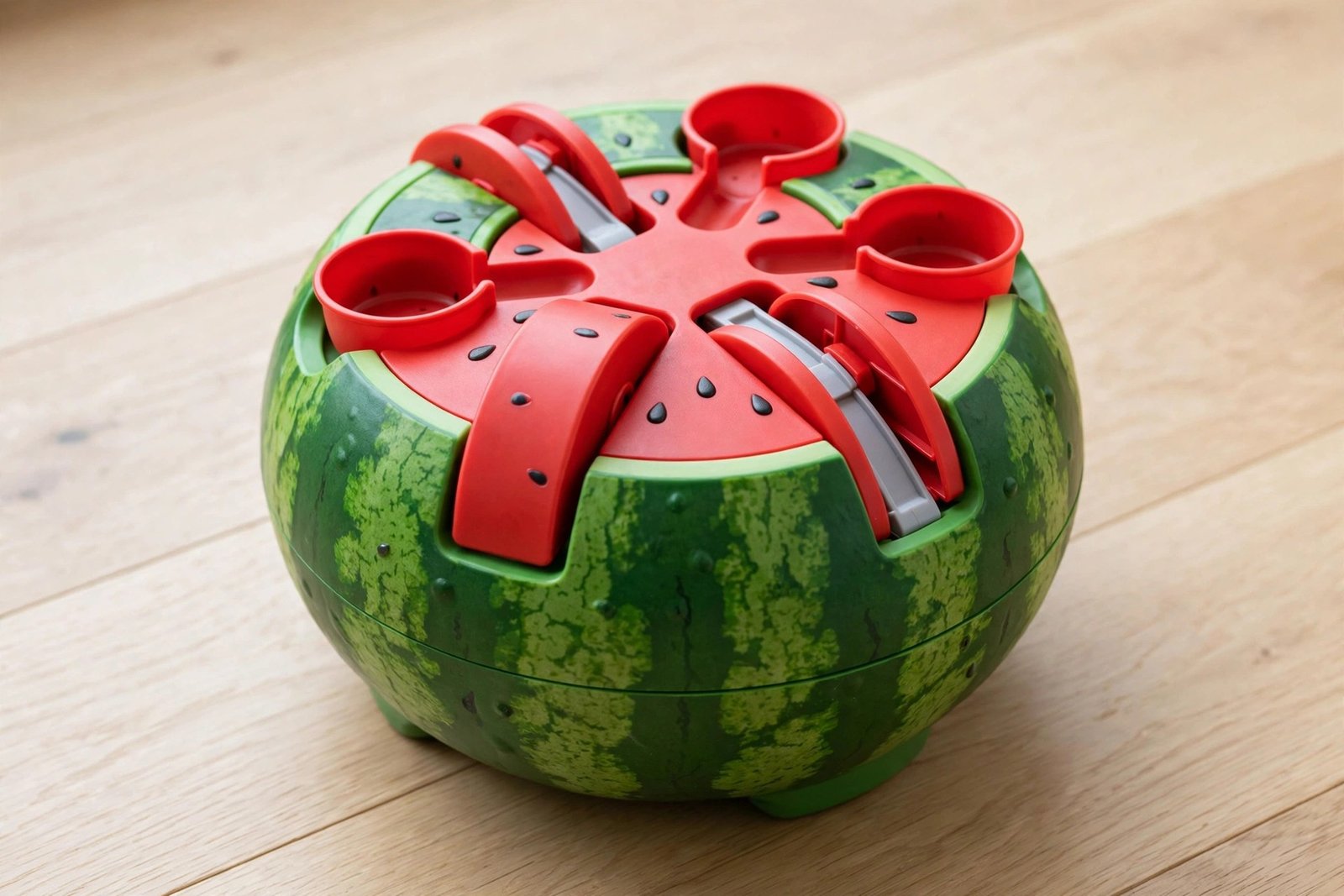
The classic beginner mistake is buying a puzzle that’s too hard — the cat tries once, fails, and never touches it again. The Melon Madness is designed against exactly that: twelve treat cups you can leave fully open for day one, then gradually hide under swiveling seeds and sliding pegs as the cat learns. No removable parts to lose under the couch, which is a genuine design virtue.
It’s BPA, PVC, and phthalate-free with a non-slip base, and at about 10.4 x 10.2 inches it sits neatly in a feeding corner. The manufacturer rates it Level 2 (intermediate), but the adjustable design makes it the right beginner pick of this list — you control the difficulty, not the label.
Honesty on specs: we found conflicting capacity figures across sources for this puzzle, so we’re not stating one — the twelve treat cups are the verified detail. Cleaning is easy precisely because there are no removable parts to disassemble. Start every treat in an open cup; only start hiding them once the cat is confidently emptying the board.
Apartment scorecard: Footprint: ~10.4 x 10.2 in — feeding-corner sized · Noise: quiet — pawing at cups · Installation: none · Rental-friendly: yes · Cleaning: easy, no removable parts · Best room: feeding area — the training ground
Best for Fast Eaters: Catit Senses 2.0 Digger
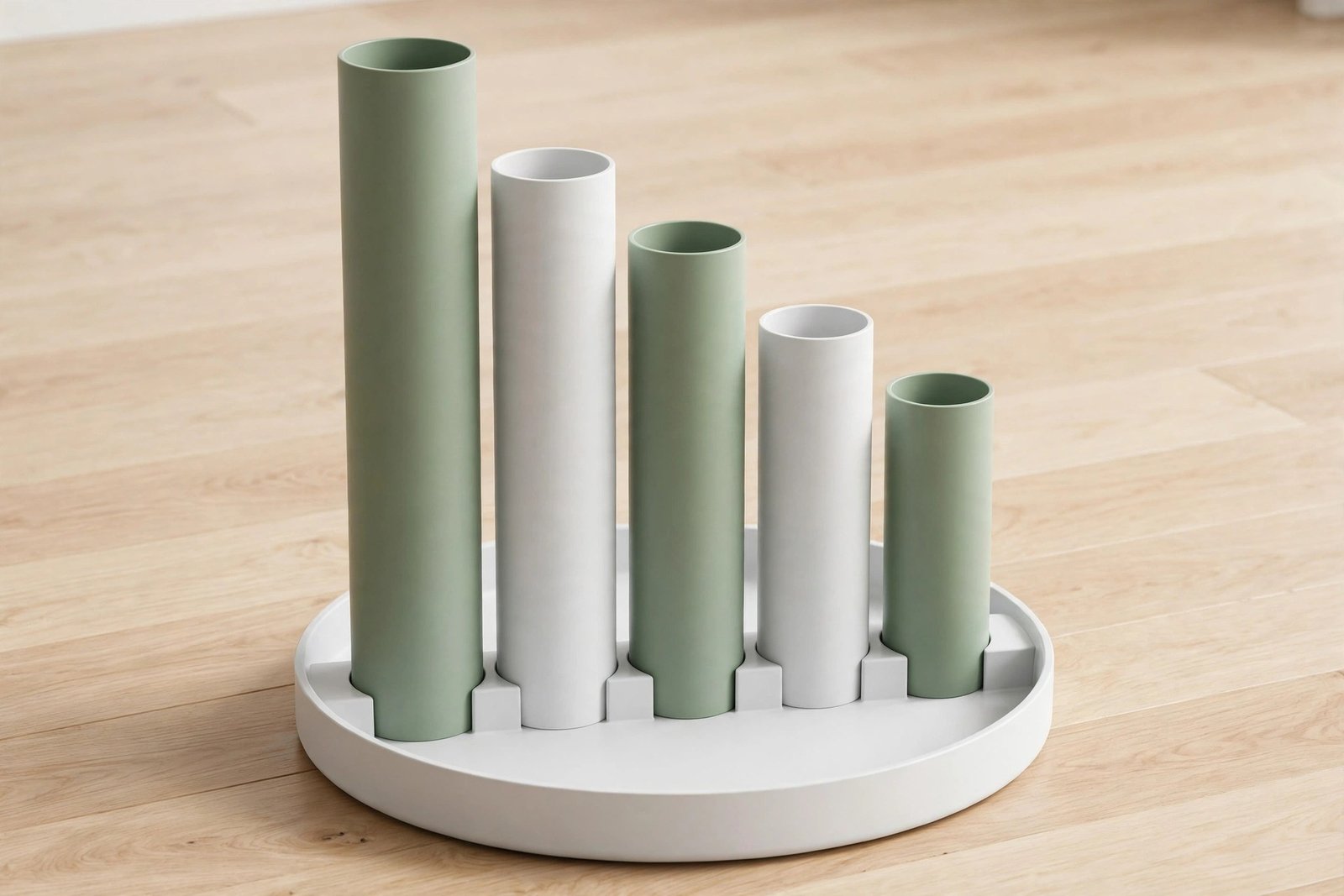
Some cats don’t eat — they inhale, and then they vomit. The Digger attacks that problem mechanically: five tubes of varying heights and widths that the cat must fish kibble out of with a paw, one piece at a time. There’s no way to rush it. The review evidence here is unusually strong — multiple reviewers report cats that “inhale” food and vomit slowed down significantly, and one memorable review: “She was also UNABLE TO FLIP IT. and she did try.”
Flip-proof matters more than it sounds: a determined cat’s first move with any slow feeder is to knock it over and eat off the floor. The Digger’s wide 14.6-inch base and low center of gravity defeat that strategy. The tubes have rounded bottoms and come out for cleaning, which reviewers confirm is easy.
It holds 4.3 stars from 439 ratings on the US listing, and the review evidence is unusually strong — multiple reviewers report cats that “inhale” food and vomit slowed down significantly, with one reporting a roughly 75% decrease in vomiting after switching. The tubes are removable for cleaning (Q&A-confirmed), which reviewers confirm is easy.
Apartment scorecard: Footprint: ~14.6 x 14.6 in — the largest footprint here, but it replaces the bowl · Noise: pawing and kibble sounds — mild · Installation: none · Rental-friendly: yes · Cleaning: tubes come out, reviewer-confirmed easy · Best room: feeding corner — it becomes the new bowl
Best Treat Ball: PetSafe SlimCat Interactive Feeder Ball
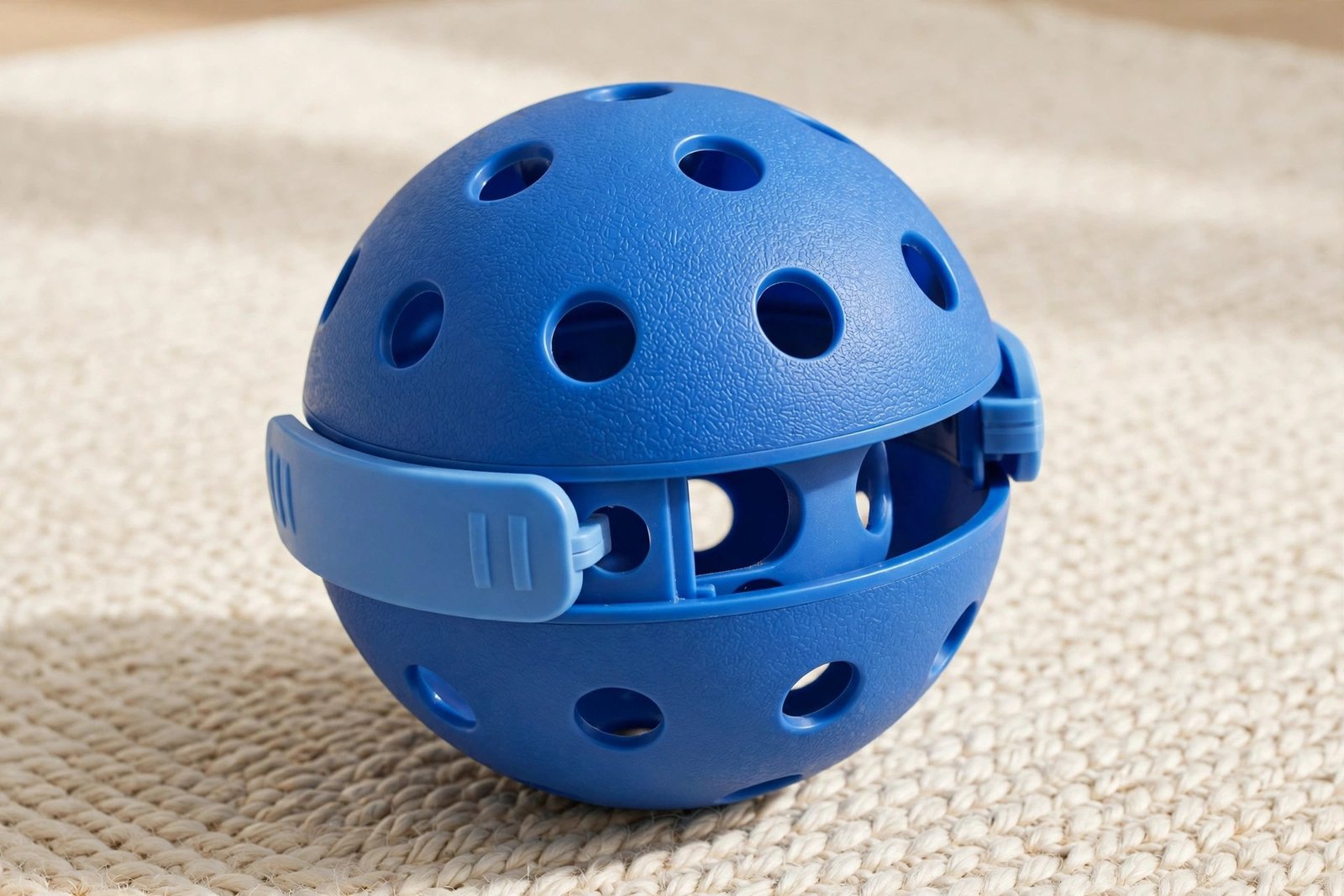
The treat ball is the simplest puzzle format: kibble goes in, the cat bats it around, kibble falls out of adjustable openings. The SlimCat holds 4.1 stars from 926 ratings, and its two real virtues are adjustability (open the holes wide for beginners, narrow them as the cat learns) and cleaning — it’s dishwasher safe, the best cleaning story on this list.
At 3.25 inches in diameter holding 2/3 cup, it’s sized for a meal’s worth of kibble or a day’s treats. The ball format also gives the cat exercise — this is the pick that gets the cat moving around the apartment, not just sitting at a board.
The honest caveat is interest: review-sourced reports say some cats ignore it entirely. A ball that dispenses food only works if the cat bothers to bat it. It’s also the noisiest pick here — a hard plastic ball batted across hard floors will be heard. Carpeted rooms or rugs underneath help considerably.
Apartment scorecard: Footprint: 3.25 in ball — rolls anywhere · Noise: plastic ball on floors — the loudest pick here · Installation: none · Rental-friendly: yes · Cleaning: dishwasher safe — best in list · Best room: carpeted living room — hard floors amplify it
Best Puzzle Board: TRIXIE Activity Fun Board 5-in-1
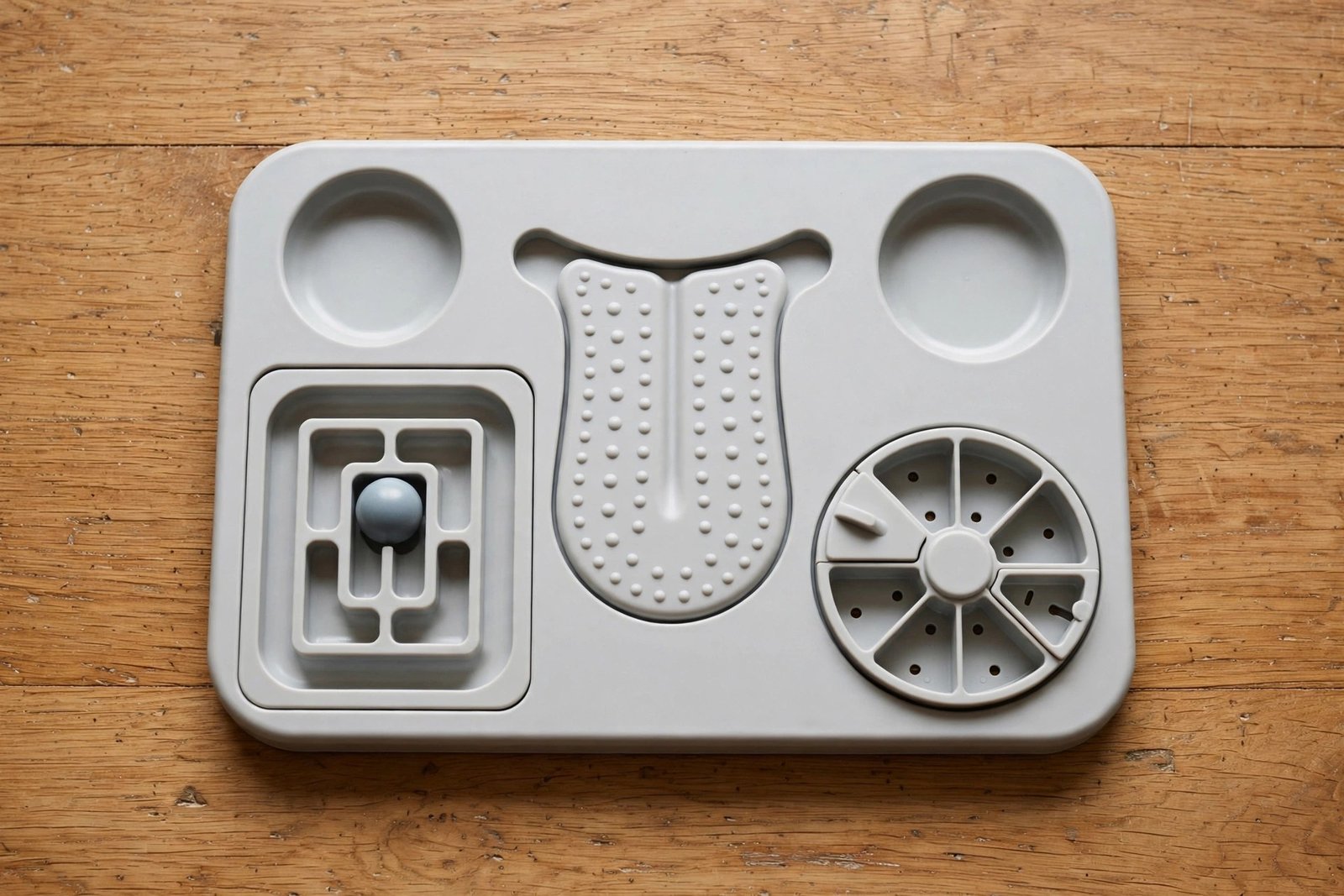
Five puzzles in one 12 x 16-inch board: the Fun Board packs multiple challenge types — including a tongue module designed for liquids — into a single unit. That variety is the point: different modules engage different problem-solving moves (pawing, licking, nosing, fishing), so the cat doesn’t master one trick and get bored.
It holds 4.3 stars from around 1,100 ratings, and two details make it stand out. First, the tongue-for-liquids module is genuinely unusual — it works with wet food and lickable treats, which most dry-food puzzles can’t handle. Second, it’s dishwasher safe, rare for a multi-part board.
The honest drawback is scale: review-sourced reports say the small bowls are hard for some cats to work with — big paws and tiny cups don’t mix. Flat-faced breeds may struggle most. It’s the best board for variety, with that one ergonomic caveat.
Apartment scorecard: Footprint: 12 x 16 in board — table or floor · Noise: quiet pawing and licking · Installation: none · Rental-friendly: yes · Cleaning: dishwasher safe · Best room: kitchen — the wet-food module lives near the food
Best Wet-Food Option: LickiMat Casper
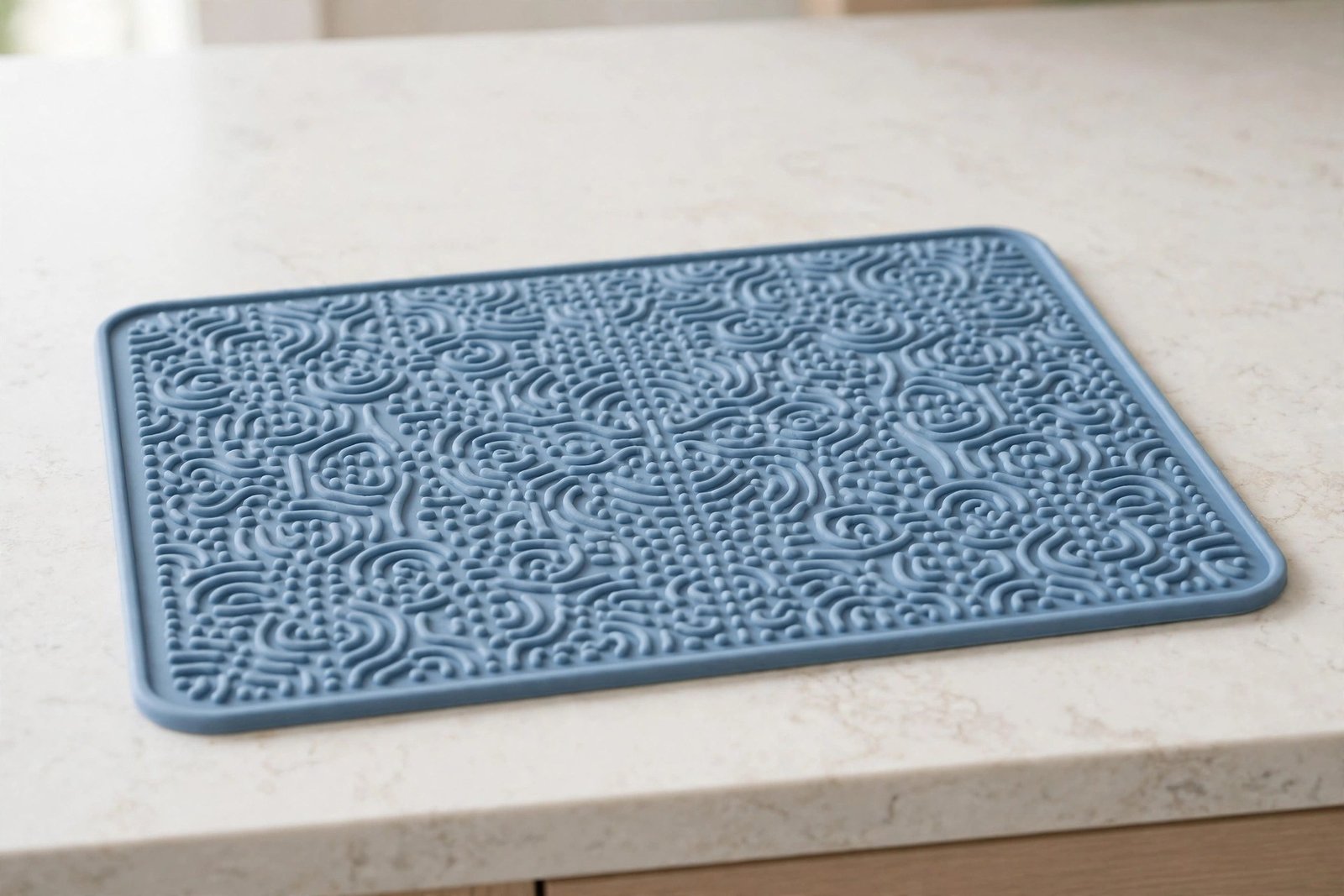
Almost every puzzle feeder assumes dry kibble — but many cats eat wet food, and wet food needs a different slow-down mechanism. The LickiMat Casper is a flat, shallow textured mat: you spread wet food, pâté, or nutritional gel across the surface, and the texture forces the cat to lick rather than gulp. Licking is naturally slower than biting, and the repetitive motion is calming for anxious cats.
The flat 8.6 x 5.9-inch design is deliberately whisker-friendly — no deep bowls, no whisker stress — and it suits mature cats who prefer crouching while they eat. It handles wet food, raw, pâté, kibble, gels, even bone broth or cat cream on its hydration surfaces, and it’s freezer and microwave safe. The thermoplastic rubber has a non-skid base.
Two honest notes. We couldn’t verify this specific variant’s rating in current listing data, so we’re recommending it on design and verified specs. And it’s not a chew toy — the manufacturer says supervise, and determined chewers need the tougher LickiMat Tuff instead. For the wet-food cat, though, this is the only pick on the list built around their diet.
Apartment scorecard: Footprint: 8.6 x 5.9 in — mat-sized · Noise: silent — licking · Installation: none · Rental-friendly: yes · Cleaning: rinse clean · Best room: feeding corner — where wet food is served
Best for Advanced Cats: Nina Ottosson Buggin’ Out Puzzle & Play
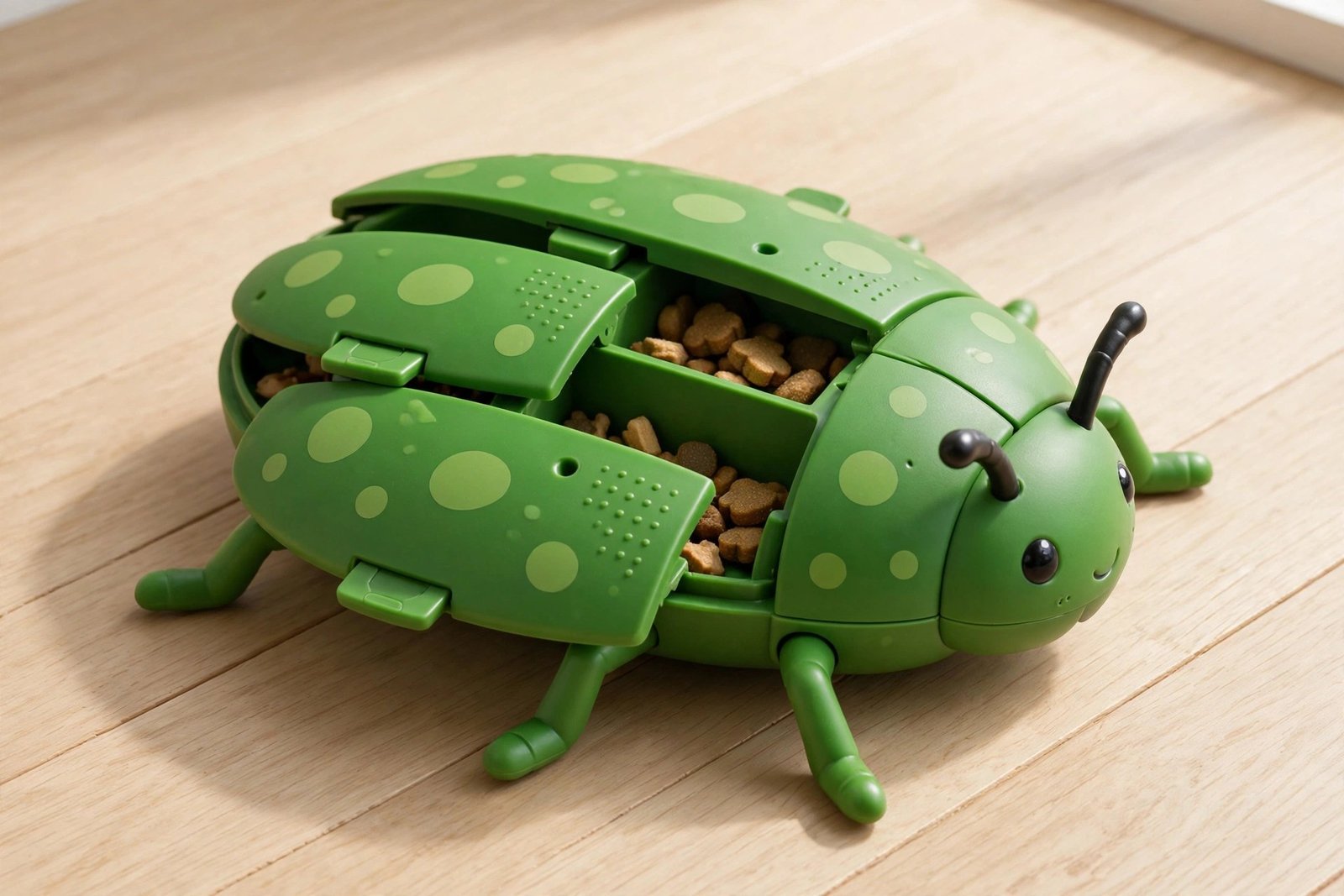
Some cats graduate. They master the beginner board in a week and need a real challenge — that’s what the Buggin’ Out is for: sixteen hidden treat compartments under multiple movable pieces, a Level 2–3 challenge that takes genuine problem-solving. It holds 4.4 stars from 1,773 ratings, the strongest social proof on this list.
It’s the most versatile feeder here on diet: the compartments work with wet and dry food, and at 1/4 cup total capacity it’s sized for treats and training rather than full meals. No removable parts, BPA/PVC/phthalate-free — the Nina Ottosson line is consistent on materials.
The honest drawbacks: review-sourced reports say it doesn’t slow down some cats (the skilled ones solve it fast), and food can trap in the seams. It’s wipe-clean only, not dishwasher safe. Buy this for the cat that’s outgrown everything else — not as a first puzzle.
Apartment scorecard: Footprint: compact board — feeding corner · Noise: quiet · Installation: none · Rental-friendly: yes · Cleaning: wipe-clean only (not dishwasher) · Best room: feeding area — the graduate school of puzzle feeders
Best Budget: Catstages Kitty Cube Puzzle
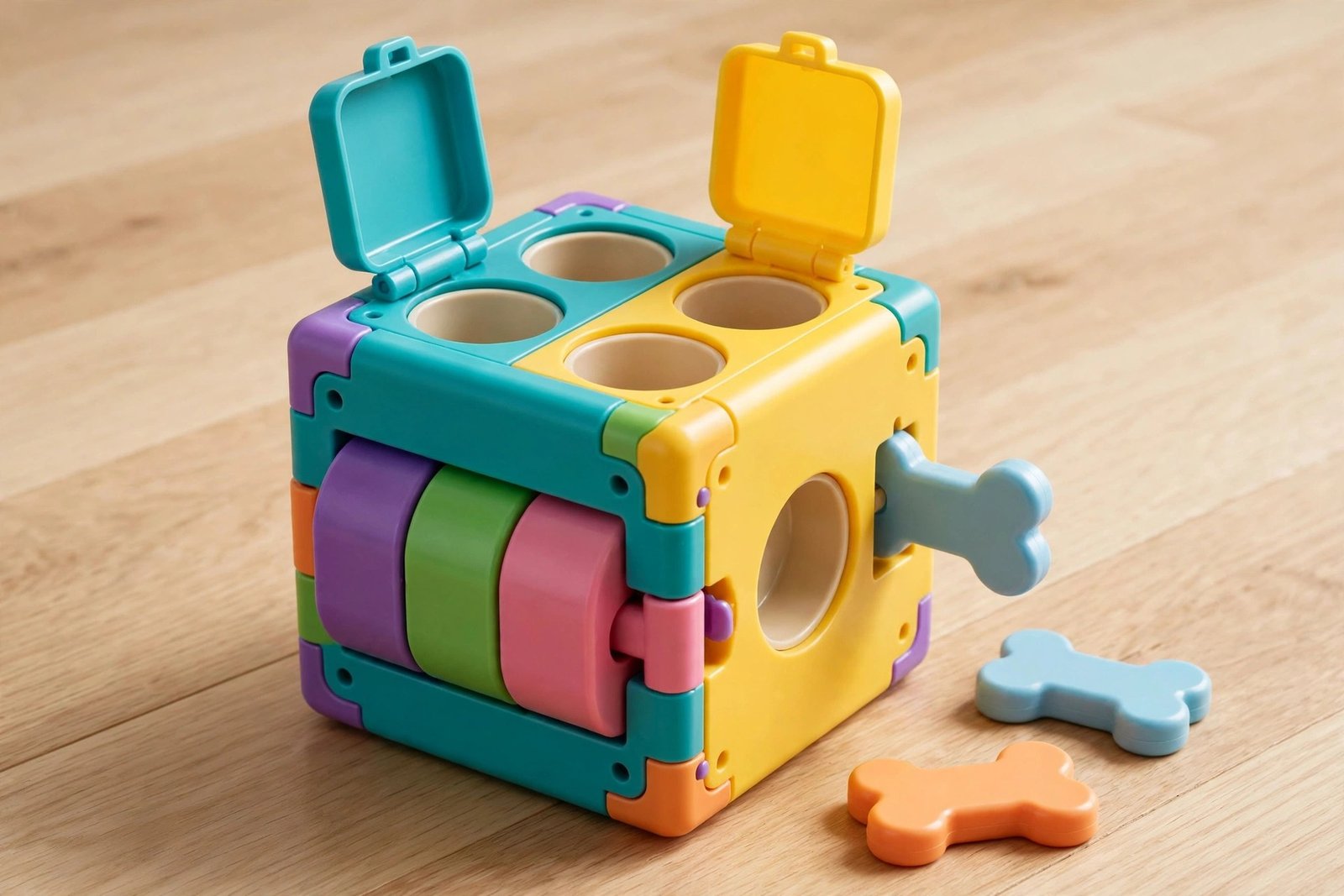
The budget pick that doesn’t feel like one: a cube with ten hidden treat cups where cats pull off bones, flip open lids, and slide blocks to reveal food. At roughly 8.7 x 6.6 inches in polypropylene, it’s a genuine multi-mechanism puzzle — not a dumbed-down version.
It holds 4.7 stars on Petco, which we verified live — but with a thin base of around two dozen reviews, so treat that score as a promising hint rather than proof. The verified specs: ten treat cups holding up to 1/3 cup of food or treats, spot-clean only, 0.67 pounds.
Now the honest apartment caveat, and it’s a real one: reviewers report cats “clicking and clacking away” on the plastic compartments at night. In a studio, that’s a 2 a.m. soundtrack. It’s also intermediate difficulty despite the price — smart cats solve it quickly, and kittens can get frustrated with the flip lids. Best as a daytime puzzle, not a leave-it-out-overnight one. Availability note: verify the listing is shippable at purchase time, as fulfillment options vary.
Apartment scorecard: Footprint: ~8.7 x 6.6 in cube — small · Noise: plastic clicking reported at night — daytime use · Installation: none · Rental-friendly: yes · Cleaning: spot clean only · Best room: living room — where daytime play happens
How we picked
We researched puzzle feeders on Chewy and Petco, comparing ratings, reading reviews for difficulty and cleaning reports, and checking each listing’s materials and care instructions. We built a difficulty ladder — beginner boards through advanced puzzles — because the number one puzzle-feeder mistake is buying too hard too soon. We gave extra weight to cleaning honesty (dishwasher-safe vs. handwash vs. wipe-only) since a puzzle you won’t clean is a puzzle you’ll abandon. No paid placements, no hands-on testing, no veterinary advice — just careful reading of what buyers and listings actually say.
Buying guide: puzzle feeders that actually get used
The difficulty ladder: start embarrassingly easy
The golden rule of puzzle feeders: the first puzzle should be so easy it feels silly. A cat that succeeds immediately comes back; a cat that fails walks away and may never try again. Start with treats in fully open cups (the Melon Madness) or wide dispensing holes (the SlimCat), then increase difficulty over weeks. Graduate to the Buggin’ Out only when the cat is visibly bored by the easy stuff — that’s success, not a problem.
How to introduce a puzzle feeder
Don’t just swap the bowl for a puzzle overnight. Run them side by side: most of the meal in the bowl, a few high-value treats in the puzzle. Let the cat discover that pawing the puzzle produces food. Over a week or two, shift more of the meal into the puzzle. For dry-food grazers, the puzzle can eventually replace the bowl entirely; for wet-food cats, the LickiMat replaces the plate for at least one meal a day.
Cleaning: the spec nobody reads until it’s too late
Puzzle feeders get gross — kibble dust, saliva, and (for wet-food puzzles) residue build up in crevices. Before buying, check the care label the way you’d check a jacket’s: dishwasher-safe (SlimCat, TRIXIE board) is the gold standard; handwash (Food Tree) is a small recurring chore; wipe-only (Buggin’ Out) demands the most discipline; spot-clean (Kitty Cube) is the thinnest margin. A puzzle you won’t clean is a puzzle you’ll throw away — buy the cleaning commitment you can actually keep.
Wet food needs different puzzles
Most puzzle feeders are engineered for dry kibble — tubes, tracks, and dispensing balls don’t work with pâté. If your cat eats wet food, your options are lick mats (the Casper), tongue modules (the TRIXIE board), and compartment puzzles rated for wet food (the Buggin’ Out). Don’t try to force kibble puzzles to do a wet-food job; the food will just sit there and the cat will just stare at you.
Frequently asked questions
Do puzzle feeders really slow down fast eaters?
Yes — mechanically, they have to. A cat physically cannot inhale food through five narrow tubes (the Digger) or a maze of compartments as fast as from an open bowl. Reviewers of slow-feeder designs consistently report reduced vomiting from speed-eating. The effect is strongest with true slow feeders; treat balls slow things less dramatically.
What’s the best puzzle feeder for a complete beginner cat?
Start with an adjustable-difficulty board like the Melon Madness: leave every treat cup open on day one so the cat succeeds immediately, then gradually introduce the hiding mechanisms. The goal of the first week is confidence, not challenge.
Can I use a puzzle feeder with wet food?
With the right puzzle, yes. Lick mats (like the Casper) are made for wet food — spread it across the textured surface. The TRIXIE board’s tongue module and the Buggin’ Out’s compartments also handle wet food. Standard kibble puzzles (tubes, tracks, balls) do not.
How do I clean puzzle feeders?
It depends on the pick: the SlimCat ball and TRIXIE board are dishwasher safe; the Food Tree is handwash only; the Buggin’ Out is wipe-clean only; the Kitty Cube is spot-clean only. Check the care label before buying and match it to the cleaning effort you’ll actually do — residue buildup in crevices is the number one reason puzzles get abandoned.
My cat tries the puzzle once and gives up. What now?
Make it easier, not harder. Go back to fully open cups or the widest dispensing setting, use higher-value treats (not regular kibble), and run the puzzle alongside the normal bowl rather than replacing it. Most “giving up” is really “this was too hard on day one.” Frustration is the enemy; easy wins build the habit.
Are puzzle feeders good for weight management?
They help with the behavior side — slower eating and mental work during meals — but they’re not a weight-loss device on their own. Portion size still matters most. If your cat needs to lose weight, talk to your vet about portions first; the puzzle feeder is the enrichment layer on top of that plan.
Related reading
- Best Interactive Cat Toys for Indoor Cats 2027 — the full interactive-play roundup, from wand teasers to electronic toys.
- 7 Signs Your Indoor Cat Is Bored (and How to Fix Each One) — when the issue is enrichment, start with the diagnosis.
Last updated: October 8, 2026
Pingback: Best Automatic Cat Feeder for Busy Owners 2027
Pingback: Small Cat Water Fountain: 6 Best Compact Picks 2027
Pingback: Best Cordless Cat Water Fountains for Apartments 2027