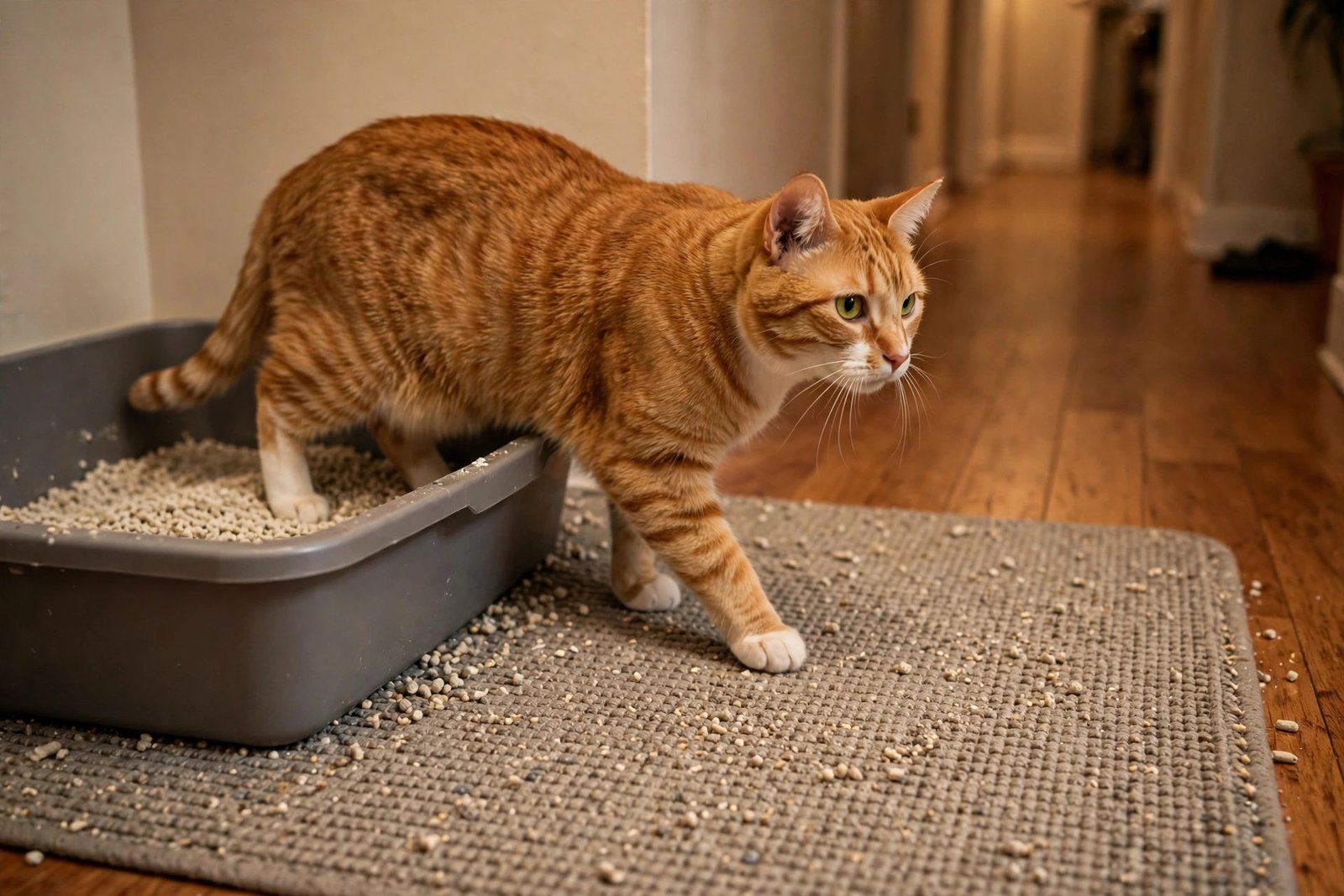
How to reduce litter tracking in an apartment comes down to one honest framework: the layered defense. Tracking is not one problem — it is four small problems stacked on each other. The litter itself throws dust and clings to paws. The cat exits the box and walks straight onto your floor. The box sits where the cat’s exit path leads directly into the living space. And the daily maintenance that would interrupt all of it gets skipped. No single product fixes all four layers, which is why “buy this mat” advice always disappoints. The system that works is layered: the right litter, the mat used as an exit path, box placement that forces a pause, and a thirty-second daily routine. Each layer is small. Together, they are the difference between litter everywhere and litter nowhere.
One distinction that keeps this guide honest: we have a separate product roundup of the best litter mats for small apartments — that article ranks mats as products. This article is the method: the full tracking-reduction system a mat alone cannot deliver. And the honest limit, stated up front: no system eliminates tracking 100%. Cats have paws; litter is granular. The goal is reduction to the point where you stop noticing it — which is achievable — not a sterile floor, which is not.
The short answer: the layered defense
If you want the whole system in one paragraph: switch to a low-tracking, low-dust litter; put a large textured mat directly in the cat’s exit path so every exit crosses it; place the box so the cat pauses after exiting instead of bolting straight onto the floor; and spend thirty seconds a day on the mat and the surrounding floor. Each layer catches what the previous one missed. Litter choice reduces what sticks to the paws. The mat catches what the paws carry. Placement slows the exit so the mat has time to work. The routine clears what escapes. Skip any one layer and the other three compensate — partially. Run all four and tracking drops to background noise.
Layer 1: the litter choice
Tracking starts in the box, so it starts with the litter. The physics are simple: fine, dusty litters cling to paws and throw dust with every dig; larger-granule, low-dust litters do neither as aggressively. That does not mean one litter type is “the answer” — every type has a trade-off, and the honest version is worth stating. Clay clumping litters track moderately but the dust is the issue; look for low-dust formulations. Crystal litters track less as dust but the crystals themselves are notorious escape artists — small, light, and prone to ending up across the room. Paper and pine pellets track the least of all, but some cats reject the texture, and a litter the cat will not use is not a litter.
The practical move: choose the lowest-tracking litter your cat will actually use, and prioritize low-dust within that type. Dust matters more than most guides admit, because dust is what settles on every surface in a small apartment — not just the floor around the box. A low-dust litter reduces the fine film that makes the whole room feel gritty. Our odor-reduction guide covers the litter side in more depth, including the odor trade-offs of each type.
Layer 2: the mat as an exit path
The litter mat is the most misunderstood product in the tracking conversation. Most people buy one, put it near the box, and wonder why tracking continues. The mistake is placement: a mat beside the box catches nothing. A mat works only as an exit path — positioned so the cat must walk across it leaving the box, every time, with no way around it. Against a wall, in a corner, or in a hallway the box faces: the geometry should make the mat unavoidable.
Size matters more than texture marketing. A mat smaller than the cat’s stride is decoration; the cat steps over it. Go large — the mat should extend at least a full body length from the box exit. Texture matters second: deep grooves or a honeycomb structure trap litter from paws better than flat rubber, and the trapped litter needs to be shakeable or vacuumable, or the mat becomes a litter reservoir that re-releases. For the product-by-product comparison, our best litter mats for small apartments roundup ranks seven mats on exactly these criteria. The guide you are reading is the method; that article is the shopping.
Layer 3: box placement and entry style
Placement is the layer nobody buys, which is why it is the most underrated. A box facing an open room lets the cat exit at full stride onto the living-room floor — the mat never gets its chance. A box placed so the cat exits, pauses, and then proceeds gives every layer time to work. The practical version: face the box exit toward a wall or into a corner arrangement, with the mat filling the gap, so the cat’s first steps are always on the mat. In a bathroom, the corner beside the toilet with the mat bridging to open floor is the classic working setup.
Entry style is the bigger lever. Top-entry boxes are the lowest-tracking format that exists — the cat pauses on the lid before and after, and the lid’s grooves or perforations knock litter off the paws mechanically. It is geometry, not marketing. The trade-off is real and must be stated: top-entry excludes seniors, arthritic cats, and young kittens. For cats the format suits, it is the single biggest tracking reduction available. Our top-entry roundup ranks the format in full. If top-entry is wrong for your cat, a high-sided or hooded front-entry box is the middle ground — more containment than an open pan, without the jumping requirement.
Layer 4: the thirty-second daily routine
The unglamorous layer, and the one that makes the other three work. Thirty seconds a day: shake the mat out (or vacuum it), and sweep or vacuum the two-foot zone around the box. That is the whole routine. Tracking is cumulative — the grains you leave today are the grit underfoot tomorrow, and in a small apartment the accumulation curve is steep because the distances are short. A handheld vacuum kept near the box turns this from a chore into a reflex; the friction of fetching the big vacuum from the closet is what kills the habit.
Scoop daily as part of the same pass. A freshly scooped box throws less loose litter around because there is less disturbed material for the cat to kick. The routine compounds: clean box, clean mat, clean zone — each one makes the next day’s thirty seconds shorter. Skip the routine for a week and no litter choice or mat geometry will save you; the layers are a system, and the routine is the maintenance contract.
What does not work: the honest limits
A few things the internet promises that do not survive contact with a real cat. Litter-box furniture enclosures reduce visible tracking but concentrate it inside the enclosure — and in a humid bathroom they become odor traps. “Non-tracking” litter is a marketing phrase, not a physical property; every litter tracks, the question is only how much. Trimming paw fur helps long-haired cats modestly but does not fix a bad setup. And the biggest myth: that one product — one mat, one litter, one box — solves tracking alone. It does not. The layered defense works because it is a system; any single layer, bought alone, disappoints. That is not a sales pitch for buying four things. Three of the four layers are free — litter choice, placement, and the routine cost nothing. Only the mat costs money.
Gear that helps
The paid layer of the system, kept short. A large, deep-textured litter mat placed as an exit path — our mat roundup ranks seven. A box that fits the placement strategy — our small-apartment litter box guide covers the category, and the top-entry format is the tracking champion for cats it suits. A handheld vacuum that lives near the box — any basic model; this is a utility purchase, not a research project. And a low-dust litter in whatever type your cat accepts. That is the complete shopping list. Everything else is placement and habit.
Frequently asked questions
Why is litter tracking worse in apartments?
Distance. In a house, tracked litter disperses across rooms and you notice it less. In a 500-square-foot apartment, the box is ten steps from the sofa and the bed, so every grain lands somewhere you walk, sit, or sleep. The tracking rate is the same; the density is higher. That is also why the layered defense matters more in small spaces — there is no spare room for the litter to disappear into.
Do litter mats actually work?
Yes — when they are used as an exit path, not as decoration. A large mat placed so the cat must cross it leaving the box catches a meaningful share of paw-carried litter. A small mat beside the box catches almost nothing. Size and placement are the entire product; texture is secondary. Our mat roundup ranks them, but the placement advice in this guide matters more than which mat you buy.
What litter tracks the least?
Paper and pine pellets track the least, but the honest answer includes the cat’s vote: some cats reject pellet textures, and a rejected litter is not a solution. Among clumping litters, low-dust formulations track less than dusty ones, and larger granules cling less than fine ones. Crystal litters are low-dust but the crystals themselves scatter. Choose the lowest-tracking option your cat will actually use — the cat’s acceptance is a hard constraint, not a preference.
Will a top-entry box fix tracking completely?
It is the biggest single reduction available — the lid-as-doormat geometry is real — but “completely” is the wrong expectation. Some litter still escapes, athletic cats can jump the lid, and the format excludes seniors, arthritic cats, and kittens. Think of top-entry as the strongest single layer, not the whole system. The mat, the litter, and the routine still matter.
How do I stop litter from getting on my bed?
The bed is usually the farthest point from the box, so litter on the bed means the whole system is leaking — fix the layers nearest the box first. The highest-leverage moves: a top-entry box if the cat qualifies, a large mat as a mandatory exit path, and the daily thirty-second routine. If the box is in the bedroom (common in studios), the mat-and-placement layers matter even more, because there is no hallway buffer. A large mat directly outside the box is the first purchase.
Does a covered box reduce tracking?
Modestly — a hood or cover slows the cat’s exit slightly and contains the scatter from digging, which is real but small compared to what the paws carry out. The cover’s main wins are odor and privacy, not tracking. For tracking specifically, the lid-as-doormat of a top-entry box does far more than a front-entry hood. Do not buy a covered box expecting a tracking solution; buy it for odor and get the tracking benefit as a bonus.
Related reading
For the product side, our best litter mats for small apartments ranks seven mats on the criteria this guide uses. For the category, see our best litter boxes for small apartments, and for the smell half of small-space litter life, how to reduce litter box smell in a small apartment.
Last updated: October 21, 2026
Pingback: Best Litter Mat for Small Apartments 2027
Pingback: Best Cat Litter Disposal System for Apartments: 6 Picks 2027