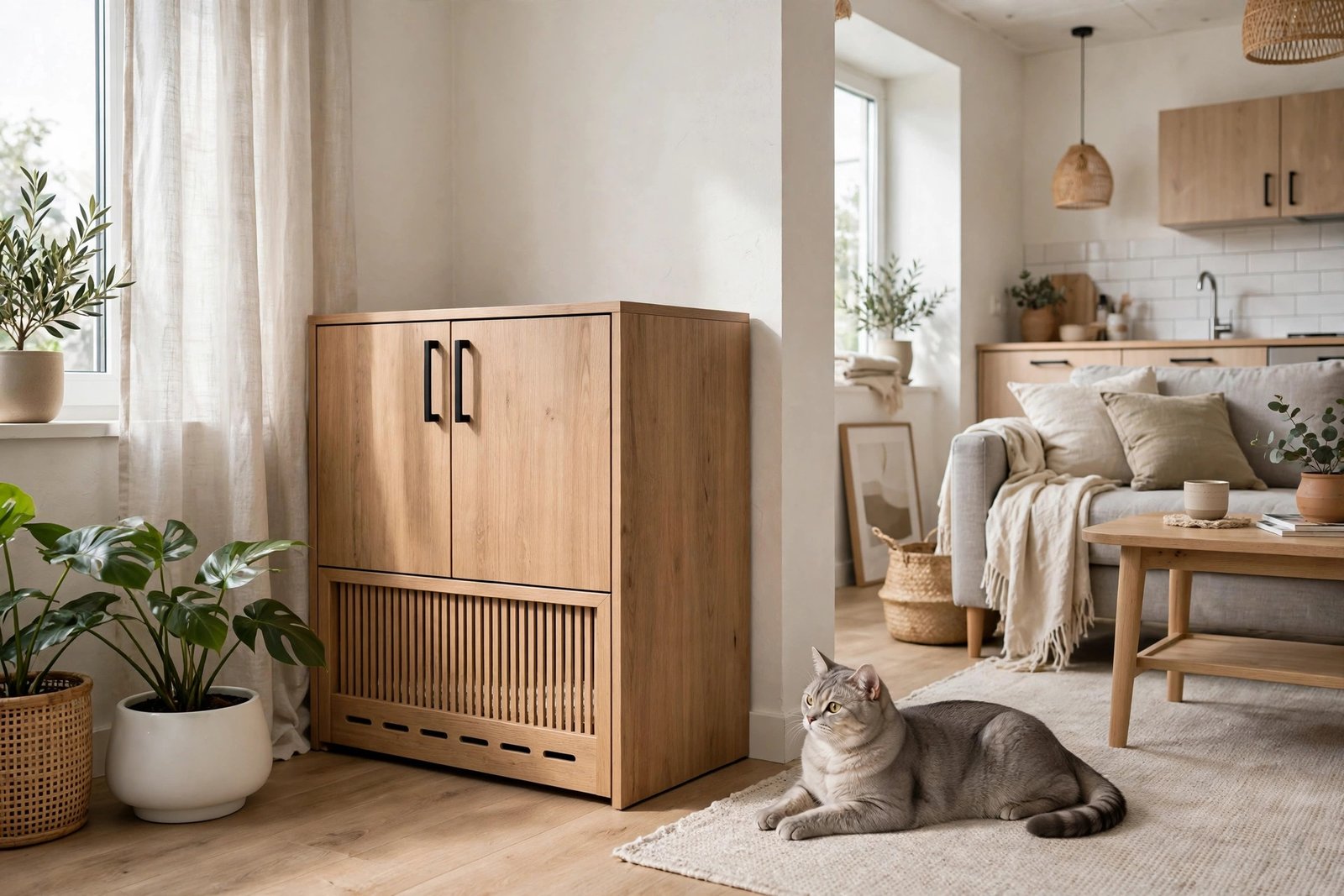
Learning how to choose a litter box for a small apartment is different from buying one for a house. In a house, the box can be mediocre and nobody notices — it’s down the hall, behind a closed door. In a 500-square-foot apartment, every compromise lives with you: the smell, the tracked litter across your floor, the footprint that eats your only bathroom corner.
These seven rules are written for that reality. Follow them in order and you’ll end up with a box your cat actually uses, that doesn’t dominate your space, and that won’t have your landlord or your guests remembering it. Let’s go.
Rule 1: Measure Your Space First
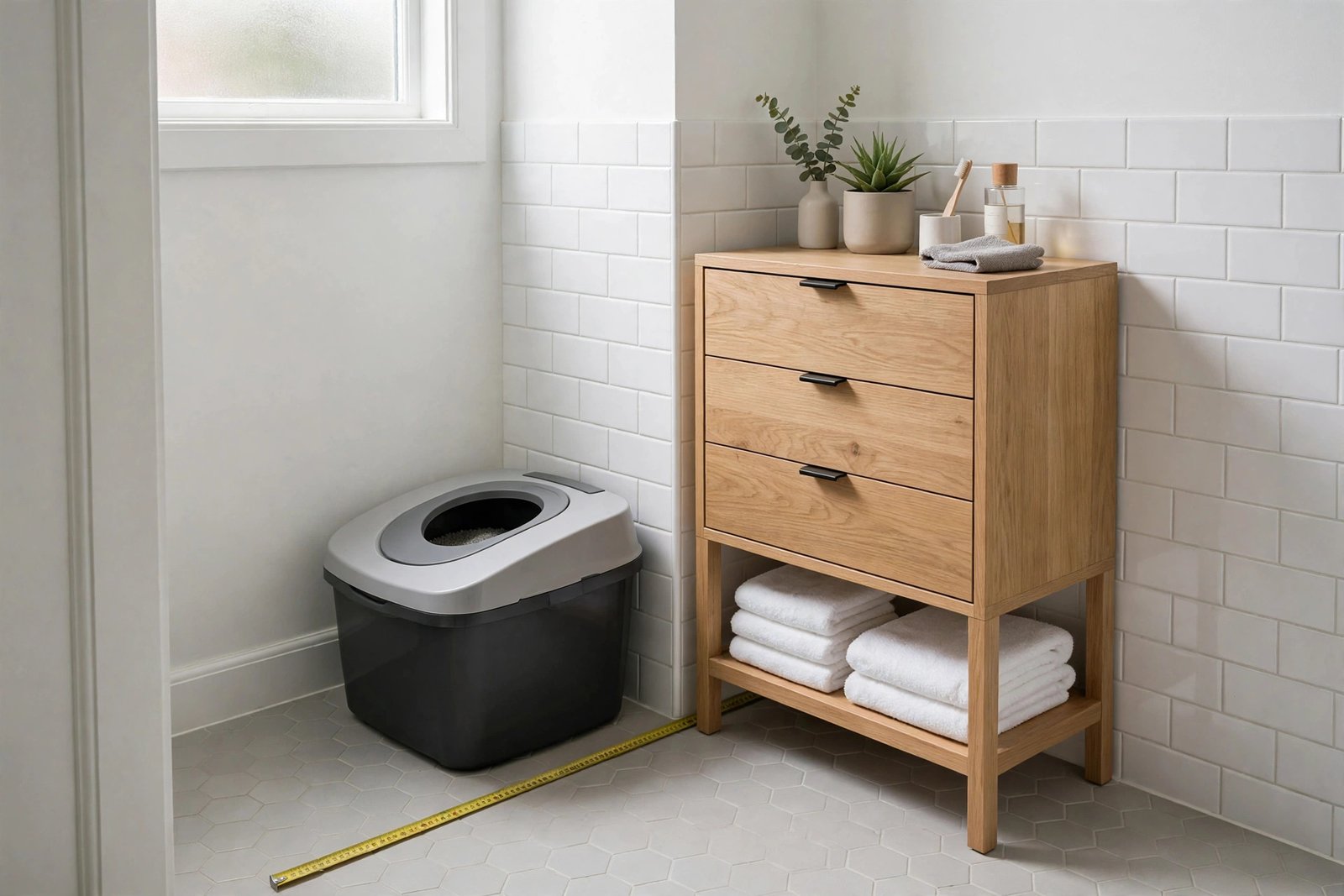
Before looking at a single box, measure the spot where it will live. Length, width, and height clearance — write all three down. Then add four to six inches of working room on at least one side for the scoop, the waste container, and your hands during cleaning.
This sounds obvious, but it’s the single most common mistake apartment dwellers make: buying a box for the cat without buying it for the room. A box that technically fits in the bathroom alcove but can’t be scooped without moving the trash can is a box that won’t get scooped. A box wedged under a sink where you can’t lift the lid is a box you’ll dread cleaning.
Also measure the path to the spot. That adorable enclosed cabinet-style box is useless if it won’t turn the corner in your hallway. Measure the narrowest doorway and tightest turn between your front door and the box’s final home.
Rule 2: Covered vs. Top-Entry vs. Open in Tight Spaces
Each style solves a different apartment problem — and creates a different one.
Open pans give your cat the most airflow and the easiest entry, and they’re the simplest to scoop. The tradeoff is containment: odor drifts freely into the room, and vigorous diggers scatter litter onto your floor. In a small space, an open pan needs the best ventilation spot you’ve got and a good litter mat.
Covered boxes contain odor and scatter better, which is why apartment dwellers gravitate toward them. But they trap ammonia inside with the cat — in a small space the concentration builds fast, and some cats find it unpleasant enough to hesitate at the entrance or go beside the box. If you go covered, look for ventilation slots and commit to more diligent scooping, because trapped air concentrates smell faster.
Top-entry boxes are the apartment sleeper pick. The cat enters from the top, so litter scatter drops dramatically and odor stays contained without the enclosed-air problem of a front-door covered box. The catch: kittens, seniors, and very large cats can struggle with the hop-in design. Fine for a healthy adult cat; wrong for a mobility-limited one.
There’s no universal winner. Match the style to your ventilation (poor airflow favors open with a fan nearby; good airflow lets you go covered) and to your cat (confident adult = any style; senior or skittish = open or low-sided).
Rule 3: Odor-Control Features That Actually Matter
Forget gimmicks. In a small apartment, three features do the actual odor work:
A tight seal where parts meet. On covered boxes, the lid-to-base seam is where odor escapes. A box with a gasketed or overlapping seam contains smell meaningfully better than one with a loose friction fit. Check reviews for mentions of smell leaking from the seam — real owners report this.
Real ventilation, not token slots. A single decorative vent does nothing. Effective designs move air through the box (carbon filters on covered boxes help modestly, but they need regular replacement to keep working — factor that into your cost expectations).
Materials that resist absorbing odor. Over time, plastic absorbs urine odor, especially if scratches let residue in. Stainless steel boxes have become popular in the apartment community for exactly this reason — steel doesn’t absorb odor the way plastic does, and it wipes clean. They’re heavier and cost more upfront, but in a small space where the box lives near your nose, the material matters more than in a house.
And pair all of this with the right litter: a tight-clumping unscented litter and two to three inches of depth do more for odor than any box feature. The box is the container; the litter does the work.
Rule 4: Sizing and the One-Per-Cat-Plus-One Rule
The standard guidance is one box per cat, plus one extra. For two cats in an apartment, that’s three boxes — which is unrealistic in 600 square feet, and everyone knows it. Here’s the honest apartment translation: the rule exists because cats avoid boxes that smell like another cat or that are occupied when they need to go.
In practice, two cats in a small apartment can share two well-maintained boxes if you scoop both twice daily. One cat does fine with one box, scooped daily at minimum. What doesn’t work is one box for three cats with weekend-level maintenance — no box survives that, and the cat will tell you by going elsewhere.
On sizing: the interior needs to be long enough for the cat to turn around and dig comfortably. A good rough guide is that the box should be about one-and-a-half times the cat’s body length (nose to base of tail). For large breeds, that means most “standard” boxes are too small — look for jumbo or extra-large sizes, and measure the interior, not just the outer dimensions.
Rule 5: Renter-Friendly Placement Spots
The best box in the wrong spot fails. In an apartment, you’re hunting for three things: ventilation, privacy, and a path the cat will actually use.
The strongest spots in most apartments: a bathroom with an exhaust fan (run it on a timer or leave it on — the airflow is the point), a laundry area with ventilation, or near a window you can crack. The spots to avoid: sealed closets (odor concentrates into a wall of smell every time you open the door), right next to the cat’s food and water (cats avoid eating near their toilet — instinct, not preference), and high-traffic hallways where the cat gets startled mid-use.
One underused trick: if the only viable spot is a visible corner of the living room, a top-entry or high-sided box in a neutral color reads as a storage bin, not a litter box. The box doesn’t have to be hidden — it has to not look like a problem.
For a full room-by-room walkthrough, our guide on where to put a litter box in a small apartment covers placement spots and the ventilation logic behind each one.
Rule 6: Pairing the Right Litter
The box and the litter are a system — a great box with the wrong litter underperforms a mediocre box with the right one. For apartments, the baseline is a tight-clumping, unscented litter at two to three inches deep. Clumping matters because it lets you remove urine completely; unscented matters because heavily fragranced litter layers perfume over odor and some cats avoid it strongly enough to cause accidents.
Litters with activated charcoal or silica crystals can help in tight quarters because they absorb odor at the source rather than masking it. What you want to avoid is constantly switching brands — cats notice, and a cat that dislikes the new texture may protest. Pick one, give it two weeks, and only change if there’s a problem.
Special note for automatic boxes: they need the litter type the mechanism was designed for, which is sometimes a proprietary crystal. That’s one of the real tradeoffs of automation, and we break it down in our comparison of self-cleaning vs manual litter boxes — worth reading before you commit to a machine.
Rule 7: Mistakes Apartment Dwellers Make
Buying for looks before function. The designer box that matches your bathroom is fine — if it also has the right size, ventilation, and entry style. Aesthetics last; a refused box doesn’t.
Skipping the litter mat. Tracked litter in a small apartment becomes a floor-wide problem in days. A decent mat outside the box catches a surprising amount, and it’s the cheapest upgrade on this list.
Placing the box where it’s convenient for you, not the cat. The cat needs a quiet, low-traffic spot it can reach at 3 a.m. without anxiety. Your convenience comes second; the cat’s acceptance determines whether any of the other rules matter.
Not replacing an old box. Plastic absorbs odor and scratches trap residue that washing can’t reach. If you’ve deep-cleaned and the box still smells, the box is the problem. In a small space, retire old boxes sooner than house-dwellers need to — roughly once the plastic starts smelling even when clean.
Putting It All Together
If you follow the seven rules, your shopping list writes itself: a box measured for your actual spot, in the style that fits your ventilation and your cat, with an odor-resistant material, the right interior size, a ventilated renter-friendly spot, a compatible clumping litter, and a litter mat. That’s the whole system — and it’s what makes a small-apartment litter setup something you forget about instead of something you smell.
Ready to pick one? Our roundup of the best litter boxes for small apartments applies these rules to real boxes sized for real apartments.
Frequently Asked Questions
Where do you put a litter box in a studio apartment?
The best spot is the most ventilated place the cat will reliably use — often the bathroom with the exhaust fan running, or near a window you can crack. Avoid sealed closets and spots right next to food and water. A top-entry box in a neutral color can sit in a living-room corner without looking like a problem.
Covered or open box for odor in a small apartment?
Covered boxes contain odor from drifting but trap ammonia inside with the cat, which some cats dislike enough to avoid the box. In a small space, an open or top-entry box in a ventilated spot, scooped diligently, often works better. If you go covered, make sure it has real ventilation and scoop it even more often.
How big should the litter box be for a large cat?
The interior should let the cat turn around and dig comfortably — roughly one and a half times the cat’s body length from nose to base of tail. For large breeds, most “standard” boxes are too small; look for jumbo sizes and measure the interior dimensions, not the outside of the box.
Can two cats share one litter box in an apartment?
They can share two boxes in a small apartment if both are scooped twice daily — that’s the realistic apartment version of the one-per-cat-plus-one rule. One box for two or more cats with casual maintenance is where problems start, no matter how good the box is.
Related reading
- Self-Cleaning vs Manual Litter Box: Honest Pros, Cons, and Real Costs — if you’re considering an automatic box, read this first.
- Best Litter Boxes for Small Apartments — our picks sized around real apartment constraints.
Last updated: October 9, 2026
Pingback: Best Litter Box for Two Cats in One Apartment 2027