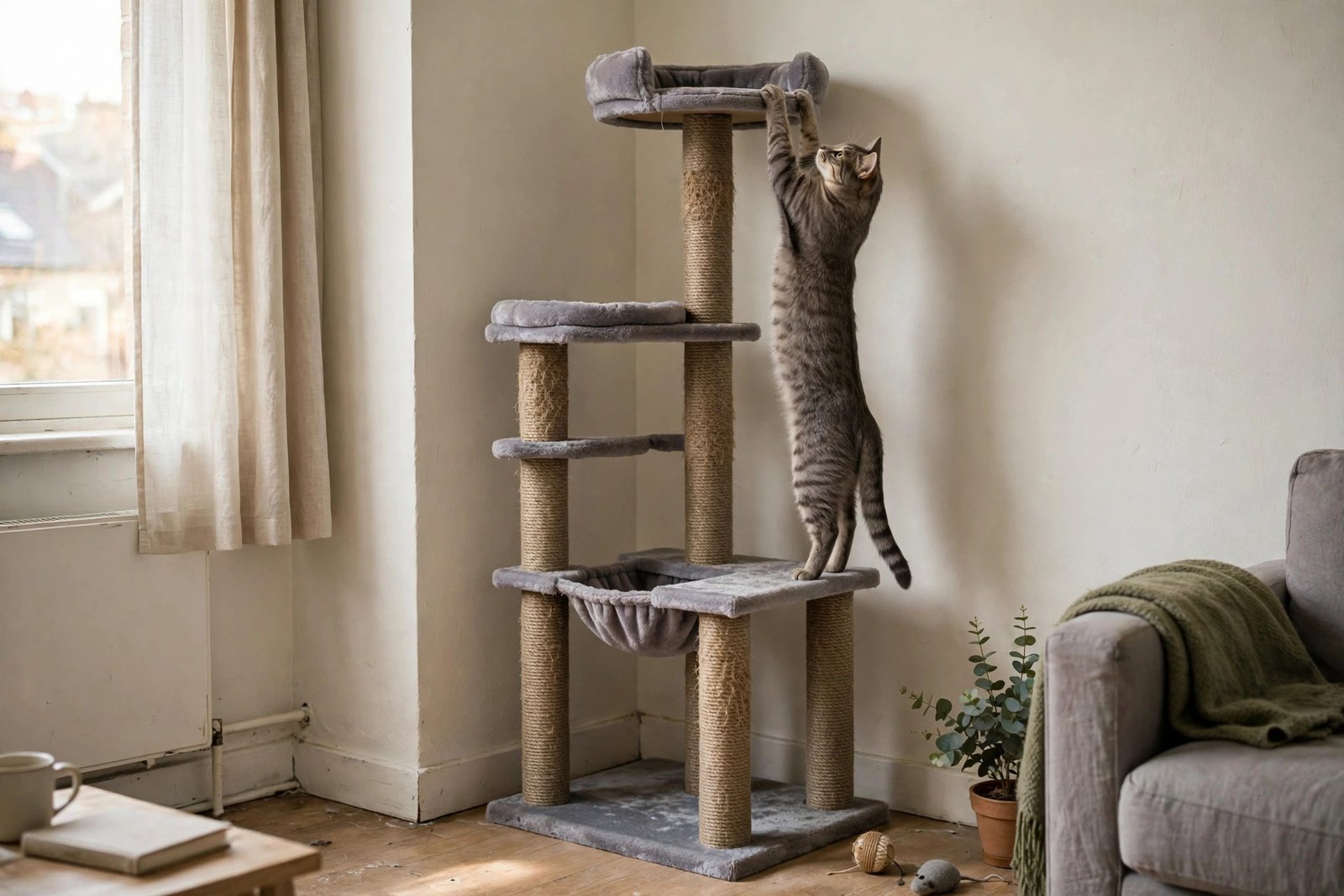
A cat tree that rocks every time your cat lands on it is not just annoying — it is a safety problem, and in a rented apartment the usual fix is off the table. Drilling a wall anchor into a landlord’s wall is exactly what most renters cannot do, so learning how to stabilize a cat tree without drilling matters more than the generic advice admits. The good news is that the no-drill fixes are the ones experienced owners reach for first anyway: a wider or heavier base, a ratchet strap, and a proper re-tightening of the assembly solve most wobble without a single hole in the wall.
This guide is built from the fixes that specialist cat sites actually publish — the wobble-fix guides from Better With Cats, Feline Fascination, Bentley’s Bark and Zoolory — and it is structured the way a renter needs it: diagnose the cause first, then apply the fixes in order of strength, starting with the ones that cost nothing. Nothing here was tested in a lab; every method is one those guides document, and where they disagree, the disagreement is stated.
Why your cat tree wobbles: diagnose first
Stabilizing the wrong cause wastes the afternoon. Before buying anything, push the tree gently from the top perch in each direction and watch where the movement starts. The table below matches what you see to the cause, so you fix the right thing.
| What you see | Likely cause | Fix |
|---|---|---|
| The whole tree rocks, base lifts on one side | Base too small or too light for the height | Widen or weight the base (methods 1 and 2) |
| Movement starts at a joint, not the base | Loose assembly bolts, loosened by months of climbing | Re-tighten every bolt (method 3) |
| Tree leans to one side even at rest | Uneven floor, or the tree was assembled slightly out of square | Level the base, then re-tighten (methods 3 and 4) |
| Only the top sways when the cat jumps on | Top-heavy design — tall tower, small footprint | Ratchet strap or corner placement (methods 4 and 5) |
| Tree slides across the floor on landing | Smooth base on a hard floor, nothing gripping | Grip mat under the base (method 2) |
One honest note before the methods: no no-drill fix turns a badly designed tree into a good one. If the base is narrower than the top platform by a wide margin and the whole tower is over five feet tall, ballast and straps reduce the wobble — they do not rewrite the physics. The “when to replace it” section at the end draws that line.
Method 1: widen the base with a plywood board
This is the fix Better With Cats documents most directly, and it is the strongest no-drill option for a tree whose base is simply too small. A wider base spreads the load, and it does it without touching the wall.

- Measure the existing base and cut — or have cut at a hardware store — a plywood board a few inches wider on every side than the base. Half-inch to three-quarter-inch plywood is the thickness the guides use; anything thinner flexes, anything thicker just adds dead weight for no benefit.
- Set the tree on the board and mark the bolt holes through the base, then drill the board (the board, not the wall) and bolt the tree to it from underneath.
- Cover the exposed plywood edge if the raw look bothers you: a strip of carpet offcut or a matching fabric, glued on, keeps it from reading as a construction project in your living room.
- Put the whole assembly back in its spot and repeat the push test. The improvement is usually obvious on the first push.
The renter’s case for this method is simple: nothing is attached to the apartment at all. The board comes with you when you move, and the floor underneath is untouched. The trade-off is floor space — a wider base eats a few extra inches in a room that may not have them. In a small apartment, measure the corner first; if the widened base will not fit, method 2 is the better call.
Method 2: add weight and grip to the base
When the base is wide enough but too light, weight is the answer, and the guides agree on the approach: load the base itself, not the perches. Sandbags, flat barbell plates, or a bag of cat litter laid across the base all do the job — the point is low, centered mass that a landing cat cannot shift.
- Sandbags or weight plates on the base. Lay them flat on the base platform around the lowest post, not stacked high where they change the tree’s balance. A sandbag conforms to the shape of the base and stays put; a flat plate does the same job more neatly if you have one spare.
- A rubber grip mat underneath. On hardwood or laminate, a tree slides as much as it rocks. A non-slip rubber mat — the kind sold for rugs — cut to the base size stops the slide without adhesive and without marking the floor. This is the cheapest fix on this page and the first one to try on hard floors.
- Wood glue on the base joints. Better With Cats lists wood glue as a method for trees whose base boards have worked loose over time: glue the joint, clamp it overnight, and the base stops flexing. This is a repair, not a stabilizer — use it when the base itself is the moving part.
Do not hang weight from the top of the tree to “counterbalance” it. Weight belongs at the bottom; weight at the top makes a top-heavy tower worse. And do not stack loose books or boxes on the base as ballast in a home with a cat that climbs — a falling stack is a worse hazard than the wobble it was meant to fix.
Method 3: re-tighten the whole assembly
This is the free fix, and it is the one most owners skip. Cat trees are bolted together, and months of jumping loosen those bolts a quarter-turn at a time. A tree that was rock-solid on assembly day can develop a sway that looks structural and is actually just loose hardware.
- Take the cat off the tree and work from the bottom up: base bolts first, then each post, then each platform.
- Tighten every bolt firmly, but stop at snug — overtightening into pressed wood strips the hole and leaves you worse off than a loose bolt.
- If a bolt spins without biting, the hole is stripped. A drop of wood glue on a wooden dowel or a toothpick pushed into the hole, left to set, gives the bolt something to grip again. Replace any bolt that is bent.
- Repeat the push test. If the wobble is gone, that was the whole problem — check the bolts again in a month, because the same loosening will recur.
Make this a routine, not a one-off repair: the guides that cover long-term tree care treat a monthly bolt check as ordinary maintenance, the same way our renter-friendly cat tree guide treats choosing a tree that does not need wall anchors in the first place.
Method 4: use the corner and the wall — without drilling
Placement is a stabilizer. A tree standing in the middle of a room has nothing to lean on; the same tree pushed into a corner has two walls bracing it on two sides, and the wobble drops sharply even before any hardware is involved.
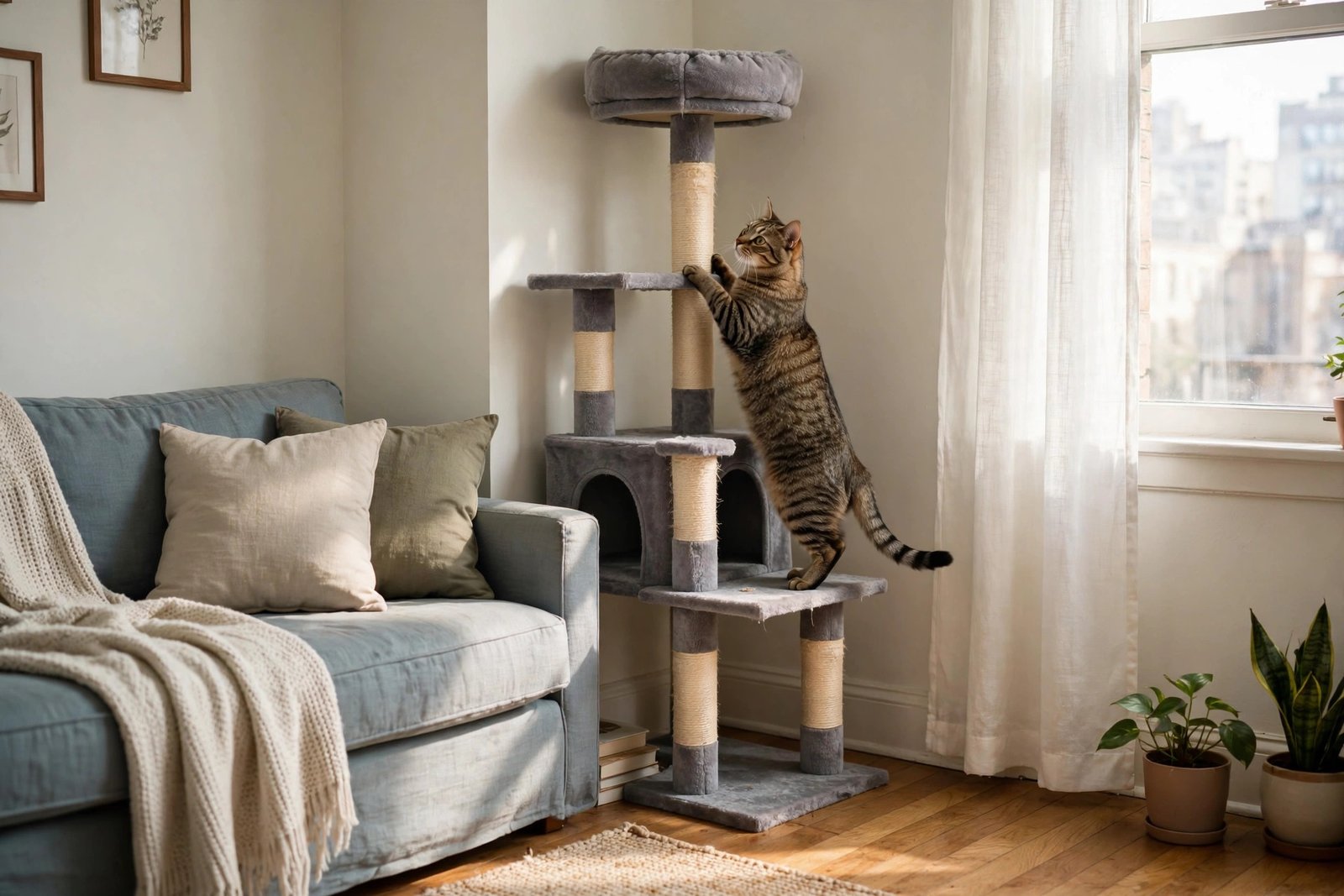
- Corner placement. Push the tree into a corner so two sides of the tower sit close to the walls. The cat still gets the height; the walls absorb the sideways movement. This is also the placement our guide to where to put a cat tree in an apartment recommends for window access and floor-space reasons, so the stability gain comes free with the better spot.
- Furniture as a brace. A heavy bookcase or wardrobe on one side of the tree acts as a second wall. Leave a finger-width gap so the tree does not rub the furniture finish, and do not wedge the tree so tightly that you cannot pull it out to clean behind it.
- Adhesive strips as a last resort. Feline Fascination lists adhesive mounting strips as a stabilizer for light trees: strips between the tree’s back edge and the wall, or between the base and the floor. They hold a light tower steady, but they are the weakest method here — they peel under a heavy cat’s landing force, and the stronger the adhesive, the more paint it takes with it when you move out. Use them only on a small tree, and only with strips rated for the weight.
Method 5: ratchet straps — the strongest no-drill hold
When the tree is tall, top-heavy, and no amount of base work is enough, the ratchet strap is the method the specialist guides converge on. A strap looped around the tree’s upper post and around a heavy, immovable piece of furniture — or around a door frame, or two straps forming a triangle — holds the tower the way a wall anchor would, with no holes at all.
- Choose an anchor that genuinely cannot move: a filled bookcase, a wardrobe, a heavy dresser. A light side table is not an anchor; the tree will pull it over.
- Run the strap around the tree’s main post just below the top platform, then around the anchor furniture, and ratchet it snug — tight enough that the tree cannot lean away, loose enough that the strap is not crushing the carpet on the post.
- Pad the strap where it crosses the post with a folded cloth, so the webbing does not cut into the sisal or carpet over months of tension.
- Check the strap monthly. Webbing stretches slightly at first, and a strap that was snug on day one can go slack by week three.
Two warnings the guides are explicit about. First, never strap a tree to a radiator, a pipe, or anything that gets hot or carries water. Second, a strap is a restraint, not a repair: if the tree’s own joints are loose, strap it only after method 3, or the strap will just hold a wobbling tree in a slightly different wobble.
What not to do in a rental
The temptation in a rental is to reach for the wall anchor anyway and patch the holes later. That is the one fix this guide will not recommend, for two reasons beyond the deposit: a patched hole in a plaster wall is visible to a landlord who looks, and an anchor in the wrong spot — into a pipe chase or a stud edge — can do damage a patch cannot hide. The five methods above exist precisely because the drill is not available, and for most trees they are enough.
Also avoid the shortcuts that look clever and fail fast: leaning the tree against the wall without any base fix (it slides back out the moment the cat lands on the far side), piling cushions against the base (they compress and shift), and screwing the tree into the floor (worse than the wall anchor, and in most rentals explicitly forbidden).
When the tree itself is the problem
Some trees cannot be stabilized, and knowing that saves you the afternoon. Replace the tree — do not keep patching it — when any of these is true:
- A post is cracked through, or the pressed wood has swollen and split from a spill. Glue and straps cannot restore a broken load path.
- The base is narrower than the widest platform by more than half, and the tower is over five feet tall. That ratio is a design flaw, not a maintenance issue.
- The wobble returns within days of a full re-tightening, with the bolts spinning in stripped holes that glue no longer saves.
- The tree tips when a cat jumps on from the floor rather than climbing up — that is a tip-over, not a wobble, and a tip-over in a small apartment can injure the cat and damage the room.
If you are shopping for the replacement, the stability-first criteria are the same ones this guide has been applying: a wide, heavy base; a height that matches the footprint; and, for renters, a design that stands on its own. Our renter-friendly cat tree guide covers the models built that way, and the vertical-space guide explains how much height a small apartment actually needs — usually less than the tallest tower on the shelf.
FAQs
How do I stop my cat tree from wobbling without drilling?
Start with the free fixes: re-tighten every bolt, then push the tree into a corner. If it still moves, widen the base with a plywood board or add weight to the base, and use a ratchet strap to heavy furniture for a tall, top-heavy tower. Those five steps cover almost every wobble without a single hole in the wall.
Can a ratchet strap really hold a cat tree?
Yes, if the anchor is genuinely immovable — a filled bookcase or wardrobe, not a light side table. Strap the tree just below the top platform, pad the strap where it crosses the post, and check the tension monthly, because webbing stretches slightly at first.
Why does my cat tree wobble even though it is new?
Most often it was never fully tightened at assembly, or it is standing on an uneven floor. Re-tighten every bolt from the base up, check the floor with a small level, and put a grip mat under the base on hard floors before assuming the tree is badly designed.
Is it safe for my cat to use a wobbly cat tree?
A slight sway on a tall tower is normal when a cat lands hard, but a tree that rocks far enough to lift its base, or that tips, is not safe to use. Keep the cat off it until the base is widened or weighted, and replace the tree if the wobble returns within days of a full re-tightening.
Will adhesive strips damage my rental walls?
They can. Light-duty strips usually peel cleanly, but the stronger the adhesive, the more paint it tends to take with it — and strips are the weakest stabilizer on this page anyway. Corner placement and a weighted base protect the walls and hold better; use strips only on a small, light tree.
How often should I check my cat tree’s stability?
Do the push test monthly, and re-tighten the bolts at the same time. Bolts loosen a little with every landing, so a tree that was solid in spring can be wobbling by autumn if nobody checks it.
Related reading
- Renter-Friendly Cat Trees — trees built to stand without wall anchors, for the same no-drill constraint.
- Where to Put a Cat Tree in an Apartment — room-by-room placement, including the corner spots that double as stabilizers.
- How Much Vertical Space Does a Cat Need? — how much height a small apartment actually needs, so the replacement tower is not taller than the room can hold.
- Best Cat Tree for Multiple Cats — multi-cat towers, where stability matters most because several cats land on one frame.
Last updated: November 10, 2026
Pingback: How to Stop Cat Scratching Door Frames 2027