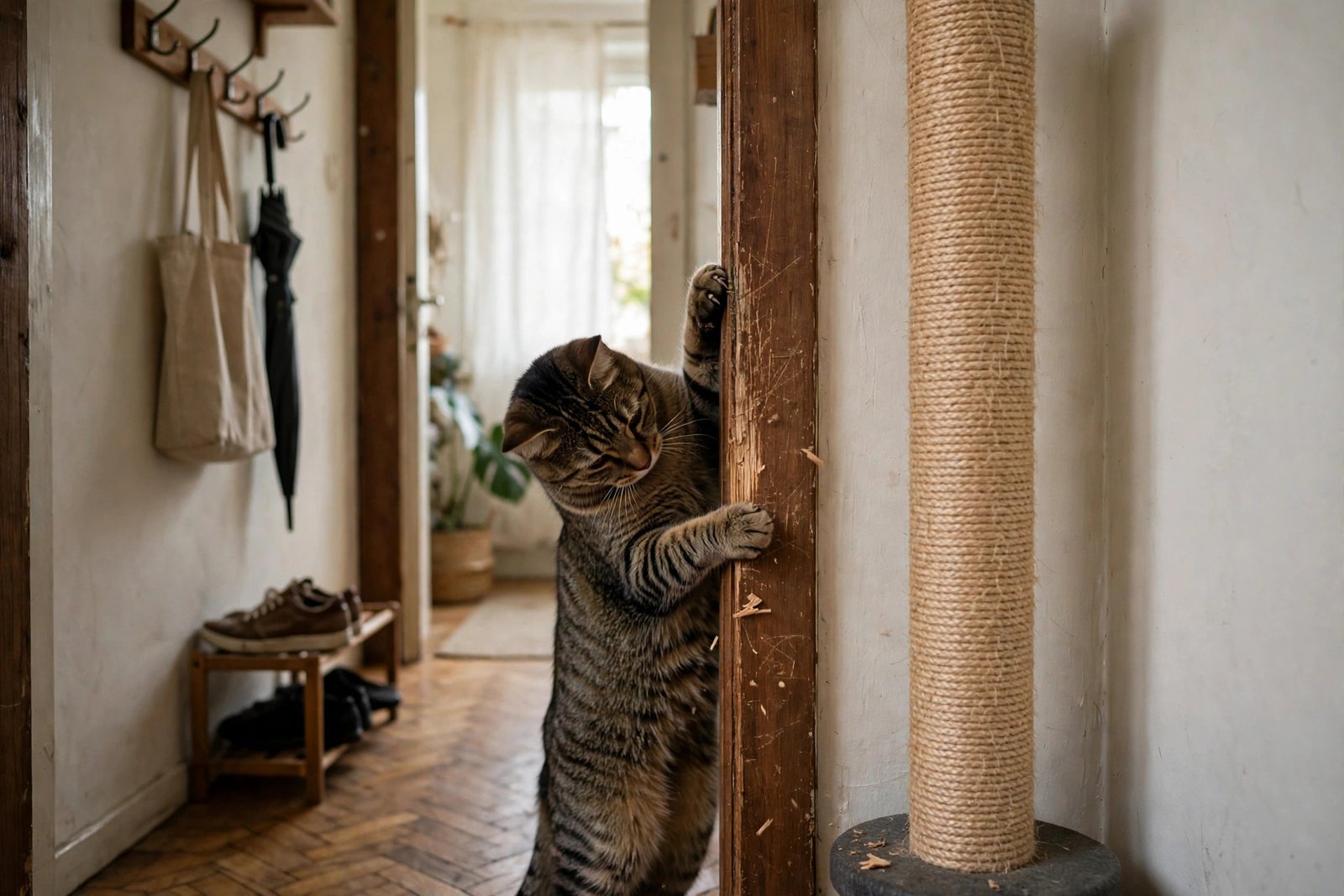
Door frames are where a cat’s scratching habit meets a landlord’s deposit. The wood is right there at paw height, it sits on the cat’s daily route, and every claw mark is visible in exactly the place a landlord looks. Learning how to stop cat scratching door frames is therefore two jobs at once: protect the wood today, and give the cat a better place to scratch tomorrow. This guide does both, in that order, using only fixes that are safe for rented wood — no drilling, no permanent adhesive, nothing that trades the scratch marks for a different kind of damage.
The methods here come from the deterrent and protection guides that actually rank for this intent — the humane-deterrent and door-frame pieces, plus the standard behaviour guidance behind them — and from the same redirection logic as our scratching-post training. Where the sources disagree, mostly on whether scent deterrents work at all, the disagreement is stated. Nothing here was tested on a cat; it is a researched guide, and it never claims a fix works because we tried it.
Why cats scratch door frames
A cat scratching a door frame is not being naughty. It is doing one of four normal things, and which one it is decides the fix.
| The reason | How to tell | What it needs |
|---|---|---|
| Marking territory | Scratching at the frame of a doorway the cat uses constantly, often after another cat has passed through | A legal scratching surface on the same route |
| Stretching and claw care | A long upward pull after a nap, claws hooking and shedding sheaths | A post tall enough for a full stretch — 30 inches minimum is the figure the deterrent guides use |
| Attention | Scratching that starts the moment you walk in, or that stops the moment you look at the cat | Play and attention on your terms, not the scratching’s |
| Boredom or anxiety | Scratching when the flat is empty, or a sudden start after a move or a new pet | Enrichment and routine, not just a new deterrent |
Most door-frame scratching is the first two reasons — territory and stretching — which is good news, because both are answered by the same fix: a proper post on the same route. The attention and boredom cases need that fix too, plus the behaviour work in the later sections.
The 4-week plan
The steps below work in order, and they work on a schedule. Here is the whole fix at a glance — the detail for each week is in the steps that follow.
- Week 1 — Shield and redirect. Fit the shields and put the post on the same route as the frame, beside the wood the cat is already scratching.
- Week 2 — Reward every use, and trim the nails. A treat the moment the cat uses the post, every time — and trim the claws so the damage drops while the habit forms.
- Weeks 3–4 — Move the post a few inches a day. Once the cat uses the post beside the frame reliably, move it inches at a time toward its final spot. A foot at once sends the cat straight back to the wood.
- Week 5 — Take the shields off, if the post wins. If the cat chooses the post every time, remove the shields. If it goes back to the frame, the shields go back on and the post stays where it is for another week.
Step 1: protect the wood today
Protection comes first because training takes weeks, and the frame cannot wait weeks. Every option below is removable and renter-safe; none of them involves drilling, screwing, or gluing anything permanently to the wood.
- Clear adhesive shields. Transparent plastic shields made for door frames stick on with a removable adhesive and take the claws instead of the wood. They are the most direct protection the deterrent guides recommend, and they are nearly invisible once fitted. Test one on a hidden spot first — on old or already-damaged paint, any adhesive can lift a flake when it comes off, and you want to learn that on a spot nobody sees.
- Double-sided tape. Wide double-sided tape, or the cat-specific Sticky Paws sheets the guides name, on the exact strip of frame being scratched. Cats dislike the sticky feeling on their paws, so the tape is both a shield and a mild deterrent. Replace it when it collects dust and stops sticking; dusty tape protects nothing.
- Silicone edge protectors. Soft silicone strips that clip or stick over the frame edge, recommended in the door-frame guides for the corners where claws catch. They round off the edge the cat hooks onto, and they come off cleanly. Measure the frame profile before ordering — a protector made for a square edge will not sit on a rounded one.
- Rigid vinyl guards. A rigid vinyl or hard-plastic guard fitted over the frame corner is the long-term version of the adhesive shield: it does not peel, it does not collect dust, and it survives a cat that returns to the same frame again and again. Adhesive shields are the temporary, renter-safe answer; a rigid guard is the answer for a frame the cat keeps coming back to. No specific guard product is named here — measure the frame profile first, and check that the fixing method is removable before you commit.
- A temporary cover. If nothing else is to hand, a strip of thick clear packing tape over the scratched area, or a cloth draped over the frame, buys a few days while the shields arrive. It looks temporary because it is temporary; do not leave cloth on a frame in a damp bathroom, where it holds moisture against the wood.
What not to use: anything that soaks into the wood or stains it — oils, polishes, and wood stain pens applied to raw scratches will change the colour of the frame and make the eventual repair harder. Keep the wood clean and dry, and leave the repair to the last section.
Soft nail caps: a stopgap while retraining
Soft Paws nail caps cover the claws while the retraining runs, so the frame takes almost no damage even if the cat slips back to the wood for a week. According to the maker, they stay on “approximately 4–6 weeks” and “fall off with the natural growth of your cat’s nails”, and one kit lasts about 4–6 months per cat. Most people apply them themselves — the maker’s own answer to “Can I apply Soft Paws myself?” is “Absolutely. Most people apply the nail caps themselves”, and “If you can trim your cat’s claws, you can apply the nail caps.” They are a stopgap, not a fix: the caps do not teach the cat where to scratch, and they need replacing as they shed with the claw.
Step 2: put a post on the same route
Protection without redirection just moves the scratching to the next frame. The post goes beside the frame being scratched, on the cat’s route through the doorway, so the cat meets the legal surface before it meets the wood.
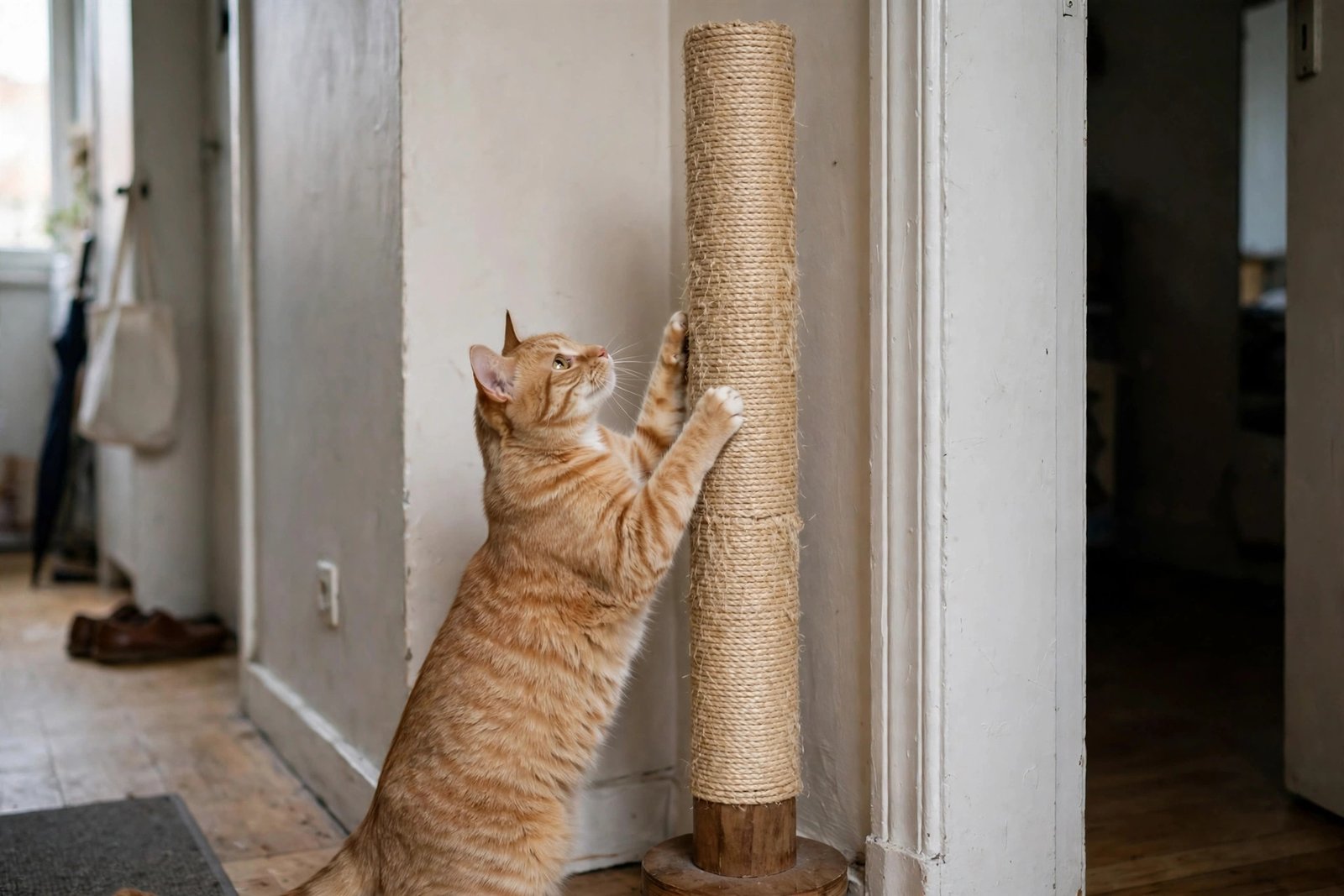
The height rule from the deterrent guides is 30 inches minimum — a post shorter than that forces a crouched scratch, and a cat that has been stretching up a full door frame will not trade down to a short post. The post must also be stable: a wobbling post beside a door frame teaches the cat to go back to the frame, which does not wobble. If your post rocks, the fixes are in our guide to stabilizing a cat tree without drilling, applied to the smaller object.
Once the post is in place, the training is the same as for any scratching post, and our guide to how to get a cat to use a scratching post covers it step by step: catnip or silvervine on the post, play that lands the cat’s paws on it, a treat the moment it scratches, and never forcing the paws. The one difference for a door frame is the move: once the cat uses the post beside the frame reliably, move it inches at a time toward its final spot — a foot at once sends the cat straight back to the wood.
Step 3: deterrents, honestly assessed
Scent deterrents are the most argued-over fix in the door-frame guides, so here is the honest version: they help some cats, do nothing for others, and the guides that recommend them do not agree on why.
- Commercial cat-deterrent sprays made for furniture are the safest starting point: they are formulated for the purpose, and the frame is an easy surface to test them on. Spray the shield or tape, not the bare wood, so you are not soaking the finish. Reapply after cleaning, because the scent fades.
- Citrus scents are the home remedy the guides repeat most: cats generally dislike citrus, and a citrus-scented cleaner on the frame can put a cat off. Test on a hidden spot first, and use a product made for the purpose rather than neat citrus oil.
- What not to use: essential oils. Many essential oils are toxic to cats, and a diffuser or a neat oil applied to a frame the cat rubs against is a health risk, not a deterrent. If a “natural” deterrent recipe calls for essential oils, skip it.
Treat deterrents as a support for the post, never as the whole answer. A cat deterred from one frame with no post to go to will pick the next frame, the sofa, or the door itself. The deterrent buys time; the post does the work.
Step 4: the behaviour behind the scratching
If the frame scratching is attention-seeking, the fix is boring and effective: do not react to the scratching itself. Do not shout, do not rush over, do not pick the cat up — any of those is attention, and attention is what the behaviour was for. Instead, play with the cat and give it attention on a schedule it can count on, and reward it at the post. The scratching fades when it stops working as a way to summon you.
If the scratching started after a move, a new pet, or a change in routine, it is likely stress, and the frame is the outlet. Keep the routine steady — same feeding times, same play times — and add a second scratching surface near the cat’s sleeping spot, so it has a legal outlet in its safe place. If the scratching is frantic, or comes with hiding, not eating, or over-grooming, that is a vet conversation, not a deterrent conversation: pain and anxiety both show up as sudden scratching, and no shield fixes either.
Trim the nails while the habit is being relearned. Trimmed nails do less damage to the frame during the weeks the post is becoming the habit, and the guides raise it as maintenance, not as training — a cat with short nails and no post will still scratch the frame, just with less effect.
One more option for the stress case: a pheromone diffuser near the targeted door. The makers say it calms cats and can lower stress-marking while the retraining runs — treat that as a maker claim, not a verified fact, and as a support for the post, never as the whole answer.
Declawing is not a fix for this — it is surgery, and it does not address the behaviour.
Repairing the damage, for the deposit
Once the scratching has stopped, the frame needs its own fix, and the renter’s version is small and reversible. Clean the scratched area, fill the shallow claw grooves with wood filler matched to the frame’s colour, sand it smooth when dry, and touch up with a matching paint or stain pen on the filled spots only. Photograph the frame before and after, and keep the filler tube and the paint pen: if the landlord asks, the repair is documented, and the materials are on hand for a second pass.
Two cautions. First, do not sand or fill a frame that is rented and already damaged beyond shallow grooves — deep gouges that go through the finish into the wood are a landlord conversation, not a DIY repair, and a bad repair is worse than an honest report. Second, do not paint the whole frame: a freshly painted frame that does not match the rest of the flat is more visible than the scratches were.
FAQs
How do I stop my cat from scratching door frames?
Protect the wood first with a removable adhesive shield or double-sided tape, then put a tall scratching post — 30 inches minimum — right beside the frame, on the cat’s route. Train the cat onto the post with catnip, play and treats, and never force its paws. The shield buys time; the post does the work.
What can I put on door frames to stop cats scratching?
Clear adhesive shields, double-sided tape or cat-specific Sticky Paws sheets, and silicone edge protectors are the renter-safe options — all removable, none drilled or glued permanently. Test any adhesive on a hidden spot first, because it can lift paint from already-damaged wood.
Do scent deterrents stop cats scratching door frames?
Sometimes. Commercial furniture deterrent sprays and citrus scents put some cats off, and do nothing for others. Treat them as support for the scratching post, not as the answer on their own — and never use essential oils, many of which are toxic to cats.
Why does my cat scratch the door frame instead of the scratching post?
Usually the post is too short, wobbles, or sits in the wrong place. A cat that has been stretching up a full door frame will not trade down to a short post in a corner it never visits. Put a tall, stable post beside the frame itself and the habit transfers.
Will my cat scratch the door frame again after I repair it?
Only if the habit was never redirected. A repaired frame with no post beside it is just a fresh surface to scratch. Repair the wood after the cat is reliably using the post — not before — or you will be repairing it twice.
Is it safe to use double-sided tape on a rented door frame?
Generally yes, with a test first. Cat-specific tape is made to come off cleanly, but any adhesive can lift a flake from old or already-damaged paint. Test a small piece on a hidden spot, leave it a day, and peel it off before covering the whole frame.
Related reading
- How to Stop a Cat Scratching the Couch — the damage-control hub for the other surface cats choose, with the same protect-then-redirect logic.
- How to Get Your Cat to Use a Scratching Post — the step-by-step training this guide’s redirection depends on.
- Best Tall Scratching Posts for Large Cats — tall posts that meet the 30-inch rule in this guide.
- How to Stabilize a Cat Tree Without Drilling — no-drill stability fixes when the post beside the frame wobbles.
Last updated: November 20, 2026