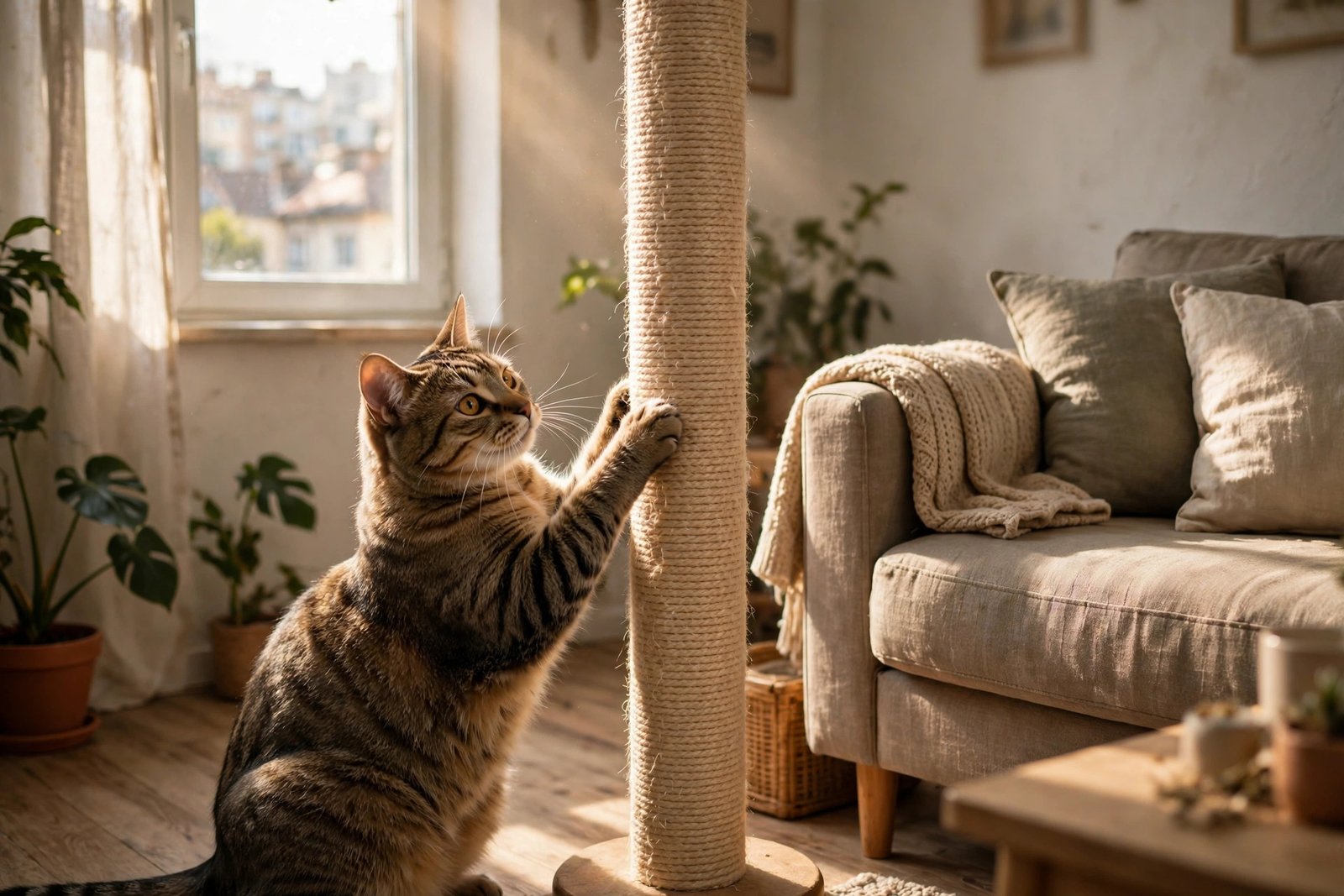
Before anything else, a line that has to be drawn, because this site already has a guide that looks almost identical: our guide to how to get a cat to use a cat tree is about the tall, multi-level furniture a cat climbs, sleeps on and surveys from. This guide is about something different and smaller: the single upright post a cat scratches. The training overlaps — placement, texture, patience — but the object is not the same, and a cat that ignores a post while loving its tree is not being stubborn. It is telling you the post is wrong, not that the idea is. Everything below is about the post, and about how to get cat to use a scratching post: choosing one the cat will actually use, putting it where the scratching already happens, and teaching the habit without force.
The advice here comes from the guides that cover this exact intent — the step-by-step foster-cat plan from Meow Mentor, the eight-ways guide from CatTree UK built on Cats Protection guidance, the exact-match guide from Cats.com, and the behaviour-consultant piece from Pets4Life. Where they agree, this guide follows them; where they differ — mostly on how much catnip matters — the disagreement is stated. Nothing here was tested on a cat in a lab; it is a researched guide built from those sources, and it never claims a method works because we tried it.
Why your cat ignores the post
A cat ignores a scratching post for a reason, and the reason is almost always one of four things. Work through them before buying anything new, because a second post with the same fault will be ignored exactly like the first.
| The reason | How to tell | The fix |
|---|---|---|
| Too short | The cat stretches up the post and runs out of post before its back is straight | A post tall enough for a full stretch — 28 to 32 inches is the rule the guides use |
| It wobbles | The post rocks when the cat pulls on it, or the base lifts | A heavier base, or a post that does not move at all under a pull |
| Wrong texture | The cat scratches the sofa (woven) but not the sisal post, or vice versa | Match the texture to what the cat already scratches |
| Wrong place | The post sits in a corner the cat never visits, while the sofa arm gets all the attention | Move the post to the scratched furniture, not the other way round |
Most ignored posts fail on two of these at once: a short, light post tucked in a corner. Fix the height and the placement together and the training below gets much easier, because you are no longer asking the cat to learn a habit on equipment it dislikes in a place it never goes.
Step 1: choose a post the cat can actually use
The height rule is the one number every guide agrees on: the post must be tall enough for the cat to stretch to full length against it, paws above its head, back straight. Meow Mentor puts that at 28 to 32 inches for an average adult cat. Shorter posts force a crouched scratch, and cats that have to crouch simply go back to the sofa, which is tall enough. Measure your cat stretched up against a wall if you want the exact figure — the post should be at least that tall, and taller is fine.
Stability matters as much as height. A post that rocks when the cat pulls on it teaches the cat, in one attempt, that the post is not to be trusted. The base should be heavy and wide enough that a full-strength pull does not lift it, and the post itself should not flex. If your current post wobbles, the fixes are the same ones in our guide to stabilizing a cat tree without drilling — a wider or weighted base, and a corner placement — applied to a much smaller object.
Texture is the third choice, and it is the one owners get wrong most often, because they buy what looks good rather than what matches the cat. Sisal rope is the default for a reason — most cats like it — but a cat that scratches woven sofa fabric wants a woven surface, and a cat that scratches carpet wants carpet. Look at what the cat already scratches and match it: the texture of the damage is the texture of the answer. The guides are consistent on this point, and the ninelivesindy guide makes it explicit: match the angle and the texture, and the cat transfers the habit on its own.
Step 2: put the post where the scratching already happens
This is the single most effective step on the page, and it costs nothing. Cats scratch where they scratch — usually the arm of the sofa, the corner of a chair, or the side of a door frame — and the post belongs right there, touching the furniture if necessary, not across the room in the spot you would prefer it to live.
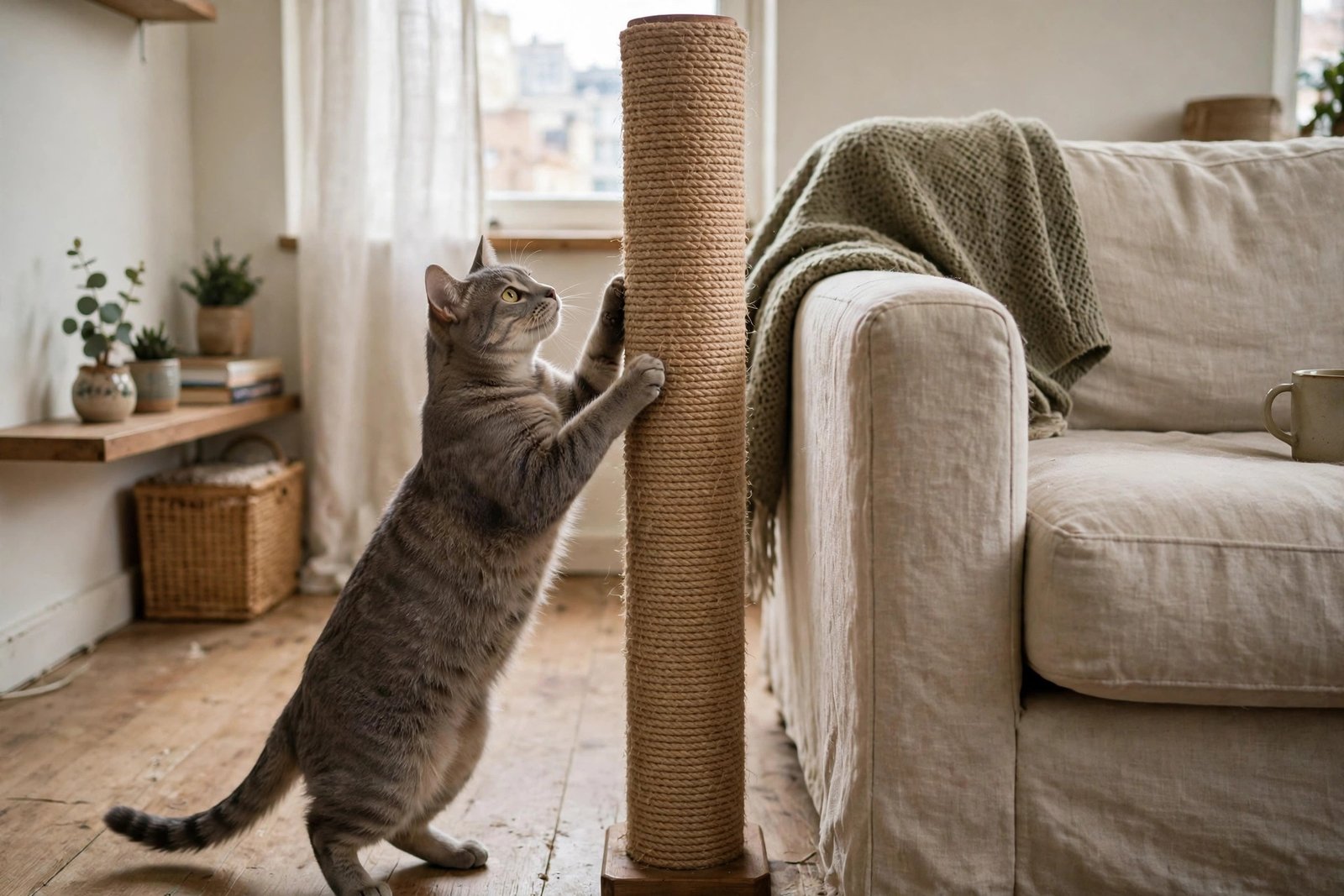
In a small apartment the placement is almost forced on you, which is an advantage: there are only so many places a post can go, and the scratched furniture is one of them. Put the post directly beside the arm or leg being scratched, close enough that the cat can choose the post without taking a step. Once the cat uses the post there reliably, move it a few inches at a time — a few inches a week, the ninelivesindy guide’s pace — toward the spot you actually want it in. Move it a foot at once and the cat goes back to the sofa; move it inches and the habit travels with it.
The other placement rule is territory: cats scratch in their core territory, where they sleep and play, and after naps, as part of waking up. A post beside the sleeping spot gets used at wake-up; a post in a room the cat only crosses does not. The Pets4Life piece makes this the central placement principle — the post goes where the cat lives, not where the owner wishes it would live.
Step 3: teach the habit, without force
With the right post in the right place, the training is short. The guides agree on the sequence, and on the one thing that must never happen in it.
- Make the post interesting. Rub catnip or silvervine on the sisal — the guides differ on which works better, and some cats ignore catnip entirely, so try silvervine if catnip does nothing. Dangle a toy on a string over the post so the cat’s paws land on it during play; the first scratch often happens by accident during a game, and that accident is the whole lesson.
- Reward the scratch, not the approach. When the cat scratches the post, praise it and offer a treat right there. The guides are consistent that the reward must land on the scratch itself: rewarding the cat for merely walking past the post teaches it to walk past the post.
- Make the wrong surface boring. Cover the scratched sofa arm with a throw or a double-sided tape sheet while the post is being learned, so the old surface stops paying off. Do not remove the cover the day the cat first uses the post — keep it on for a week or two, until the post is the habit.
- Never force the cat’s paws onto the post. Every guide on this topic says this, and Cats Protection’s guidance is the source: holding a cat’s paws and dragging them down the post frightens the cat and teaches it to avoid the post, not to use it. A cat that has been forced once may take weeks to come back to the object.
- Keep the post where it is until the habit is set. Two to four weeks of consistent use in one spot is the usual window the guides describe. Only then start the inches-at-a-time move toward the post’s final home.
Nail trimming is a side note the Cats.com guide raises, and it is worth including honestly: trimmed nails do less damage while the habit is being learned, but trimming is maintenance, not training. A cat with trimmed nails and no post will still scratch the sofa — just with shorter nails.
How many posts, and where the second one goes
The rule the guides use is one scratcher per cat, plus one extra — the same arithmetic as litter boxes, for the same reason. In a one-cat apartment that means two posts, and the second one goes in the cat’s other core spot: one beside the sofa, one beside the sleeping area, so the cat never has to cross the flat to find a legal scratch.
In a multi-cat home the arithmetic matters more, because cats do not always share a scratching post any more than they share a food bowl. Two cats that tolerate each other may share; two that do not will each claim a post, and the cat without one goes back to the furniture. The extra post is insurance, and in a small flat it is cheap insurance — a second tall post takes less floor than the sofa arm it protects.
When to try a different post
If the right post in the right place with catnip and play still gets ignored after three weeks, the post itself is the problem, and the guides’ answer is to change the variable you have not changed yet. A cat that ignores a vertical sisal post may take to a horizontal cardboard scratcher immediately — some cats scratch down, not up, and a horizontal scratcher on the floor is a different object, not a failure of the first one. A cat that ignores sisal may take to carpet, or to bare wood. Change one variable at a time — texture, then angle, then location — and give each change a week, or you will not know which change worked.
What you should not do is keep buying the same kind of post in different colours. A second short sisal post is the same mistake in a new shade, and the cat will ignore it for the same reason.
FAQs
How long does it take for a cat to use a scratching post?
With the right post in the right place, most cats start within a few days, and the habit is usually set in two to four weeks. If nothing has happened after three weeks, change one variable — texture, angle, or location — and give the new version a week.
Why won’t my cat use a scratching post?
Almost always height, stability, texture, or placement. The post is usually too short for a full stretch — 28 to 32 inches is the rule — or it wobbles, or its texture does not match what the cat already scratches, or it sits in a corner the cat never visits while the sofa gets all the attention.
Should I put catnip on a scratching post?
Yes, as an invitation, not as the training itself. Rub catnip or silvervine on the post to get the first investigation; some cats ignore catnip entirely, so try silvervine if catnip does nothing. The habit is built by placement and reward, not by the herb alone.
Can I force my cat’s paws on the scratching post?
No. Every guide on this topic, including Cats Protection’s guidance, says not to: holding a cat’s paws and dragging them down the post frightens the cat and teaches it to avoid the post. Use play and treats to get the first scratch instead.
Where should a scratching post go in a small apartment?
Directly beside the furniture the cat already scratches, in the cat’s core territory — near where it sleeps and plays. Once the habit is set, move the post a few inches at a time toward its final spot; moving it a foot at once sends the cat back to the sofa.
Is a scratching post or a cat tree better for scratching?
They are different objects for different jobs. A post is for scratching — a single upright surface at the right height. A tree is for climbing, perching and sleeping, with scratching as one feature among several. If the cat scratches the furniture, it needs a post; if it needs height and a view, it needs a tree. Our cat tree guide covers the tree side.
Related reading
- How to Get a Cat to Use a Cat Tree — the tree-side companion to this guide: climbing, perching and sleeping, not scratching.
- How to Stop a Cat Scratching the Couch — the damage-control hub for the furniture this post is meant to protect.
- Best Tall Scratching Posts for Large Cats — tall posts that meet the 28-to-32-inch rule for bigger cats.
- How to Stabilize a Cat Tree Without Drilling — the same no-drill stability fixes, applied when the post itself wobbles.
Last updated: November 10, 2026
Pingback: How to Stop Cat Scratching Door Frames: Renter-Safe 2027