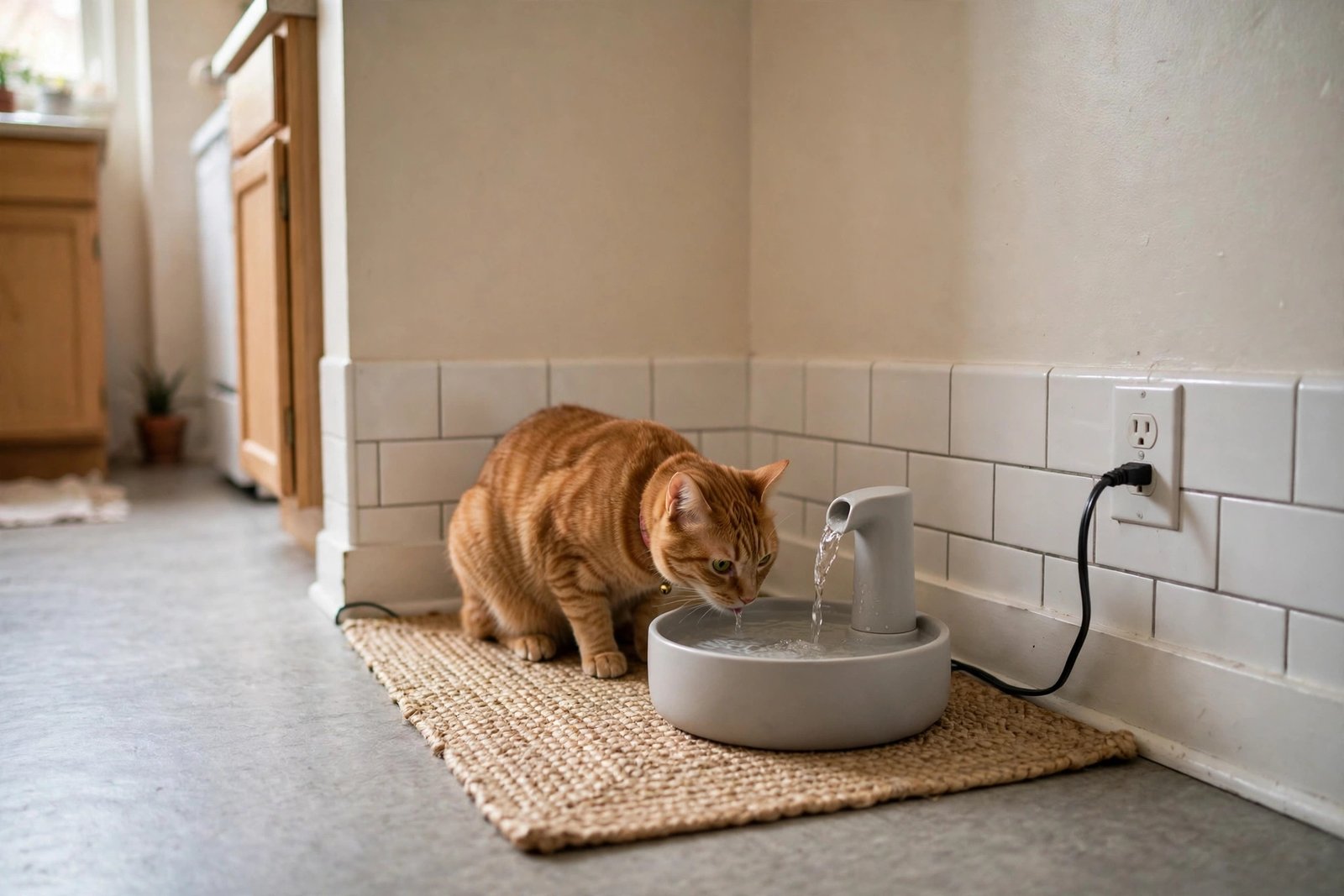
Most fountain guides tell you to put the water “in a quiet spot away from the food” and stop there. In an apartment, that advice collides with reality: there may be one free outlet in the whole kitchen, the quiet spot is also the only walkway, and the food, the water and the litter box are all within fifteen feet of each other whether you like it or not. Getting cat water fountain placement right in an apartment is less about finding the perfect room and more about working the constraints in the room you have — outlet first, then traffic, then distance from food and litter, in that order.
This guide pulls together what the placement guides actually say — the outlet-first rule from the recent Medium piece on placement, the spot guides from Aosom and PetSnowy, and the hydration-habit guidance from Purrwise — and then applies each rule to a small flat, where the rules fight each other. Where the guides disagree, the disagreement is stated rather than smoothed over.
The six placement rules, in order
Placement guides agree on the rules; they disagree on which one wins when two of them conflict. In an apartment, the order below is the order that works: the outlet decides first, because a fountain that cannot reach power cannot go anywhere else.
| Rule | What it means | Apartment reality |
|---|---|---|
| 1. Near an outlet | The fountain needs power; the cord must reach without crossing a walkway | Kitchen outlets are scarce and often behind appliances — the outlet may pick the room for you |
| 2. On a flat, stable surface | Level floor or counter, no wobble, no slope | Old apartment floors slope; test with a glass of water before committing to a spot |
| 3. Away from the food bowl | Cats prefer water away from where they eat; a few feet at minimum | A few feet may be all the kitchen allows — across the room is better than across the counter |
| 4. Away from the litter box | Water and litter in different parts of the home | In a studio, “different part” means opposite corners, not opposite rooms |
| 5. Low traffic, but not hidden | Quiet enough that the cat is not startled mid-drink | The hallway to the bathroom is not low traffic, even if it looks empty most of the day |
| 6. Out of direct sunlight | Sun warms the water and speeds up algae and slime | A sunny windowsill is the worst spot in the flat, however convenient the outlet there is |
Rule 1: the outlet decides
The freshest placement piece on the topic puts it bluntly: your outlet decides where the cat water fountain goes. That sounds like a defeat, but it is the honest starting point in a small home, and working from it beats choosing a perfect spot and then discovering the cord does not reach.
Walk the kitchen and the nearest room and count the outlets that are actually free — not behind the fridge, not already running the microwave, and not so low that the cord has to drape across the floor. In many apartments that leaves one or two candidates, and the fountain goes at one of them. The cord itself is part of the placement: it must run along the wall or behind furniture, never across a walkway where a person trips and a cat chews. Cord safety is one of the points the hydration guides stress, and it matters more in a small flat, where every path crosses every other path.
If the only free outlet is in the wrong room — the bathroom, say — weigh it against the other rules before accepting it. A bathroom fountain works if the bathroom stays dry and the cat actually goes in there; a bathroom that is damp all day, or a door the cat will not push through, fails rule 5 even though it passes rule 1. When no outlet works at all, a cordless model is the honest answer rather than an extension cord across the kitchen: our guide to best cordless cat water fountains covers the battery models that can live away from the wall entirely.
Rule 2: flat and stable, tested not assumed
Fountains are shallow bowls with a pump. On a slope, the water pools to one side, the pump runs dry on the other, and the noise goes up — which is why the placement guides and the quiet-fountain guides agree that a level surface is a placement rule and a noise rule at once. Old apartment floors slope more than they look like they do, so test the spot: set a glass of water down and watch the surface line. If the glass is visibly tilted, the fountain will be too.

Counters are the obvious flat surface, but they have their own costs in a small kitchen: the fountain takes counter space every day, and a cat that jumps up to drink can knock it. Floor placement is the usual apartment answer, on a mat (see the workflow section below), with the fountain pushed against a wall or into a corner so the cat approaches it from one side only. Either way, the surface must be waterproof underneath — a spill on a laminate counter edge or a wooden floor is a landlord problem, not just a mess.
Rules 3 and 4: distance from food and litter
Cats evolved to drink away from where they eat and away from where they eliminate. The guides phrase it as a preference, but the behaviour is consistent enough that the placement rules treat it as one: water a few feet from the food bowl, and the litter box in a different part of the home.
In a one-bedroom flat, “a few feet” and “a different part” need translating. A few feet from the food bowl is achievable in almost any kitchen: food on one side of the room, water on the other, even if “the other side” is only six feet away. The litter box is the harder one, because a small flat may genuinely have only two rooms. The practical version is opposite corners — food and water in the kitchen, litter in the bathroom or the far corner of the living room — and never water beside the litter box, which is the one arrangement every guide rules out. If the litter box lives in the bathroom and the only outlet is also in the bathroom, put the fountain in the kitchen instead and accept the cordless trade-off, or accept a longer cord run along the wall: proximity to litter is the worse compromise.
Rule 5: quiet, but where the cat actually goes
A fountain in a dead corner the cat never visits is a decoration. The guides call for a low-traffic spot, and in an apartment that means the cat’s own territory — near where it sleeps and plays — rather than a hallway it only crosses. Watch where your cat already drinks: if it laps from the bathroom tap, the bathroom is its water territory, and a fountain there will be used; if it waits by the kitchen sink, the kitchen is the territory, and a fountain in the bedroom will sit untouched. Once the spot is right, choose from quiet cat water fountains so the pump hum does not spoil the calm.
Multi-cat homes add one more consideration, and the placement guides raise it explicitly: more than one cat means more than one water station, or one larger station where the cats do not have to queue. In a small flat that usually means two fountains in two spots — the kitchen and the living room, say — rather than one big one, because two cats that do not share well will not share a single bowl no matter how large it is. PetSnowy’s multi-cat placement guidance makes the same point from the other side: a single station works only where the cats already drink together.
The mat and the cleaning workflow
Placement is not finished when the fountain is set down. The guides that cover cleaning all assume a mat underneath, and in a small apartment the mat is what makes the spot workable day to day: it catches the drips, it gives the fountain a level footing on a slightly uneven floor, and it marks the spot so the fountain goes back to exactly the same place after every wash.
Put the mat down first, then the fountain on it, and build the cleaning routine around the spot: the fountain comes apart in the sink, the parts dry on a towel, and the mat gets a shake outside or a wipe. That loop is why our guide to how to clean a cat water fountain is the natural companion to this one — a well-placed fountain that is a chore to clean will be moved to a worse spot within a month, and a badly placed fountain that is easy to clean will be kept. If the fountain hums in its new spot, the cause is usually water level or a dirty pump rather than the spot itself; our guide to how to make a cat water fountain quieter works through those causes in order.
Spots to avoid, and why
| Spot | Why it fails |
|---|---|
| Beside the litter box | Cats avoid drinking near elimination; litter dust lands in the water |
| Right next to the food bowl | Food debris in the water; the cat’s own preference is distance |
| A sunny windowsill | Warm water, faster algae and slime; more cleaning for the same fountain |
| A hallway or doorway | Startled drinking, tripping hazard, cord across the path |
| On a washing machine or dryer | Vibration, heat, and a fall risk every spin cycle |
| Behind a door that swings shut | The cat gets locked out of its own water |
| On carpet with no mat | Spills soak in, the base wobbles, and the carpet under it never dries |
The sunny-windowsill case deserves a second look, because it is the mistake the outlet rule creates: the only free outlet is often by the window, and the window is the sunniest spot in the flat. If that is your only outlet, shade the fountain — a small shelf above it, or a spot a foot back from the glass — rather than accepting the sun. And if the fountain is stainless steel, the sun problem is smaller than with plastic, because steel stays cleaner between washes; our roundup of the best stainless steel cat water fountains covers the models where the material itself helps.
How to test a new spot
Do not commit to a spot on theory. The placement guides agree on the test, even when they phrase it differently: put the fountain in the candidate spot, fill it, and watch for three days. Count how often the cat drinks there, and whether it still goes to the old water source — a tap, a bowl, a glass left on the counter. If the cat drinks from the fountain and ignores the old source, the spot works. If it drinks from the old source and walks past the fountain, the spot fails rule 5, whatever the other five rules say.
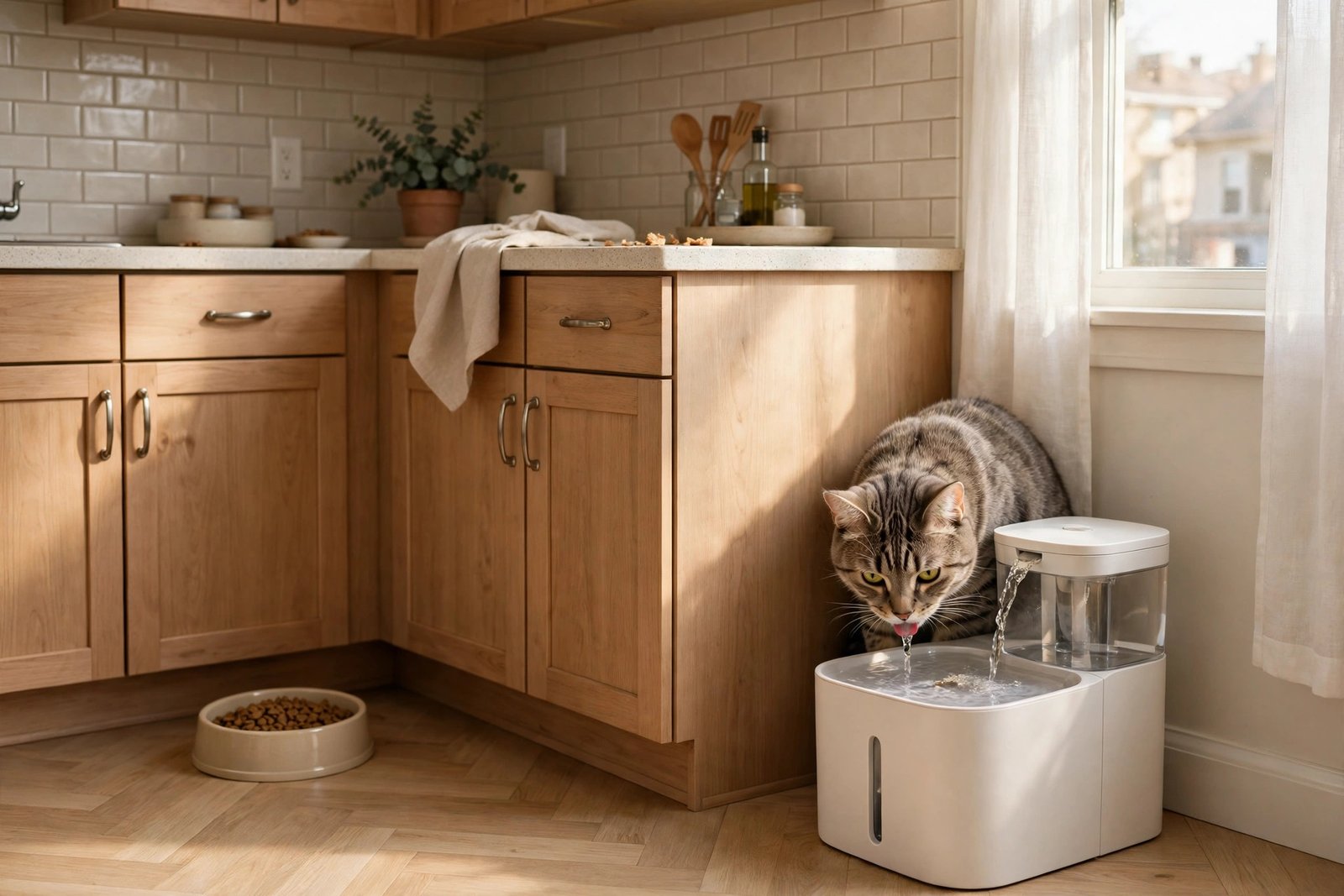
One practical note for the test: leave the old bowl in place for the first few days, full of fresh water. A cat that cannot find water where it expects it will drink less, not search harder, and the test should measure preference, not thirst. Move the old bowl only once the fountain is clearly winning.
FAQs
Where is the best place to put a cat water fountain in an apartment?
Near a free outlet, on a flat surface, a few feet from the food bowl and in a different part of the home from the litter box, in a quiet corner of the cat’s own territory. In most small flats that means a kitchen corner on a mat — the outlet usually decides the room, and the corner decides the exact spot.
Should a cat water fountain be near the food bowl?
No. Cats prefer to drink away from where they eat, and every placement guide puts distance between the two. A few feet is the minimum; across the room is better. Food debris in the water is the practical reason as well as the behavioural one.
Can I put a cat water fountain in the bathroom?
Yes, if the bathroom is dry, the cat actually goes in there, and the litter box is not in the same bathroom. A damp bathroom, or a door the cat will not push through, makes it a bad spot even if the outlet is convenient.
Does a cat water fountain need to be near an outlet?
A plug-in fountain does — the cord must reach without crossing a walkway. If no outlet works in the right spot, a cordless battery fountain is the honest alternative; our cordless roundup covers the current models.
Why does my cat ignore the new fountain?
Usually the spot, not the fountain: too close to the food or litter, too much foot traffic, or a corner the cat never visits. Move it to the cat’s own territory — near where it sleeps or already drinks — and leave the old bowl full for a few days while it switches over.
Is it okay to put a cat fountain on carpet?
Only on a waterproof mat, and only if the surface underneath is level. Without a mat, spills soak into the carpet, the base wobbles, and the damp patch under the fountain never fully dries.
Related reading
- How to Clean a Cat Water Fountain — the part-by-part schedule, so the well-placed fountain stays clean enough to keep using.
- How to Make a Cat Water Fountain Quieter — when the problem in the new spot is pump noise rather than placement.
- Best Stainless Steel Cat Water Fountains — steel models, which stay cleaner between washes in a sunny or hard-to-reach spot.
- Best Cordless Cat Water Fountains — battery models for the rooms where no outlet works.
- Best Small Cat Water Fountains — compact models sized for the counter and floor space a small flat actually has.
Last updated: November 10, 2026
Pingback: Studio Apartment Cat Layout Ideas 2027
Pingback: Cat Water Fountain vs Bowl: Which Is Better 2027