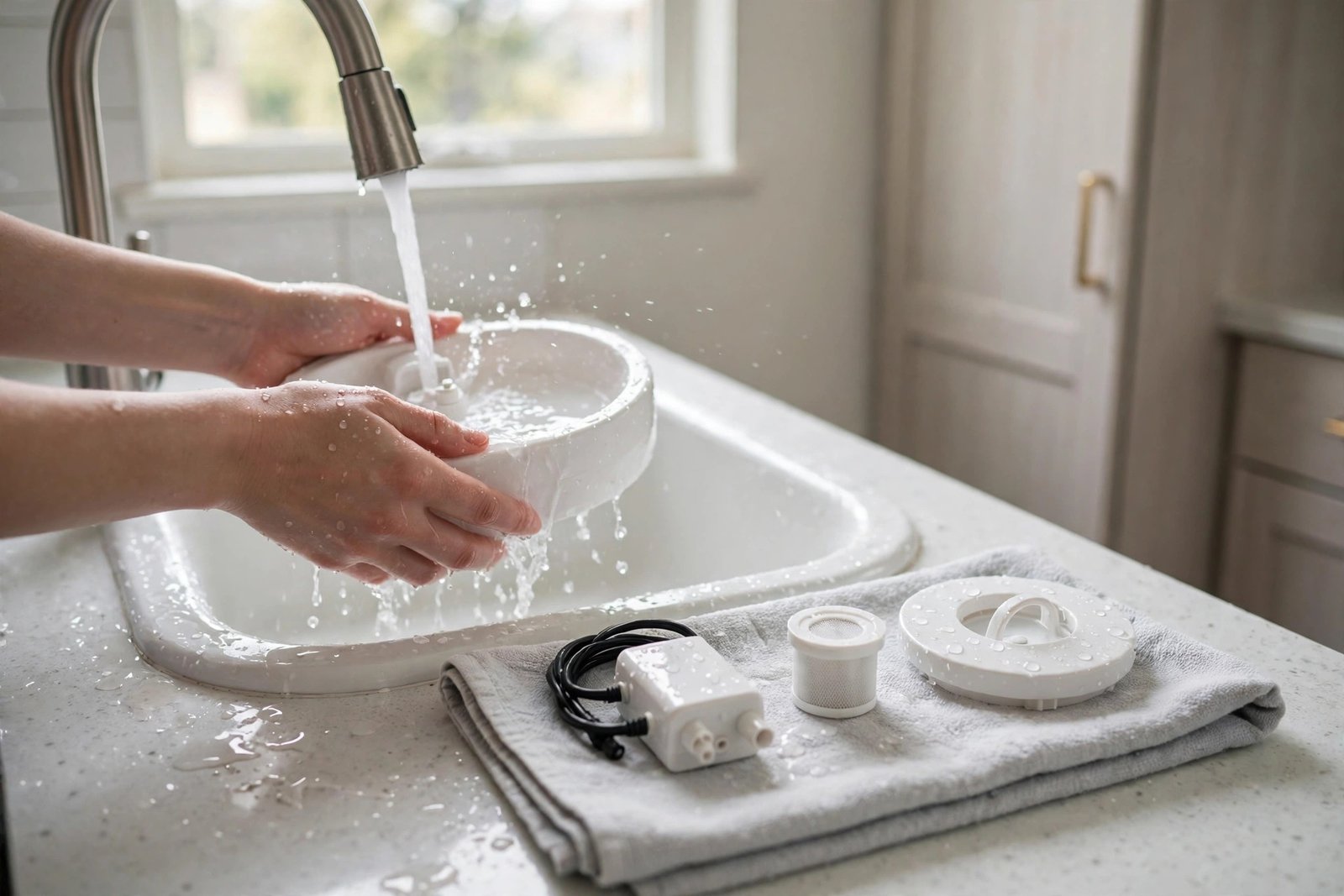
A cat water fountain looks low-maintenance right up until you lift the lid and find the slime. Knowing how to clean a cat water fountain properly is mostly about the parts you cannot see — the pump and its impeller — and in an apartment that job usually happens in a small kitchen sink, quite possibly with no dishwasher to fall back on. This guide gives you the schedule the makers themselves publish, part by part.
The intervals below come from PetSafe’s Drinkwell manuals and Catit’s care instructions as carried by pet retailers. Where those sources disagree — and on filters and pumps they genuinely do — both figures are printed with their sources, because the honest answer to “how often” is “it depends on the model.” Your own manual outranks any general guide, including this one.
The schedule: every part, how often
Two brands’ paperwork covers most of the fountains in apartment homes, so the table is built from PetSafe and Catit. Read the Source column before you set a reminder: where the two disagree, the disagreement is the information.
| Part | How often | How | Source |
|---|---|---|---|
| Bowl, basin and drinking surfaces | Once a week (full wash) | Warm soapy water and a soft sponge; rinse thoroughly | PetSafe Drinkwell manual; Catit care pages |
| The water itself | Change every 24 hours | Empty, rinse the bowl, refill with fresh water | Catit care pages (Pets at Home) |
| Pump | PetSafe: every 2 weeks. Catit: every 4 weeks (zooplus) — or every 2 weeks (Pets at Home) | Full strip-down: impeller out, cavity scrubbed, vinegar soak for scale (step by step below) | PetSafe manual; Catit care pages |
| Impeller (the “drive magnet”) | At every pump clean | Lift out and wipe clean; clean with vinegar against limescale | PetSafe manual; Catit care pages |
| Carbon (charcoal) filter | PetSafe: every 2-4 weeks, sooner in multi-pet homes. Catit: every 3 weeks (zooplus) — or every 30 days (Pets at Home) | Replace it. Rinse only, never soap; rinse a new filter under water until it runs clear before fitting | PetSafe manual; Catit care pages |
| Foam pre-filter | Every 1-2 months | Replace it; never wash it with soap | PetSafe manual |
One honesty note on the weekly wash itself: PetSafe’s manual states it plainly — “Clean the Pet Fountain once a week” — while one of the brand’s answers on a retailer listing suggests “at least once a month.” When a maker’s own channels conflict, the manual is the stronger citation, and weekly is also where Catit lands, so weekly is the schedule this guide builds on.
The weekly wash, step by step
- Unplug the fountain and empty it.
- Take it apart: bowl and housing pieces out, filter out, pump out.
- Wash the bowl and housing parts in warm soapy water with a soft sponge. Keep the filter out of the soapy water entirely — it gets a plain-water rinse only (the reason is in the filters section below).
- Rinse everything thoroughly. Catit’s care pages stress rinsing carefully so no soap residue is left behind, and that applies to every part, not just theirs.
- Dry the parts, reassemble, fit the rinsed or new filter, and refill.
The pump runs on its own clock (every 2 weeks on PetSafe’s schedule), so most weeks it stays in place. When its turn comes, it gets the full treatment next.
The pump, taken apart
This is the section most cleaning guides skip, and it is the one that matters most. The slime in a fountain concentrates in the impeller cavity — the one place a surface wipe never reaches — and PetSafe’s manual treats pump cleaning as maintenance, not optional care: it warns that the warranty may be void if the pump motor is not cleaned regularly. The steps below follow that manual.
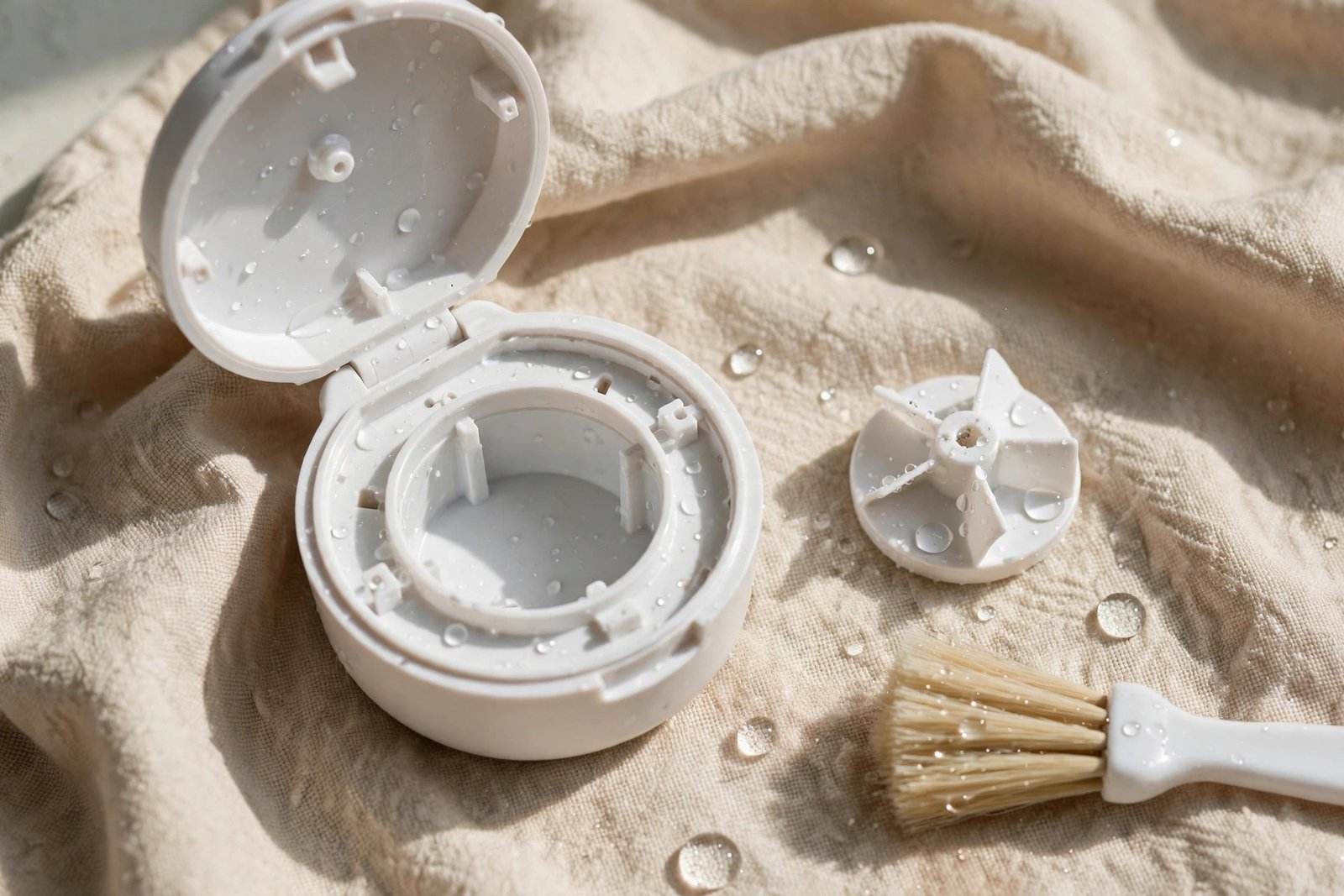
- Remove the pump: unplug the fountain, disconnect the pump’s inline plug, and lift the pump out.
- Take the faceplate off. A fingernail or a coin may be needed to get it started.
- Lift the impeller out and set it aside.
- Clear hair and food debris from around the flow-control knob and the intake plate.
- Wash the impeller and the pump parts in warm soapy water.
- Clean inside the motor cavity with a cotton swab or a small round brush — PetSafe sells one as the “motor” brush in its Drinkwell Cleaning Kit, and the brand’s retailer answers describe working soapy water around the cavity with the brush.
- For disinfecting and for hard-water scale, soak the cavity with a diluted solution of 20% white vinegar and 80% water.
- Rinse, reassemble, and put the pump back.
Catit’s version of the same job is shorter: remove the impeller (they call it the drive magnet), wipe it clean, and use vinegar against limescale several times a year. And if your fountain has started humming, buzzing or running weak, a fouled impeller is one of the first suspects — our guide to how to make a cat water fountain quieter works through the noise causes in order.
Filters, without the folklore
Start with the one rule every maker agrees on: never wash a fountain filter with soap. PetSafe gives the reason — soap residue seeps into the filter and cannot be removed from it. Filters are rinsed under plain water only, and a brand-new charcoal filter gets rinsed until the water runs clear before it goes in, to wash off the loose charcoal dust.
The replacement clock is where the folklore starts, because the sources do not agree with each other. PetSafe says every 2-4 weeks for the carbon filter, changed more often in homes with several pets or a heavy-saliva cat. Catit’s own retailer pages give two different figures — every 3 weeks on zooplus, every 30 days on Pets at Home — and this guide prints both rather than averaging them into a number nobody published. The foam pre-filter, where a model has one, runs on a slower clock: every 1-2 months per PetSafe.
Run the arithmetic on the carbon clock and you get the real commitment behind a filtered fountain: at one change every 2-4 weeks, a single cat drinks through 13-26 carbon filters a year, plus 6-12 foam pre-filters if the model uses them. That count — not any single purchase — is the running cost of the category. If the replacement clock is the part of fountain ownership you are tired of, our roundup of cat water fountains without proprietary filters covers the models built to escape it.
Two more honest points from the manuals. First, a filter is not required for a PetSafe fountain to run — the manual says so — though the maker recommends one because it keeps the water cleaner. Second, retire the bleach soak: it appears in an older PetSafe manual, but the current maker guidance disinfects with the vinegar solution from the pump section instead. Follow the current manual for your model.
Slime: why it comes back, and how to slow it
The slippery coating on the inside of the bowl is a biofilm — a living film that builds up on surfaces that stay wet. Scrubbing the bowl alone does not finish the job, because the thickest of it sits inside the pump, in the impeller cavity. Skip the pump on its schedule and the bowl slimes up again quickly, because the part you skipped never got reset.
The prevention habits are unglamorous and entirely maker-based:
- Keep the weekly wash. Both brands’ schedules are built on it.
- Never skip the pump clean. It is the reservoir the rest of the routine cannot reach.
- Dry the parts fully before reassembly rather than putting the fountain back together wet.
- Replace filters on schedule — Pets at Home’s Catit care text adds “or when visibly saturated,” which is the right trigger to watch for.
- Keep the water itself fresh: Catit’s care pages call for a full water change every 24 hours.
Pink-tinged slime worries a lot of owners; it shows up in the same places as the clear kind, and the maker-based response is the same — the full wash, the pump taken apart, a filter check — not a specialty product. The same routine is also the mold answer: the vinegar soak in the pump section is the disinfecting step the makers themselves specify.
The small-apartment workflow
None of the steps above requires a dishwasher, a utility sink or a second bathroom. The makers’ routine is a hand-wash routine, which makes it a renter’s routine by default — the dishwasher, where it is allowed at all, is only ever a shortcut for the housing parts. Here is how the job fits a galley kitchen:
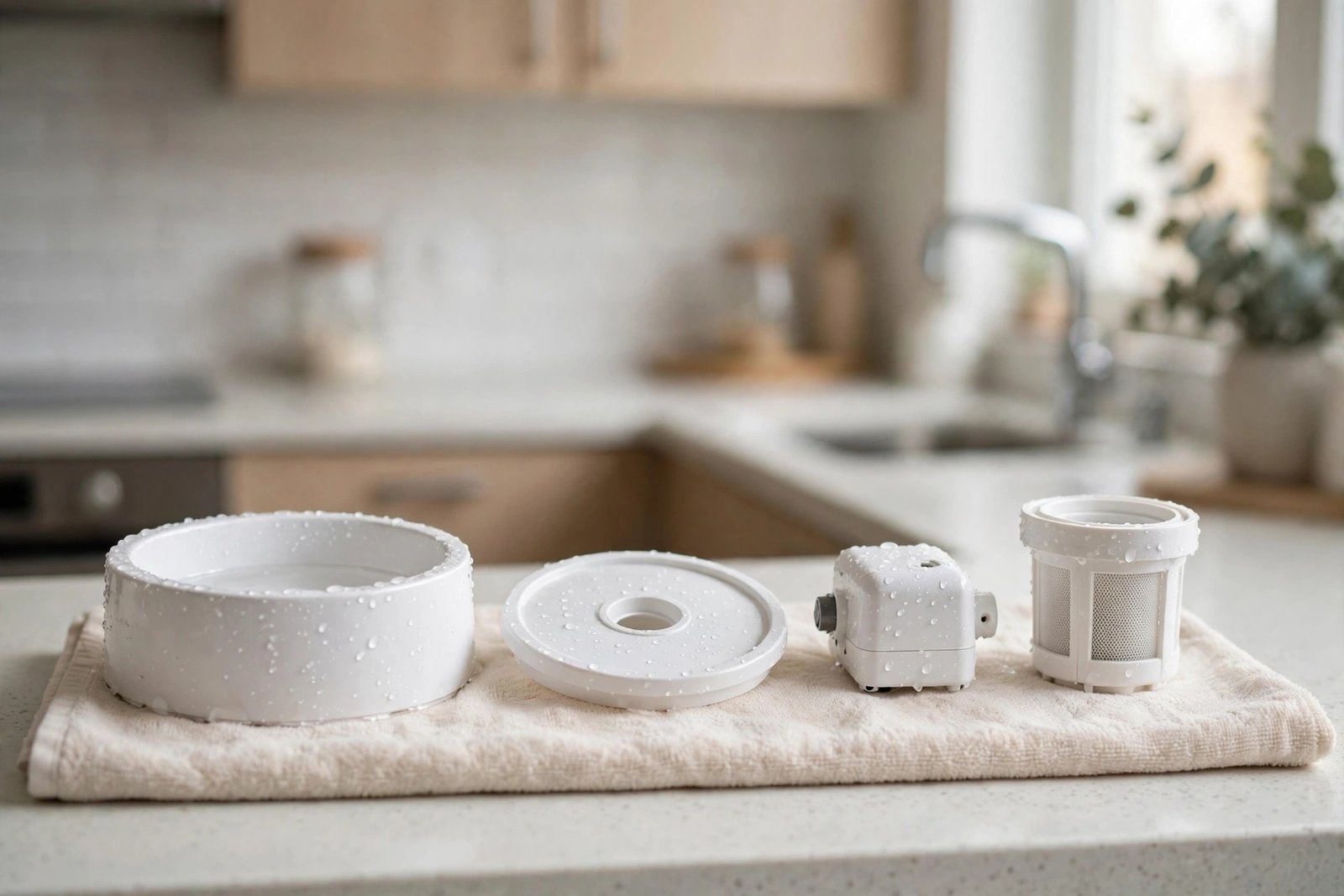
- Claim one towel of counter. Lay a towel beside the sink and put each part on it in the order it came off. In a small kitchen, the towel is both the workbench and the drying rack.
- Batch the soaking. While the pump cavity sits in its vinegar soak, wash the housing parts. Rinse the filter last, away from the soapy water, so it never touches soap by accident.
- Keep a drawer-sized toolkit. Cotton swabs, a small round brush or an old toothbrush, and a soft sponge — that is the whole kit the makers’ instructions call for.
- Dry before you rebuild. Let the parts dry fully on the towel before reassembly; it doubles as one of the slime-prevention habits above.
- Tighten the clock for more cats. PetSafe’s guidance is to change the carbon filter more often in multi-pet homes, and a shared fountain in a small flat earns that shorter interval.
What can go in the dishwasher
Dishwasher safety is part-specific, and the makers are precise about it. Steel earns a mention here: the Catit stainless steel insert is dishwasher-safe per its care pages, and steel is the material to look at if easy cleaning drives your choice — our guide to the best stainless steel cat water fountains covers the current models.
| Part | Dishwasher? | Source |
|---|---|---|
| Fountain bowl and housing | Yes — top rack, where the maker allows it; hand-wash instead if your dishwasher runs very hot | PetSafe manual |
| Stainless steel insert / top | Yes | Catit care pages (zooplus) |
| Pump and motor | Never | PetSafe manual |
| Power cord | Never | PetSafe manual |
| Filters (carbon and foam) | Never — rinse in plain water only; soap is banned as well | PetSafe manual; Catit care pages |
| Filter housing on Pagoda and Avalon models | No — hand-wash only | PetSafe, via Chewy |
Where these schedules come from
Every interval in this guide traces to the makers’ own published material: PetSafe’s Drinkwell manuals and the brand’s answers on retailer listings, and Catit’s care instructions as published by zooplus and Pets at Home. Where those sources disagree — Catit’s filter and pump intervals are the standing example — both figures are shown with their sources rather than smoothed into one. This is a researched guide built from those documents; it is not a hands-on test, and it never quotes a schedule we could not trace back to a maker’s page.
FAQs
How often should you clean a cat water fountain?
Once a week for the full wash — that is PetSafe’s manual wording, and Catit’s care pages land on the same weekly wash. On top of that, the pump comes apart every 2 weeks on PetSafe’s schedule, while Catit’s retailer pages say every 4 weeks (zooplus) or every 2 weeks (Pets at Home). Check your model’s manual for which pump clock applies.
Can you wash a cat fountain filter with soap?
No. This is the one point every maker agrees on: rinse the filter under plain water only. PetSafe’s manuals explain why — soap residue seeps into the filter and cannot be removed from it. A new charcoal filter should also be rinsed until the water runs clear before it is fitted.
Can you clean a cat water fountain with vinegar?
Yes — vinegar is the makers’ own descaling and disinfecting tool. PetSafe specifies a solution of 20% white vinegar and 80% water, soaked in the pump’s motor cavity, for disinfecting and hard-water buildup. Catit’s care pages use vinegar on the impeller against limescale, several times a year.
Can you put a cat water fountain in the dishwasher?
Parts of it. PetSafe allows the fountain itself on the top rack, with the pump, motor and cord always excluded, and advises hand-washing if your dishwasher runs very hot; the filter housing on the Pagoda and Avalon models is hand-wash only. Catit’s stainless steel insert is dishwasher-safe. Filters never go in — they are rinsed in water only.
Do you have to use a filter in a cat water fountain?
Not for the fountain to run: PetSafe’s manual states a filter is not required for normal operation. The maker still recommends one because it keeps the water cleaner — so treat it as a water-quality choice with a replacement schedule attached, not a mechanical necessity.
How often should a multi-cat home clean the fountain and change filters?
More often than the standard schedule. PetSafe advises changing the carbon filter more often in homes with multiple pets or a cat with heavy saliva, and the weekly full wash stays weekly at minimum. The pump interval is the one not to stretch: more cats means more hair and debris reaching the intake plate and impeller.
Related reading
- How to Make a Cat Water Fountain Quieter — when the problem is pump noise rather than hygiene, start here.
- Best Stainless Steel Cat Water Fountains — the steel models, including the dishwasher-safe designs.
- Best Cat Water Fountains Without Proprietary Filters — for owners who are done with the replacement-filter clock.
- Best Quiet Cat Water Fountains for Apartments — the low-noise picks, once yours is clean and still too loud.
- Best Small Cat Water Fountains — compact models sized for small counters and studios.
- Best Cordless Cat Water Fountains — battery models that can live away from the kitchen outlet entirely.
Last updated: November 9, 2026
Pingback: Best Quiet Cat Water Fountains for Apartments: 8 Picks 2027