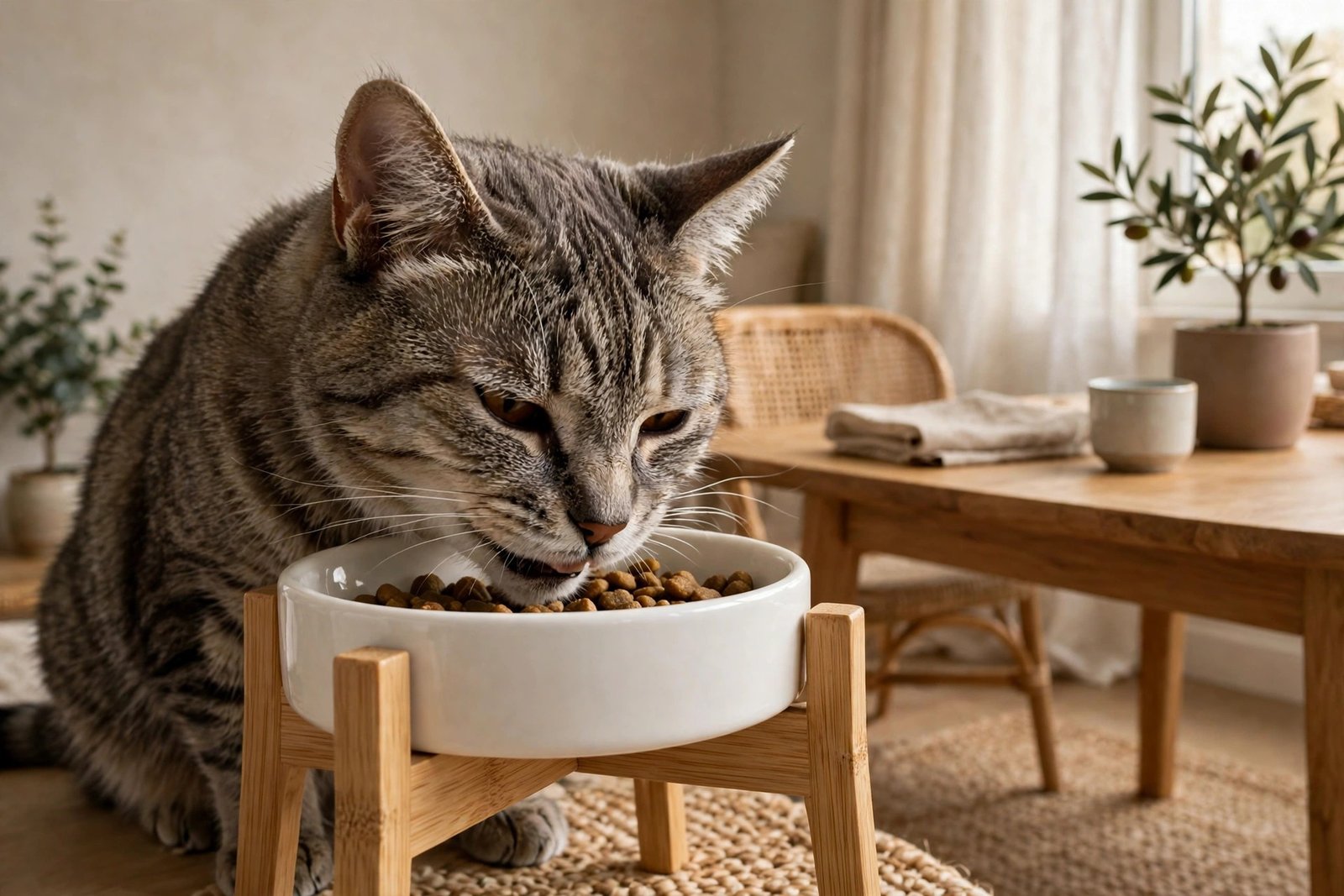
Degenerative joint disease is the quiet fact of old-cat life: radiographic studies consistently find signs of it in the large majority of cats over about twelve, and most of those cats are never diagnosed, because cats hide stiffness well. What gives it away is the small stuff — hesitating at the litter box lip, sleeping in lower spots, and eating in short visits from a bowl on the floor. That last one is the easiest to fix. The case for elevated cat bowls for senior cats is not that a bowl treats arthritis; it does not. It is that raising food and water is a standard piece of arthritis home care, and it removes a deep crouch your cat currently holds through every meal, several times a day.
So this list is ranked on joint criteria and nothing else: the rim height a listing actually publishes, whether a tilt exists and at what published angle, whether the bowl stays put when a stiff cat leans on it, and whether the cat can eat from a single bowl without twisting. If you are shopping for a healthy young cat and a tidy feeding corner, our best elevated cat bowls guide is the broader list; this one is narrower on purpose. Six picks follow, every one verified on its Chewy or Petco listing. Where a listing does not publish a height — and several do not — the section says so instead of borrowing a number from a roundup, because a rim height you cannot check is not a criterion, it is a guess.
Quick picks
| Award | Product | Why it stands out | Check Price |
|---|---|---|---|
| Best overall | Necoichi 15° Tilted Elevated Porcelain Ceramic Cat Food Bowl | A published 3.7 in base and a real 15° tilt in porcelain, with the strongest senior-owner evidence on any listing here; 4.7★/1,675 | Check Price on Chewy |
| Best wide, shallow food bowl | Necoichi Extra Wide Elevated Porcelain Ceramic Cat Food Bowl | The widest, shallowest food surface here, in heavy porcelain that stays where you put it; 4.8★/1,728 | Check Price on Chewy |
| Best raised water bowl | Necoichi Ceramic Elevated Cat Water Bowl, Extra Tall | A 4.134 in water bowl with measurement lines inside, so the water gets raised — and tracked — too; 4.8★/795 | Check Price on Chewy |
| Best adjustable tilt | PETKIT Fresh Nano 15 Degree Adjustable Stainless Steel Elevated Bowl | Steel bowls that twist-lock level or at 15°, so one feeder lets your cat vote on tilt; 4.5★/201 | Check Price on Chewy |
| Best budget pair | Kitty City Raised Cat Bowls, 2 count | Two pedestal bowls — one for food, one for water — at the value end of this list; 4.7★/74 | Check Price on Chewy |
| Best weighted ceramic | PawsPik Watermelon Elevated Angled Ceramic Pet Bowl | The tallest verified rim here at 5 in, in 2 lb of ceramic built to resist a leaning cat; no rating yet on Petco | View at Petco |
Best overall: Necoichi 15° Tilted Elevated Porcelain Ceramic Cat Food Bowl
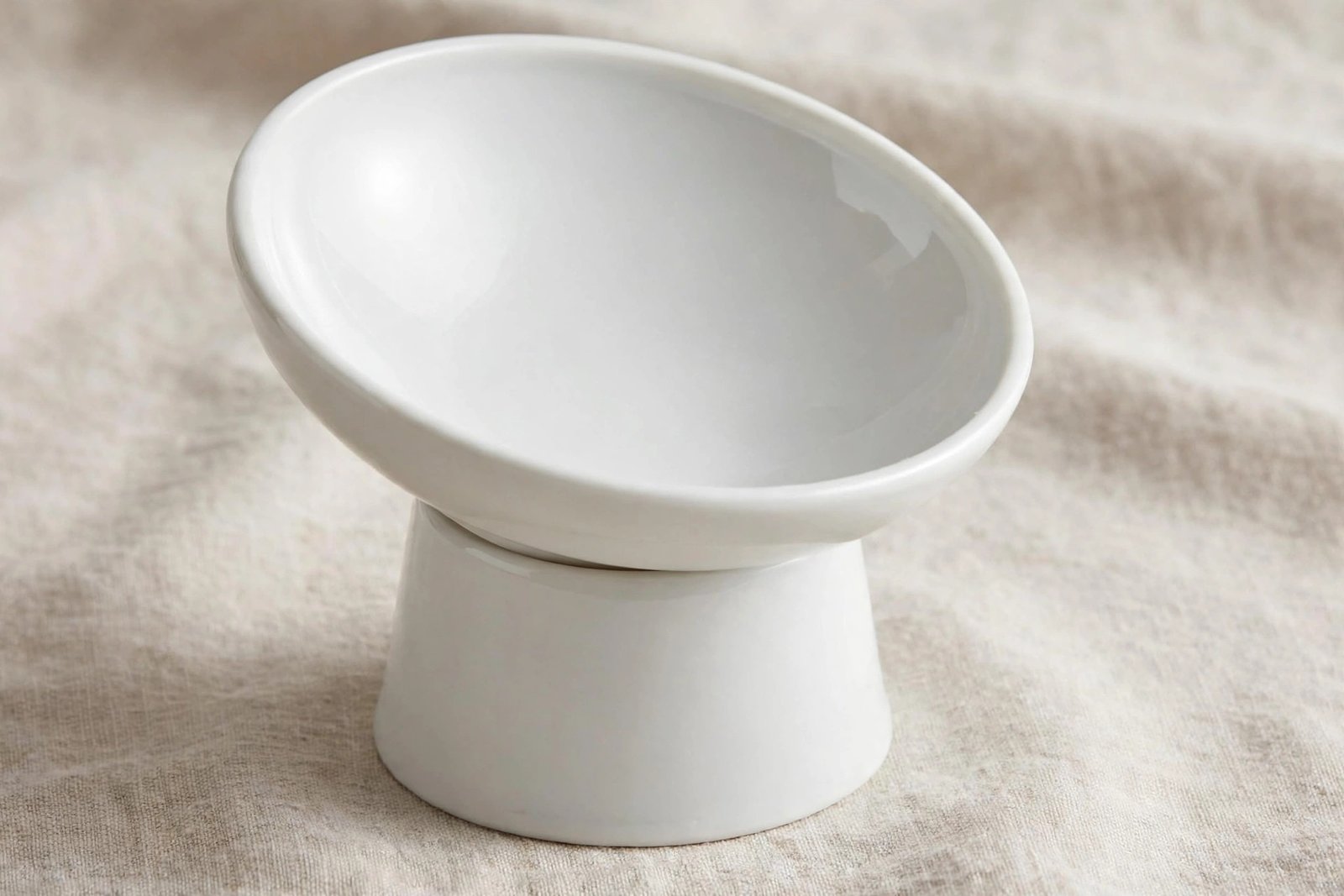
This is the pick where every number survives checking. Per its Chewy listing: a porcelain bowl tilted at 15° — a manufacturer design figure, and we treat it as one, not as a clinical standard — on a base the listing’s Q&A puts at 3.7 inches tall, holding up to two cups, rated 4.7★ across 1,675 ratings. The tilt does mechanical work you can see: food gathers at the low front edge instead of spreading across a flat curve, so a cat that cannot crouch and scoop at the same time is not chasing dinner around the bowl. Chewy’s feature ratings on the listing put stability at 90% positive, and the porcelain has the weight to back that up, with a non-slip silicone ring under the base.
The senior evidence is in the listing’s own reviews, and it is unusually specific. One reviewer bought it for a geriatric blind cat with orthopedic issues who had stopped staying at the bowl — “his whole stance changed with using the elevated feeder… he is eating much better now.” A three-legged cat’s owner reports he “doesn’t need to lean forward so far to eat.” Owners of toothless cats show up repeatedly too, because the tilt keeps wet food reachable at the front. This is owner-reported comfort, not a trial result, and we present it as exactly that — but it is the deepest pool of it attached to any pick here.
The drawbacks are the porcelain’s own. Food can slide around the slick surface — one reviewer describes her cat chasing food and making the bowl “clang loudly” with a collar tag, and solved both with a silicone insert. It is a single bowl, sold for food only: the listing’s Q&A is explicit that it is not intended for water, so a raised water bowl is a second purchase (the third pick below is the matching answer). And porcelain is not drop-proof — reviewers report breakage, including a predecessor bowl from the same brand. Buy it for the verified height, the verified tilt and the review base; handle it like the ceramic it is.
Apartment scorecard: Height — base 3.7 in, per the listing’s Q&A. Installation — none; place and use. Rental-friendly — yes; freestanding, nothing fixed. Cleaning — porcelain is dishwasher- and microwave-safe per the listing; the silicone ring lifts off for washing. Best room — kitchen feeding corner, on a hard floor where the ring can grip.
Best wide, shallow food bowl: Necoichi Extra Wide Elevated Porcelain Ceramic Cat Food Bowl

Some older cats do not struggle with the crouch so much as with the bowl itself: a deep, narrow dish means pushing the face down and in, and some cats simply eat more readily from a wide, shallow surface where the food spreads out in front of them. That observation — and it is an observation, not a diagnosis — is this bowl’s whole design. Per the Chewy listing, it is the extra-wide member of Necoichi’s raised line: non-absorbent porcelain, free of lead and cadmium, holding approximately two cups, with a non-slip silicone ring and a 4.8★ rating across 1,728 ratings — the deepest review base in this roundup. The listing’s feature ratings put stability at 90% positive, which tracks with the porcelain’s weight: this is a bowl a leaning cat is unlikely to walk across the floor.
Its senior reviews are direct. “Our elderly, arthritic cat loves this,” one begins. “I think hunching down to eat at floor level was painful to his aging joints, and he has an easier time eating from this elevated bowl. His appetite has improved.” A 14-year-old Himalayan’s owner calls it “the perfect height for him.” We quote those as what they are — owner reports on the listing — alongside the listing’s own checks.
Now the paperwork gap, stated plainly: Chewy’s listing for this bowl does not publish its height or dimensions, so there is no height line in the scorecard below and this article will not import the figure from other websites. If an exact rim height is the deciding factor for your cat, the tilted pick above publishes its base height and this one does not — choose accordingly. The physical drawbacks are also on the listing: porcelain chips and can crack (one reviewer reports a small plastic medicine bottle dropped from about a foot cracked theirs), the silicone ring comes off a little too easily in the wash, and one reviewer “wouldn’t complain if it was taller.” It is also awkward to stack in a small apartment sink. None of that stops it being the strongest wide-and-shallow option we could verify — it just is not the pick for a buyer who needs the height in writing.
Apartment scorecard: Height — not published on the listing; not estimated here. Installation — none; place and use. Rental-friendly — yes; freestanding. Cleaning — dishwasher- and microwave-safe porcelain per the listing; the ring removes for washing but comes off easily. Best room — kitchen feeding corner; allow sink room, as the wide bowls do not stack neatly.
Best raised water bowl: Necoichi Ceramic Elevated Cat Water Bowl, Extra Tall

Arthritis home care raises the water as well as the food, and most elevated-bowl shopping quietly forgets the water. This is the pick built for that half of the job. Per its Chewy listing, the Extra Tall version of Necoichi’s raised water bowl stands 4.134 inches — the listing’s Q&A gives both heights in the line, 2.9 inches for the standard Raised and 4.134 for this one — in the same lead- and cadmium-free porcelain, with a curved inner surface, a non-spill lip and a removable non-slip silicone ring. It is rated 4.8★ across 795 ratings on Chewy. The feature a senior-cat owner will actually use weekly is inside the bowl: measurement lines, so you can see how much your cat drank today. For an older cat, that number is real information — the kind worth mentioning at a vet visit — and almost no other bowl at any height gives it to you.
Two honesty notes from the listing itself. First, capacity: the size name says 12.2 ounces, but a Q&A answer on the same listing says the bowl holds 10 ounces — plan on the lower figure as the usable fill. Second, stability: asked directly, the listing’s Q&A answers “this water bowl is not tip proof.” The porcelain’s weight and the ring do most of the work, and the listing’s reviewers call it stable, but if your cat is a committed bowl-pusher, that sentence is on the record. Reviewers also note it runs narrower than the matching food bowl — one found it a bit tight and wished for the food bowl’s width.
Why a separate water pick at all, rather than a double diner? Because a stiff cat should not have to crouch and twist sideways between two fixed bowls, and because a standalone water bowl can go where the cat actually drinks — plenty of cats prefer water away from food, and a second raised water point near a senior cat’s sleeping spot is a genuinely useful setup. Pair this with either Necoichi food bowl above and both halves of the meal are at the same working height.
Apartment scorecard: Height — 4.134 in (Extra Tall), per the listing’s Q&A; the standard Raised version is 2.9 in. Installation — none; place and use. Rental-friendly — yes; the non-spill lip and ring protect floors. Cleaning — dishwasher- and microwave-safe porcelain per the listing; measurement lines inside. Best room — wherever the cat drinks most, including a second point near her sleeping spot.
Best adjustable tilt: PETKIT Fresh Nano 15 Degree Adjustable Stainless Steel Elevated Bowl

A note on names first, because it decides whether this list has six honest picks or seven padded ones: this feeder is sold under more than one name — the manufacturer’s own manual for it is titled “Fresh Nano Metal CyberTail” — so the PETKIT CYBERTAIL and the PETKIT Fresh Nano are the same product, and it appears here once. What it offers that nothing else in this roundup does is a choice you can reverse. Per the Chewy listing, the stainless steel bowls twist-lock into the stand at either 0° (level) or 15° (tilted) — the angle is a manufacturer design feature, and the useful part is not the number but the experiment: set the food bowl tilted and the water bowl level, watch which posture your cat settles into, and keep the winner. For an arthritic cat whose preference you are still learning, that is worth more than a fixed guess. The set is rated 4.5★ across 201 ratings and was in stock on Chewy at research time; the listing’s Q&A confirms the bowls can be used for water in their designated slots.
The trade-offs are equally specific, and they are about hands — yours. The twist-lock that makes the angle adjustable is the listing’s most common complaint: one reviewer reports her husband, after a stroke, could not navigate locking and unlocking the bowls at all. If your own grip or dexterity is limited, that mechanism will annoy you twice a day. The stand itself divides reviewers — “the plastic base is thick & sturdy” in one five-star review, “rather cheap… difficult to set at an angle” and “pretty flimsy… wobbles quite a bit” in others, the wobble appearing when an excited eater leans in. The bowls are also deep for a feeding bowl: a small cat in one review had trouble getting food out of them, which is the opposite of what a senior pick should do. And two paperwork notes: Chewy’s listing does not publish this feeder’s height, so none is printed here, and Chewy does not sell replacement bowls for the set — break one and you are replacing the unit.
Apartment scorecard: Height — not published on the listing; not estimated here. Installation — bowls twist-lock into the stand by hand; no tools. Rental-friendly — yes; freestanding, with a spill-catching base design. Cleaning — steel bowls lift out and are dishwasher-safe per the listing; the base wipes down. Best room — kitchen feeding corner on a hard floor, where the stand sits steadiest.
Best budget pair: Kitty City Raised Cat Bowls, 2 count

The simplest way to raise both food and water in one purchase is a pair of pedestal bowls, and this is the value version of that idea. Per the Chewy listing, the set is two bowls of 6.5 ounces each on modern pedestals, with an oval shape and a slanted front edge, rated 4.7★ across 74 ratings. The oval matters more than it looks: a cat eats along the long axis without her face dropping into a deep round well, and the listing’s reviewers notice the posture change in plain language — “my cat didn’t look all crouched over as she did with other food bowls.” A 14-year-old cat’s owner bought the set hoping it would help her and reports simply that “she really does like them.” Chewy’s feature ratings on the listing put ease of cleaning at 93% positive.
The caveats are about material and weight, and for this article’s reader they matter. The bowls are plastic — the listing description says PET-safe plastic, while a Q&A answer on the same listing says polyurethane; either way it is not the porcelain or steel of the picks above, and one listing reviewer goes so far as to use the set as a stand with a ceramic bowl on top, citing the chin-acne concern that follows plastic. The second caveat is stability: the bowls are lightweight, and a reviewer whose cat paws food out piece by piece reports the cat “knocks the whole thing over and spills all his food on the floor.” A senior cat that leans her weight onto the bowl rim — exactly the cat this article is for — may do the same, so treat this pair as the budget trial that tells you whether raised feeding helps your cat, on a mat, in a low-traffic corner. And the listing publishes no height, so none is claimed here.
Apartment scorecard: Height — not published on the listing; not estimated here. Footprint — two separate pedestal bowls; place them side by side or split food and water between rooms. Installation — none. Rental-friendly — yes; put a mat under them, because a tipped bowl is a floor problem. Cleaning — washes easily per the listing’s reviewers. Best room — a quiet, low-traffic corner, on a mat.
Best weighted ceramic: PawsPik Watermelon Elevated Angled Ceramic Pet Bowl

This is the one pick whose paperwork is a full spec table, and it earns its place on the article’s own criteria. Per Petco’s specifications: 5 inches tall — the tallest verified rim in this roundup — 6.14 by 6.69 inches across, and 2.01 lb of food-grade ceramic with a weighted base, which is the stability answer for a cat that leans. The design pairs that height with a built-in angled bowl (Petco publishes no tilt degree, so none is claimed here) and a wide, open interior. It is handmade ceramic with a non-toxic glaze, dishwasher-safe per the listing description, and it ships from Petco as an online-only item. The watermelon styling — red interior, green striped exterior — is either a delight or a dealbreaker, and only you can call that one.
The honesty file on this pick is longer than most, because the listing argues with itself. Its description bullets call the bowl microwave-safe; the care warning on the same page says “Do not use in a microwave or conventional oven.” We follow the warning — treat it as dishwasher-only — and flag the contradiction rather than picking the convenient half. The same care section is blunt about ceramic: it can chip, crack or break if dropped, and a chipped bowl should be retired because of sharp edges. Petco also states that the product information is provided by the manufacturer and not independently verified by Petco. And there is no owner evidence to borrow: the listing shows no reviews and no star rating yet, so unlike every other pick here, nothing in this section rests on other owners’ experience — it rests on the spec table alone. If you want the tallest verified height and real weight in the bowl, this is the only candidate that publishes both. If you want a track record, the Necoichi picks above have thousands of ratings behind them.
Apartment scorecard: Footprint — 6.14 x 6.69 in, 5 in tall, 2.01 lb (Petco specifications). Installation — none; place and use. Rental-friendly — yes; the weighted base stays put and the wide shape contains spills. Cleaning — dishwasher-safe per the listing; do NOT microwave — the listing’s care warning contradicts its own description, and the warning wins. Best room — kitchen feeding corner, where the watermelon styling is a feature.
How we picked
We researched the elevated bowls stocked at Chewy, PetSmart and Petco, and kept only picks whose facts we could verify on the retailer listing itself: ratings and review counts as displayed, heights and tilt angles only where the listing publishes them, drawbacks taken from the listings’ own reviews and Q&A. That standard shaped this list in ways worth stating. Two well-known elevated feeders were excluded on evidence: one popular diner whose own listing sizes it by dog shoulder height — 8- and 12-inch feeders with bowls over 7 inches across — because a dog feeder wearing a cat label is still a dog feeder; and one PETKIT model that appears in other roundups under two different names, which is listed here once, under its Chewy name, not twice. Three of the six listings publish no height at all, and those scorecards say so rather than borrowing figures from review sites. One pick’s listing contradicts itself twice (capacity, and a microwave claim), and both contradictions are printed in its section. No paid placements, no hands-on testing, no veterinary claims — and no prices anywhere in this article, because they change; the Check Price buttons take you to the live listing.
Buying guide
Measure your cat, not the marketing
There is no measured, vet-agreed ideal bowl height for cats, and the sources for senior cats do not even agree with each other: senior-care guidance variously points to rims in the 2-to-4-inch range and the 4-to-6-inch range. The honest window is roughly 2 to 6 inches, and where your cat belongs in it is a measurement, not a slogan. While your cat stands normally, measure from the floor to her chest — about elbow height, where the front legs meet the body. The bowl’s rim should land at or just below that line, so she eats with her neck in a gentle downward slope instead of a deep crouch or an upward reach. A bowl that is too tall is its own problem: she will eat around it, off the edge, or not at all. Stiff, long-bodied and large cats generally belong in the taller half of the range; small, frail cats in the lower half. The verified rims in this roundup run from 3.7 to 5 inches where listings publish them at all — check the number against your cat before you check anything else.
Raise the water too
Most owners raise the food bowl and leave the water on the floor, which keeps half the crouch. Standard arthritis home care raises both, and the drinking posture is the one a stiff cat holds longest. A raised water bowl does not need to match the food bowl’s height exactly, but it should be in the same working range, and a standalone water bowl has one advantage a double diner cannot offer: it can live where the cat actually drinks, including a second water point near where an old cat sleeps. If the bowl has measurement lines, use them — a senior cat’s daily water intake is one of the most useful numbers you can hand a vet.
Tilted or straight raised?
A straight raised bowl changes one thing: height. A tilted bowl also changes where the food sits — gravity gathers it at the front edge, within reach of a cat who cannot push her head deep into a bowl or scoop food up a curve. Owners of toothless and three-legged cats report the clearest difference, and it is mechanical, not medical: the food comes to the cat. The 15° figure attached to several picks here is a manufacturer design number, not a studied standard — what matters is whether your cat eats more readily at the angle. Two practical notes: tilted bowls are food bowls (the tilted Necoichi’s listing says so outright), so water still wants a level raised bowl; and an adjustable model, if you can tolerate its mechanism, lets the cat settle the argument herself.
Stability is a joint feature too
A cat with sore shoulders or hips does not just eat from the bowl; she leans on it. That is why this list weighs bowls, literally where listings allow: porcelain’s heft and a weighted ceramic base keep a rim steady under a leaning cat, while the lightest plastic pair here has a listing review describing exactly the failure you would predict — the whole bowl knocked over by a cat eating paw-first. Non-slip rings help on hard floors, and a mat under the station helps everywhere. Format matters as well: single bowls, or a pair you can position separately, let a stiff cat approach square-on. A fixed double diner asks her to crouch and twist between two bowls at once, which is why this list leans single — the one double-format pick keeps its bowls in independent slots for food and water.
When the bowl is not the answer
A raised bowl is home care, not treatment. It can remove a painful crouch; it cannot diagnose why a cat is stiff, losing weight, or leaving meals. Some owners report that a cat vomits less after meals once the bowl is raised, and that may be worth trying — but vomiting that persists, a shrinking appetite, weight loss, or a cat who stops eating from any bowl is a veterinary visit, not a shopping problem. The same goes in the other direction: a healthy cat with no mobility or digestive issues may gain nothing measurable from a raised bowl, and that is fine. Buy these for the cats the evidence describes — old, stiff, diagnosed, or visibly working too hard at mealtime — and let a vet own the medical questions.
Frequently asked questions
Do elevated bowls really help cats with arthritis?
They help with the part of arthritis that happens at mealtime. Raising food and water is a standard environmental modification in feline arthritis home care, because it removes the deep, sustained crouch a stiff cat otherwise holds through every meal. What a bowl cannot do is treat the joint disease itself — the large majority of cats over twelve show radiographic signs of it, most undiagnosed, and pain management is a conversation for your vet. Expect comfort, not a cure.
How high should a bowl be for a senior cat?
There is no single proven number, and sources conflict — senior guidance points variously to the 2-to-4-inch and 4-to-6-inch ranges. Measure instead: with your cat standing, find the height of her chest, roughly at the elbow. The bowl’s rim should sit at or just below that line. Large or long-bodied seniors usually land in the taller half of the range; small, frail cats in the lower half. Too high is a real failure mode — if she eats off the near edge or walks away, the bowl is overshot.
Is a tilted bowl better than a straight raised bowl for an older cat?
For some older cats, yes, for a mechanical reason: the tilt gathers food at the front edge, so a cat who cannot crouch deeply or scoop food up a curve — toothless cats, three-legged cats, very stiff cats — reaches it more easily. A straight raised bowl is simpler and works well for a cat whose only problem is the crouch itself. The commonly quoted 15° tilt is a manufacturer design figure, not a clinical standard, so judge tilt by watching your cat eat, not by the number. Keep water in a level raised bowl either way.
Will a raised bowl stop my cat vomiting after meals?
It might reduce it, and that is as far as the evidence honestly goes. Some owners report fewer post-meal vomiting episodes after raising the bowl; there are no controlled feline trials that turn that into a promise, and no bowl should be sold as anti-vomiting. If the vomiting is new, frequent, or paired with weight loss or appetite change, that is a vet visit — and if the real problem is eating speed rather than posture, a slow feeder addresses the cause a raised bowl cannot.
Should I raise the water bowl too, or just the food bowl?
Both. Arthritis home care raises food and water together, and drinking is the posture a stiff cat holds longest. The raised water bowl can sit near the food or wherever your cat prefers to drink — many cats drink more away from the food station, and a second raised water point near a senior cat’s sleeping area is a legitimate setup. If the water bowl has measurement lines, check them daily; a change in intake is worth reporting at the next vet visit.
What if my senior cat won’t eat from a raised bowl?
Transition like you would any change for an old cat: gradually, and with an exit. Put the raised bowl beside the old floor bowl with the same food in both, and let her choose for several days — some cats need a week to accept a new feeding posture. Check the height before blaming the concept: a rim above chest height is the most common reason for refusal. Try the other posture (tilted if you started straight, straight if tilted). And if she will not eat properly from anything — raised, tilted or floor-level — stop troubleshooting bowls and call the vet, because appetite loss in a senior cat is a symptom, not a shopping problem.
Related reading
For the general version of this list — every age, ranked for apartment feeding corners rather than joints — our best elevated cat bowls roundup is the hub, and the two articles are written to work together: general picks there, senior-specific picks here. If post-meal vomiting is the problem that brought you here and speed is the likely cause, our best slow feeder for cats guide covers the bowls that slow a fast eater down. And because senior cats’ water intake matters as much as their food posture, our best stainless steel cat water fountains roundup covers the running-water option for cats who drink more from a fountain than from any bowl.
Last updated: November 9, 2026