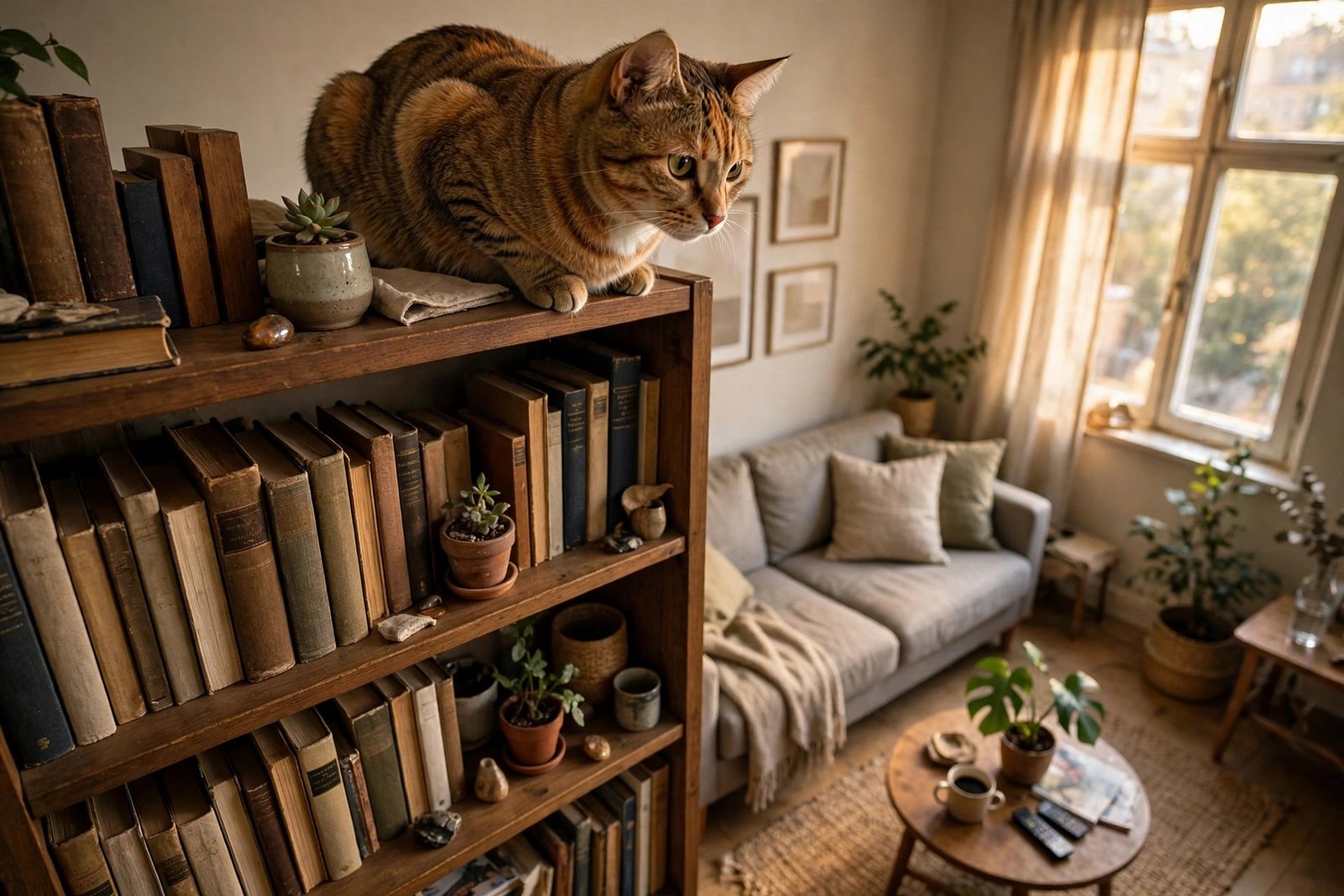
If your cat’s favorite spots are the top of the fridge, the highest bookshelf, and that one precarious stack of boxes you keep meaning to move, you’ve already got your answer in principle: cats want to be up high. The real question — how much vertical space does a cat need in an apartment, and what counts — has a more practical answer than most guides give. It’s not about square footage. It’s about usable height, and most apartments already have plenty of it going to waste.
Cats are both predator and prey animals, and height serves both instincts: a high perch is a safe observation post and a launch point. Behaviorists consider vertical territory one of the core components of an enriched indoor environment, alongside scratching outlets and hiding spots. The good news for renters is that vertical space is the cheapest dimension to add — it doesn’t eat floor space, and most of it goes up without a single hole in the wall.
Why vertical space matters more than floor space
A cat in a 400-square-foot studio with a tall cat tree, a window perch, and clear shelf tops effectively lives in a much bigger territory than a cat in a 900-square-foot apartment where everything sits at human knee height. Height multiplies usable territory: each level a cat can reach and rest on is additional “room” in feline terms.
It also defuses multi-cat tension. In small apartments, the most common conflict isn’t about food — it’s about one cat blocking the other’s path. Vertical escape routes (a shelf, a tree top, a perch) let a lower-ranking cat simply go up instead of engaging. If your two cats have started doing the hallway standoff, height is usually the missing piece.
The minimum: what one cat actually needs
There’s no official number, but the practical minimum that behaviorists and experienced owners converge on looks like this for a single indoor cat:
- One dedicated high resting spot — a perch, tree top, or cleared shelf at roughly 3–5 feet, where the cat can survey the room undisturbed.
- One climbing route — a way to get up and down that isn’t a single leap onto your fragile stuff. A cat tree with staggered platforms, or a step-stool plus shelf combo, counts.
- One hiding spot at height or ground level — a cave bed, a box on a shelf, the tree’s enclosed condo. Height without a retreat option only solves half the stress equation.
That’s it. A single 4–5 foot cat tree near a window covers all three for most cats. Everything beyond that is enrichment bonus, not requirement — which is liberating if you’re working with a studio.
Layouts that work: studio vs. one-bedroom
The studio (one open room): You need vertical zoning — distinct high spots in different “areas” so the cat has somewhere to be that’s not wherever you are. A window perch at the window, a tall scratcher-tree near the bed, and one cleared shelf top in the kitchen area gives the cat three territories in one room. Wall-mounted shelves work beautifully here because they add territory with zero floor footprint.
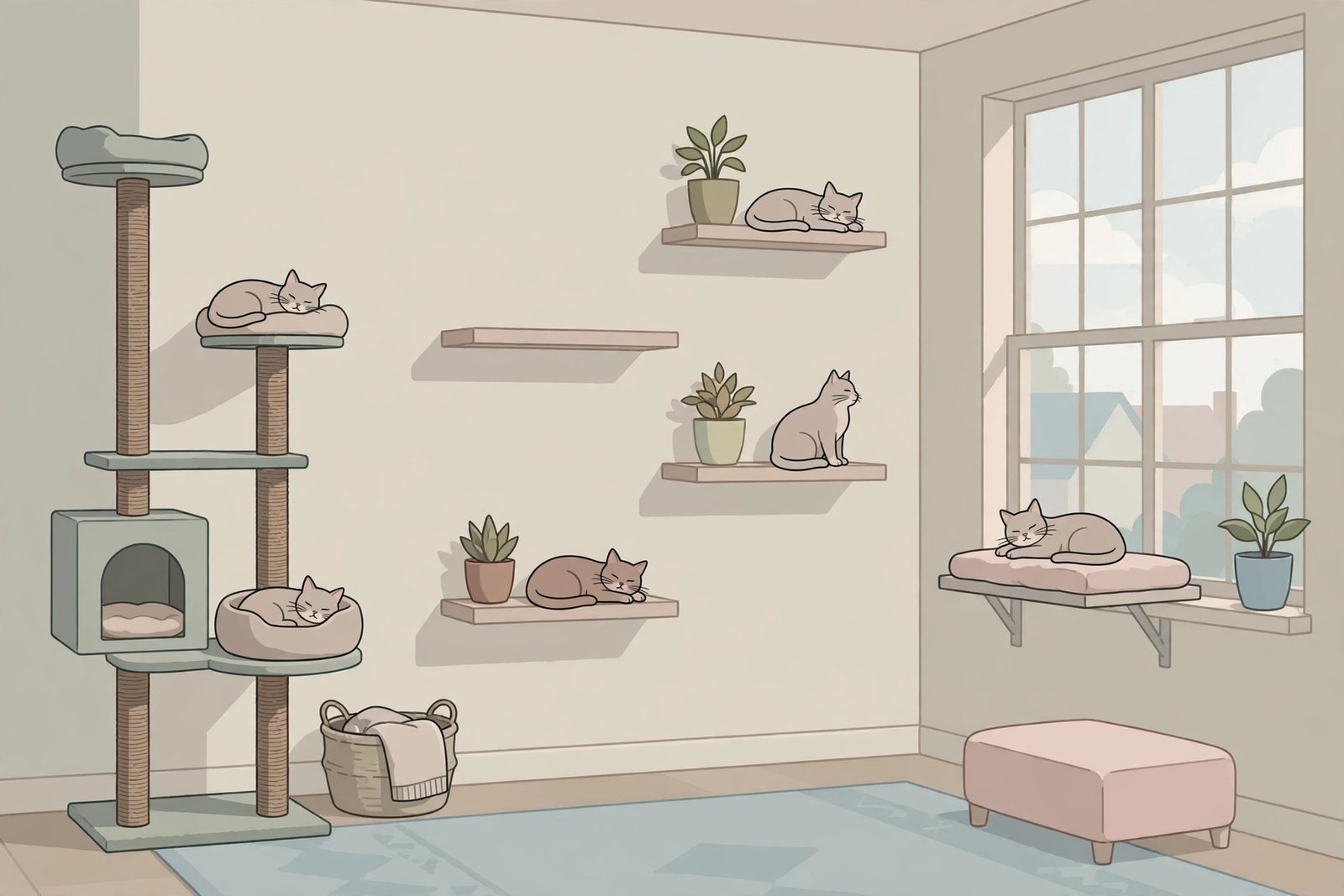
The one-bedroom: Spread the height across rooms so the cat patrols. A perch in the living room window, a tree or shelf in the bedroom, and keep one high surface clear in each room. The hallway — usually dead space — is prime real estate for a wall shelf or two, creating a “superhighway” between rooms that cats genuinely use.
The principle in both: think in routes, not objects. A perch the cat can only reach by leaping over your TV is a perch the cat won’t use. Each high spot should connect to the next via a jump the cat can comfortably make (most healthy adult cats handle 2–3 feet between levels easily; seniors and kittens need shorter hops).
Wall shelves vs. cat tree vs. window perch
These are the three ways to add height, and they solve different problems:
- Cat tree: the all-in-one. Climbing, scratching, perching, and hiding in a single footprint. Best first purchase if you have 2–4 square feet of floor to spare. For small apartments, look for vertical “tower” designs rather than sprawling multi-base models — height with a small footprint is the whole game. Our small-space cat condo guide covers compact options.
- Wall shelves: the zero-footprint option. Purpose-made cat shelves (with a grippy surface and raised edge) mounted in a stair-step pattern turn a blank wall into a climbing wall. The renter catch is mounting — see below.
- Window perch: the highest-value single addition. It combines height with the single most stimulating thing in an apartment: the moving world outside. A perch at window height is where most cats will spend their daylight hours if given the choice.
If you can only add one: window perch. If you can add two: window perch plus a compact tree. That combination covers observation, climbing, scratching, and napping for the vast majority of cats.
Renter-friendly: height without drilling
The standard advice — “just mount shelves” — ignores the deposit. Here’s what actually works without holes:
- Suction-cup and sill-mounted window perches: no tools, no holes, and they hold far more weight than renters expect when the suction cups are properly seated on clean glass. See our no-drill window perch roundup for weight-tested options.
- Tension-mounted floor-to-ceiling cat trees: a vertical pole wedged between floor and ceiling with platforms — climbing height with zero wall contact.
- Furniture you already own: a cleared bookshelf top (with bookends so nothing slides), the top of a wardrobe with a folded blanket, a sturdy step-stool next to a dresser creating a two-level route. “Catifying” existing furniture costs nothing.
- Freestanding tall scratchers: a 3-foot-plus vertical scratcher doubles as a stretch-and-climb post and needs no mounting at all.
What about adhesive-mounted shelves? Treat manufacturer weight claims skeptically and test with your own weight first — a shelf failing at 2 a.m. is worse than no shelf. When in doubt, freestanding beats stuck-on.
Multi-cat adjustments
Two cats don’t just need twice the height — they need separate height. The rule of thumb: each cat should be able to reach a high resting spot without passing the other cat’s spot. That means perches on different walls, or a tree with platforms on alternating sides, rather than one premium penthouse everyone fights over.
Watch for blocking: if one cat camps the single route up (the top of the tree, the one shelf), the other cat effectively has no vertical territory. Adding a second route — even a cheap step-stool creating an alternate path — resolves most of it. In multi-cat apartments, two modest perches beat one luxurious one.
Cheap ways to add height this weekend
You don’t need to buy anything to start:
- Clear the top of one bookshelf or wardrobe and put a folded blanket there. Instant high resting spot.
- Leave a sturdy box on its side on top of a dresser — a high hiding spot in one move.
- Move an existing cat tree to the window. Half of unused cat trees are unused because they’re in a dead corner; location is enrichment.
- Stack two sturdy storage boxes as steps up to a shelf the cat eyes but can’t quite reach.
Cats don’t grade your interior design. They grade: can I get up there, can I see the room, and will it hold me. A cleared wardrobe top passes all three.
Gear that helps
- Compact cat trees & condos → small-space cat condos (vertical towers with tiny footprints)
- Window perches → no-drill perches for renters (suction and sill-mounted, no holes)
- Rest spots at height → cat beds sized for small spaces (shelf and desk-friendly picks)
Frequently asked questions
How much vertical space does a cat need?
There’s no official measurement, but one dedicated high resting spot (3–5 feet up), one climbing route, and one hiding spot covers the essentials for a single indoor cat. A 4–5 foot cat tree near a window satisfies all three. More height is enrichment bonus — valuable, but not required.
Do cats need vertical space or is it optional?
Behaviorists treat it as a core need, not a luxury. Vertical territory reduces stress, gives cats observation posts and escape routes, and defuses multi-cat tension. Cats without any high resting spots often claim the tops of fridges and shelves instead — which is the cat telling you the need is real.
Can I add vertical space without drilling holes?
Yes. Suction-cup and sill-mounted window perches, tension-mounted floor-to-ceiling trees, tall freestanding scratchers, and cleared furniture tops (bookshelves, wardrobes) all add usable height with zero wall damage — all deposit-safe.
Is a cat tree enough vertical space for an apartment?
For most single cats, yes — one well-placed tree (near a window, not in a dead corner) covers climbing, perching, and scratching. Add a window perch and you’ve covered the two highest-value additions. Multi-cat homes benefit from a second high spot on a different wall.
My cat ignores the expensive cat tree. Why?
Almost always location. Trees in corners away from windows and household activity get ignored; the same tree by a window becomes prime real estate. Try moving it before replacing it. Also check stability — a wobbly tree teaches the cat not to trust it. Once the height is sorted, here’s how to get your cat to actually use the cat tree.
How high can cats safely jump indoors?
Healthy adult cats comfortably manage 5–6 feet in a single leap and navigate 2–3 foot gaps between shelf levels. Design routes with intermediate steps for kittens, seniors, and heavier cats — and make sure every high perch has a safe way back down that doesn’t cross fragile objects.
Related reading
- 7 Signs Your Indoor Cat Is Bored (and How to Fix Each One) — when the issue isn’t space but stimulation, start here.
- Best Cat Condos for Small Spaces 2027 — compact vertical towers with minimal footprints.
- Best No-Drill Cat Window Perches for Renters 2027 — height plus a view, zero holes.
Last updated: October 8, 2026
Pingback: 8 Best Cat Tree for Small Apartments: Space-Smart Picks 2027
Pingback: Best Wall Mounted Cat Shelves for Renters 2027
Pingback: Best Wall Mounted Cat Shelves for Renters 2027