 A renter friendly cat scratcher has one job to do before it ever makes a cat happy: it has to leave the apartment exactly as it found it. No screw holes in the wall, no bracket marks on the paint, nothing a landlord can point at during the move-out walk-through. That quietly rules out most wall-mounted scratchers — they are decent products bolted into the wrong homes. Every pick below works with zero drilling instead: it stands on a weighted base, leans against the wall, slides under a couch leg, or sticks on with adhesive you can test before you commit.
Two neighbouring guides, so this one stays in its lane. Our best cat scratcher for couches roundup owns the couch angle — which scratcher saves a sofa, whatever the installation. Our furniture guards guide covers protection films — covers that shield furniture but give the cat nowhere to scratch. This article is the third piece: actual scratchers, chosen only if a renter can use them with no drill at all. If the problem is behaviour rather than gear, our guide to stopping couch scratching covers the redirect routine in full.
The renter’s scratching problem
Cats scratch to maintain their claws, to stretch, and to mark territory — the behaviour is not negotiable, only the surface is. In a house you own, a shredded door frame is an annoyance. In a rental, it is a line item on the deposit deduction, and so is the couch corner, the carpet edge, and the paint around the spot where a scratcher was screwed to the wall. Renters do not need fewer scratchers than owners; they need scratchers whose installation leaves no evidence.
There are three installation families in this list, and one extra category. Weighted freestanding posts and lounges touch nothing but the floor. Lean-to scratchers rest against a wall or a couch without attaching to it. Adhesive mats and sheets stick to furniture or walls — the only family that can hurt a deposit, because adhesive can pull latex paint on removal if you skip the test-spot step. The extra category is the deterrent: not a scratcher at all, and it only earns its place paired with a real scratcher next to it. Redirect beats repel, every time.
Quick picks
| Award | Product | Why it stands out | Check Price |
|---|---|---|---|
| Best overall | SmartCat The Ultimate 32-in Sisal Scratching Post | Full 32-in stretch on a 16 x 16 weighted base — zero wall contact; 4.6★/3,999 | Check Price on Chewy |
| Best couch corner | SOFA-SCRATCHER Furniture Protector Squared | Guards the couch corner cats target first; its base slides under the couch leg | Check Price on Chewy |
| Best lean-to | Necoichi Premium Comfort Cat Scratcher Wall, Large | Leans against the wall — no screws; reversible, replaceable pad; 4.5★/2,740 | Check Price on Chewy |
| Best floor lounge | PetFusion Ultimate Cat Scratcher Lounge | Scratch-and-nap curve in recycled cardboard; reversible; 4.5★/2,024 | Check Price on Chewy |
| Best deterrent (redirect pair) | CLAWGUARD Scratch Protection Sheets, 10 count | Clear double-sided sheets that guard the hot spot while you redirect; 4.2★/217 | Check Price on Chewy |
| Best adhesive mat | Protecto Cat Scratch Furniture Protector, 39.5 x 16-in | Peel-and-stick and trim-to-fit — included with its honest 3.1★/15 disclosed | Check Price on Chewy |
| Best tall floor-standing | MidWest Feline Nuvo Grand Forte 41-in Scratching Post | 41-in full stretch on a 20.5-lb wide base; 4.8★ from only 4 reviews | Check Price on PetSmart |
Best overall: SmartCat The Ultimate 32-in Sisal Scratching Post
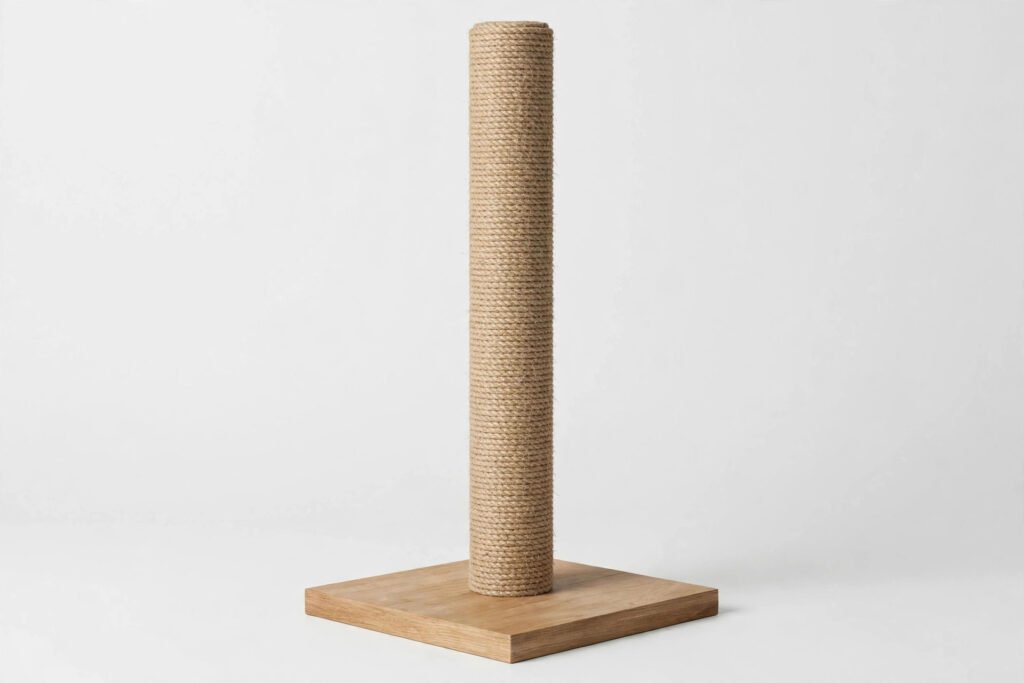
The SmartCat Ultimate makes the whole no-drill argument for you: a full-height post that never touches a wall because it does not need to. Per the Chewy listing, it stands 32 inches on a 16 x 16 inch weighted base, wrapped in fibrous woven sisal rather than rope, and carries a 4.6★ rating across 3,999 ratings — the deepest review sample in this roundup by a wide margin. Thirty-two inches is the height that matters: it lets an adult cat stretch to full length, and the wide base is what replaces the wall anchor a renter cannot install.
The honest drawbacks are small but real. Assembly takes two screws — into the post’s own base, not into anything of your landlord’s. The 16 x 16 base is genuinely wide, so measure your corner first; in the smallest studios it reads as furniture, not an accessory. And it is vertical only: if your cat is a committed horizontal scratcher who works carpets and rugs, a post of any height is the wrong shape — our vertical vs horizontal cat scratcher comparison explains how to tell before you spend.
Apartment scorecard: Footprint — 16 x 16 in base, 32 in tall. Installation — freestanding; two screws assemble the post to its own base, nothing enters a wall. Rental-friendly — yes; zero wall contact. Cleaning — vacuum the woven sisal; no loose rope fibres to shed. Best room — living room corner.
Best couch corner: SOFA-SCRATCHER Furniture Protector Squared
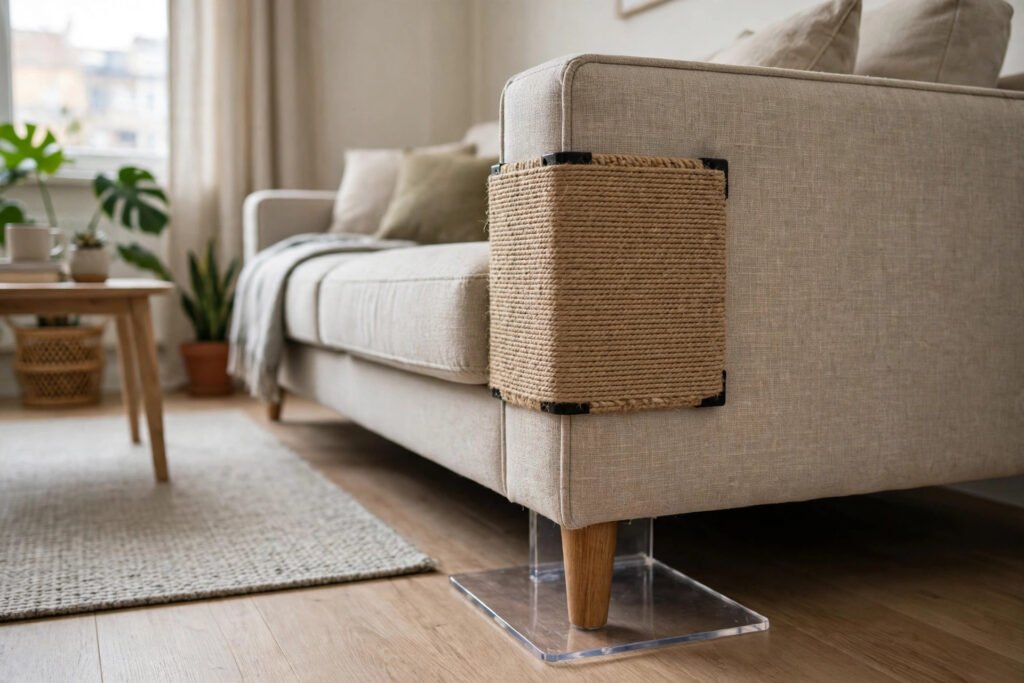
Most couch scratching happens in one place: the front corner nearest the room, worked daily like a job. The SOFA-SCRATCHER Squared is built for exactly that corner — a scratching panel shaped to sit over a squared couch corner, held by a polycarbonate base that slides under the couch leg. The couch’s own weight is the anchor: no drilling, no adhesive, nothing to peel off at move-out. The cat gets an approved surface in the precise spot it already chose, and the corner underneath stays unshredded.
The honest drawback is in the name: squared. It protects the corner it covers and no more, and a rounded-arm sofa is not its shape. A cat that simply moves to the other corner beats it, which is why this pick works best as half of a pair: the protector on the corner, and a real post (the SmartCat above) beside the couch as the more attractive option. On its own it is armour; paired, it is a redirect that works.
Apartment scorecard: Installation — base slides under the couch leg; no tools, no adhesive. Rental-friendly — yes; nothing attaches to a wall or floor. Cleaning — wipe the polycarbonate base; brush the scratching surface. Best room — living room, on the couch corner itself.
Best lean-to: Necoichi Premium Comfort Cat Scratcher Wall, Large
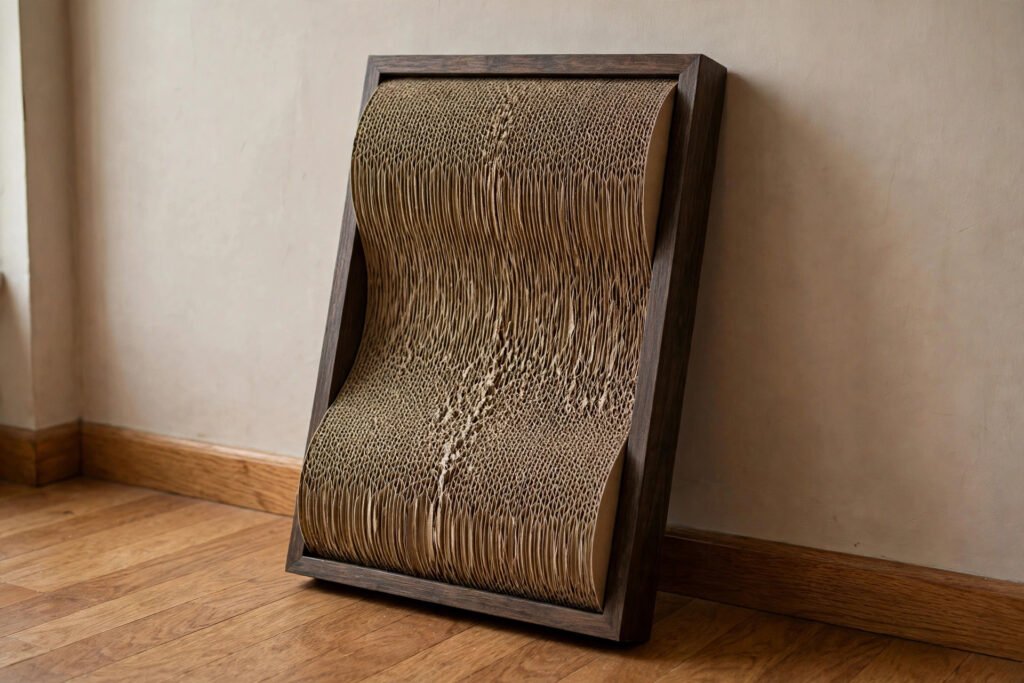
The Necoichi is the lean-to done properly: a tall scratching board you simply rest against a wall or the side of a couch, at the angle a cat would choose, with nothing screwed into anything. The Chewy listing rates it 4.5★ across 2,740 ratings, and reviewers on that listing confirm the setup in their own words — leaned against a couch or a wall, it stays put and gets used. The scratching pad is replaceable and reversible: flip it when one side is shredded, replace the pad when both sides are done. (The screws mentioned in some reviews hold the unit’s own cardboard panels together — none of them go into your wall.)
The honest drawbacks: it needs something solid to lean on, and a determined cat can walk a badly-angled board flat — the lean angle matters, steeper is stabler. The pad is also a consumable, so budget for replacements over the unit’s life. Neither point disqualifies it; they are the price of a full-height vertical scratcher that leaves the wall behind it untouched.
Apartment scorecard: Installation — lean-to against a wall or couch; zero screws into the wall. Rental-friendly — yes; rests against the wall, never attaches to it. Cleaning — flip the pad to the fresh side; replace the pad when both sides wear. Best room — hallway wall or beside the couch.
Best floor lounge: PetFusion Ultimate Cat Scratcher Lounge
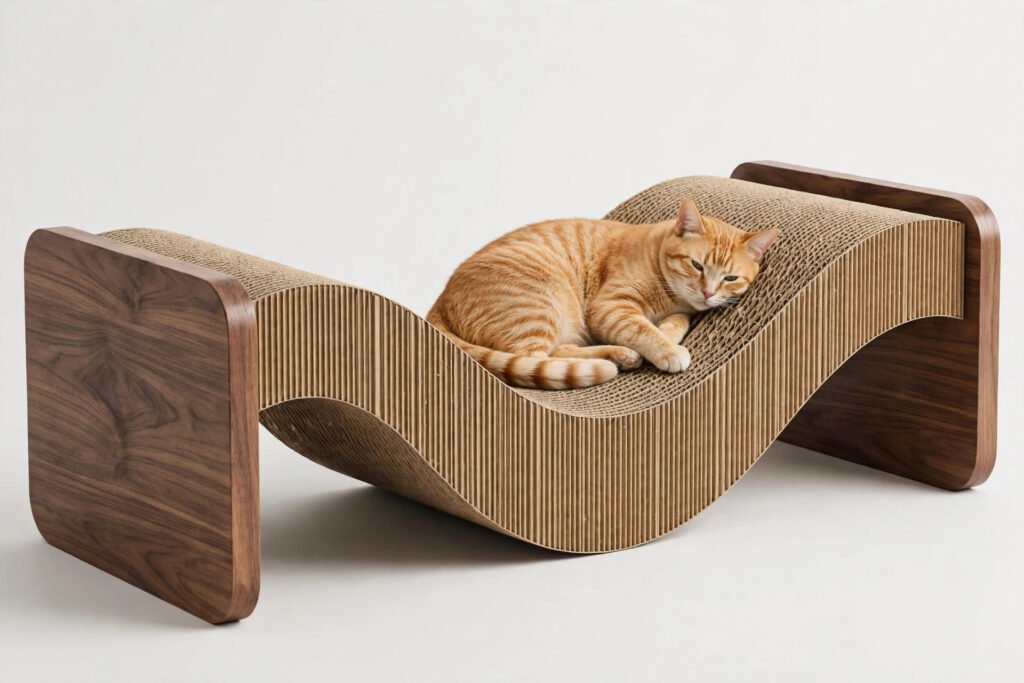
The PetFusion Lounge is the horizontal answer: a curved wave of recycled cardboard, 34 x 10.5 x 10.5 inches per the Chewy listing, that works as a scratcher, a ramp and a nap spot in one piece of floor furniture. It is rated 4.5★ across 2,024 ratings, the cardboard is held with non-toxic cornstarch glue per the listing, and it is reversible — flip it when the top curve is shredded and the second side is fresh. For renters, the installation section of this review is one word long: none. It sits on the floor, weighs about 7.5 lb, and leaves with you on moving day.
Two honest notes. First, cardboard means cardboard dust: every cardboard scratcher sheds flakes as it is worked, so put it on a hard floor or a washable rug and vacuum around it. Our sisal vs cardboard cat scratcher comparison covers that trade-off in full. Second, stock: the Walnut Brown was out of stock at Chewy when we last verified (early November 2026), as was the grey variant. We are keeping it as the lounge pick anyway — with that rating across two thousand reviews it is the benchmark in its class — but check the listing before you plan around it.
Apartment scorecard: Footprint — 34 x 10.5 x 10.5 in. Installation — none; a floor lounge that arrives ready. Rental-friendly — yes; floor only, touches nothing else. Cleaning — shake out or vacuum cardboard flakes; flip for the second side. Best room — living room, in front of the sofa.
Best deterrent (redirect pair): CLAWGUARD Scratch Protection Sheets, 10 count

Read this award carefully: the CLAWGUARD sheets are not a scratcher, and we are not pretending otherwise. They are clear, double-sided adhesive sheets — 10 in the pack, 17 x 12 inches each — stuck over the exact spot your cat is destroying, so the claws meet a surface the cat dislikes and slides off. CLAWGUARD’s own listing frames them as a companion to scratching posts and pads, and that framing is the whole point: a deterrent with nowhere better to send the cat just moves the scratching six inches to the left. Paired with a post beside the protected spot, it is the fastest honest fix here. The listing rates them 4.2★ across 217 reviews.
The caveats are why this pick is conditional. The brand itself recommends testing a small piece in an inconspicuous spot for a week first, and one reviewer on the listing reports the sheets peeling paint off a small section of wall — exactly why the test-spot rule exists. They are also not for leather, pleather, velvet or microfiber, per the listing. Used on the right fabric, tested first, and paired with a redirect, they protect well; used carelessly on paint, they can cost you the deposit they were bought to save.
Apartment scorecard: Footprint — sheets 17 x 12 in, 10 count. Installation — peel-and-stick double-sided adhesive. Rental-friendly — conditional; test a hidden spot for a week first, and keep them off painted walls unless the test passes. Cleaning — replace sheets as the surface loses its tack. Best room — wherever the damage is happening: sofa arm, door, drapes.
Best adhesive mat: Protecto Cat Scratch Furniture Protector, 39.5 x 16-in
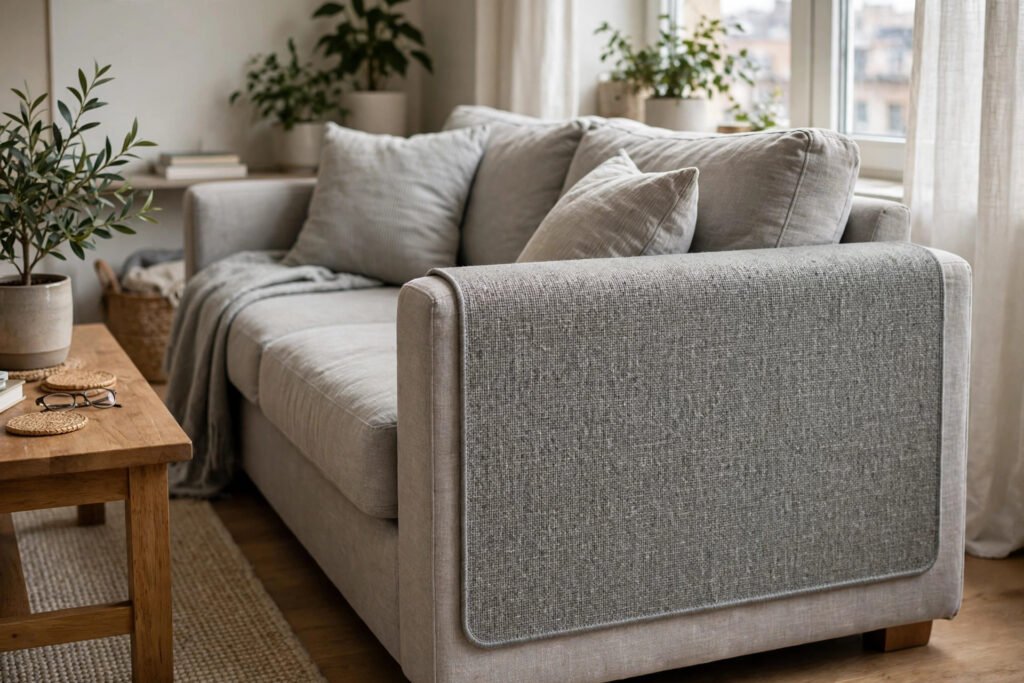
The Protecto is the one pick here that is both an adhesive product and an actual scratching surface: a 39.5 x 16 inch self-adhesive mat you stick to a couch side, a wall or a door, then trim to fit with scissors. The listing says it removes cleanly and is designed for easy setup and removal, and one big trimmable sheet can cover the whole scratching height of a sofa arm, which the smaller deterrent sheets cannot.
Now the honesty this pick requires: it is rated 3.1★ from just 15 ratings on Chewy, the lowest score in this roundup by a distance, and we are not going to dress that up. Reviewers are mixed on the adhesion — some report it not sticking well to textured upholstery, and the included corkscrew pins bending. It stays on this list because it is nearly alone in its class (a true stick-on scratching mat, not just a deterrent film) and a 15-rating sample is thin evidence either way — but buy it as the experiment it is: test-spot it like every adhesive product here, and know the verified alternatives above are the safer money.
Apartment scorecard: Footprint — sheet 39.5 x 16 in, trims to fit. Installation — self-adhesive backing, peel and stick; pins included for fabric. Rental-friendly — conditional; test-spot first, especially on any painted surface. Cleaning — wipe clean; replace when the surface wears smooth. Best room — living room couch side, or the wall beside an existing post.
Best tall floor-standing: MidWest Feline Nuvo Grand Forte 41-in Scratching Post
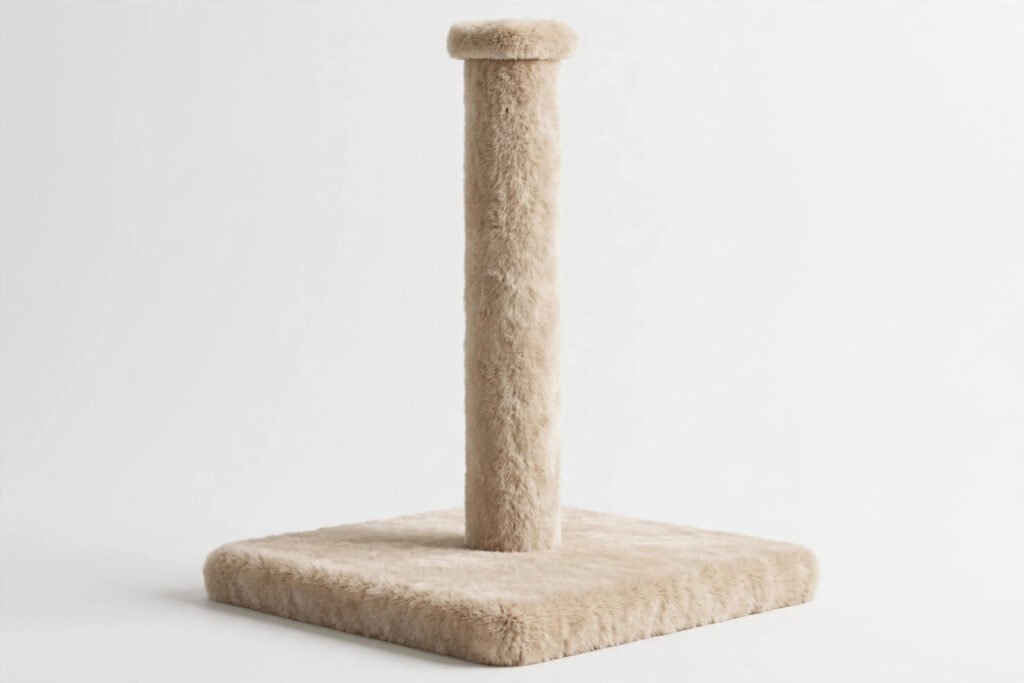
If 32 inches is a full stretch, 41 inches is a full stretch for the biggest cats in the building. The Grand Forte stands 41.07 inches on an 18.9 x 18.9 inch oversized base per the PetSmart listing, and weighs 20.5 lb — the anti-tip strategy in physical form, a post that stays put because moving it is a two-hand job. PetSmart rates it 4.8★ from only 4 reviews, and we flag that sample size rather than hide it: four happy buyers are a promising start, not a verdict.
The honest drawbacks follow from the verified facts. That 20.5 lb is real every time you want the post in a different room, and the covering is faux fur rather than sisal, which is a different scratching feel that some cats take to and some walk past. The thin review sample also means the long-term durability story is not written yet, where the SmartCat above has thousands of ratings behind it. Buy the Grand Forte when height is the requirement — a large cat, a multi-cat home, a determined climber — and buy the SmartCat when you want the proven record.
Apartment scorecard: Footprint — 18.9 x 18.9 in base, 41.07 in tall; 20.5 lb. Installation — freestanding on an oversized base; no wall contact. Rental-friendly — yes. Cleaning — vacuum the faux-fur covering. Best room — living room corner, or a multi-cat room.
How we picked
One hard rule ran this whole list: every pick had to be usable with zero drilling. Wall-mounted scratching posts that need screws were excluded by design, however well rated — a renter cannot use them as directed. Within the rule, we researched the live listings on Chewy and PetSmart, verified every URL, rating and dimension quoted here against the retailer pages on 8 November 2026, and took the drawbacks from reviewer reports on those listings — the lean-to confirmations for the Necoichi and the paint-peel report for the CLAWGUARD sheets both come from buyers themselves. We kept the PetFusion Lounge despite its stock status because its rating across two thousand reviews makes it the class benchmark, and said so in its section instead of quietly swapping it out. No paid placements, no hands-on testing, no veterinary claims — and where a listing gave us no verified dimension, the scorecard leaves that line out rather than guessing.
Buying guide
Choose the install type before the material
Renters should shop in this order: installation first, scratching surface second. A weighted freestanding post is the zero-risk default — nothing touches a wall, ever. A lean-to gives wall-height scratching with the same profile, as long as you have a solid surface to lean it on. Adhesive is the flexible option and the only risky one: it goes where nothing else fits, but it touches your landlord’s paint, and it has to earn that trust with a test spot. Decide which family your walls allow, then worry about sisal versus cardboard inside it.
The painted-wall warning, in full
Adhesive and painted drywall are a negotiated peace, not a friendship. Flat and latex paints can lift with adhesive on removal, and the risk is highest on fresh or cheap paint. The protocol is simple: stick a small piece in a hidden spot — behind the couch, inside a closet — leave it a full week, then peel it slowly and look. The CLAWGUARD brand recommends exactly this on its own listing, and the reviewer there who skipped it lost a small section of paint. If the test patch lifts, adhesive products are off your list; the freestanding and lean-to picks above lose nothing by comparison.
Redirect, don’t just repel
A deterrent tells a cat where not to scratch; it says nothing about where to scratch, and a cat with no approved option will find an unapproved one. The setup that works is a pair: the deterrent or protector on the hot spot, and an attractive scratcher immediately beside it, so the lesson is “not that, this.” The same protocol protects floors — if carpet is the target, our guide to stopping carpet scratching walks through the protector-plus-redirect routine for renters specifically.
Vertical, horizontal, or both
Watch before you buy. A cat that works couch arms and door frames is a vertical scratcher; a cat that works carpets, rugs and the top of the couch cushions is a horizontal one, and the wrong orientation gets ignored no matter how renter-friendly it is. Our vertical vs horizontal comparison is the full version of that test. Multi-cat homes with one of each should skip the debate and buy one of each — the two shapes do not compete.
The cardboard reality
Cardboard picks — the PetFusion lounge and the Necoichi’s pad — are consumables on a slow fuse. They shed flakes as they are used, wear through in months rather than years, and replacement pads are part of the deal. That is not a flaw to hide; cardboard is cheap to replace, silent, and many cats prefer it. Place it on a hard floor or a shakeable rug, and treat the pad budget as a running cost, the way you already treat litter.
Frequently asked questions
Will an adhesive cat scratcher damage my paint?
It can. Flat and latex paint may lift when adhesive is peeled off, and one reviewer on the CLAWGUARD listing reports exactly that happening on a wall. Test a small piece in a hidden spot for a full week first — the brands recommend it, and it is the difference between a deposit-safe product and a deposit claim. If the test lifts paint, stick with freestanding or lean-to picks.
Is deterrent tape alone enough to stop couch scratching?
No. A deterrent makes one surface unpleasant; it does not remove the need to scratch. Without an attractive scratcher right beside the protected spot, most cats simply move to the next surface. Pair the deterrent with a redirect — that pairing is why the CLAWGUARD sheets are in this list at all.
How do I stop my cat scratching the couch without drilling anything?
Cover the targeted corner (the SOFA-SCRATCHER above is built for exactly that corner), put a freestanding post immediately beside the couch, and protect any remaining hot spots with tested adhesive sheets. Our couch scratching guide covers the full routine, and our couch scratcher roundup covers the gear side.
Do leaning scratchers fall over?
Not when they are leaned properly. Reviewers on the Necoichi listing report it staying put leaned against a couch or wall, and the mechanics are simple: a steeper lean against a solid surface is stable, a shallow angle on a slippery floor is not. If a board walks or tips, steepen the lean and give the base a grippier floor.
Which of these works for a horizontal scratcher?
The PetFusion Lounge is the pick — a floor-level cardboard curve made for cats that scratch flat surfaces and like to sprawl on their work. The lean-to Necoichi at a low angle is the second option. A tall post, however good, is the wrong shape for a committed horizontal scratcher.
What if my cat ignores the new scratcher?
Move it before you blame it. A scratcher placed where the cat already scratches — beside the couch corner, on the carpet edge — gets investigated; one in a spare corner gets ignored. A little catnip on the surface helps the introduction, and a deterrent on the old spot completes the steer. Give it two weeks in the right place before concluding the cat has voted no.
Related reading
For the couch-specific gear, see our best cat scratcher for couches roundup — the parent guide to this one. For protection without a scratching surface, our furniture guards guide covers the clear-film options. For the material and orientation questions behind these picks, read our sisal vs cardboard comparison and our vertical vs horizontal comparison. If the target is the floor rather than the furniture, our carpet scratching guide is the renter-safe fix. And the same zero-holes test applied to cat trees — tension poles, suction perches and freestanding towers — is our renter friendly cat tree roundup.
Last updated: November 8, 2026
Pingback: Best Tall Scratching Post for Large Cats 2027