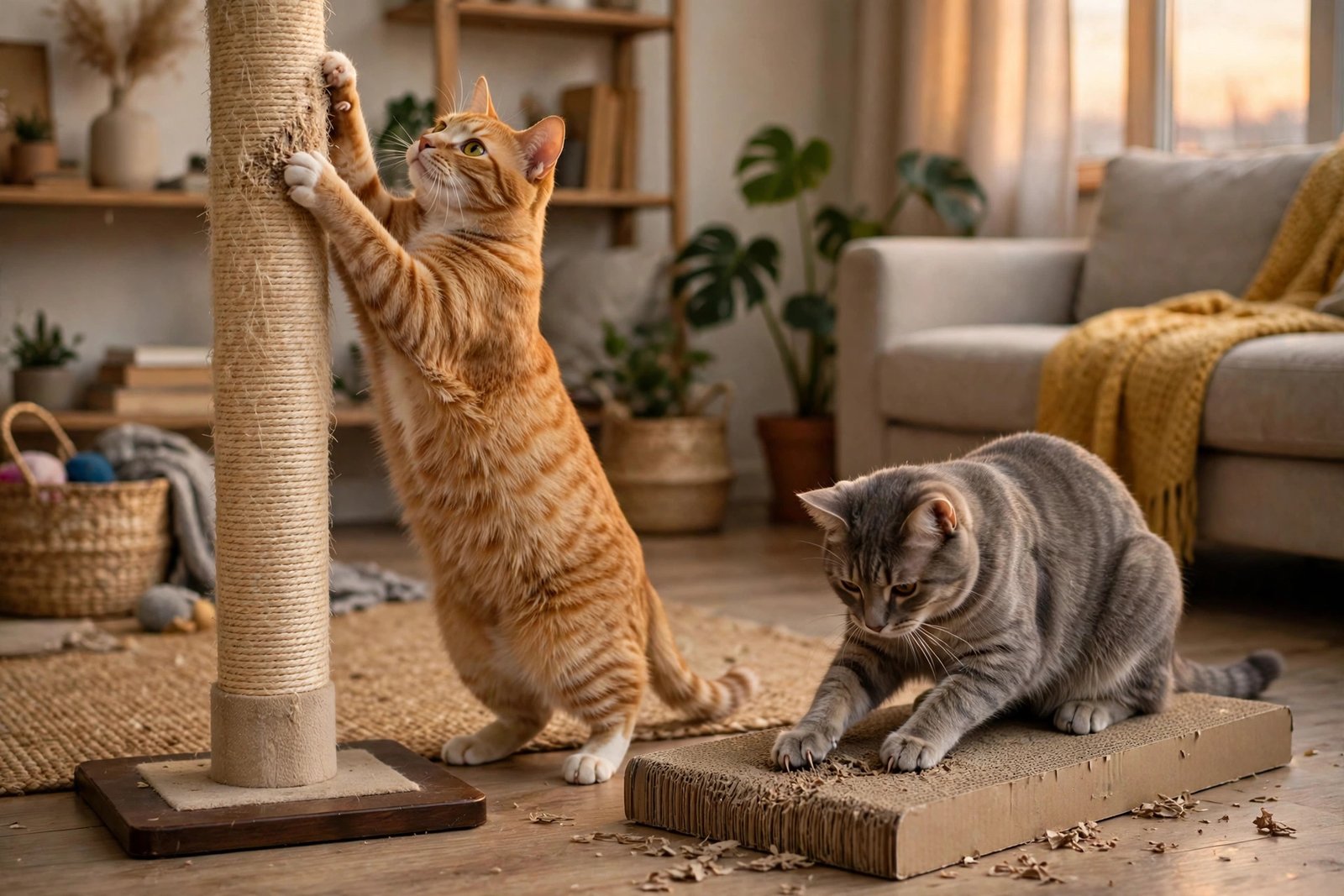
Vertical vs horizontal cat scratcher is a question of orientation, not quality — and it matters more than the material, because a cat that scratches upright will ignore a flat pad no matter how good the cardboard is, and a cat that scratches flat will ignore a tall post no matter how good the sisal is. The orientation decides whether the scratcher gets used at all. Vertical gives the full-body stretch; horizontal gives the dig-and-drag. Seniors, kittens, and multi-cat homes each have a different answer. This guide compares the two orientations honestly — stretch range, senior-friendliness, footprint, and durability — and gives you a simple 48-hour test to find out which one your cat actually is.
One distinction that keeps this comparison honest: this is an orientation comparison only. The material question — sisal versus cardboard — is the companion guide, and it matters too, but it is a separate decision. For the broader family question — post versus pad versus tree — our cat scratching post vs pad vs tree guide is the parent article. What follows is the orientation decision, on its own terms.
The short answer: which wins for most apartments
For most apartment cats, the honest answer is that you need to watch your cat, not read a ranking. That said, a pattern holds: cats that scratch door frames, sofa arms, and the sides of furniture are vertical scratchers, and a tall post is the right buy. Cats that scratch rugs, the carpet at the doorway, and the flat of the sofa seat are horizontal scratchers, and a flat lounge or pad is the right buy. If you have never watched closely, the default first purchase is a vertical post — more cats scratch upright than flat, and a tall post also doubles as a stretch station. But if your cat is a senior, or if the damage in your home is all at floor level, start horizontal. And in a multi-cat home, one of each beats two of one, because two cats rarely share an orientation.
Head-to-head: vertical vs horizontal
| Factor | Vertical | Horizontal |
|---|---|---|
| Stretch range | Full-body stretch, paws overhead; the whole point of the behaviour | Low stretch; dig-and-drag motion, paws at floor level |
| Ideal cat profile | Young and adult cats that scratch door frames and sofa arms | Seniors, kittens, and cats that scratch rugs and carpet |
| Footprint | Small floor footprint, tall profile; needs a stable, weighted base | Larger floor footprint, low profile; slides under furniture when not in use |
| Senior-friendliness | Poor for arthritic cats; jumping and stretching up hurts | Excellent; no jumping, no balance, no stretching up required |
| Multi-cat homes | One cat at a time; dominant cats can guard a tall post | Several cats can use different spots; easier to offer two |
| Cost and durability | Costs more; a good sisal post lasts a year or more | Costs less; a cardboard lounge lasts 2–4 months and is replaced |
The vertical case: the full-body stretch
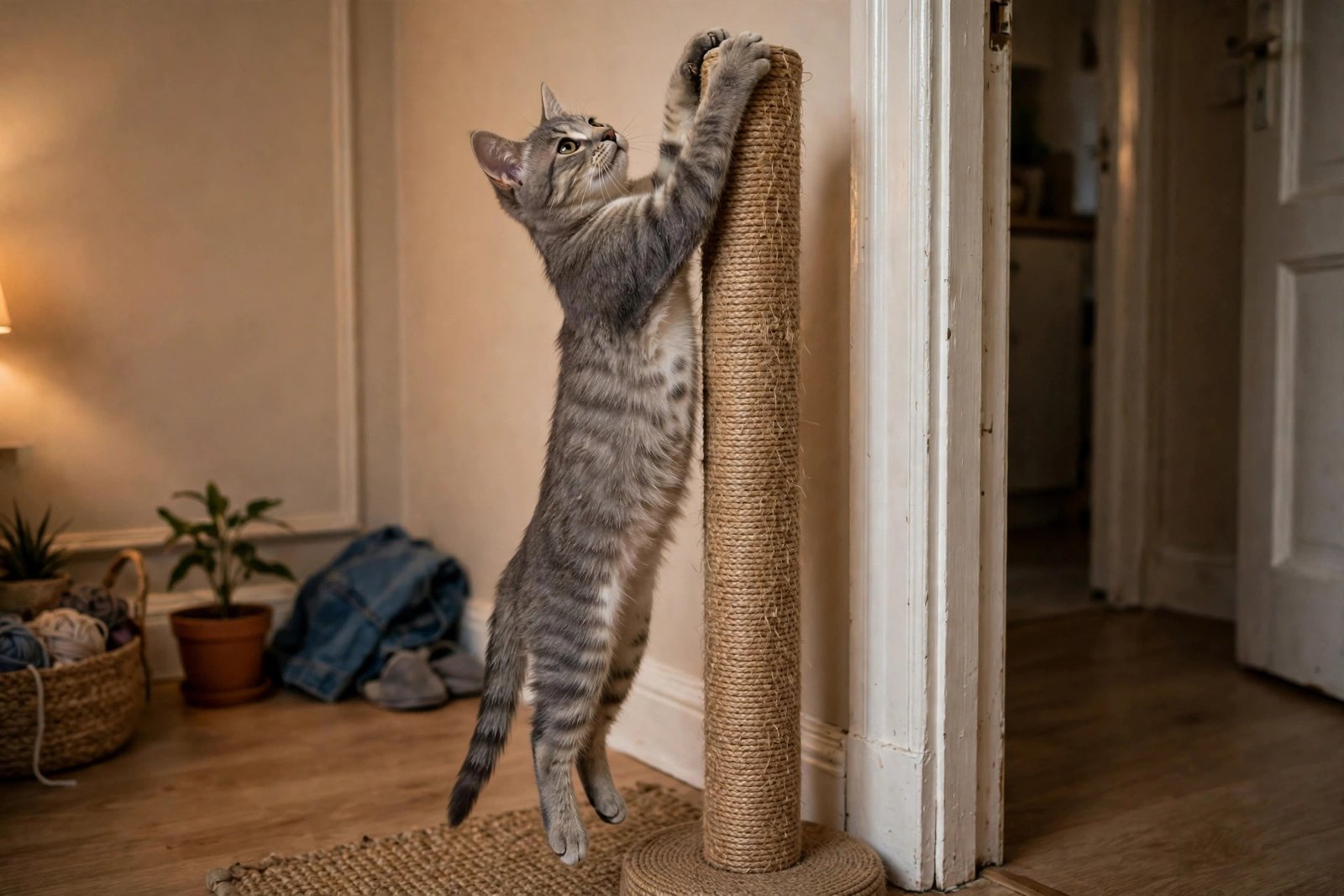
Scratching is not just claw maintenance — it is a full-body stretch, and the vertical post is the only format that delivers it. A cat reaching up a tall post extends its spine, its shoulders, and its front legs in one motion, which is why cats return to the same door frame every morning. The post needs to be tall enough for that stretch — a post your cat cannot fully extend on is a post your cat will abandon for the door frame — and it needs a base heavy enough not to wobble, because a post that tips over once is a post the cat will never trust again. That is the real durability question for vertical scratchers: not how long the sisal lasts, but whether the base stays planted.
The honest drawback is the senior problem. A vertical post asks an arthritic cat to jump, balance, and stretch up — exactly the movements arthritis makes painful. A senior cat that stops using the tall post has not stopped needing to scratch; it has stopped being able to use the format you gave it. The other drawback is space: a tall post is a piece of furniture, and in a small apartment it needs a corner where it can live permanently. The example vertical products in our live roundups are the SmartCat Ultimate sisal post and the Frisco heavy-duty sisal post — both tall, both weighted-base designs, and both researched in our scratching guides rather than tested here.
The horizontal case: dig-and-drag
Horizontal scratchers work a different motion: the cat stands over the surface and rakes downward, digging its claws in and dragging. It is the motion cats use on rugs and carpet, and it is the motion that suits cats who scratch the floor rather than the furniture. The format’s strengths are practical: it is low, so it fits under a coffee table or beside the sofa; it is cheap, so replacing it every few months is painless; and it asks nothing of the cat’s joints, which is why seniors and kittens take to it first.
The honest drawback is the mess and the lifespan. A horizontal cardboard lounge sheds dust across the floor, and it is a consumable — two to four months of regular use, then it is shredded flat. The other drawback is that a horizontal scratcher cannot deliver the full-body stretch, so a cat that is a vertical scratcher by nature will use a flat pad politely and then go back to the door frame. That is not a failure of the product; it is a mismatch of orientation. The example horizontal product in our live roundups is the PetFusion cardboard lounge — a flat, reversible design that is the standard reference for the format.
The preference test: watch your cat for 48 hours
Do not buy on a guess. Watch your cat for two days and note where the claws actually land. Door frames, sofa arms, the sides of chairs, and the edge of the bed: vertical. Rugs, the carpet by the door, the flat of the sofa seat, and the mat by the litter box: horizontal. Most cats show a clear preference within 48 hours if you are actually looking, and many cats use both — scratching the door frame in the morning and the rug in the evening — which is the one-of-each answer, not indecision.
The cheap version of the test is a cardboard lounge on the floor. If the cat uses it daily, you have a horizontal scratcher, or at least a cat that will accept one. If the cat walks past it and goes straight for the door frame, you have a vertical scratcher, and the next purchase is a tall post. Either way you have spent very little to learn something a product page cannot tell you. Do not run the test by placing the new scratcher in a corner the cat never visits — put it where the damage already is, because that is where the behaviour lives.
Seniors and arthritis: horizontal wins — and why
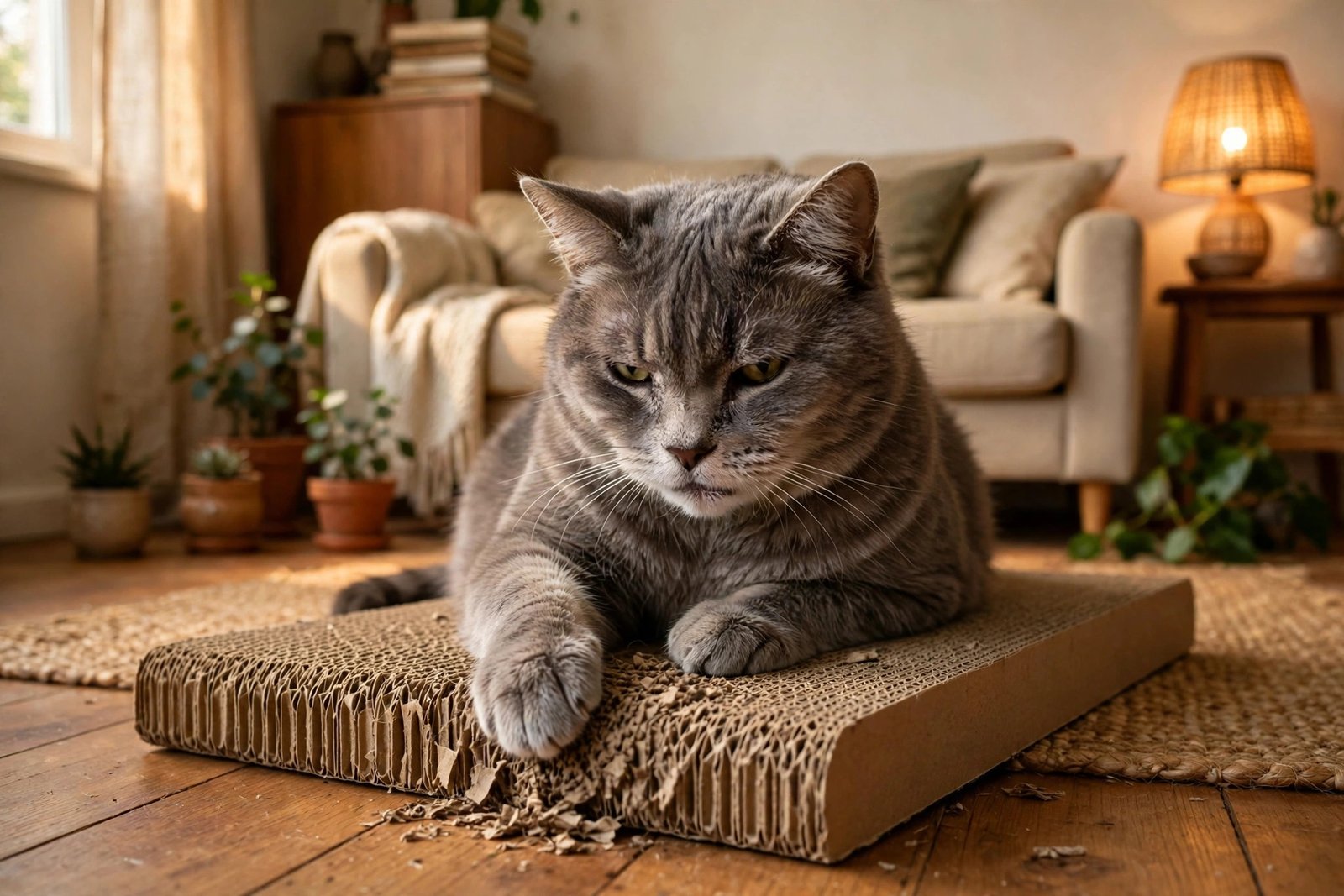
For a senior or arthritic cat, horizontal is not a preference, it is a necessity. Jumping up, balancing on hind legs, and stretching overhead are the first movements arthritis takes away, and a cat that cannot do them will simply stop scratching — which means claws grow long, the cat gets uncomfortable, and the behaviour the scratcher was meant to serve disappears. A flat lounge at floor level asks for none of those movements. It is also the format a kitten learns on first, for the opposite reason: it is low, stable, and impossible to fall off.
If your cat is a senior and you already own a tall post, do not throw the post away — add a horizontal lounge beside it and let the cat choose. The cat will tell you, within a week, which format its body still allows. That is a better test than any age chart. And never let a guide talk you into declawing as a solution to a scratching problem — it is not a solution, it is a surgery that removes the behaviour by removing the claws, and it is not something this site recommends.
The one-of-each setup for multi-cat homes
In a multi-cat home, one vertical post and one horizontal lounge is the setup that ends the most arguments. Two cats rarely share an orientation, and even when they do, a dominant cat can guard a single tall post and leave the other cat with nowhere to scratch — which is how the sofa gets involved. Two formats in two different rooms also spreads the scratching around, which spreads the mess around, which is a genuine benefit in a small apartment. The total cost is one post and one lounge, and the lounge is the cheap half of the pair.
The verdict
Buy vertical if your cat scratches door frames and sofa arms, is young or adult, and has the mobility for a full stretch. Buy horizontal if your cat scratches rugs and carpet, is a senior or a kitten, or has arthritis. Buy one of each if you have two cats, or if your 48-hour test shows your cat using both. What you should not do is buy two of the same orientation and wonder why the second one sits unused — the second scratcher should be a different orientation, not a duplicate, because the orientation is the decision that matters.
How we compared
We compared the two orientations on the factors that decide the purchase in a small apartment: stretch range, which cats each format suits, floor footprint, senior-friendliness, how each behaves in a multi-cat home, and cost over a year. We did not test products for this guide — it is a comparison of orientations, drawn from the product research in our live scratching roundups, where the example products are the same ones we have already researched: the SmartCat Ultimate and Frisco heavy-duty sisal posts for vertical, and the PetFusion cardboard lounge for horizontal. For product-by-product picks, those roundups are the place to look; this guide is the decision between the two orientations. For the material side of the same decision, see the companion comparison of sisal versus cardboard.
Frequently asked questions
How do I know which my cat prefers?
Watch for 48 hours. Door frames and sofa arms mean vertical; rugs and carpet mean horizontal. The cheap test is a cardboard lounge on the floor — if the cat uses it daily, you have a horizontal scratcher; if the cat walks past it to the door frame, you have a vertical one.
Are horizontal scratchers good for kittens?
Yes — they are the best first scratcher for a kitten. Low, stable, and impossible to fall off, a flat lounge lets a kitten learn the scratching motion without the balance a tall post demands. Add a vertical post later, once the kitten is confident and stretching up.
Do seniors need horizontal scratchers?
Usually, yes. Arthritis takes away the jumping, balancing, and overhead stretching that a vertical post requires. A flat lounge at floor level asks for none of those movements, so a senior cat can keep scratching — which it needs to do — without pain.
Can a scratcher be both vertical and horizontal?
Some designs try — a ramp, a wedge, or a curved lounge that offers both angles. They are a reasonable compromise in a very small apartment, but they are rarely as good at either orientation as a dedicated format. If you have the floor space, one dedicated vertical post and one dedicated horizontal lounge beats one compromise piece.
Which takes less space?
Vertical takes less floor space and more vertical space; horizontal takes more floor space and almost no vertical space. In a small apartment the real question is which space you have spare — a corner for a tall post, or a stretch of floor beside the sofa for a lounge.
Should I buy two scratchers of the same type?
No. The second scratcher should be the other orientation. Two vertical posts give a cat the same option twice; one vertical and one horizontal gives the cat a real choice — and in a multi-cat home, it gives two cats somewhere to go at the same time.
Related reading
For the broader family question, see our cat scratching post vs pad vs tree guide. For the companion question of material, the sisal vs cardboard comparison. For the mess angle, our best cat scratcher that doesn’t shed guide. And for renter-safe scratcher products, the renter friendly scratcher roundup.
Last updated: October 26, 2026
Pingback: Cat Scratching Post vs Scratching Pad vs Tree: Which Does Your Cat Need? 2027
Pingback: Sisal vs Cardboard Cat Scratcher 2027