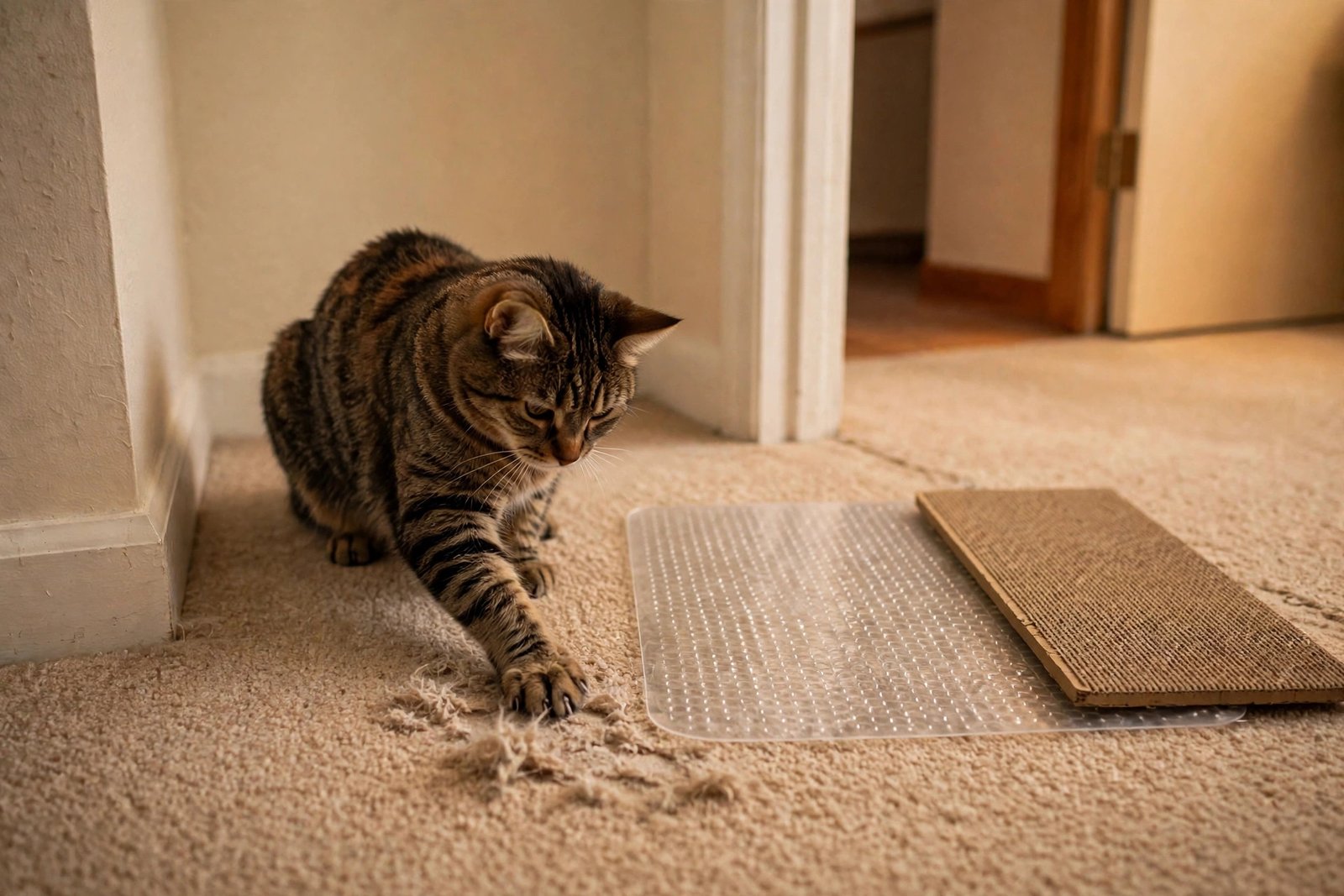
Cat scratching carpet is a renter’s problem before it is a cat problem — because in a rented apartment, the carpet is not yours, the damage is visible at move-out, and the deposit is the price of getting it wrong. The cat is not being spiteful. Cats scratch carpet for two reasons: the texture feels right under their claws, and the location is right — by the door, at the corner of the room, where the cat passes every day. Fix the texture and the location, and the carpet stops being the target. This guide is the renter-safe fix in four steps: protect the carpet, redirect to a surface that matches it, deter safely, and trim on a schedule.
One distinction that keeps this guide honest: the couch is a different problem with a different fix, and our how to stop your cat from scratching the couch guide is the one you want. What follows is carpet and flooring only — the renter’s deposit problem, solved without drilling, without sprays on the whole room, and without anything a landlord would object to.
Why cats scratch carpet (texture + location, not spite)
Carpet is, from a cat’s point of view, an ideal scratching surface: it is textured, it gives under the claws, and it is exactly where the cat already walks. A scratching post that is the wrong texture, in the wrong room, will not compete with it. That is why the redirect in Step 2 has to be texture-matched and placed on the damage, not tucked in a corner out of sight.
Understanding that is the whole fix. You cannot talk a cat out of scratching, and you cannot make carpet un-scratchable while it is still carpet. What you can do is make the carpet unavailable and make something better available, in the same place, at the same time.
The deposit math: why renters should care
A small worn patch by the door is a cleaning charge. A shredded patch the size of a dinner plate is a replacement charge, and replacement is priced by the room, not by the patch. The difference between the two is usually a few weeks of scratching, which is why this is a this-week problem, not a someday problem.
Fixing the patch you already have
The deposit math above is the reason to act early — but if the damage is already there, a small worn patch is not automatically a replacement charge. Two things are worth doing before move-out. First, trim loose fibres flush and never pull them: Bob Vila warns, “Whatever you do, don’t pull a snag — you’ll likely tear the carpet away from the backing and make the problem worse. Instead, grab a pair of nail scissors and trim the snag at the base.” Second, a small worn spot can be patched with a matching piece cut from a hidden corner — Family Handyman advises taking the replacement “plug” “from inside a closet”, and This Old House gives the same advice for a closet or under furniture that is rarely moved. Two honest limits. The invisible-repair claim only holds for plain plush carpet with no pattern: Family Handyman is clear that patterned, textured, or looped carpet may show the repair, and This Old House says the same — patch repairs work best on plush, tufted pile with no patterns that require matching. And none of this is a promise for glued-down carpet, which neither source covers. If the shredded area is large, or the damage goes through to the backing, tell the landlord first instead of attempting a DIY patch — a large shredded area is a conversation, not a cover-up, and a bad repair is worse than an honest report.
Step 1: protect the carpet

Protection comes first, because redirecting takes a week and the carpet is being damaged today. The simplest protector is a clear plastic carpet mat — the kind sold as a chair mat — laid flat over the worn patch, spikes down. It removes the texture the cat is after, and it is invisible enough that a landlord will not mind it. Clear adhesive carpet film works the same way on a smaller patch, and it comes off without residue if you remove it slowly.
For a doorway, a flat plastic runner works the same way. For a corner, a clear mat tucked under the skirting board protects the edge the cat is working on. What matters is coverage of the exact patch being scratched, not the whole room: protect the target, and the cat’s attention moves to the board you are about to offer.
Step 2: redirect — texture-matched horizontal boards
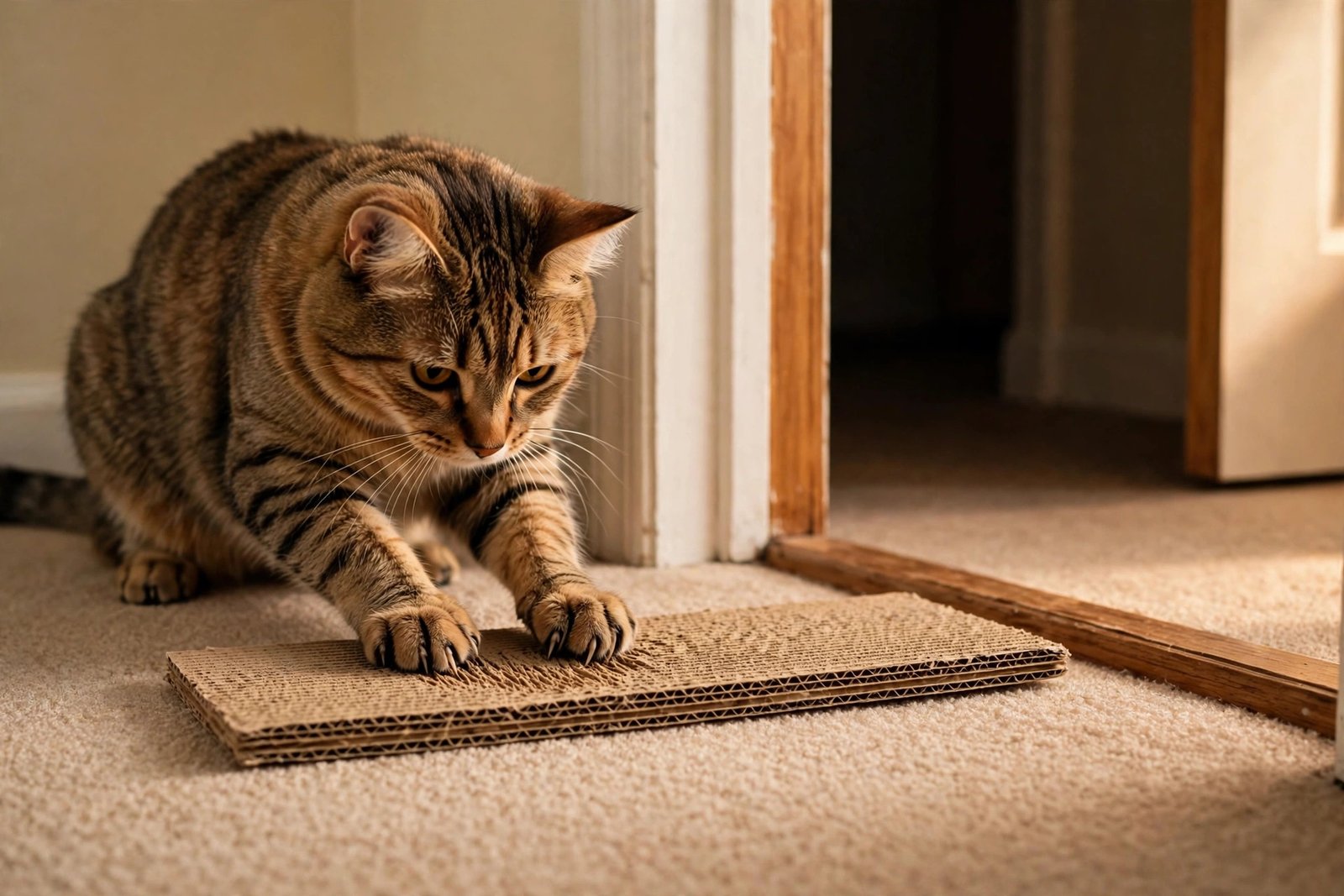
This is the step that actually solves the problem, and the key word is texture-matched. A cat that scratches carpet wants a horizontal, carpet-like surface. A tall sisal post will not do it. What works is a flat board — corrugated cardboard, or a carpet-covered board — laid directly on the carpet, on the spot the cat is already scratching. If the cat scratches a low-pile carpet, a low-pile board matches; if it scratches a shaggy rug, a shaggier board matches. The closer the texture, the faster the switch.
Placement is the whole technique. Put the board where the damage is, not where it looks tidy. If the cat scratches by the door, the board goes by the door. If it scratches the corner, the board goes in the corner. Once the cat is using the board reliably, you can move it a few inches a day towards a tidier spot — but move it a foot at once and the cat will go back to the carpet. If the cat uses it, you have your answer.
Make the board the better offer
Placement gets the board in front of the cat. Making it attractive gets the paws on it. Rub a pinch of catnip — or silver vine, if your cat ignores catnip — into the board’s surface, and refresh it every day or two while the habit is forming. Play with a feather wand across the board so the cat’s paws land on it mid-game; a cat that has already scratched a surface in play is far more likely to return to it on its own. If the scratching started after a move or a new pet, a pheromone spray near the board can help a stress-scratcher settle — the makers say it reduces stress-related scratching, and many owners report it takes the edge off, but that is a maker claim, not a verified fact, and it is no substitute for the board itself.
Reward the switch. The moment the cat uses the board — not a minute later, within seconds — give it a treat and a calm word of praise. Every time, at first: the cat has to learn that the board pays and the carpet does not. Once the board is the habit, mix it up — a treat sometimes, praise the rest of the time — so the behaviour survives without a treat in your hand. And never reward the carpet scratch itself with attention: rushing over, shouting, or picking the cat up mid-scratch is exactly the response the at-night scratcher is after, and it teaches the cat that carpet scratching summons you.
Step 3: deter safely — sprays and tape, with a test spot
Deterrents have a place, but only as the second half of redirecting — never on their own. A cat deterred from the carpet with nothing to scratch instead will find another surface, and that surface will be worse. The deterrent goes on the protected patch, at the same time as the board goes down, so the cat has a yes and a no at the same moment.
Apply the deterrent to the protected patch, not to the whole room, and apply it at the same time as the board. Double-sided tape on the protected patch is the most reliable deterrent for carpet: cats dislike the sticky feeling under their paws, and it comes off the protector, not the carpet. Test any spray on a hidden spot first — some sprays discolour cheap carpet. Remove tape slowly, at a low angle, so it lifts without pulling fibres.
Foil, short-term. A sheet of kitchen foil over the targeted strip is a texture deterrent some cats will not walk on, let alone scratch. It is ugly and it is temporary — a few days while the redirect board takes hold, not a permanent fixture — and it works on some cats and not others, so treat it as an experiment, not a solution.
Soft nail caps, as a stopgap. Soft Paws nail caps cover the claws while the retraining runs, so the damage per scratch drops to almost nothing. According to the maker, they stay on “approximately 4–6 weeks” and “fall off with the natural growth of your cat’s nails” — and most people apply them themselves: the maker’s own answer to “Can I apply Soft Paws myself?” is “Absolutely. Most people apply the nail caps themselves.” They are a stopgap, not a fix: the caps do not teach the cat where to scratch, and they need replacing as they shed with the claw.
Step 4: trim — the nail-trim cadence
Trimming does not stop scratching, and anyone who tells you it does is wrong. What trimming does is reduce the damage per scratch while the redirect takes hold. Trim only the sharp tip, every two to three weeks, and stop if the cat is stressed — a stressed cat scratches more, not less.
When the scratching is boredom or stress
Not every carpet scratcher is a texture problem. The tell is timing: scratching that spikes after a move, a new pet, or a change in your schedule — or scratching that happens mostly when the flat is empty — is usually boredom or stress, not a missing scratcher. Before reaching for another deterrent, give the cat more to do. Adopt-a-Pet’s guide to stopping carpet scratching advises owners to “make time for at least two 10-minute play sessions each day to keep them active and mentally stimulated” — that is the behaviourist-backed guidance in their guide, and it is the cheapest fix in this whole article. Rotate the toys so the same mouse is not the only option every day, and end the evening session with a small meal before bed. If the scratching is frantic, or it comes with hiding, not eating, or over-grooming, that is a vet conversation, not a deterrent conversation: pain and anxiety both show up as sudden scratching, and no board or spray fixes either.
The under-door and at-night variants
Two variants are harder than the rest, and they are the ones people search for most. The under-door scratch is a cat that wants through a closed door, and the fix is the same redirect on the same spot, plus a door draft stopper the cat cannot hook its claws under. If the door has to stay shut, the board goes on the cat’s side of it.
The at-night scratch is usually a cat that is bored, or a cat that has learned that scratching the carpet summons you. Play in the evening, feed a small meal before bed, and put the redirect board in the spot the cat uses at night. Do not get up to stop it — that is the reward.
What doesn’t work
Punishment does not work, and it damages the relationship. Spraying the cat with water, shouting, or picking the cat up mid-scratch teaches the cat to scratch when you are not watching, which is the opposite of what you want. Declawing is not a fix either: it is surgery, and it does not address the behaviour.
Frequently asked questions
Will a carpet protector stop my cat scratching the carpet?
It stops the damage, not the behaviour. A clear mat over the worn patch protects the fibres while you redirect the cat to a board, and the redirect is what stops the scratching.
What is the best scratcher for a carpet-scratching cat?
A flat, horizontal board with a carpet-like or corrugated texture, placed directly on the spot the cat already scratches. Vertical posts do not match the texture or the orientation.
How do I stop my cat scratching the carpet at night?
Play in the evening, feed a small meal before bed, and put the redirect board in the spot the cat uses at night. Do not get up to stop it — that is the reward.
Is it safe to use deterrent spray on carpet?
Usually, but test it on a hidden spot first. Some sprays discolour cheap carpet, and tape adhesive can pull fibres if it is left too long. Tape on a protector, not directly on the carpet, is the safer route.
How often should I trim my cat’s claws?
Every two to three weeks for most indoor cats, trimming only the sharp tip. Trimming does not stop scratching, but it reduces the damage per scratch while the redirect takes hold.
Will my landlord charge me for scratched carpet?
It depends on the damage. A small worn patch is usually a cleaning charge; a shredded patch can be a replacement charge, priced by the room. Fix it early and the difference is usually a cleaning charge.
Related reading
For the couch version of this problem, see our how to stop your cat from scratching the couch guide. For the product side, the best cat scratcher for couches roundup, and for the material and orientation decisions behind the redirect board, the sisal vs cardboard and vertical vs horizontal comparisons.
Last updated: November 20, 2026
Pingback: How to Stop Your Cat Scratching the Couch: 9 Fixes That Work 2027