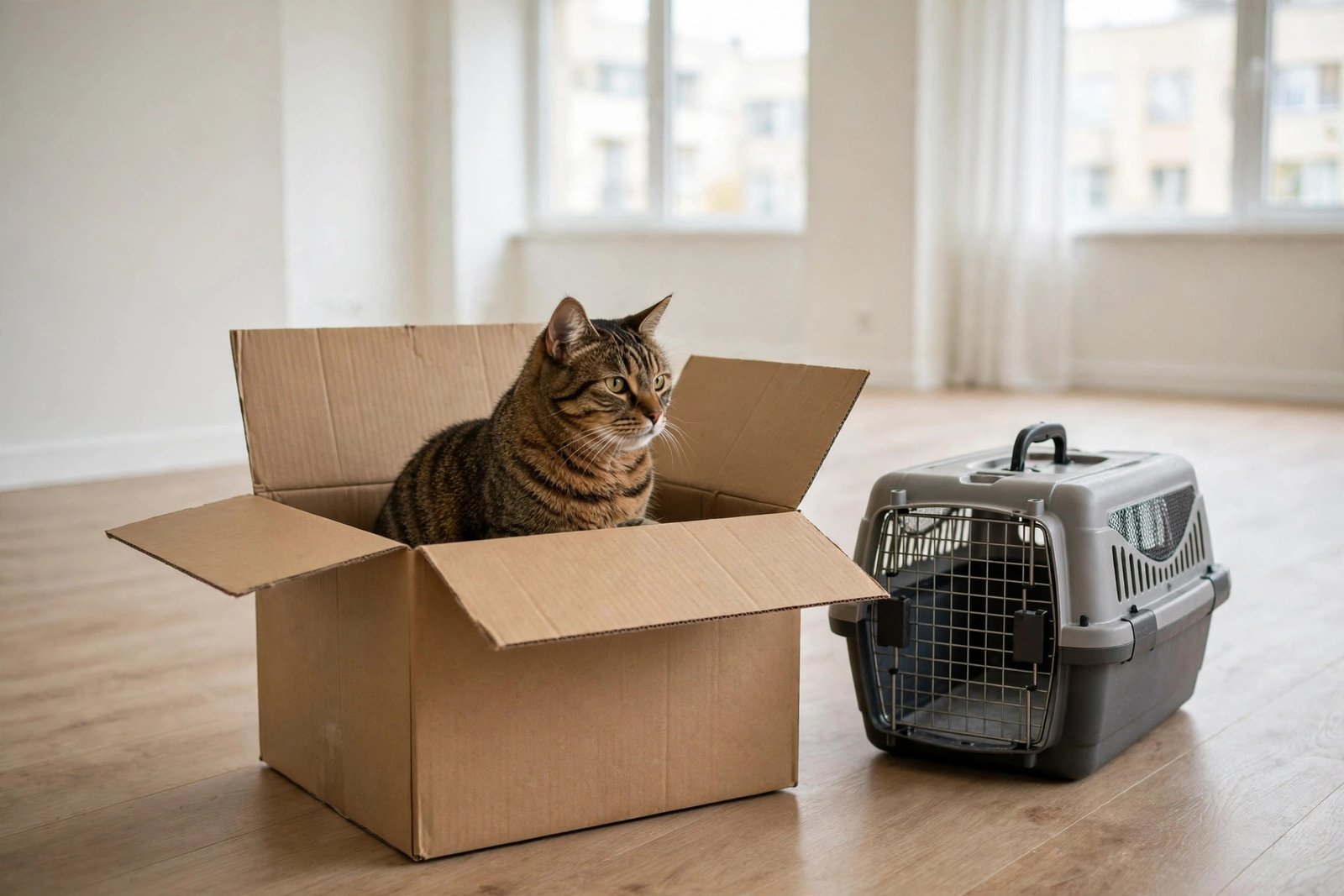
A cat does not understand a move. It understands that its territory — every scent-marked corner, every sunny sill, every hiding spot it has mapped over months — has vanished overnight, and that the new place smells of strangers, paint, and cardboard. Moving to a new apartment with a cat is therefore not a logistics job with a cat attached; it is a territory transfer, and the cat’s stress is the thing to plan around. This guide runs the move as a timeline: before moving day, the day itself, the first room, and the rest of the apartment at the cat’s pace — all of it renter-safe, because the deposit is on the line too.
The plan below is built from the guides that cover this exact situation — the apartment move-in advice from apartments.com, the cat-specific move-in checklist from Litter-Robot, the relocation guide from Molloy Moving, and the settling-in advice from Putnam Rental Properties. Where they agree, this guide follows them; where they differ — mostly on how long settling takes — the range is stated. Nothing here was tested on a cat; it is a researched guide, and it never claims a method works because we tried it.
Before moving day: the two weeks that decide everything
The work that matters most happens before a single box is taped, and almost none of it involves packing. Start with the vet. Book a check-up in the two weeks before the move, update the microchip details and the tag with the new address, and ask for the records — a new vet will want them. If the cat is on medication, get a refill that covers the move week plus a margin; pharmacies near the new place are an unknown on day one.
Next, reintroduce the carrier. Most cats only see their carrier on vet days, which is exactly why they hate it. Leave it out in the living room with the door open, a familiar blanket inside, and treats placed near it and then in it, for at least a week before the move. A cat that walks into its carrier on its own is a cat that can be moved without a wrestling match at the worst possible moment. If the carrier is old, cracked, or too small, replace it now — our guide to choosing a cat carrier for apartment living covers what fits a small flat, and a backpack carrier is worth considering if the new building has stairs, a long walk from the car, or no lift.
Pack the cat’s essentials bag separately, and keep it with you — not in the moving van. It needs food and water for two days, the litter box and litter, a scoop and bags, the familiar blanket and one worn item of your clothing, the favourite toy, any medication, and the vet’s number — so the cat’s first night works even if nothing else is unpacked and the van is late.
Then cat-proof the new place before the cat arrives, not after. Visit the empty flat and check the things a cat will find first: gaps behind the fridge and the washing machine, open vents, a balcony door that does not latch, a window screen with a tear, dangling blind cords. Tape or block the gaps, fix or report the screen, tie the cords up high. Photograph every existing mark on the walls, floors and door frames as you go — those photos are your deposit evidence, and they are much harder to take honestly once your furniture is in. The full room-by-room version of this job is our cat-proofing checklist for renters, and it is best done on the empty flat, when every corner is reachable.
One small trick the moving guides repeat is worth doing: scent transfer. A few days before the move, rub a clean cloth gently on the cat’s cheeks — where the scent glands are — and then rub the same cloth on the door frames and furniture legs of the new place. It costs nothing, and the cat arrives to a flat that already carries a faint version of its own scent.
Moving day: keep the cat out of the chaos
Moving day is the worst day of the whole process for a cat: strangers in the flat, doors standing open, furniture disappearing, noise everywhere. The single most important decision is to keep the cat away from all of it. The guides agree on the order of operations: the cat goes into the carrier first, before the movers arrive, and stays in a closed room — bathroom is the usual choice — with its litter box, water, and blanket, while the old flat is emptied. A closed door and a sign on it are not overkill; an open door and a stressed cat is how cats slip out and disappear on moving day.
Transport the cat in your own car, in its carrier, with you — never in the moving van, and never loose in the car. Put the carrier on the back seat, secured with a seatbelt, covered lightly with a blanket, and keep the car cool and quiet. Do not feed the cat a big meal right before the drive; a small meal a few hours earlier is enough, and an empty-ish stomach travels better. If the drive is long, offer water at stops but do not let the cat out of the carrier — a cat loose in a car park is a lost cat.
At the new flat, the cat does not get the run of the place. It goes straight into the safe room, which you set up before the movers arrive, and the door stays closed while the rest of the flat fills with boxes and strangers. The cat’s first experience of the new home should be one quiet room that already smells familiar, not a whole flat in chaos.
The first room: set up the safe room
The safe room is the heart of the whole plan. Pick a room with a door that closes — a bedroom in a one-bedroom flat, a large bathroom in a studio — and set it up completely before the cat comes out of the carrier. The Molloy guide puts the cat in one room for one to two days before it explores further; in a studio the “room” can be a single corner screened off with furniture, as long as nobody disturbs it.

What goes in the safe room: the litter box in a corner away from the food, food and water bowls, the familiar blanket and the worn item of clothing, a hiding spot — a box on its side, the carrier with its door open — and a scratcher. Put the water station where it will stay, because moving it later restarts the settling; our guide to fountain placement in apartments covers the quiet-corner and away-from-food rules if the cat drinks from a fountain. Keep the routine the same as the old flat: same food, same feeding times, same litter. Everything new can wait.
Then leave the cat alone in it. Visit often, sit quietly, let the cat come to you — but do not drag it out, do not invite friends round to meet it, and do not open the door “just to see”. A cat that hides under the bed for the first day is settling, in the only way it knows how. Eating, drinking and using the litter box are the signs that matter, and they usually start within the first day. If the cat has not eaten or used the litter box after 24 hours, watch closely; if it goes past a day without eating, that is a vet call, not a patience exercise.
Opening up the apartment, room by room
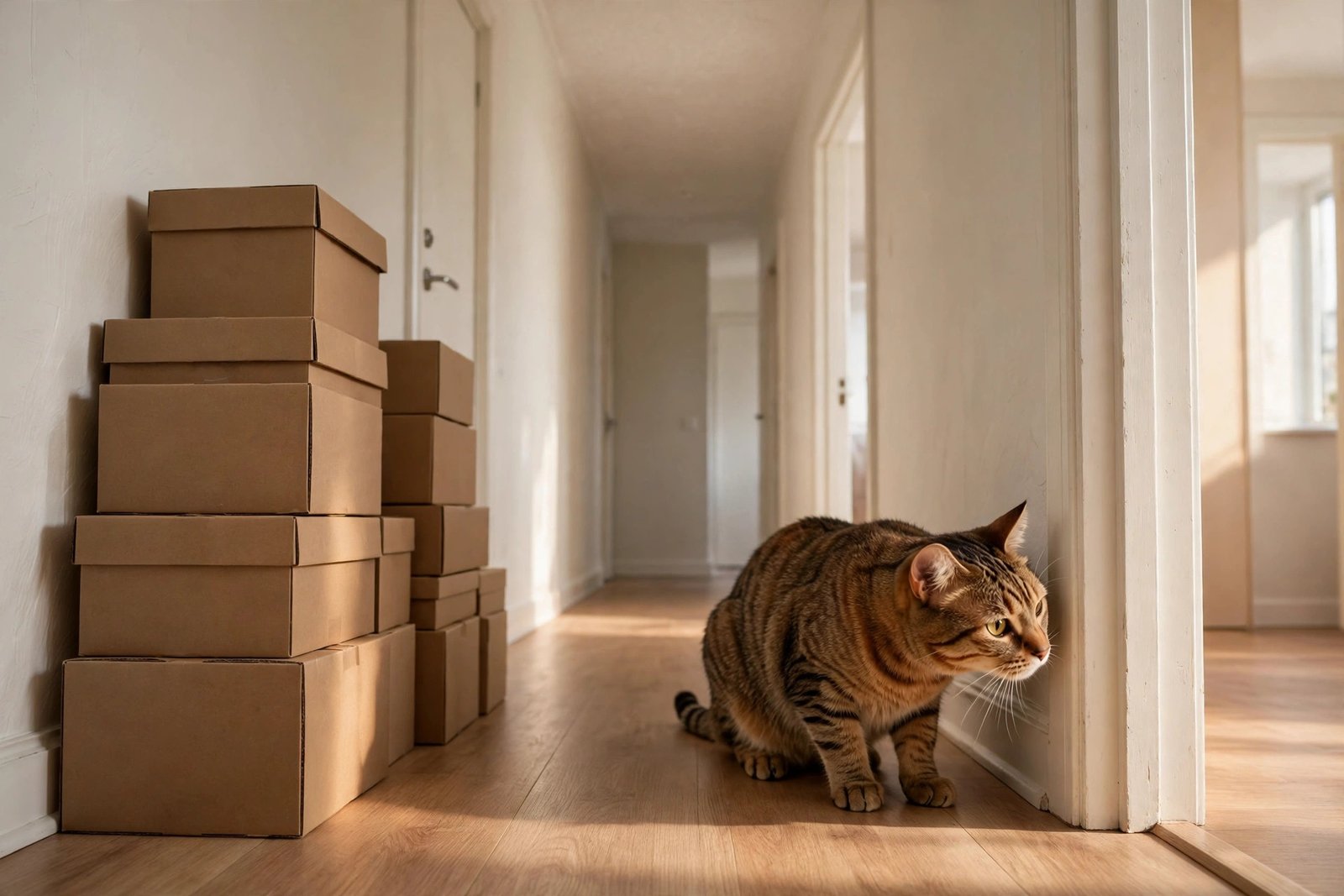
After a day or two in the safe room — sooner for a confident cat, later for a nervous one — open the door and let the cat explore on its own terms. Do not carry it into the new rooms. Leave the safe room door open so it can retreat, and let it map the flat in short trips: out for ten minutes, back to base, out again.
Open the flat in stages rather than all at once. The living room first, then the kitchen, then the hallway and the rest. Keep windows closed and balcony doors locked until the cat knows the layout — an unmapped flat is when a cat is most likely to slip through a gap. As each room opens, put something familiar in it: a blanket, a scratcher, a toy. The cat is marking territory as it goes, and familiar objects give it anchors in rooms that still smell strange.
The litter box stays in the safe room until the cat is confident, and only then moves a few steps at a time. The same goes for the food and water: do not move everything on the day the door opens. One change at a time is the pace the guides describe, and it is the pace that works.
The first week: routine is the settling
Settling is not a single moment; it is a week of routine. Same feeding times, same play times, same bedtime. The Putnam guide puts the adjustment window at one to four weeks for most cats: a confident young cat may be asleep on the new sofa by night two, and a nervous older cat may still be sleeping in the safe room at the end of week two. Both are normal. What matters is the direction — more exploring, eating and play each day — not the speed.
Play is the best settling tool you have. Two short play sessions a day, in rooms the cat has already explored, burn off nervous energy and build positive associations with the new space. Follow play with a meal, the way the cat’s day worked in the old flat. Keep the cat indoors for at least the first two weeks — longer if the building has a balcony or the neighbourhood has free-roaming cats. A cat that goes out before it has bonded to the new flat may try to walk back to the old one.
Watch for the signs that settling is not happening: hiding that does not ease after a few days, not eating, over-grooming, or a sudden change in litter habits. A few bad days are part of a move. A week of them, or any sign of illness, is a vet conversation — stress shows up as behaviour first and illness second, and the vet would rather see a stressed cat early than a sick one late.
The deposit: protect the new flat from day one
The renter’s side of the move deserves its own paragraph, because the new flat’s condition on moving-out day starts on moving-in day. Photograph the empty flat before the cat arrives and keep those photos. Put a scratcher in every room the cat uses from the first week — a cat with a legal scratching surface does not need the door frames, and a frame scratched in week one is a deduction in year one. Keep the litter box on a mat and check under it weekly. And if the cat does damage something, fix it small and early: a shallow scratch filled and touched up in week one is invisible, and a year of ignored scratches is a repair bill.
FAQs
How long does it take a cat to settle into a new apartment?
Most cats adjust in one to four weeks, according to the settling-in guidance from Putnam Rental Properties. Confident cats may be comfortable in days; nervous or older cats can take the full month. The direction matters more than the speed: more exploring, eating and play each day means settling is happening.
Should I keep my cat in one room after moving?
Yes, for the first one to two days. Set up a safe room with the litter box, food, water, a hiding spot and familiar bedding before the cat comes out of the carrier. In a studio, a screened-off corner works as the safe room.
How do I get my cat used to its carrier before a move?
Leave the carrier out with the door open for at least a week before moving day, with a familiar blanket inside and treats placed near it and then in it. A cat that walks in on its own is far easier to move than one that has to be caught on the morning of the move.
Should I update my cat’s microchip before moving?
Yes, before moving day. Update the microchip registry and the ID tag with the new address, and ask the old vet for the cat’s records so a new vet has them from the start. A cat that slips out during a move is found through its chip, and the chip is only useful if the details are current.
What should go in my cat’s essentials bag for moving day?
Food and water for two days, the litter box and litter, a scoop and bags, the familiar blanket and one worn item of your clothing, the favourite toy, any medication, and the vet’s number. Keep the bag with you in the car, not in the moving van, so the cat’s first night works even if nothing else is unpacked.
My cat stopped eating after the move — when should I worry?
A skipped meal on moving day is common. If the cat has not eaten at all after 24 hours, watch it closely, and if it goes past a day without eating, call the vet — cats that go too long without food can develop liver problems.
Related reading
- Cat-Proofing Your Apartment: A Renter’s Checklist — the once-you-are-in companion: room-by-room proofing for the new flat, done on the empty place before the cat arrives.
- Best Cat Carrier for Apartment Living — the carrier to use on moving day, chosen for a small flat and a cat that hates travelling.
- Best Airline-Approved Cat Carriers — if the move involves a flight, the carrier rules that decide whether you board.
- Best Cat Backpack Carrier — the hands-free option when the new building has stairs or a long walk from the car.
- Cat Water Fountain Placement in Apartments — where the water station goes in the safe room and after, so the cat drinks from day one.
Last updated: November 11, 2026