 Deciding where to put cat tree in apartment is the step most owners skip, and it is the step that decides whether the tree gets used at all. A cat tree is a big piece of furniture in a small flat, and the wrong spot — a dead corner, a dark hallway, a room the cat never enters — turns an expensive purchase into a piece of furniture the cat walks past. The right spot is simpler than most guides make it: by a window, against a wall, in a room the cat already spends time in, with a view and an escape route. This guide works through the placement room by room, covers where not to put it, and answers the renter-specific questions about floors, walls, and moving day.
One distinction that keeps this guide honest: this is a placement guide, not a buying guide. If you have not bought a tree yet, our best cat tree for small apartments roundup is the buying guide. This guide is for the tree you already own — or the one you are about to buy and want to place well from day one. The vertical-space math — how much height a cat actually needs — is covered in our vertical space guide; what follows is where in the room that height goes.
The short answer: window, wall, lived-in room
Put the tree by a window, against a wall, in the room where your cat already spends the most time. That is the whole answer in one sentence, and the rest of this guide is the detail. The window matters because the view is the point — a cat on a high perch wants to watch the street, the birds, and the world going past. The wall matters because a tree against a wall is stable, and a stable tree is a tree the cat trusts. The lived-in room matters because cats want to be near their people; a tree in a room nobody uses is a tree nobody uses, including the cat.
The window rule
The window is the best spot in the flat for a cat tree, and it is not close. Cats are watchers by nature, and a high perch by a window gives them the two things they want most from a tree: height and a view. A tree by a window gets used daily, often for hours, because the cat is not just sitting on a platform — it is watching birds, tracking people on the street, and keeping an eye on the territory. A tree away from the window is a piece of furniture; a tree by the window is the cat’s favourite spot in the home.
Choose the window with the best view, not the biggest window. A window that looks onto a street, a garden, or a courtyard beats a window that looks onto a brick wall. If the window has a wide sill, the tree can sit slightly back from the glass so the cat can move between the sill and the platform. Keep the tree out of direct, all-day sun in summer — a cat will bake on a sunny platform and then abandon it — and keep it clear of the curtain track, because a cat that has to fight curtains to reach the perch will stop bothering. If the only window is in the bedroom, that is fine: the bedroom is a lived-in room, and a window perch there is a good night-time spot.
The living room
The living room is the default placement for most apartments, and for a good reason: it is where the family is, and cats want to be near their people. A tree in the living room, against a wall and near (but not in front of) the window, gives the cat height, a view, and company at the same time. Put it in a corner where it is stable and out of the main traffic path — a tree that gets bumped every time someone walks past is a tree the cat stops trusting. Keep it clear of the television: a cat on a high perch in front of the TV will block the screen and then get moved, and a moved tree is a tree the cat has to relearn.
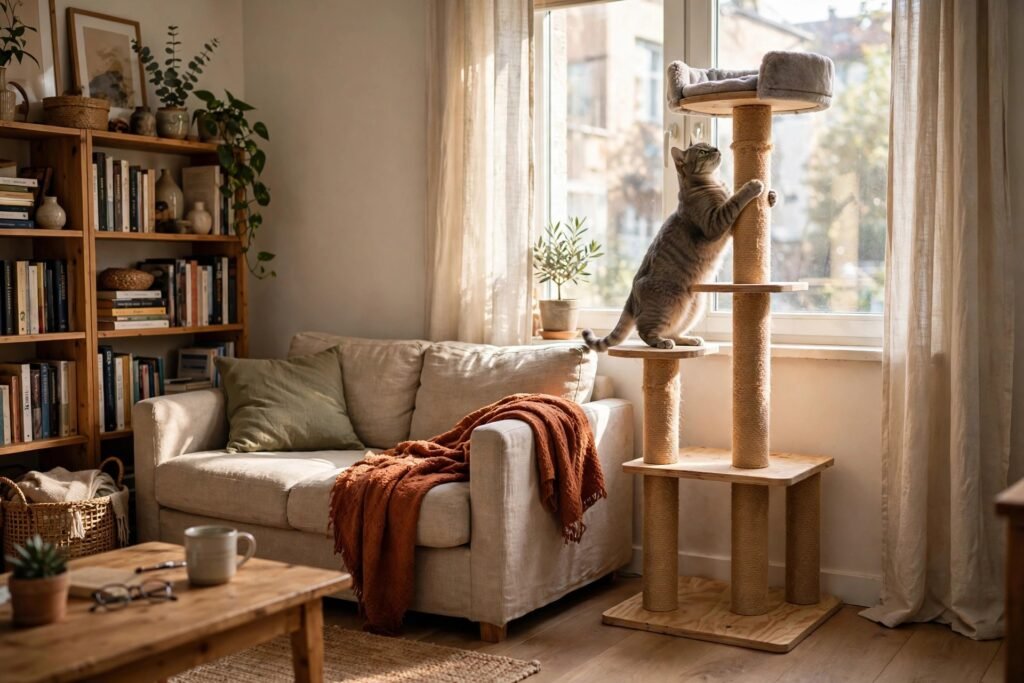
The honest trade-off in a small living room is floor space. A tall tree has a small footprint, but it is still a piece of furniture, and in a studio or a small one-bedroom it needs a spot where it can live permanently. Do not put it somewhere you will want to move every week — a tree that moves is a tree the cat has to re-approve, and some cats will not bother. Pick the spot once, put it there, and leave it.
The bedroom
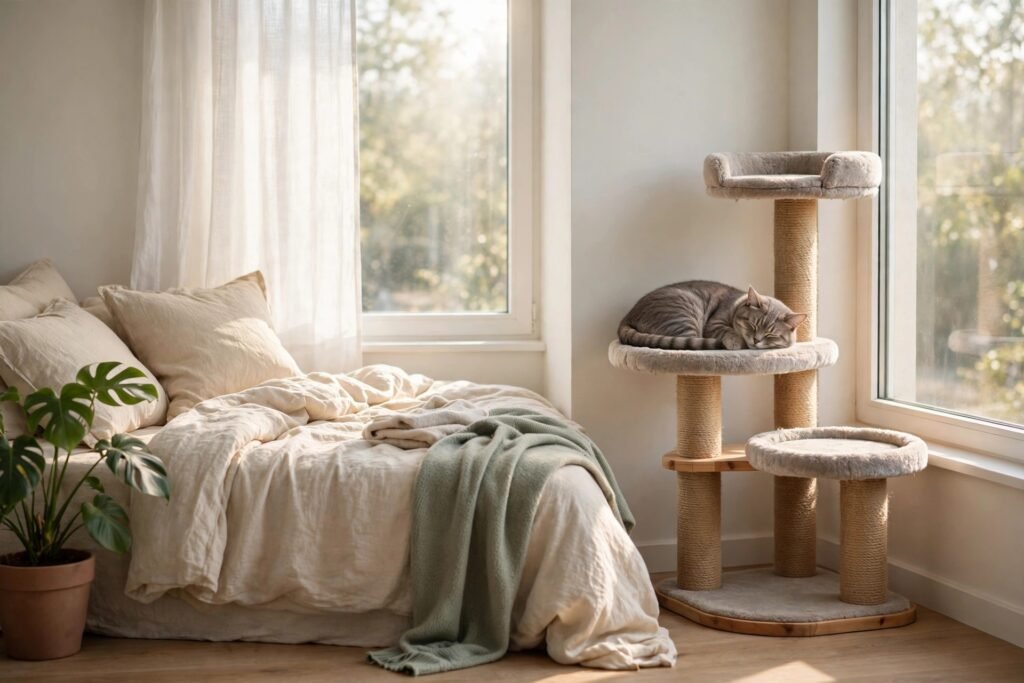
The bedroom works well for cats that sleep with their owners. A tree by the bedroom window gives the cat a night-time perch, and a cat that wakes at 3 a.m. has somewhere to go that is not your pillow. Keep the tree out of the doorway — a tree in the path to the bathroom is a tripping hazard at night — and keep it away from the headboard if it wobbles, because a wobbling tree next to a sleeping person is a bad combination. If the bedroom is small, a shorter tree or a window perch is a better fit than a full-height tower; the height matters less than the location.
Near the litter box? No
This is the question people ask most, and the answer is no. Cats do not like to eat, sleep, or play near their toilet, and a cat tree next to the litter box is a tree the cat will avoid. Keep the tree and the litter box in different areas — ideally different rooms, or at least opposite ends of the same room. The litter box has its own placement logic (quiet, ventilated, low-traffic), and our litter box placement guide covers it. The tree’s logic is the opposite: view, height, and company. Put them apart and both get used.
The hallway and the spare corner
Hallways and spare corners are the worst spots, and they are where most unused trees end up. A hallway has no view, no people, and no room for the cat to settle. A spare corner — the one behind the door, the one by the boiler, the one nobody walks past — has the same problem. Cats need two things from a high spot: something to look at, and an escape route. A corner gives them neither: they are boxed in, with one way down, and nothing to watch. If the only spot you have is a corner, it is better than no tree, but put the tree at an angle so the cat can see into the room, and give it a route down that does not cross the room’s traffic.
Where NOT to put it
A few spots are actively bad. Do not block a door — a tree in front of a door is a fire-safety problem and a tripping hazard. Do not put it in front of a radiator: the heat dries the materials and the cat will bake. Do not put it on a thick, wobbly rug: the base needs a firm, level floor, and a tree that rocks is a tree the cat will abandon after one wobble. Do not put it against a shared wall if it wobbles, because the vibration carries through the wall. Do not put it in a damp room or a bathroom: the materials absorb moisture and the cat will not want to sit there. And do not put it where it blocks the only window — the cat needs the window, and so do you.
Renter rules
Renters have one hard rule: no drilling. A cat tree should be freestanding — no wall fixings, no screws, no brackets. If the tree comes with an anti-tip strap, that strap is optional in a rental: it needs a wall to anchor to, and in a rented flat that is a hole in the wall you will have to fill. A heavy, wide base is the renter’s version of an anti-tip strap, and it is the thing to look for when you buy. Protect the floor under the base with a small mat or a felt pad, because a heavy tree on a hard floor can mark it, and on a carpet it can leave a dent that shows at move-out. And when moving day comes, the tree disassembles into flat pieces — keep the instructions, because a tree that cannot be taken apart is a tree that does not fit in the van.
Multi-cat homes
In a multi-cat home, placement is about territory, not just views. Two cats rarely share a single high perch happily, and a dominant cat can guard one tree and leave the other cat with nowhere high to go. The fix is spacing: two trees in different rooms, or one large tree with multiple perches at different heights so each cat has its own spot. Put the second tree where the second cat already spends time — not next to the first tree, where it becomes one territory, but in a different room, where it becomes a second territory. In a small apartment that can mean the living room and the bedroom, which is usually enough.
If the cat ignores the tree
If the cat ignores the tree, the placement is the first thing to fix, not the tree. Move it to the window, or to the room where the cat already sleeps. Put it where the cat already goes, not where you wish the cat would go. Sprinkle a little catnip on the top platform, or put a familiar blanket on it, so it smells like the cat’s own things. Do not pick the cat up and put it on the tree — a cat that is placed on a perch will jump straight off and decide the perch is not to be trusted. Let the cat discover it. Our how to get your cat to use a cat tree guide covers the full process, including the treats-and-patience method that works when placement alone is not enough.
How we researched this guide
We did not test cat trees for this guide — it is a placement guide, not a product roundup, and the advice here is drawn from cat behaviour (cats want height, a view, and an escape route), from the placement questions people actually ask, and from the gap we found on page one, where no dedicated apartment cat-tree placement guide exists and the results are generic or forum threads. For product-by-product picks, our live cat-tree roundups are the place to look — this guide is where the tree goes once you have it.
Frequently asked questions
Where should a cat tree be placed?
By a window, against a wall, in a room your cat already spends time in. The window gives the view, the wall gives stability, and the lived-in room gives company. Avoid dead corners, hallways, and anywhere the cat has only one way down.
What is the 3-3-3 rule with cats?
It is a rule of thumb from rescue and shelter practice for a cat settling into a new home: three days to decompress, three weeks to learn the routine, and three months to feel at home. It is a guide, not a scientific law, and it applies to a new cat or a new home. Placement matters during that settling period — a tree by the window in a room the cat already uses helps the cat feel at home faster than a tree in a corner nobody visits.
Should a cat tree go by the window?
Yes — the window is the best spot in the flat. The view is the main draw, and a cat on a high perch by a window will use the tree daily. Choose the window with the best view, keep the tree clear of the curtain track, and keep it out of direct all-day sun in summer.
Can I put a cat tree in the bedroom?
Yes, if your cat sleeps there. A tree by the bedroom window is a good night-time perch. Keep it out of the doorway and away from the headboard if it wobbles, and choose a shorter tree if the bedroom is small — the location matters more than the height.
Where is the best place to put cat litter in an apartment?
That is a litter question, not a tree question — but since people ask it alongside placement, the short answer is a quiet, ventilated, low-traffic spot, away from the cat’s food, water, and tree. Our litter box placement guide covers it in full, and the key point for this guide is to keep the tree and the litter box apart.
How do I get my cat to use the cat tree?
Move it to the window or to the room where the cat already sleeps, put a familiar blanket or a little catnip on the top platform, and let the cat discover it — do not pick the cat up and place it on the tree. Our how to get your cat to use a cat tree guide covers the full process.
Related reading
For the buying side, see our best cat tree for small apartments roundup. For the height question, our vertical space guide. For placement of the other things in your cat’s life, our scratching post placement and litter box placement guides. And if the cat ignores the tree once it is placed, our how to get your cat to use a cat tree guide is the next step.
Last updated: October 28, 2026
Pingback: Best No-Drill Cat Furniture Ideas for Renters 2027
Pingback: Studio Apartment Cat Layout Ideas 2027