
You know the sound. That rhythmic shhk-shhk-shhk from the living room, and your stomach drops
because you already know what you’ll find: fresh claw marks down the arm of the couch. The couch you saved up for. The couch your landlord will absolutely charge you for. If you’re wondering how to stop cat scratching couch damage without declawing, the answer is redirection, not punishment — and it works in apartments of any size.
Here’s the thing most guides won’t tell you straight: your cat is never going to stop scratching. Scratching is as built-in as purring. The goal isn’t zero scratching — it’s getting 100% of it onto something that isn’t your furniture. Every fix below is aimed at that one outcome, and they’re ordered the way they actually work in real apartments, not in theory.
How we chose what to recommend: we compared live listings and owner reviews across major pet retailers to find scratching solutions that consistently work for apartment cats. No paid placements, no sponsored picks — just what the research points to.
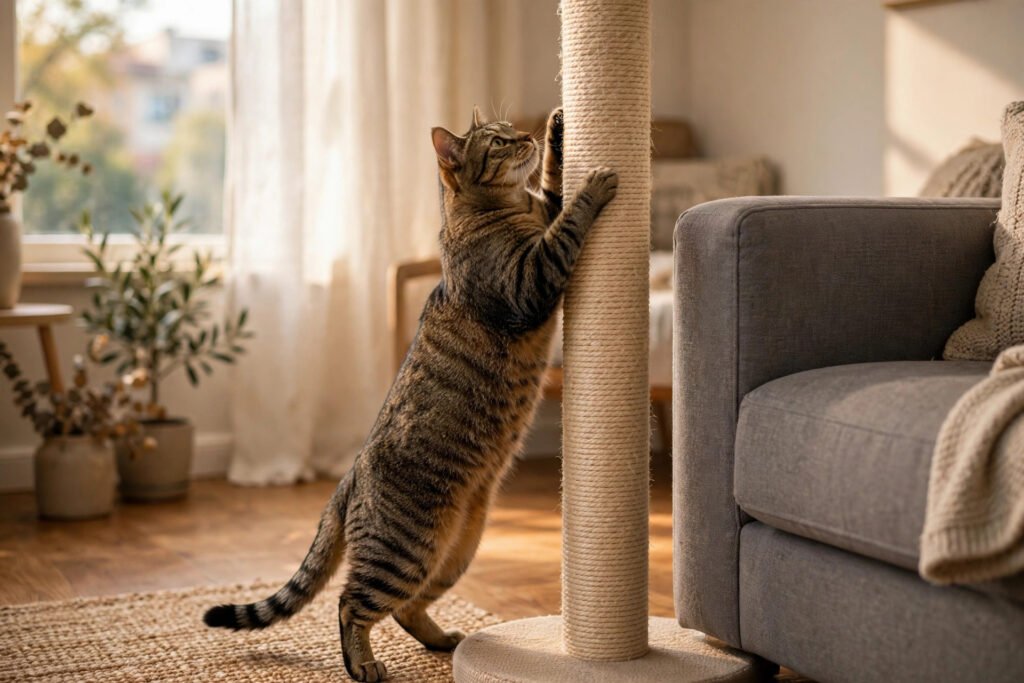
Fix 1: Understand what your cat is actually doing
Your cat isn’t scratching the couch out of spite, boredom with your decor choices, or some personal vendetta. Three instincts are firing at once:
- Claw maintenance. Cats shed the outer sheath of their claws by scratching. Skip this and the claws overgrow, curl, and hurt.
- Full-body stretching. Watch next time — the scratch is really a stretch. Shoulders, back, legs, all in one motion. It feels good.
- Territory marking. Paw pads carry scent glands. That couch arm is your cat’s way of putting a name tag on the most-used spot in the apartment.
This matters because it kills the most common mistake: trying to train the instinct out. You can’t. What you can do — and what every fix below does — is redirect the instinct onto a better surface. Work with the wiring, not against it. Still unsure which format to buy? Our scratching post vs pad vs tree comparison breaks down the pros and cons for apartment living.
Fix 2: Match the angle your cat already prefers
Before buying anything, spend two days just watching where the damage lands. Once you know the angle, match the format to it — vertical scratchers do best with a tall scratching post they can stretch up fully.
- Couch arms and door frames → your cat is a vertical scratcher. They want height and a good downward pull.
- Rugs, carpet edges, the corner where the rug meets the floor → horizontal scratcher. They like to plant their feet and rake forward.
- Both, or the sloped arm of a recliner → they want an angled surface.
This single observation decides whether your money works or burns. Most “my cat ignores the scratching post” stories end here: the owner bought a cute vertical post for a cat that has always been a horizontal rug-shredder. Get the angle right and you’re halfway done.
Fix 3: Put the new scratcher exactly where the crime happens
This is the fix people skip, and it’s the one that matters most. Cats are intensely location-loyal. Your cat scratches the left arm of the couch because that spot is the scratching spot in their mental map of the apartment.
So for the first one to two weeks, put the new scratching post touching the couch arm — right against it, in the exact spot being destroyed. Yes, it looks ridiculous. It’s temporary.
Once your cat is using the post reliably (usually 7–14 days), start moving it a few inches a day toward its permanent home. Most cats follow the post.
Apartment note: in a studio or one-bedroom, “permanent home” for a scratcher usually means within six feet of where it started. That’s fine. Cats don’t need the post in another zip code; they need it near the territory they’re marking.
Fix 4: Make the couch boring while the new habit forms
While the post earns its place, the couch needs to lose its appeal. You’re not protecting it forever — two to three weeks of deterrent is usually enough to break the location habit.
- Double-sided sticky tape (the pet-specific kind, or any wide double-sided tape) on the scratched areas. Cats hate the tacky feeling on their paws. It’s the single most effective deterrent in this list.
- A tightly tucked throw or furniture cover over the arms. Loose fabric is fun to knead and claw; drum-tight fabric is boring.
- Aluminum foil as a last resort. It works, but your living room will look like a baked potato for a fortnight. Guests will ask questions.
One honest warning: deterrents alone, without a good alternative scratcher in place, just move the scratching to the next piece of furniture. Fix 3 and Fix 4 are a pair. Never run one without the other.
Fix 5: Pick the right material — this is where most posts fail
Not all scratching surfaces are equal, and cats have strong opinions. Kittens in particular take to the right texture quickly — see our guide to the best scratching post for kittens if you’re starting young:
- Sisal rope (wrapped around a post): the gold standard for vertical scratchers. Rough enough to catch claws, tough enough to last. If you’re buying one thing, make it this.
- Corrugated cardboard: the favorite for horizontal scratchers. Cheap, replaceable, and cats go feral for it. The downside is the confetti — keep a hand vacuum nearby.
- Carpet-covered posts: avoid them. They teach the cat that carpet texture = scratchable, and then your actual carpet pays the price.
Also check stability. A wobbly post is a dead post — one tip-over and most cats never trust it again. In apartments, where floors are often slick laminate or tile, look for a wide, heavy base. For our full rundown of tall, wobble-free options, see the best cat scratching posts that actually save your furniture.
Fix 6: Redirect and reward — never punish
When you catch the couch scratch in progress, don’t yell, don’t clap aggressively, don’t reach for the spray bottle. All punishment teaches is “scratch when the human isn’t looking” — plus a cat that’s slightly afraid of you, which is a miserable trade.
Instead, keep a wand toy near the couch for two weeks. The moment claws hit fabric: lure the cat to the post with the toy, let them grab the sisal mid-play, then treat or praise the instant they scratch the right thing. You’re building an association — this surface gets the good stuff — and it works faster than most people expect, usually within days.
If boredom is the real driver, a proper play session helps — see our picks for the best interactive cat toys for indoor cats.
A pinch of dried catnip rubbed into the sisal (or a catnip spray) helps for the holdouts. About half of cats respond strongly to catnip; for the rest, a silvervine stick rubbed on the post does the same job.
Fix 7: Trim the nails — it reduces damage even before the behavior changes
Even a perfectly retrained cat has off days. Blunt nails turn those off days from “reupholstery” into “barely noticeable.”
Trim every 2–3 weeks, taking only the sharp curved tip — about 2mm. The pink part inside (the quick) has blood vessels; nicking it hurts and bleeds, so if you’re unsure, have a vet or groomer show you once. Most cats tolerate it fine if you do one paw per sitting and follow with a treat.
This won’t stop the scratching instinct at all — and it’s not supposed to. It’s damage control while Fixes 1–6 do the real work.
Fix 8: Consider nail caps if trimming isn’t enough
Soft vinyl nail caps glue over each claw and fall off naturally in 4–6 weeks as the nail sheds. Honest assessment:
- Pros: near-zero furniture damage; good for the training period or for households with leather furniture.
- Cons: some cats chew them off obsessively; application takes practice; they’re a recurring cost and chore.
They’re a bridge, not a lifestyle. Useful while a new scratcher habit forms. Not a substitute for giving the cat something proper to scratch.
Fix 9: Fix the boredom underneath the scratching
Here’s the pattern most owners miss: the cats that destroy furniture fastest are usually the under-stimulated ones. A cat with nothing to do all day has two hobbies — sleeping and shredding. Scratching is one of the classic signs your indoor cat is bored.
- One real play session a day, 10–15 minutes, with a wand toy that mimics prey (erratic movement, let them “catch” it sometimes). Evening sessions work best — they burn off the energy that becomes 3am couch attacks.
- Rotate toys instead of leaving all of them out. Five toys in a drawer, two out at a time, swap weekly. Novelty is free enrichment.
- A window perch gives a bored apartment cat a full-time job: bird watching. It’s the highest-value enrichment purchase for small spaces.
If the scratching is frantic, constant, and paired with other behavior changes (hiding, appetite shifts, over-grooming), that’s beyond this guide — talk to your vet. This guide covers furniture, not medical issues.
What NOT to do
- Don’t declaw. Declawing isn’t nail removal — it’s amputation of the last bone of each toe. It’s banned or condemned by veterinary bodies in many countries and US cities, and it frequently causes chronic pain and worse behavior problems. There is no version of this that’s worth it for furniture.
- Don’t use spray bottles or yelling as training. It doesn’t teach the right behavior, it just teaches fear and sneakiness.
- Don’t remove every scratchable surface hoping they’ll “learn.” A cat with zero legal scratching options doesn’t stop scratching. They just pick your most expensive remaining option.
Your 2-week quick-start plan
Week 1: Watch and note the angle (Fix 2). Buy a sturdy sisal post (or cardboard scratcher for horizontal cats). Put it touching the couch arm (Fix 3). Tape the couch (Fix 4).
Week 2: Redirect with play and treats every time (Fix 6). Rub catnip on the post. Trim nails (Fix 7). Once the post is getting daily use, start inching it toward its permanent spot.
Most households see the couch damage stop inside this window. The stragglers are usually a wrong-angle or wobbly-post problem — go back to Fix 2 and Fix 5 before assuming your cat is “untrainable.”

Frequently asked questions
Why does my cat scratch the couch even with a scratching post nearby?
Almost always one of three things: wrong angle (Fix 2), wrong spot (Fix 3 — the post is across the room from the territory being marked), or a wobbly/cheap post the cat doesn’t trust (Fix 5). Fix those before buying a second post.
Will my cat ever stop scratching furniture completely?
Honest answer: the instinct never goes away, and it shouldn’t — it’s healthy. What goes away is the furniture part. A cat with a good scratcher in the right spot, rewarded for using it, will choose the post over the couch. That’s the realistic win.
Does vinegar or citrus spray stop cats from scratching?
Evidence is thin and mostly anecdotal. Some cats dislike the smell for a day or two, then scratch right through it. Don’t build your strategy on scents — build it on a better scratcher in a better spot.
How long does retraining usually take?
Two to four weeks for most cats, with the first visible shift often inside the first week. Kittens learn fastest; senior cats set in their ways can take six weeks. Consistency matters more than speed.
Keep going
Keep your sofa safe: corner cat scratchers that hug couch corners or sofa-shaped scratchers that give your cat its own couch.
>
Browse all scratching guides: scratching guides
>
Last updated: October 2, 2026
Pingback: 7 Best Cat Scratching Posts That Actually Save Your Furniture
Pingback: Cat Scratching Post vs Pad vs Tree: Which Does Your Cat Need?
Pingback: Best Scratching Post for Kittens: 7 Picks to Start Good Habits Early 2027
Pingback: Best Corner Cat Scratchers for Couches and Apartments 2027 - Velvnox
Pingback: Wall Cat Scratcher: 7 Best for Apartments 2027
Pingback: Best Cat Scratcher Couch Picks for 2027
Pingback: Best Sisal Scratching Mat to Protect Couch 2027