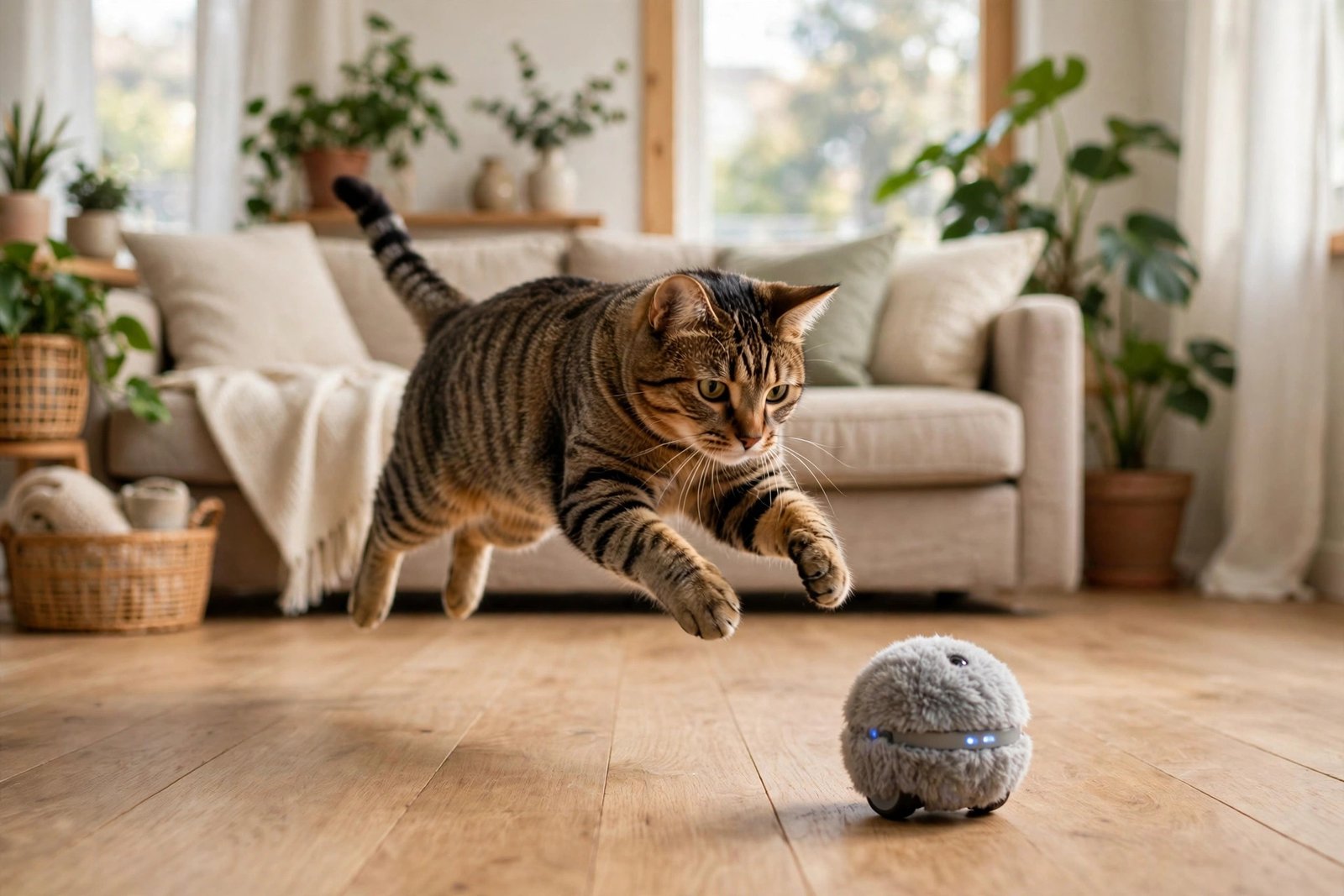
You lock the door, your cat watches you leave, and eight hours later you come home to a furball who’s been napping, staring at the wall, and plotting. The best automatic cat toys for when you’re at work exist precisely for this gap: toys that move, chirp, or flutter on their own, no human required.
These aren’t wand toys that demand your arm. They’re motion-activated balls, self-waking birds, and concealed-motion toys designed to run while you’re at your desk — most with timers, rest cycles, or motion sensors so play happens in healthy bursts instead of one chaotic marathon. We researched and compared seven of them, with honest notes on battery life, noise for thin walls, and what they can’t do.
| Award | Product | Why it stands out | Check Price |
|---|---|---|---|
| Best overall | Cheerble Wicked Ball Duo2 Bird Chirping | 2-in-1 smart core, obstacle avoidance, play-and-rest cycles | Check Price on Chewy |
| Best wall-mounted | PAWSPIK Peek & Play | Hangs on a door, wand hunts between fabric layers | Check Price on Chewy |
| Best for laser chasers | YVE LIFE Automatic Motion Activated Laser | Motion sensor fires 15-minute sessions, sleeps between | Check Price on Chewy |
| Best quiet motor | PET FIT FOR LIFE Flapping Bird | USB rechargeable, tap-to-switch modes, soft-sounding motor | Check Price on Chewy |
| Best budget | FRISCO Interactive Flopping Fish | Touch-activated flopping, no sound chip, Chewy’s own brand | Check Price on Chewy |
| Best hanging solo toy | SmartyKat Twirly Tail | Door-mounted twirling teaser with 10-minute auto shutoff | Check Price on Chewy |
| Best motion-reactivated toy | PAWSPIK Spinning Feather Chick | Every paw tap wakes it back up, rolling design never tips over | Check Price on Chewy |
Best overall: Cheerble Wicked Ball Duo2 Bird Chirping

The Wicked Ball Duo2 is the closest thing to a playmate in a box. One smart core powers two game modes — a rolling ball shell and a spinning-top shell — and the ball senses your cat’s touch, then rolls, bounces, and chirps with built-in bird sounds. Automatic obstacle avoidance steers it away from furniture legs and corners instead of dying under the couch at 10 a.m.
The part that suits workday hours best is the play-and-rest rhythm: roughly 10-minute play bursts, then a 30-minute nap before it’s available again — mirroring how cats actually hunt. Per charge you get somewhere around 40 to 110 minutes of active play, so think enrichment shift, not all-day babysitter. Set it down charged in the morning and it holds the early hours, when many cats are most restless.
Honest drawbacks: the Chewy listing carries a 4.6-out-of-5 rating but only 27 reviews, so the verdict is thin. One reviewer’s note that the shell pieces are “a little tough to change out” rings true for anything with swappable parts, and you’d wish for a bit more runtime between charges. The bird chirps are a feature for most cats — and a consideration if your walls are paper-thin.
Apartment scorecard: Footprint: tiny (rolling shell about 2.8 in long) · Noise: motor whir plus built-in bird chirps — audible, not silent · Installation: none, charge via USB-C and set it down · Rental-friendly: yes · Best room: living room floor, away from bedroom doors
Best wall-mounted: PAWSPIK Peek & Play

This one earns its spot by staying out of the way. The Peek & Play is a fabric panel that hangs on a doorknob (or mounts with an adhesive back) with an electronic wand that moves randomly between two layers of fabric, peeking out and disappearing. It chirps like a bird, which pulls cats in from across the room.
For apartments, a door-mounted toy has a real edge: zero floor space, nothing to trip over, and the motion stays in one spot instead of roaming under the fridge. It ships with two green wands and attaches without tools — a two-minute setup before you leave for work.
Honest drawbacks: the 5-out-of-5 rating rests on a small review base (about two dozen reviews) — promising, not proven. The adhesive mount is a caveat in a rental; door hanging is the damage-free route, and sticky backs can pull paint on cheap finishes. And the bird chirps that make it exciting are the same ones a neighbor might hear through a thin wall — one reviewer took it away at night because their cat got obsessed.
Apartment scorecard: Footprint: zero floor space — hangs flat on a door · Noise: bird chirps, audible · Installation: hang on doorknob or adhesive mount, no tools · Rental-friendly: yes via doorknob; adhesive mount could mark paint · Best room: bedroom or hallway door
Best for laser chasers: YVE LIFE Automatic Motion Activated Laser
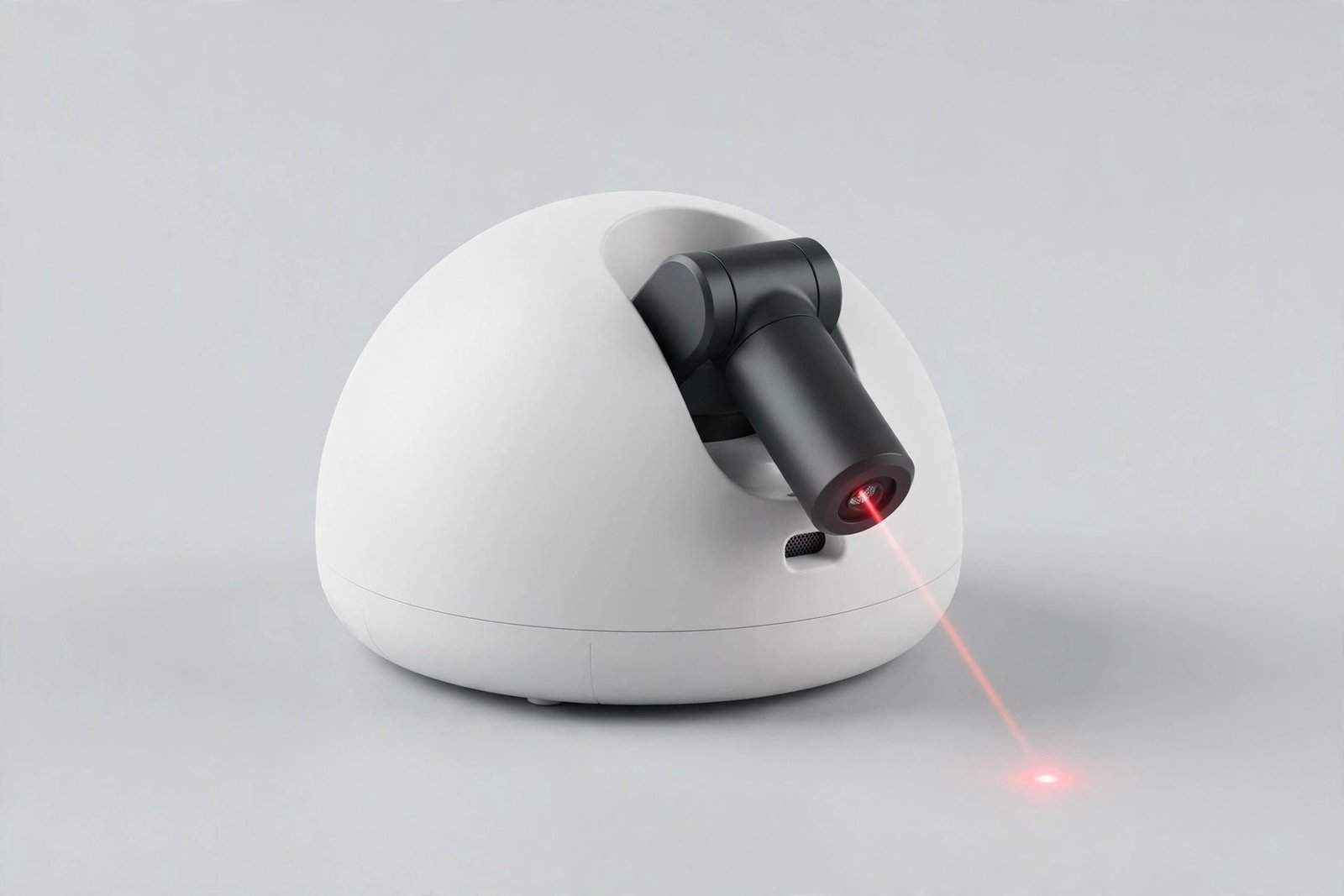
If your cat is the type that would chase a red dot off a cliff, this is the workday version. The YVE LIFE sits on the floor and projects genuinely random laser paths — not the same tired circle cheap auto-lasers draw. A motion sensor fires a 15-minute session whenever your cat walks up, then it sleeps and wakes again later, roughly on a two-hour cycle.
Three speed modes (fast, slow, mixed) match the dot to your cat’s energy, and the head tilts and sweeps so the dot dances across floor and wall. The 1200mAh battery recharges over USB, and it can run continuously plugged in — park it near an outlet and the dead-battery-by-noon problem disappears.
Honest drawbacks: no rating surfaced for this listing, so you’re buying on specs, not crowd verdicts. And the standard laser caveat applies double when you’re not home: lasers are light, not prey, so your cat never gets the satisfaction of a catch. Leave a tangible toy or treat puzzle nearby so sessions end with something real — and give it clear floor space, because the dot is only as good as the surface it lands on.
Apartment scorecard: Footprint: small dome on the floor · Noise: not specified — expect near-silent electronics · Installation: none; USB rechargeable, optional always-plugged setup · Rental-friendly: yes · Best room: living room with clear floor or bare wall
Best quiet motor: PET FIT FOR LIFE Flapping Bird
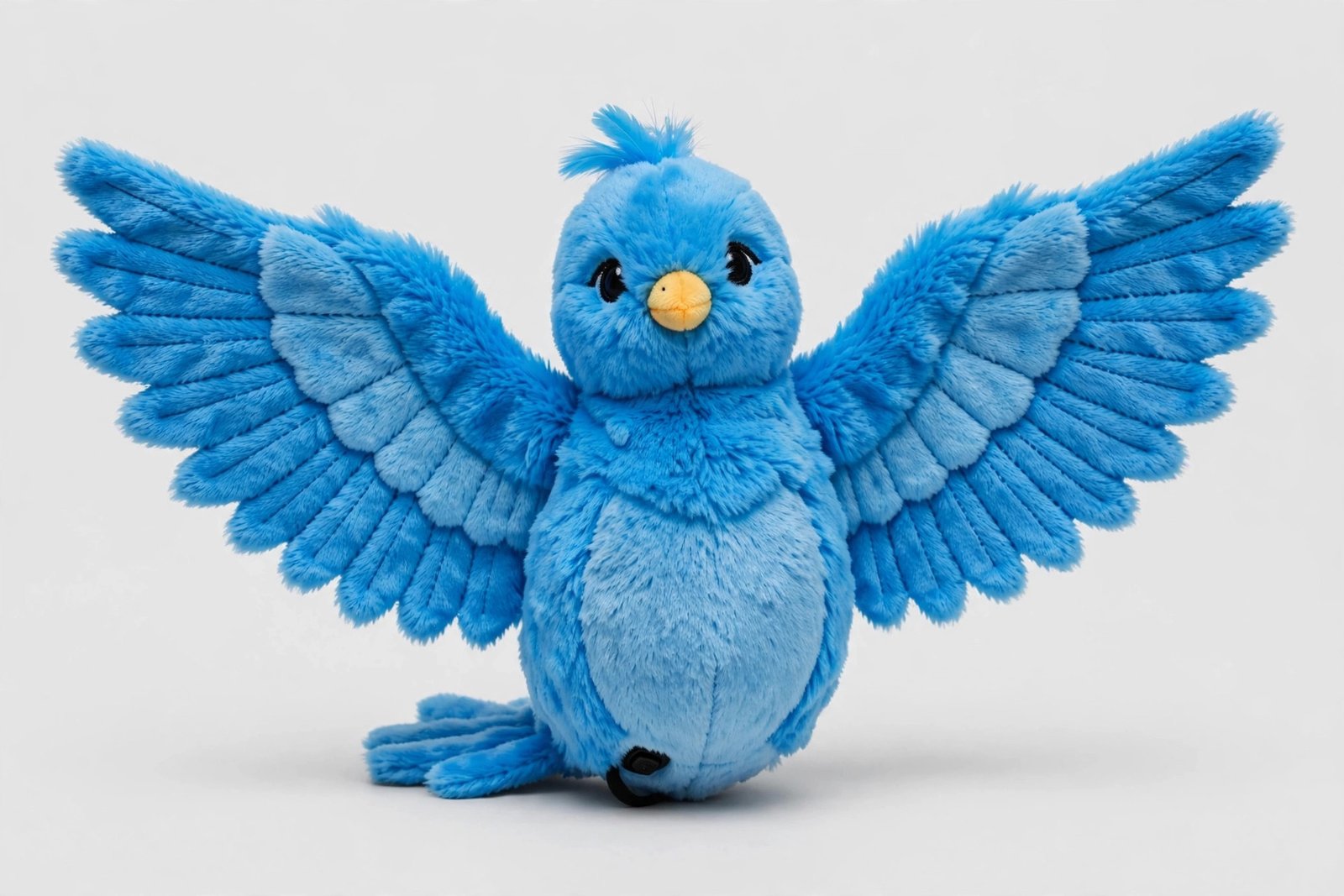
Flapping-bird toys are cat magnets, and this one is the least obnoxious we’ve found for shared-wall living. Tap the bird to cycle through three movement modes, and the listing describes the motor as quiet — realistically, expect a soft mechanical hum rather than silence.
It’s USB rechargeable, so there’s no battery drawer to fuss with and no ongoing battery cost — a real plus for daily use. And with 1,658 ratings behind a 3.4-out-of-5 score, this is the most-reviewed toy on our list, which makes the middling rating itself useful information: plenty of cats love it, and plenty of owners found something to complain about.
Honest drawbacks: that 3.4 suggests durability and habituation complaints are common — skim the critical reviews before buying. Flapping motion can also startle a timid cat on day one; introduce it powered off, then let the cat discover it moving before you trust it to a full workday.
Apartment scorecard: Footprint: single plush bird, toss-and-go · Noise: soft mechanical hum per listing — among the quieter options · Installation: none, charge via USB · Rental-friendly: yes · Best room: anywhere; soft enough for the bedroom
Best budget: FRISCO Interactive Flopping Fish

Chewy’s own Frisco brand makes this touch-activated flopping fish, and it’s the cheapest way into the category. Bat it and it flops with unpredictable motion; leave it alone and it rests. A Chewy Q&A describes it as flopping “without sound” — no chirp or squeak chip, just the flop — which makes it genuinely apartment-friendly if noise is your main worry.
At 3.8 out of 5 across 1,409 ratings with catnip included, it’s a solid budget workhorse — and for a first automatic toy, the kind you buy to learn whether your cat even cares about self-play, the price-to-experiment ratio is hard to beat.
Honest drawbacks: the battery is built in and non-replaceable. You charge it with a 5V source for at least 90 minutes, and when the battery eventually degrades, the fish is done — Chewy confirms no replacement parts exist. Some reviewers report their cats ignored it completely: the eternal risk of any flopping toy is that the motion is either fascinating or furniture.
Apartment scorecard: Footprint: single plush fish · Noise: no sound chip — just the flop · Installation: none, rechargeable · Rental-friendly: yes · Best room: living room or hallway
Best hanging solo toy: SmartyKat Twirly Tail
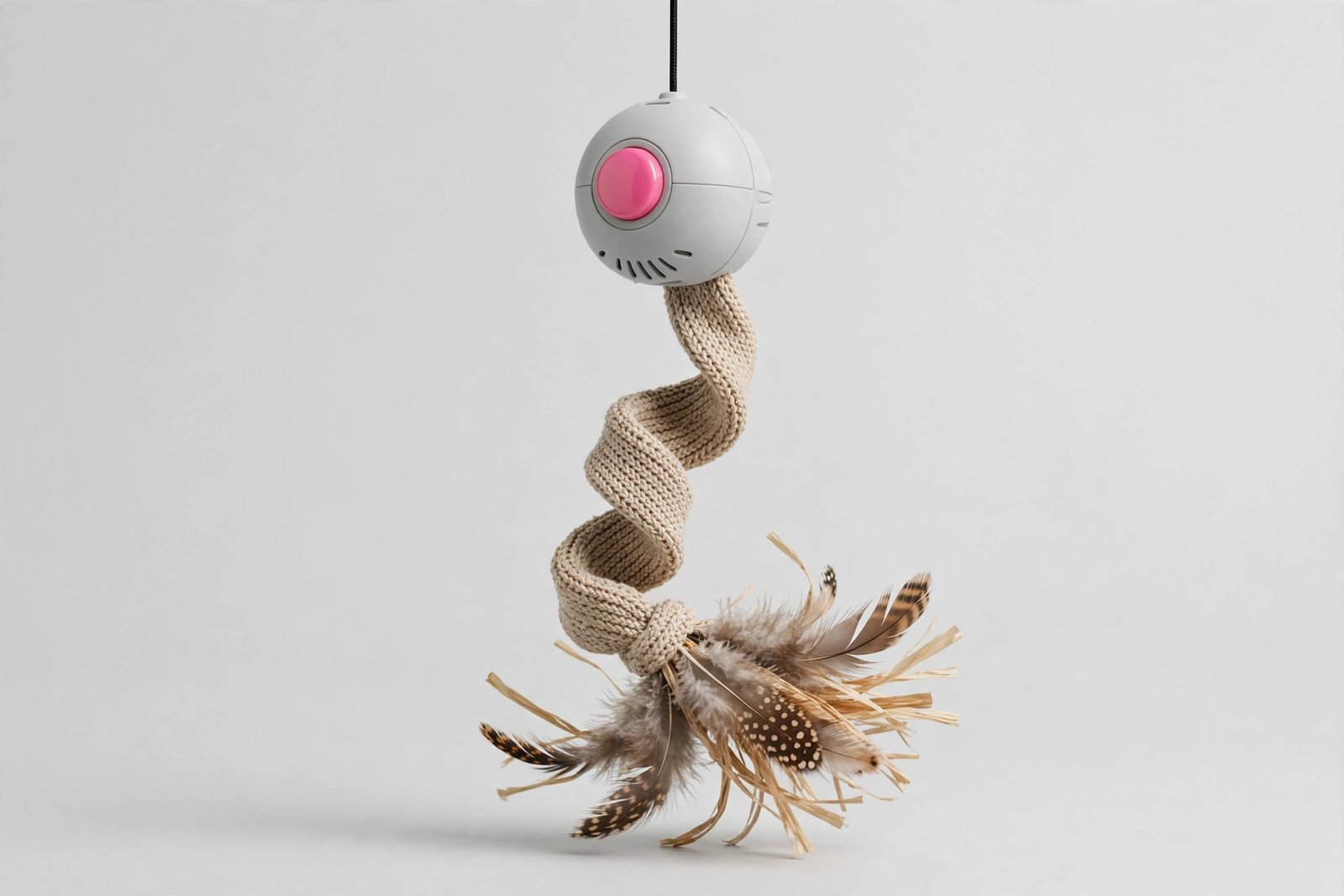
The Twirly Tail solves a different problem than floor toys: it hangs on a doorknob. Press the button before you leave, and the long stretchy knit tail — feathers and raffia included — twirls and spins in random patterns at cat height. An automatic 10-minute shutoff kills the session so it doesn’t drain itself by 9:30 a.m.
Door-mounted toys are brilliant for small apartments because the play zone is vertical — nothing rolling into the kitchen, nothing to fish out from under the bed later. SmartyKat includes the replaceable batteries, and the brand designs to child safety standards, which is reassuring for a toy that runs while nobody’s watching.
Honest drawbacks: it runs on disposable batteries rather than USB charging, so factor in an ongoing battery cost for daily use. No rating surfaced for this listing, so there’s less crowd wisdom to lean on. And like any feather toy left unsupervised, the tail needs a weekly inspection — retire it if feathers or raffia start coming loose.
Apartment scorecard: Footprint: zero floor space — hangs on a doorknob · Noise: small electronic motor — expect a soft whir (mechanism-based, not measured) · Installation: hang on doorknob, press button · Rental-friendly: yes · Best room: any interior door the cat hangs around
Best motion-reactivated toy: PAWSPIK Spinning Feather Chick
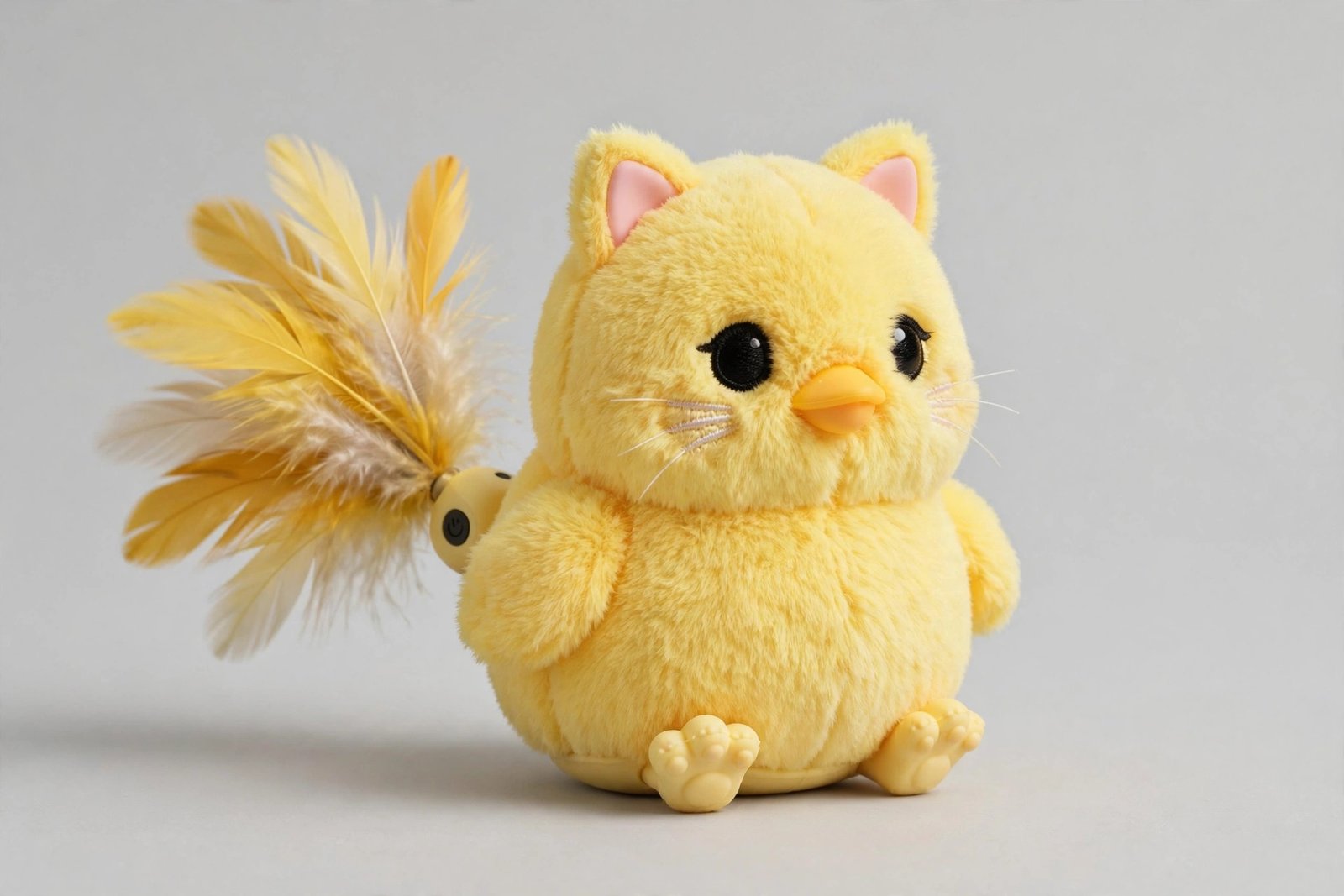
The Spinning Feather Chick is built for the cat who loses interest the moment a toy goes still. Its feather tail spins, wags, and shakes in unpredictable patterns — and the moment your cat bats it, a built-in motion sensor fires it right back up. It’s the closest any toy on this list gets to being “always on” during the hours it holds charge.
The rolling design is a thoughtful detail: it rights itself instead of tipping over or wedging under furniture. The silicone and feather construction is built for rough play, and USB recharging keeps the running cost at zero.
Honest drawbacks: do the runtime math — up to 2 hours of continuous play per charge against an 8-hour workday means a nightly charging habit to cover the full shift. No rating surfaced, so the crowd verdict is missing. And assume it’s audible: small motors like this are never truly silent, so thin-wall households should treat it like the other electronic picks here.
Apartment scorecard: Footprint: small rolling plush · Noise: small-motor electronic — assume audible (not measured) · Installation: none, USB rechargeable · Rental-friendly: yes · Best room: living room floor
What “automatic” really means (and its limits)
“Automatic” covers three different trigger styles, and knowing which one you’re buying saves disappointment. Motion-sensor toys wake when your cat walks up — best for shy cats, since the toy waits for them. Tap-activated toys fire when batted and rest between — best for battery life and for cats who like to start the game themselves. Timer-based toys run on play-and-rest cycles regardless — best for predictable routine, worst if your cat naps through the “play” window.
The honest limit: no automatic toy replaces you, and no toy is 100% unsupervised-safe. These are enrichment tools for the hours you’re gone, not babysitters. Set expectations around burst play — 10 to 15 minutes at a time with rest cycles — because that’s how cats actually hunt, and it’s how every well-designed toy on this list behaves.
Supervision rules for workday toys
Before any of these runs while you’re out, run through this checklist. First, inspect the toy: no loose feathers, strings, or dangling parts your cat could chew off. Battery compartments should be screwed shut — if the cover is loose, tape isn’t a fix; retire the toy. Second, match the toy to your cat: aggressive chewers shouldn’t get unsupervised access to plush electronic toys, and timid cats deserve a powered-off introduction first.
Third, set the room up: clear the play zone of cords and small objects, and never point laser toys where the beam could catch eyes — human or feline. Fourth, rotate. Two or three toys in circulation beat seven out at once; cats habituate fast, and a toy that disappears for a week comes back as a novelty. These are practical ground rules, not veterinary advice — when in doubt about a specific toy and your cat, ask your vet.
How we picked
We researched listings across Chewy, compared specs, ratings, and review counts, and filtered for one specific job: self-play toys that genuinely run while the owner is at work. Every pick had to have a real automatic trigger — motion sensor, tap activation, or a play-and-rest cycle — not just a toy you could theoretically leave on the floor.
We prioritized apartment realities: noise character, footprint, and whether the toy needs installation a renter can’t do. We flagged thin or missing ratings instead of hiding them, and called out battery math honestly — a toy that runs two hours per charge doesn’t cover an eight-hour shift without a charging habit. No paid placements, no sponsored picks, no hands-on testing, and no veterinary claims. What you see is what the listings and reviewers say.
Buying guide
Trigger types: motion sensor vs tap vs timer
Motion sensors wake the toy when your cat approaches — ideal for the workday because the toy conserves energy while your cat naps and comes alive when they prowl. Tap-activated toys need a first bat to start, which suits bold cats but can leave shy cats staring at a dead toy. Timer-based toys run cycles on schedule, predictable but indifferent to whether your cat is actually awake. For a full workday, motion-sensor and tap-reactivated designs stretch battery life furthest.
Battery vs USB rechargeable
USB rechargeable toys cost nothing to run and charge overnight like your phone — but they have a hard runtime limit, and a forgotten charge means a dead toy all day. Battery-powered toys (AA or AAA) run longer between attention but create a steady battery bill and the environmental weight of disposables. Our rule of thumb: if the toy gets daily use, rechargeable wins on cost within a month or two; if it’s an occasional toy, batteries are simpler.
Noise for thin walls
Electronic toys make noise — motors whir, chirps chirp, feathers swish. In a concrete building, none of this matters. In a thin-walled apartment, it matters a lot, and not just for you: a toy that chirps every 20 minutes can become your downstairs neighbor’s least favorite thing. Prefer toys with no sound chip (like the Frisco flopping fish) or quiet-motor designs (like the PET FIT FOR LIFE bird) if your walls are thin, and keep the louder, chirpier picks in rooms farthest from shared walls.
Auto shut-off and play cycles
This is the feature that separates real workday toys from battery vampires. Look for a stated auto shut-off — 10 or 15 minutes — and ideally a play-and-rest rhythm that mimics natural hunting bursts. A toy with no shutoff will either drain itself by mid-morning or overstimulate a cat that can’t switch it off. If the listing doesn’t mention shutoff, assume it doesn’t have one.
FAQ
Can I really leave these running while I’m at work?
Yes, with the caveat that “automatic” doesn’t mean “worry-free.” Choose toys with auto shut-off, inspect them weekly for loose parts, and match the toy to your cat’s chewing habits. Most owners run them on workdays without incident — but nothing replaces checking the toy when you get home.
Will my cat get bored of an automatic toy?
Probably, eventually — cats habituate to anything predictable. The fix is rotation: keep two or three automatic toys in circulation and swap weekly, and prefer random or motion-reactive patterns over toys that repeat the same loop. A toy that “sleeps” and wakes unpredictably holds interest longer than one that never stops.
Are automatic toys loud enough to bother neighbors?
Some can be. Chirping and squeaking toys are the main offenders; plain motorized motion is usually no louder than a phone vibrating on a table. If you share thin walls, lean toward sound-free designs and keep electronic toys away from the bedroom side of shared walls. When in doubt, run the toy yourself one evening and listen from the next room.
Battery or rechargeable — which is better for a workday?
Rechargeable for daily drivers: zero running cost, and an overnight charge habit covers the shift. Batteries for occasional-use toys: longer shelf readiness, no charging routine, but a real ongoing cost. Either way, check the runtime math — a 2-hour-per-charge toy needs help (a second toy, a timed routine) to cover a full 8-hour day.
Are laser toys okay to leave on unsupervised?
Motion-activated lasers with auto shut-off are designed for exactly this, and the YVE LIFE-style 15-minute sessions with rest periods are the right pattern. Just give the toy clear floor or wall space, never position it where the beam could hit eyes, and leave a tangible toy nearby so your cat’s session can end with a real catch.
What should I do with the toys when I get home?
Quick inspection: check feathers, tails, and battery doors for wear, then either rotate the toy out or leave the favorite in place. And give your cat five minutes of real play yourself — automatic toys cover the hours you’re gone, but the evening session with you is still the highlight of their day.
Related reading
For the other half of playtime — toys you play with your cat — see our parent guide: Best Interactive Cat Toys for Indoor Cats 2027. Wand teasers, ball tracks, and flopping fish that turn your evening into the main event.
Not sure your cat even needs more stimulation? Signs Your Indoor Cat Is Bored walks through the behaviors — from 3 a.m. zoomies to curtain climbing — that mean it’s time to upgrade the toy box.
Last updated: October 9, 2026
Pingback: Best Feather Wand Toys for Cats 2027