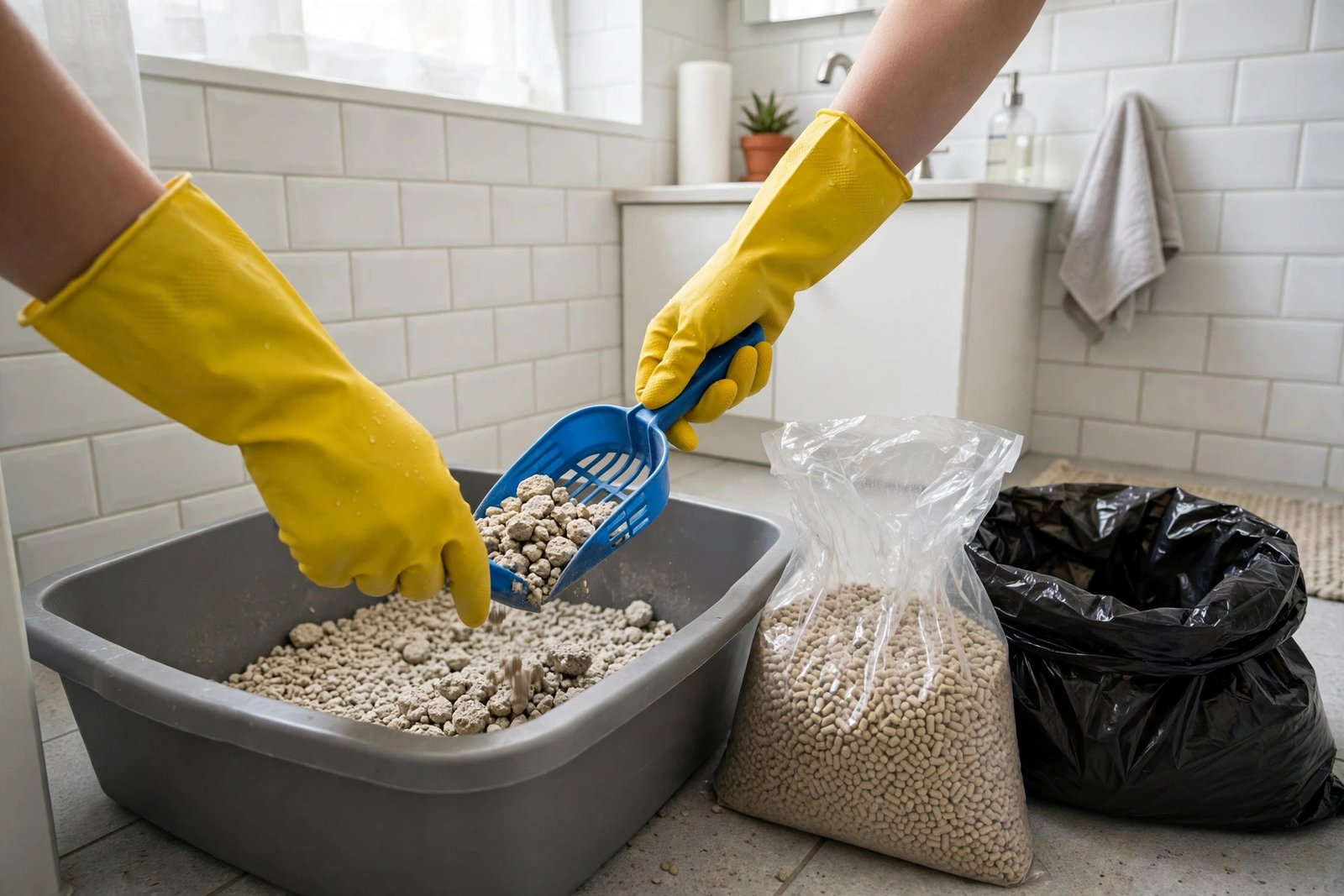
How often to change cat litter in a small apartment has a short answer and an honest answer. The short answer: scoop daily, and do a full litter change every one to four weeks depending on the litter type. The honest answer: in a small apartment, odor concentrates — the same box that smells like nothing in a house smells like something in a studio — so the cadence that works in a big house fails in a small space, and most guides never say that. This article gives the real schedule: the non-negotiable daily scoop, the full-change cadence by litter type, the multi-cat math, and the box-WASH cadence that most guides skip entirely. No testing claims, no paid placements — just the maintenance schedule that keeps a small apartment livable.
The short answer
Scoop every day — non-negotiable, say it plainly, no exceptions. A day’s waste in a small apartment is an evening’s smell; there is no version of this where skipping works. Full litter change (dump everything, wash the box, refill fresh): for clumping litter, every 2–4 weeks with daily scooping; for non-clumping litter, every 1–2 weeks; for crystal litter, roughly every 3–4 weeks per the manufacturer’s guidance, with solids scooped and the crystals stirred. These are ranges, not lab data — the real schedule depends on the number of cats, the number of boxes, and the size of the space. The sections below tune it.
The litter-type frequency table
| Litter type | Scoop | Full change | Small-apartment note |
|---|---|---|---|
| Clumping clay | Daily | Every 2–4 weeks | The default; dustiest option — ventilation matters |
| Non-clumping clay | Daily (solids) | Every 1–2 weeks | Urine stays in the box — shortest change cycle |
| Crystal/silica | Solids daily; stir crystals | Every 3–4 weeks | Longest cycle, but saturated crystals smell sharply — do not stretch it |
| Natural (wood, paper, corn, walnut) | Daily | Every 1–3 weeks by type | Varies most by brand — follow the bag, then adjust by smell |
Why small apartments are different
Odor concentration is the physics nobody puts on the bag. The same box, the same cat, the same litter produces the same amount of odor molecules — but in 500 square feet those molecules have nowhere to go, while in 2,000 square feet they disperse. The practical consequence: the change cadence that a house gets away with fails in an apartment, and the failure shows up as the faint background smell you stop noticing and guests notice immediately. The rule of thumb: in a small apartment, use the SHORTER end of every range in the table above. If clumping litter says 2–4 weeks, you are a 2-week household. Ventilation helps — a bathroom fan run during and after scooping, a cracked window when weather allows — but ventilation is a supplement to cadence, not a substitute for it.
The multi-cat math
The standard guidance is n+1 boxes: one per cat, plus one. In a small apartment that math collides with floor space, and many two-cat apartments run two boxes or even one — which changes the change cadence directly. The honest formula: divide the single-cat full-change interval by the number of cats using the box, roughly. One cat on clumping litter at 2–4 weeks becomes two cats at 1–2 weeks on the same box. Scooping goes from daily to twice daily — morning and evening — because two cats’ waste in a small space is a smell by dinnertime. If you cannot fit n+1 boxes, you pay for it in cadence; there is no way around the arithmetic, only the schedule. And the box-WASH cadence below matters more with every cat you add.
The box-wash cadence (the thing most guides skip)
Changing the litter is not cleaning the box. Urine residue films the box walls and floor over time — especially on scratched plastic, where micro-grooves harbor odor that survives a litter change. The wash cadence: scrub the empty box with mild soap and water every full litter change — which means every 2–4 weeks for most households, every 1–2 for multi-cat or non-clumping setups. No harsh chemicals, no strong fragrances (cats reject perfumed boxes); mild dish soap, thorough rinse, complete dry before refilling. This is the step that separates the apartments that smell like nothing from the ones with the mysterious background odor nobody can source. The box is the source. Wash it on the litter-change schedule, every time, not when you remember.
Signs you are waiting too long
The cat tells you before the schedule does. Going outside the box is the big one — a cat that has used the box reliably and starts going beside it is usually protesting the box’s condition, not the box’s location. Perching on the edge to avoid touching the litter is the early warning of the same complaint. Ammonia smell when you walk in means you are already late — if you can smell it fresh off the street, the change was due days ago. Clumps breaking apart in clumping litter means the litter is saturated and done. And the guest test: if you have stopped noticing and a visitor mentions it, the cadence has been wrong for a while. Adjust to the shorter interval and hold it for a month before deciding it was unnecessary.
Related reading
For the odor-reduction companion to this schedule — what actually controls smell between changes — see how to reduce litter box smell in a small apartment. For choosing the litter itself, see the best cat litters for odor control.
Last updated: October 19, 2026
Pingback: How to Fix Litter Box Smell in Small Apartment