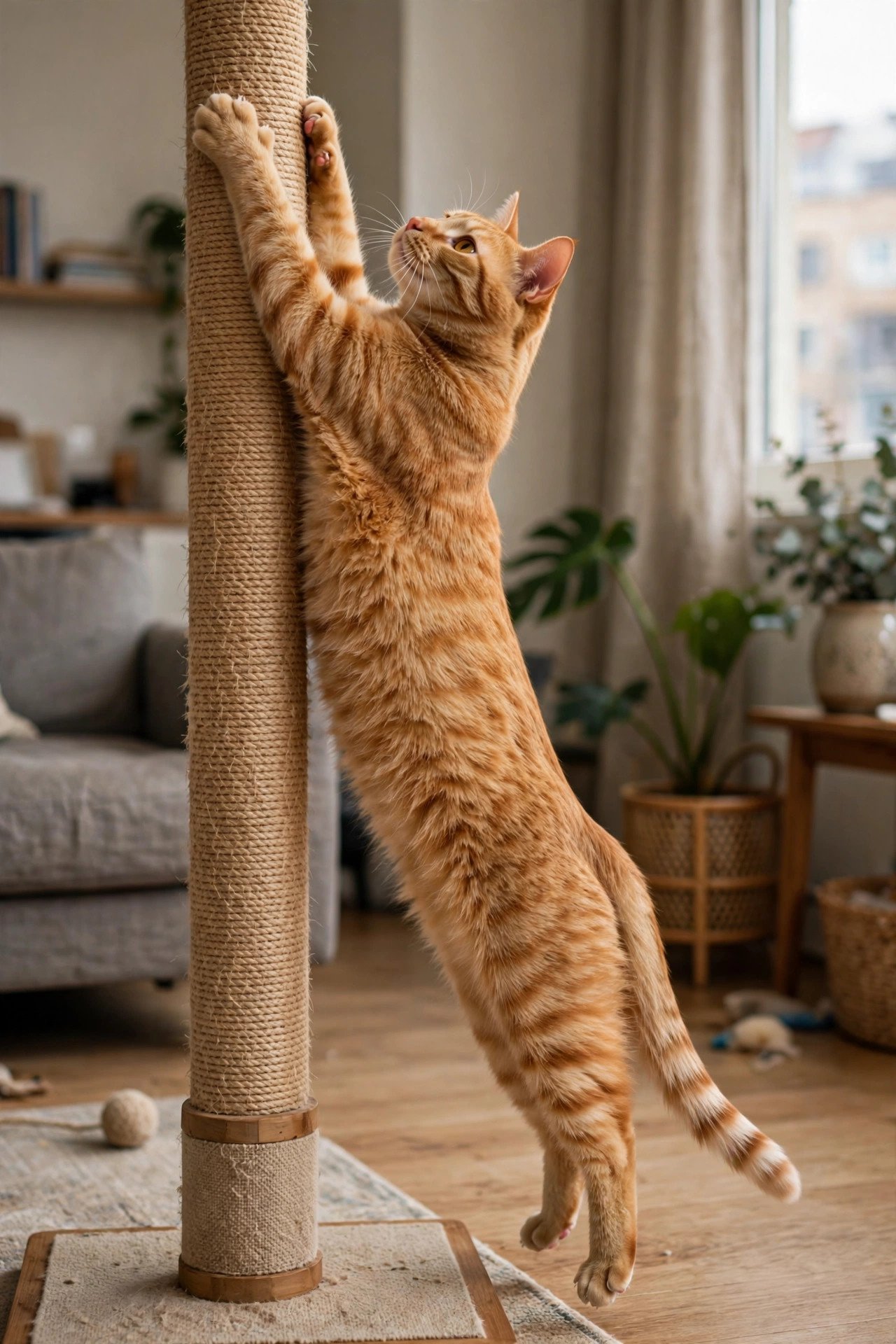
There is a reason so many scratching posts gather dust while the couch keeps getting shredded, and it is not always placement or fabric. A surprising number of posts are simply too short. Cats scratch to stretch — the full-body extension, front paws reaching high, spine and shoulders elongated — and a post that prevents that stretch gets ignored, no matter how well you positioned it. If you are asking how tall should a cat scratching post be, the honest answer starts with your own cat, not a generic number. But the expert-cited numbers do exist, they cluster tightly, and most posts sold in big-box stores sit below them. Here are the real heights, by cat size, plus the measurement trick that settles it for any individual cat.
Before you measure: height only matters if the post is stable. A tall post on a tippy base is worse than a short one, because one fall is usually enough to make a cat reject the post for good. When you are ready to shop, start with a scratching post with a heavy base — the Day-51 picks are filtered for exactly the tall-and-stable combination this guide calls for. For cats that only scratch sideways, our post vs pad vs tree comparison will tell you whether height matters at all.
The stretch test: how to measure your cat
The gold standard comes from Cats International: a post should be as tall as your cat when fully stretched out, plus a few inches. That is the whole test — it works for a kitten, an average adult, and a Maine Coon, and it beats any generic chart because your cat’s body is the actual requirement.
Here is how to do it at home. Catch your cat mid-stretch against a wall or a door frame — or encourage one with a wand toy held high so the cat reaches up for it. Note (or mark, with a sticky note) the highest point the front paws reach. Then add a few inches on top. That number is your minimum usable post height for a vertical scratcher. Anything shorter forces the cat to hunch, and a hunched scratch is a scratch the cat would rather do on your taller, sturdier couch arm. This is practical guidance distilled from behaviorist sources, not a published laboratory protocol — but it is the method the expert numbers below are built on.

Height numbers by cat size
Not everyone wants to run a measurement experiment before shopping, so here are the sourced benchmarks. The expert consensus for average adults is remarkably tight.
Average adult cat (about 8–10 pounds)
32 inches or taller is the recommendation from the Humane Society and from veterinary behaviorist Dr. Cutler, widely cited in PureWow’s scratching-post coverage. At least 36 inches (three feet) is the call from certified cat behaviorist Dr. Mikel Delgado, also via PureWow. Shelter and manufacturer guidance mostly lands in between: HAWS (Humane Animal Welfare Society) says at least 30 inches for full-body stretching, and one buying-guide survey puts the average adult post at 30–35 inches. A UK DIY guide notes most adult cats prefer 90–110 cm (roughly 35–43 inches), which sits at the tall end of the same consensus.
One outlier to know about: a UK retailer guide (petz.uk) lists 65–70 cm — about 26–28 inches — as its minimum for average adults. That is notably lower than the US 30–32-inch consensus, and we flag it as an outlier rather than a recommendation; a post at that height will fail the stretch test for most full-grown cats. Practically, manufacturers have already voted: many popular tall posts standardize around 32 inches, which lines up with the Humane Society/Dr. Cutler figure. Treat 30 inches as the working floor, 32 inches as the consensus buy, and 36 inches as the enthusiast target.
Large breeds (Maine Coon, Ragdoll, large British Shorthair)
Big cats need more. A UK guide sets the minimum at 80–90 cm (about 31–35 inches) for large breeds, and a large-post manufacturer describes its 32-inch model as ideal for tall cats and Maine Coons — that manufacturer’s number is marketing copy, but it corroborates the 32-inch norm from the other side. For the very largest individuals, one cat blog recommends at least 40 inches on a 19-inch-plus base for heavy British Shorthairs (adult males can reach 18 pounds, per a weight figure the article attributes to the Cat Fanciers’ Association — note that the 40-inch figure itself is that article’s recommendation, not the CFA’s).
The buying logic for large breeds is “taller is better, anchored is best”: look past 33 inches for tall cats, and favor floor-to-ceiling designs or anchored towers over freestanding posts, because a big cat throwing its weight into a stretch generates real tipping force. Our dedicated tall posts for large cats guide covers the picks; this article is the measurement logic behind them.
Kittens: start low, plan the upgrade
Kittens are the one case where the 32-inch consensus does not apply immediately. One retailer guide says anything over 40 cm (about 16 inches) is fine to start, but notes kittens outgrow it quickly. Another buying guide recommends going 32 inches even for kittens to accommodate their growth. Both are defensible, with one important caution from Dr. Cutler: very tall posts pose a fall risk for young kittens, and a leg fracture is a real possibility — wait until the kitten is adult before buying a very tall post.
The practical middle path: a sturdy, shorter post for the kitten months (it will get used hard), then upgrade to a full 32-inch-plus post as the cat approaches adult size. Or buy the adult post early and set it where the kitten cannot take a high fall from it. Either way, do not mistake “the kitten uses the short post” for “the short post is fine forever” — a cat that outgrows its post returns to the furniture, and owners often blame the cat for what is really a sizing problem.

Apartment ceilings and tall posts
Eight-foot ceilings are the apartment reality, and they are plenty. A 32–40-inch post fits easily; the challenge is not height but stability, because tall posts are top-heavy and enthusiastic scratchers lean their full weight into them. The behaviorist literature is consistent here: stability matters as much as height. A post that wobbles or tips gets abandoned, and one fall is usually enough to make a cat reject the post permanently.
That means the base is the purchase, not just the height. Look for a wide, heavy base — low center of gravity, solid build — before you look at the inch count. For large cats in small rooms, floor-to-ceiling tension posts are the apartment hack: they cannot tip because they are wedged between floor and ceiling, and they waste zero footprint. DIY-minded renters can build to spec (90–110 cm upright on a 45–60 cm plywood base, lag-screwed from below, wrapped tight in 8–10 mm natural sisal), but most apartment dwellers are better served buying a purpose-built tall post on a genuinely heavy base.
When height isn’t the answer
Height only matters for vertical scratchers, and not every cat is a vertical scratcher. If your cat stretches flat along the rug — butt in the air, claws raking forward — a tall post is wasted money no matter how perfectly measured. What that cat needs is length: a horizontal scratcher long enough for a full flat-out stretch, per Dr. Delgado’s guidance on horizontal surfaces.
Senior and arthritic cats are another exception. Older cats with joint problems or extra weight that have difficulty standing on their back feet do better with angled or low scratchers than with a towering post. And cat trees deserve their own mention: a tree is bed plus observation tower plus scratching post in one footprint, and the same stretch rule applies to any vertical scratching surface on it — measure the tree’s scratching column the way you would a post. If height, orientation, and tree-versus-post are all still open questions, the post vs pad vs tree comparison walks through the choice properly.
Frequently asked questions
How tall should a scratching post be for an average adult cat?
At least 32 inches, per the Humane Society and veterinary behaviorist Dr. Cutler; certified behaviorist Dr. Mikel Delgado goes further and recommends 36 inches. Thirty inches is the practical minimum most sources agree on. Below that, most adult cats cannot get the full vertical stretch scratching is supposed to deliver, and they will go back to the furniture.
How do I measure my cat for the right post height?
Watch the cat stretch vertically against a wall or reach for a toy held high, note the highest paw reach, and add a few inches — that is your minimum post height. Cats International’s formulation is “as tall as your cat is when fully stretched out, plus a few inches.” It takes one observed stretch and it settles the question better than any chart.
Is a 24-inch scratching post tall enough?
For an adult cat, almost certainly not. Twenty-four inches sits well below the 30-inch working minimum and the 32-inch expert consensus, so most adults will hunch on it or ignore it. It is fine as a kitten starter or a secondary horizontal-leaning surface, but do not buy it as your one main vertical post for a grown cat.
What height does a Maine Coon or other large breed need?
More than an average cat: at least 80–90 cm (31–35 inches) as a floor, with 32–36 inches the realistic shopping range and up to 40 inches for the heaviest individuals (one article’s recommendation for large British Shorthairs, not an official breed-body figure). For large breeds, also prioritize anchoring or floor-to-ceiling designs, because a big cat can generate enough force to tip a freestanding tall post.
Do kittens need a tall scratching post?
Not immediately — a sturdy 16-inch-plus post serves a young kitten — but they outgrow short posts fast, so plan the upgrade to 32 inches as they approach adult size. The one hard rule from Dr. Cutler: avoid very tall posts for young kittens because of fall-and-fracture risk. Buy for growth, but stage the tall purchase for adulthood.
Does height matter for horizontal or angled scratchers?
No. For horizontal scratchers, what matters is length — long enough for the cat to stand on it and stretch flat — and for angled or low scratchers the same length logic applies. Height is strictly a vertical-scratcher requirement, which is why matching the post’s orientation to the cat’s observed preference comes before any tape measure.
Last updated: October 13, 2026
Pingback: Cat Scratching Post vs Scratching Pad vs Tree: Which Does Your Cat Need? 2027
Pingback: Best Tall Cat Scratching Posts for Apartments: 7 Picks 2027